Paper I — Q6
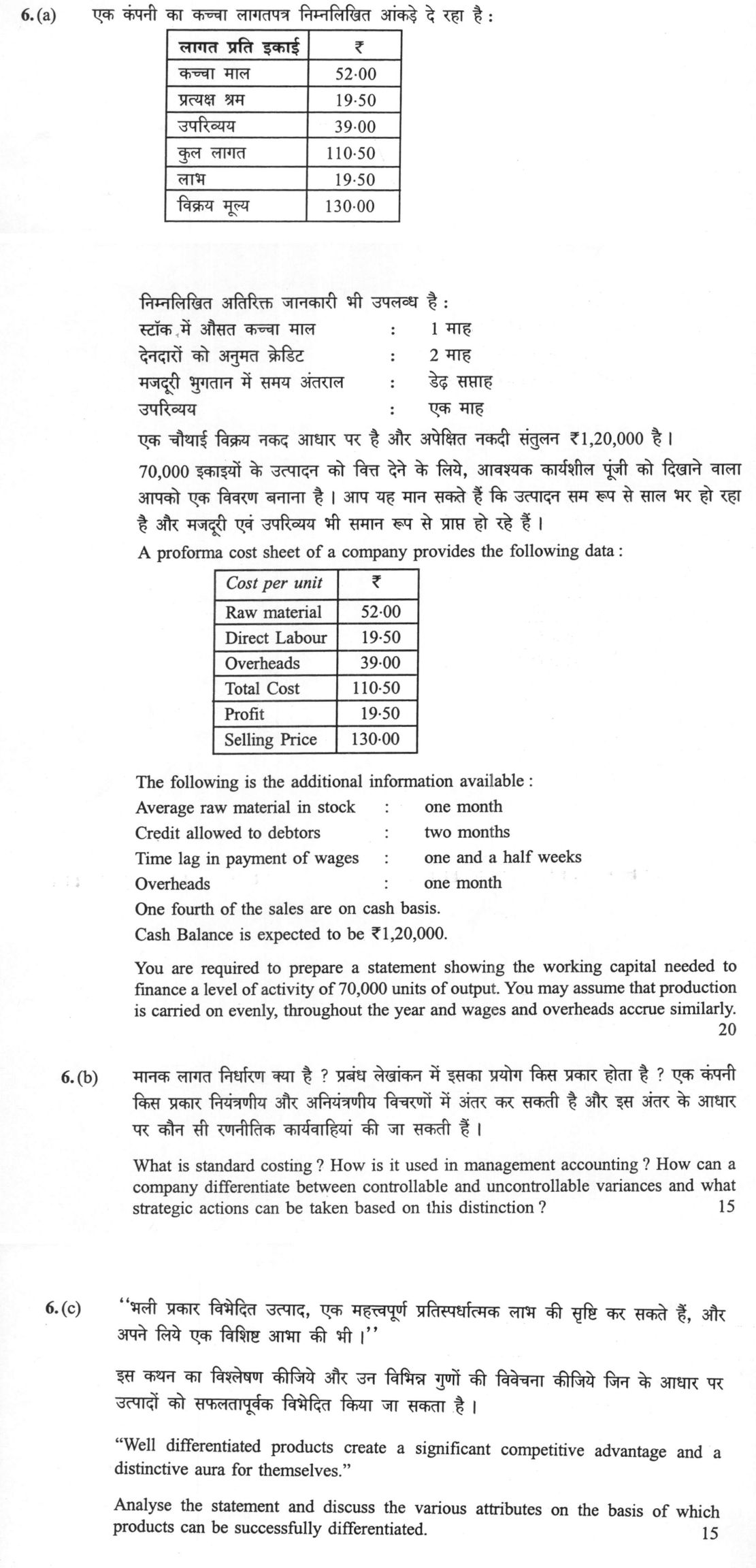
(a) A proforma cost sheet of a company provides the following data : | Cost per unit | ₹ | |-------------|---| | Raw material |…
A proforma cost sheet of a company provides the following data :
| Cost per unit | ₹ |
|---|---|
| Raw material | 52.00 |
| Direct Labour | 19.50 |
| Overheads | 39.00 |
| Total Cost | 110.50 |
| Profit | 19.50 |
| Selling Price | 130.00 |
The following is the additional information available :
Average raw material in stock : one month Credit allowed to debtors : two months Time lag in payment of wages : one and a half weeks Overheads : one month One fourth of the sales are on cash basis. Cash Balance is expected to be ₹1,20,000.
You are required to prepare a statement showing the working capital needed to finance a level of activity of 70,000 units of output. You may assume that production is carried on evenly, throughout the year and wages and overheads accrue similarly. 20 marks
What is standard costing ? How is it used in management accounting ? How can a company differentiate between controllable and uncontrollable variances and what strategic actions can be taken based on this distinction ? 15 marks
"Well differentiated products create a significant competitive advantage and a distinctive aura for themselves."
Analyse the statement and discuss the various attributes on the basis of which products can be successfully differentiated. 15 marks
हिंदी में प्रश्न पढ़ें
एक कंपनी का कच्चा लागतपत्र निम्नलिखित आँकड़े दे रहा है :
लागत प्रति इकाई | ₹ कच्चा माल | 52.00 प्रत्यक्ष श्रम | 19.50 उपरिव्यय | 39.00 कुल लागत | 110.50 लाभ | 19.50 विक्रय मूल्य | 130.00
निम्नलिखित अतिरिक्त जानकारी भी उपलब्ध है :
स्टॉक में औसत कच्चा माल : 1 माह denदारों को अनुमत क्रेडिट : 2 माह मजदूरी भुगतान में समय अंतराल : डेढ़ सप्ताह उपरिव्यय : एक माह एक चौथाई विक्रय नकद आधार पर है और अपेक्षित नकदी संतुलन ₹1,20,000 है।
70,000 इकाइयों के उत्पादन को वित्त देने के लिये, आवश्यक कार्यशील पूंजी को दिखाने वाला आपको एक विवरण बनाना है। आप यह मान सकते हैं कि उत्पादन सम रूप से साल भर हो रहा है और मजदूरी एवं उपरिव्यय भी समान रूप से प्राप्त हो रहे हैं। 20
मानक लागत निर्धारण क्या है ? प्रबंध लेखांकन में इसका प्रयोग किस प्रकार होता है ? एक कंपनी किस प्रकार नियंत्रणीय और अनियंत्रणीय विचरणों में अंतर कर सकती है और इस अंतर के आधार पर कौन सी रणनीतिक कार्यवाहियाँ की जा सकती हैं। 15
"भली प्रकार विभेदित उत्पाद, एक महत्वपूर्ण प्रतिस्पर्धात्मक लाभ की सृष्टि कर सकते हैं, और अपने लिये एक विशिष्ट आभा की भी।"
इस कथन का विश्लेषण कीजिये और उन विभिन्न गुणों की विवेचना कीजिये जिन के आधार पर उत्पादों को सफलतापूर्वक विभेदित किया जा सकता है । 15
Model answer
Written by UPSC Answer Check against this question's marking rubric, to the expected length. UPSC does not publish answers for Mains — this is one way to score well, not an official key.
(a) Using the operating-cycle/working-capital estimation method, working capital = current assets - current liabilities. Activity = 70,000 units per year; production, wages and overheads accrue evenly. Assume 12 months and 52 weeks per year.
- Raw material consumption = 70,000 × ₹52 = ₹36,40,000. Average raw material stock = one month = ₹36,40,000/12 = ₹3,03,333.33.
- Direct wages = 70,000 × ₹19.50 = ₹13,65,000. Wage payment lag = 1.5 weeks, so outstanding wages = ₹13,65,000 × 1.5/52 = ₹39,375.
- Overheads = 70,000 × ₹39 = ₹27,30,000. Overhead payment lag = one month, so outstanding overheads = ₹27,30,000/12 = ₹2,27,500.
- Sales = 70,000 × ₹130 = ₹91,00,000. Cash sales = 1/4, hence credit sales = 3/4 × ₹91,00,000 = ₹68,25,000. Debtors for two months = ₹68,25,000 × 2/12 = ₹11,37,500.
- Minimum cash balance = ₹1,20,000.
Current assets = raw material stock + debtors + cash = ₹3,03,333.33 + ₹11,37,500 + ₹1,20,000 = ₹15,60,833.33. Current liabilities = wages outstanding + overheads outstanding = ₹39,375 + ₹2,27,500 = ₹2,66,875. Working capital = ₹15,60,833.33 - ₹2,66,875 = ₹12,93,958.33.
Final answer: working capital required = ₹12,93,958.33 (₹38,81,875/3). No work-in-progress, finished-goods or raw-material creditor period is included because such periods are not given.
(b) Standard costing is a management accounting technique in which predetermined standards are set for material, labour and overheads under efficient operating conditions. Actual costs are recorded, compared with standards, and variances are computed, analysed and corrected. It is used for cost control by exception, budgeting, performance evaluation, pricing, inventory valuation, make-or-buy decisions, profit planning and continuous improvement.
A variance is the difference between standard and actual cost. A controllable variance arises from factors within a manager’s responsibility and authority, e.g. material usage, labour efficiency, idle time, waste, spoilage and overhead spending. An uncontrollable variance arises from external or non-controllable factors, e.g. market price changes, inflation, taxes, exchange rates, natural calamities, strikes and government policy. To differentiate, use responsibility accounting: identify the responsible cost centre, separate price and efficiency/usage components, study root cause, and test whether the manager could have influenced the cause in that period. For example, a raw-material price rise may be uncontrollable, but excessive usage is usually controllable; a wage-rate increase may be uncontrollable, but labour efficiency is controllable.
Strategic actions: for controllable adverse variances, take corrective action through training, process redesign, quality improvement, tighter supervision, supplier development and incentives. For uncontrollable variances, revise standards, use flexible budgets, hedge input/currency risk, enter long-term contracts, diversify suppliers, redesign products to reduce exposure, or pass on costs where market permits. Appraise managers mainly on controllable variances, so uncontrollable factors do not distort accountability. Thus standard costing links cost control with strategy, responsibility and performance management.
(c) The statement means differentiation makes a product appear unique and superior on attributes valued by customers. This reduces substitutability and price competition, builds brand loyalty and switching costs, supports premium pricing, creates entry barriers and gives a “distinctive aura” or brand identity. It is the basis of Porter’s differentiation strategy. However, advantage is real only when customers value the uniqueness, willingness to pay exceeds differentiation cost, and rivals cannot easily imitate it.
Products can be differentiated on:
- Physical/functional attributes: quality, features, performance, durability, reliability, design, packaging, safety.
- Service attributes: after-sales service, delivery speed, warranty, installation, customer support, complaint handling.
- Symbolic/emotional attributes: brand image, status, lifestyle, trust, prestige, heritage.
- Innovation/technology attributes: R&D, patents, digital features, automation, network effects.
- Customization attributes: personalization, tailor-made solutions, co-creation.
- Convenience/channel attributes: distribution reach, online access, location, ambience, ease of purchase.
- Price/value attributes: premium positioning or value-for-money.
- Sustainability/ethical attributes: eco-friendliness, social responsibility, fair trade.
- People/process attributes: employee competence, service quality, customer experience.
Successful differentiation must be important to buyers, distinctive, communicable, defensible, affordable and consistent. Risks include imitation, over-differentiation, cost escalation and changing customer tastes. Hence well-differentiated products do create competitive advantage and a distinctive aura, but only when the differentiation is valued, sustainable and profitably delivered.
What "Calculate" is asking you to do
Apply the standard formula or schedule to data the question has already supplied — a table of readings, cost records, a balance sheet — and produce the number. The method is rarely in doubt; the marks sit in the named intermediate quantities, each of which has to appear as a labelled line.
Structure that answers it
Data as given → formula or standard treatment, named → substitution → each intermediate, labelled → result with units
Where marks are lost
Omitting an intermediate the marking scheme pays for separately, or rounding at an intermediate line so the final figure drifts. In commerce and accountancy, any figure in a statement that no numbered working note supports is treated as unearned.
How this answer will be evaluated
Approach
Framework: Working Capital Statement. (a) calculate: given > formula > substitution > result with units > interpretation | (b) explain: definition/context > points in order > small example > short close | (c) analyse: intro > causes > effects > stakeholders/linkages > way forward Full marks: Accurate calculations, clear frameworks, and strategic insights with real examples.
Key points expected
- Annual sales and cost calculations for 70,000 units
- Raw material stock value (1 month's usage)
- Debtors value (2 months' credit sales)
- Wages and overheads accrual values
- Definition of standard costing
- Application in management accounting
- Distinction between controllable and uncontrollable variances
- Strategic actions based on variance type
Evaluation rubric
Each sub-part is marked on its own, against the marks and word limit printed on the paper.
- (a) Statement of working capital needed for 70,000 units of output. 20 marks
calculate— given → formula → substitution → result with units → interpretation
Must cover
- Annual sales and cost calculations for 70,000 units
- Raw material stock value (1 month's usage)
- Debtors value (2 months' credit sales)
- Wages and overheads accrual values
Loses marks
- Ignoring 1.5 weeks lag for wages
- Treating all sales as credit sales
- Omitting cash balance from calculation
Earns more
- Correct conversion of time lags to months
- Inclusion of ₹1,20,000 cash balance
- Clear tabular presentation of assets and liabilities
- Final net working capital figure
Extra mark
- Explicit formula for each component
- Step-by-step derivation of monthly values
- (b) Definition of standard costing, its use, and variance classification. 15 marks
explain— definition/context → points in order → small example → short close
Must cover
- Definition of standard costing
- Application in management accounting
- Distinction between controllable and uncontrollable variances
- Strategic actions based on variance type
Loses marks
- Textbook definition without application
- Confusing controllable with fixed costs
- No strategic actions mentioned
Earns more
- Example of a controllable variance
- Example of an uncontrollable variance
- Link to performance evaluation
- Reference to budgetary control
Extra mark
- Real company example of standard costing
- Recent regulatory change affecting costing
- (c) Analysis of product differentiation and its competitive advantage. 15 marks
analyse— intro → causes → effects → stakeholders/linkages → way forward
Must cover
- Interpretation of the given statement
- Attributes for successful product differentiation
- Link to competitive advantage
- Balanced conclusion on differentiation strategy
Loses marks
- Generic discussion without specific attributes
- Ignoring the 'distinctive aura' aspect
- No link to competitive advantage
Earns more
- Examples of differentiated products
- Discussion of brand aura
- Reference to market positioning
- Mention of customer perception
Extra mark
- Real company example of differentiation
- Reference to Porter's generic strategies
Practice this exact question
Write your answer and it is marked point by point against the model answer above — what you covered, what you missed, what you got wrong.
Evaluate my answer →More from Management 2024 Paper I
- Q3 (a) Discuss the key determinants of organisational structure and design. Among the emergi…
- Q4 (a) How do variables like organisational culture and choice of performance criteria affec…
- Q5 (a) How can Cost-Volume-Profit (CVP) analysis be used to assess the effect of changes in…
- Q6 (a) A proforma cost sheet of a company provides the following data : | Cost per unit | ₹…
- Q7 (a) Sunder Ltd. is planning an expansion programme which will require ₹30 crores and can…
- Q8 (a) Directors of ABC Ltd. wish to diversify. Presently, ABC Ltd. is into selling finished…