Paper I — Q5
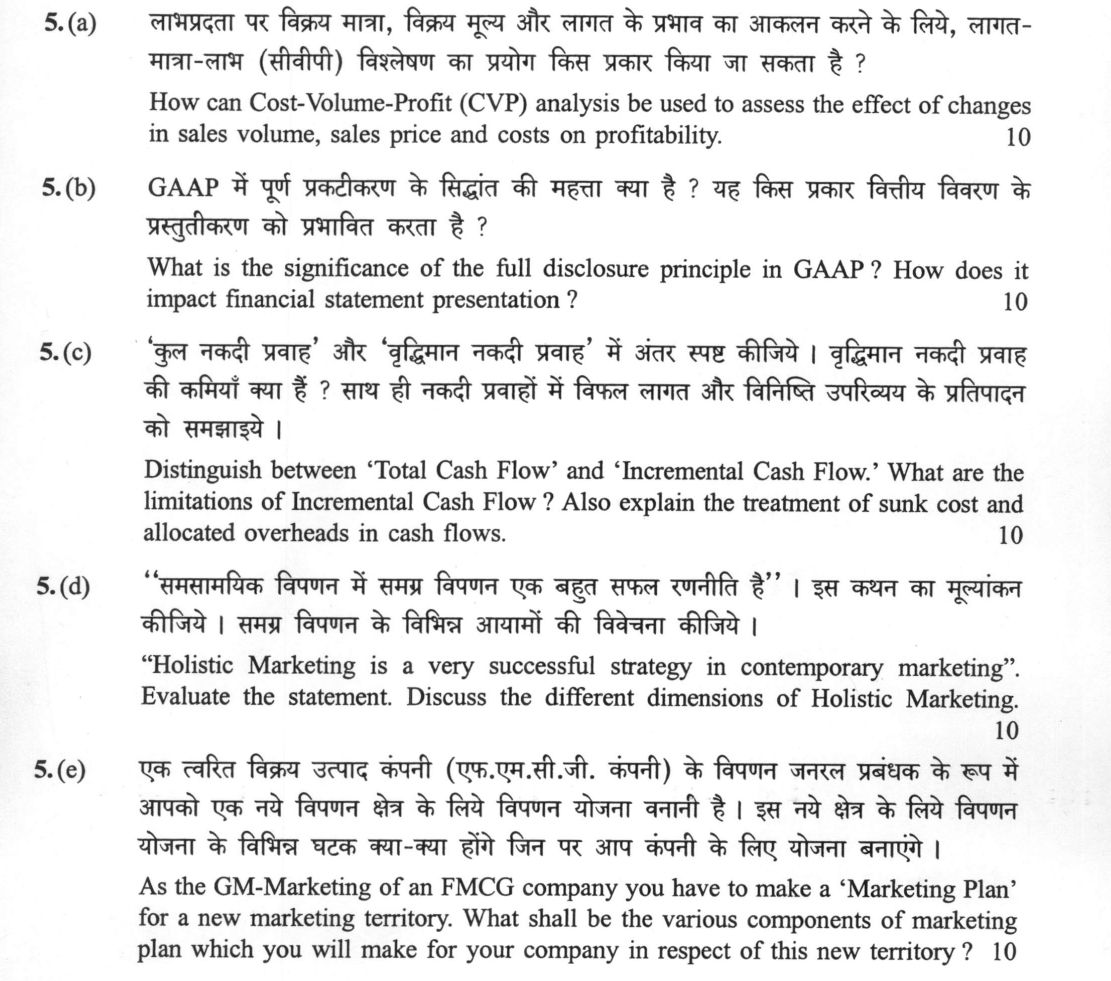
(a) How can Cost-Volume-Profit (CVP) analysis be used to assess the effect of changes in sales volume, sales price and costs on…
How can Cost-Volume-Profit (CVP) analysis be used to assess the effect of changes in sales volume, sales price and costs on profitability. 10 marks
What is the significance of the full disclosure principle in GAAP ? How does it impact financial statement presentation ? 10 marks
Distinguish between 'Total Cash Flow' and 'Incremental Cash Flow.' What are the limitations of Incremental Cash Flow ? Also explain the treatment of sunk cost and allocated overheads in cash flows. 10 marks
"Holistic Marketing is a very successful strategy in contemporary marketing". Evaluate the statement. Discuss the different dimensions of Holistic Marketing. 10 marks
As the GM-Marketing of an FMCG company you have to make a 'Marketing Plan' for a new marketing territory. What shall be the various components of marketing plan which you will make for your company in respect of this new territory ? 10 marks
हिंदी में प्रश्न पढ़ें
लाभप्रदता पर विक्रय मात्रा, विक्रय मूल्य और लागत के प्रभाव का आकलन करने के लिये, लागत-मात्रा-लाभ (सी.वी.पी.) विश्लेषण का प्रयोग किस प्रकार किया जा सकता है ? 10 marks
GAAP में पूर्ण प्रकटीकरण के सिद्धांत की महत्ता क्या है ? यह किस प्रकार वित्तीय विवरण के प्रस्तुतीकरण को प्रभावित करता है ? 10 marks
'कुल नकदी प्रवाह' और 'बुद्धिमान नकदी प्रवाह' में अंतर स्पष्ट कीजिये । बुद्धिमान नकदी प्रवाह की कमियाँ क्या हैं ? साथ ही नकदी प्रवाहों में विफल लागत और विनियोजित उपरिव्यय के प्रतिपादन को समझाइये । 10
"समसामयिक विपणन में समग्र विपणन एक बहुत सफल रणनीति है" । इस कथन का मूल्यांकन कीजिये । समग्र विपणन के विभिन्न आयामों की विवेचना कीजिये । 10
एक त्वरित विक्रय उत्पाद कंपनी (एफ.एम.सी.जी. कंपनी) के विपणन जनरल प्रबंधक के रूप में आपको एक नये विपणन क्षेत्र के लिये विपणन योजना बनानी है । इस नये क्षेत्र के लिये विपणन योजना के विभिन्न घटक क्या-क्या होंगे जिन पर आप कंपनी के लिये योजना बनायेंगे । 10
Model answer
Written by UPSC Answer Check against this question's marking rubric, to the expected length. UPSC does not publish answers for Mains — this is one way to score well, not an official key.
(a) Cost-Volume-Profit (CVP) Analysis and Profitability
Cost-Volume-Profit (CVP) analysis evaluates how operating decisions, cost structures, and sales parameters interact to drive net operating income. It is grounded in the fundamental relationship:
Profit = (Selling Price - Variable Cost per Unit) × Volume - Fixed Costs
The core engine of CVP is the Contribution Margin (CM = Price - Variable Cost), which first covers fixed overheads before generating operating profit. The Break-Even Point (BEP), calculated as Fixed Costs / CM per Unit (or Fixed Costs / P/V Ratio in value terms), identifies the operational threshold where total revenue equals total costs.
`` Profit / Cost ^ | Total Revenue | / | / Profit Region | BEP -------- / | | / Total Cost | | / | | * / | | /___________ Fixed Cost | Loss| / +-----+-----------------------> Volume (Q) Q_bep ``
CVP assesses parameter variations through sensitivity analysis:
- Sales Volume: Changes in volume affect profitability directly by the unit CM once beyond the BEP. The Degree of Operating Leverage (DOL = Contribution / EBIT) measures this elasticity; high-fixed-cost firms experience magnified percentage swings in operating profit for a given percentage change in sales volume.
- Sales Price: A price increase expands the unit CM and steepens the Total Revenue curve. This lowers the BEP and widens the Margin of Safety (MOS = (Actual Sales - Break-even Sales)/(Actual Sales)), dramatically enhancing profit per unit without requiring extra capacity.
- Cost Structure Shifts: An increase in variable costs flattens the contribution slope, pushing BEP higher and reducing unit profitability. Conversely, an increase in discretionary fixed costs elevates the total cost intercept, requiring a higher break-even volume to achieve target profits without altering the marginal contribution rate.
---
(b) Full Disclosure Principle in GAAP and Financial Statement Presentation
The Full Disclosure Principle in Generally Accepted Accounting Principles (GAAP) and Ind AS mandates that financial statements must present all material information necessary for users to make informed economic decisions, preventing disclosures from being misleading.
The significance rests on three core pillars:
- Materiality: An item is material if its omission or misstatement influences the economic decisions of stakeholders (as codified under Ind AS 1 and Schedule III of the Companies Act, 2013). Materiality balances exhaustive disclosure with relevant clarity.
- Information Asymmetry: It protects external stakeholders—minority shareholders, lenders, and regulators (such as SEBI)—by providing parity with internal management regarding risks, accounting policies, and off-balance-sheet exposures.
- Decision-making Integrity: Comprehensive disclosure allows investors to accurately adjust valuation multiples and evaluate earnings quality.
Impact on Financial Statement Presentation:
- Notes to Accounts: Qualitative and quantitative explanations detailing revenue recognition policies, depreciation methods, inventory valuation models, and deviations in accounting estimates.
- Contingent Liabilities (Ind AS 37 / AS 29): Disclosing potential financial obligations dependent on uncertain future events (e.g., disputed tax liabilities, ongoing litigation, corporate guarantees) in footnote tables rather than balance-sheet line items.
- Segmental and Related Party Disclosures (Ind AS 108 and Ind AS 24): Clear presentation of disaggregated business/geographical segments and transactions with promoter-held entities, ensuring transparency against tunneling or transfer-pricing risks.
---
(c) Cash Flows in Capital Budgeting: Total vs. Incremental, Limitations, and Cost Treatments
Total Cash Flow encompasses the entire aggregate cash inflows and outflows of an enterprise across all operational divisions. In contrast, Incremental Cash Flow represents the net additional cash flows generated strictly as a direct consequence of accepting a specific capital expenditure proposal:
Δ CF = Cash Flow_With Project - Cash Flow_Without Project
| Parameter | Total Cash Flow | Incremental Cash Flow | | :--- | :--- | :--- | | Scope | Enterprise-wide operations | Project-specific boundary | | Application | Liquidity analysis, credit rating | Capital budgeting (NPV, IRR) | | Perspective | Holistic corporate cash position | Marginal addition to firm value |
Limitations of Incremental Cash Flow:
- Difficulty in establishing the counterfactual baseline ("without project" cash flows).
- Failure to capture qualitative externalities, systemic dependencies, or brand cannibalization accurately.
- Susceptibility to management bias in isolating interdependent inter-divisional synergies.
Treatment of Specific Cost Categories:
- Sunk Costs: Past, irreversible expenditures (such as prior market research, R&D, or feasibility studies) must be strictly excluded from decision-making, as they do not change regardless of whether the project is accepted or rejected.
- Allocated Overheads: Existing general administrative and corporate overheads (e.g., corporate HQ rent, CEO salary) must be excluded unless the project creates an actual incremental addition to those overheads. Only direct, incremental overheads are relevant cash outflows.
- Opportunity Costs: Foregone measurable cash flows from the next best alternative use of an existing asset (e.g., utilizing vacant company land) must be included as an incremental cash outflow.
---
(d) Evaluation and Dimensions of Holistic Marketing
The Holistic Marketing philosophy, formulated by Philip Kotler and Kevin Lane Keller, posits that "everything matters in marketing" and that a broad, integrated perspective is essential for sustained brand equity.
`` +-------------------------------+ | HOLISTIC MARKETING | +---------------+---------------+ | +------------------+-----------+-----------+------------------+ | | | | +-------v-------+ +-------v-------+ +-------v-------+ +-------v-------+ | Integrated | | Internal | | Relationship | | Performance | | Marketing | | Marketing | | Marketing | | (Responsible) | | (4Ps Synergy) | | (Employees) | | (CRM/Partners)| | (ESG/Ethics) | +---------------+ +---------------+ +---------------+ +---------------+ ``
Dimensions of Holistic Marketing:
- Integrated Marketing: Aligning all marketing-mix elements (product design, pricing strategies, physical distribution, and omnichannel communication) into a seamless, mutually reinforcing value proposition.
- Internal Marketing: Treating employees, especially customer-facing staff, as internal customers. It ensures that every department embraces appropriate customer-centric values before market execution begins.
- Relationship Marketing: Deepening long-term, collaborative networks with customers, suppliers, distributors, and channel partners (via CRM, loyalty architectures, and vendor development).
- Performance / Socially Responsible Marketing: Evaluating both financial returns and non-financial societal consequences, incorporating business ethics, environmental sustainability (ESG), legal compliance, and community impact (e.g., Tata Tea's Jaago Re campaigns).
Evaluation: Weighing holistic marketing against the realities of contemporary markets reveals strong strategic value. It eliminates organizational silos, enhances lifetime customer value, and protects brands from reputational risks in an era of hyper-transparency. Indian conglomerates like Hindustan Unilever (HUL) successfully leverage this through the integration of Project Shakti (rural distribution/relationship) with Lifebuoy public health initiatives (social responsibility) and unified trade channels.
However, its implementation requires heavy cross-functional coordination, increases organizational overheads, and risks diluting tactical focus in fast-moving, price-sensitive segments.
Verdict: Despite its organizational complexities, holistic marketing is an indispensable strategic imperative in modern, consumer-centric markets where fragmented, purely transaction-led approaches inevitably fail to sustain competitive advantage.
---
(e) Marketing Plan for an FMCG Company Entering a New Territory
As General Manager (Marketing), launching operations in a new geographic territory requires a structured, phase-gate marketing plan:
1. Situational and Environmental Analysis:
- Macro-Environment (PESTLE): Demographic profile, regional disposable income, retail infrastructure, and local regulatory compliance.
- Micro-Environment: Competitor benchmarking (incumbents' share of shelf, dealer margins), consumer buying habits, and supply-chain logistics footprint.
2. Segmentation, Targeting, and Positioning (STP):
- Segmentation: Classify regional consumers into SEC tiers, urban versus semi-urban/rural clusters, and regional taste preferences.
- Targeting: Focus on Tier-2 and Tier-3 urban households and aspirational middle-income consumers.
- Positioning: Value-for-money, high-quality, regionally customized proposition distinct from national incumbents.
3. Marketing Mix Strategy (4Ps):
- Product: Localized product portfolio, tailored packaging sizes (e.g., low-unit-price sachets for trial, family packs for modern trade), and regional flavor/fragrance adaptations.
- Price: Penetration pricing, aggressive introductory trade schemes, and value-based consumer price points.
- Place (Distribution): Hybrid distribution model combining traditional Kirana wholesale networks (via carrying-and-forwarding agents and super-stockists) with modern retail and quick-commerce integrations.
- Promotion: Hyper-local Below-The-Line (BTL) activations, regional language influencer campaigns, localized Out-Of-Home (OOH) media, and van promotions for rural market activation.
4. Budget Allocation and Financial Modeling:
- Objective-and-task method allocating expenditures: 45% Trade/Distributor margins and promotional incentives, 35% ATL/BTL advertising, and 20% Field-force logistics and sampling.
5. Implementation and Rollout Schedule:
- Phase 1 (Months 1–2): Distributor appointment, pipeline filling, and sales-force onboarding.
- Phase 2 (Months 3–4): High-decibel multimedia launch, consumer sampling drives, and retail visibility contests.
- Phase 3 (Months 5–6): Repeat-purchase tracking, replenishment stabilization, and network expansion.
6. Control, Monitoring, and Corrective Metrics:
- Real-time tracking via Sales Force Automation (SFA) on key metrics: Numerical and Weighted Distribution, Secondary Sales velocity, Days of Inventory at retail, Customer Acquisition Cost (CAC), and Net Promoter Score (NPS). Periodic variance audits trigger contingency promotional interventions if sales milestones fall below target.
---
Integrated Synthesis: Strategic managerial decision-making requires linking analytical disciplines: rigorous CVP and capital budgeting frameworks ensure financial viability, GAAP-compliant disclosures secure stakeholder trust, while holistic marketing plans translate analytical targets into successful market execution.
What "Evaluate" is asking you to do
Judge how well something has performed against the standard it set for itself — its stated aim, mandate or promise — and commit to a verdict. Name the yardstick before you judge; an unanchored judgement reads as opinion.
Structure that answers it
Name the yardstick — stated aim, mandate or benchmark → performance against it → shortfall against it → why the gap exists → verdict
Where marks are lost
Presenting both sides and then declining to decide, or delivering a verdict against a standard you never stated, which makes it look arbitrary.
How this answer will be evaluated
Approach
Framework: CVP Analysis, GAAP Full Disclosure Principle, Incremental Cash Flow Analysis, Holistic Marketing, Marketing Plan Components. (a) explain: definition/context > points in order > small example > short close | (b) explain: definition/context > points in order > small example > short close | (c) compare: paired headings or table > key differences > significance > conclusion | (d) critically evaluate: positives > negatives/limits > conditions/safeguards > conclusion | (e) describe: define > structure or process in order > labelled diagram > significance Full marks: Comprehensive, well-structured, with real examples and balanced judgment
Key points expected
- Define CVP analysis and its core assumptions
- Explain the break-even point calculation
- Show how changes in sales volume affect profit
- Show how changes in price and costs affect profit
- Define the full disclosure principle
- Explain its significance in GAAP
- Describe how it impacts financial statement presentation
- Give examples of disclosures required
Evaluation rubric
Each sub-part is marked on its own, against the marks and word limit printed on the paper.
- (a) Explain how CVP analysis assesses the effect of changes in sales volume, price, and costs on profitability. 10 marks
explain— definition/context → points in order → small example → short close
Must cover
- Define CVP analysis and its core assumptions
- Explain the break-even point calculation
- Show how changes in sales volume affect profit
- Show how changes in price and costs affect profit
Loses marks
- Defining CVP without explaining its use
- Ignoring the effect of cost changes
- No connection to profitability assessment
Earns more
- Include a CVP chart or graph
- Provide a numerical example
- Discuss the margin of safety
- Mention the contribution margin ratio
Extra mark
- Reference a real company's CVP application
- Discuss limitations of CVP analysis
- (b) Explain the significance of the full disclosure principle in GAAP and its impact on financial statement presentation. 10 marks
explain— definition/context → points in order → small example → short close
Must cover
- Define the full disclosure principle
- Explain its significance in GAAP
- Describe how it impacts financial statement presentation
- Give examples of disclosures required
Loses marks
- Defining without explaining significance
- No examples of required disclosures
- Ignoring the impact on presentation
Earns more
- Mention specific GAAP standards requiring disclosure
- Discuss the impact on user decision-making
- Reference recent regulatory changes
- Compare with other accounting principles
Extra mark
- Cite a specific SEC or FASB rule
- Reference a real company's disclosure practice
- (c) Distinguish between Total and Incremental Cash Flow, explain limitations, and treatment of sunk costs and allocated overheads. 10 marks
compare— paired headings or table → key differences → significance → conclusion
Must cover
- Define Total Cash Flow and Incremental Cash Flow
- Distinguish between the two clearly
- Explain limitations of Incremental Cash Flow
- Explain treatment of sunk costs and allocated overheads
Loses marks
- Defining without distinguishing
- Ignoring the treatment of sunk costs
- No explanation of limitations
Earns more
- Provide a numerical example
- Discuss the relevance to capital budgeting
- Mention the opportunity cost concept
- Reference a real investment decision
Extra mark
- Cite a specific capital budgeting case
- Discuss the impact of inflation on cash flows
- (d) Evaluate the statement on Holistic Marketing and discuss its different dimensions. 10 marks
critically evaluate— positives → negatives/limits → conditions/safeguards → conclusion
Must cover
- Define Holistic Marketing
- Evaluate the statement with evidence
- Discuss the different dimensions of Holistic Marketing
- Provide a balanced judgment
Loses marks
- Defining without evaluating
- Ignoring the dimensions
- No balanced judgment
Earns more
- Reference Kotler's dimensions of Holistic Marketing
- Give a real company example
- Discuss the relevance in contemporary marketing
- Mention the role of digital marketing
Extra mark
- Cite a specific marketing campaign
- Reference a recent marketing trend
- (e) Describe the various components of a marketing plan for a new marketing territory for an FMCG company. 10 marks
describe— define → structure or process in order → labelled diagram → significance
Must cover
- Identify the key components of a marketing plan
- Explain each component in the context of a new territory
- Include market analysis and objectives
- Include strategies and tactics
Loses marks
- Listing components without explanation
- Ignoring the context of a new territory
- No specific FMCG application
Earns more
- Reference the 4Ps or 7Ps of marketing
- Provide a specific FMCG company example
- Discuss the role of digital marketing
- Mention the budget and timeline
Extra mark
- Cite a specific FMCG company's market entry
- Reference a recent market entry strategy
Practice this exact question
Write your answer and it is marked point by point against the model answer above — what you covered, what you missed, what you got wrong.
Evaluate my answer →More from Management 2024 Paper I
- Q2 (a) Discuss the various types of "Control Mechanisms" a manager can apply in order to tak…
- Q3 (a) Discuss the key determinants of organisational structure and design. Among the emergi…
- Q4 (a) How do variables like organisational culture and choice of performance criteria affec…
- Q5 (a) How can Cost-Volume-Profit (CVP) analysis be used to assess the effect of changes in…
- Q6 (a) A proforma cost sheet of a company provides the following data : | Cost per unit | ₹…
- Q7 (a) Sunder Ltd. is planning an expansion programme which will require ₹30 crores and can…
- Q8 (a) Directors of ABC Ltd. wish to diversify. Presently, ABC Ltd. is into selling finished…