Paper I — Q7
(a) Sunder Ltd. is planning an expansion programme which will require ₹30 crores and can be funded through one of the three…
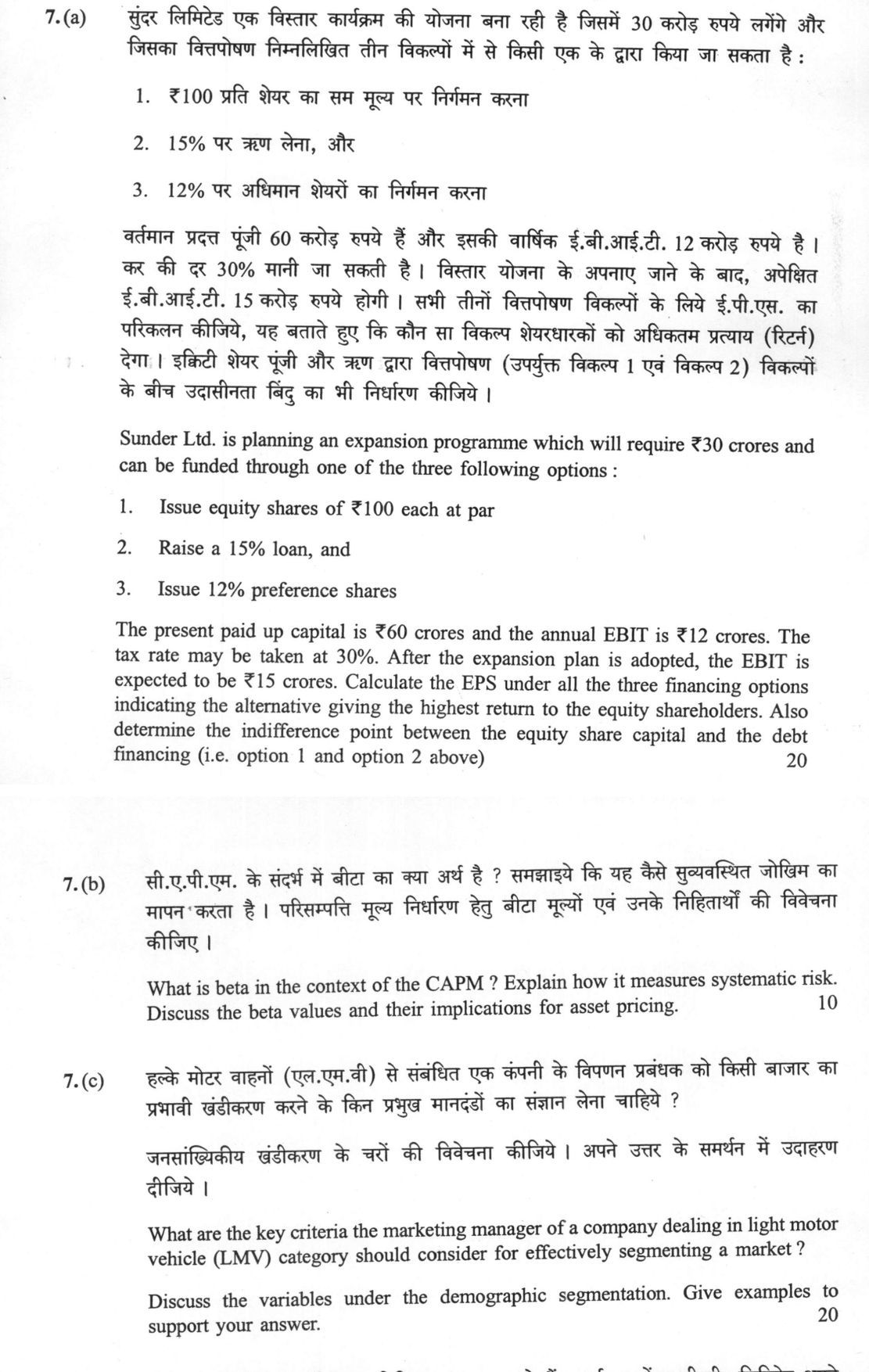
Sunder Ltd. is planning an expansion programme which will require ₹30 crores and can be funded through one of the three following options : 1. Issue equity shares of ₹100 each at par 2. Raise a 15% loan, and 3. Issue 12% preference shares. The present paid up capital is ₹60 crores and the annual EBIT is ₹12 crores. The tax rate may be taken at 30%. After the expansion plan is adopted, the EBIT is expected to be ₹15 crores. Calculate the EPS under all the three financing options indicating the alternative giving the highest return to the equity shareholders. Also determine the indifference point between the equity share capital and the debt financing (i.e. option 1 and option 2 above) 20 marks
What is beta in the context of the CAPM ? Explain how it measures systematic risk. Discuss the beta values and their implications for asset pricing. 10 marks
What are the key criteria the marketing manager of a company dealing in light motor vehicle (LMV) category should consider for effectively segmenting a market ? Discuss the variables under the demographic segmentation. Give examples to support your answer. 20 marks
हिंदी में प्रश्न पढ़ें
सुन्दर लिमिटेड एक विस्तार कार्यक्रम की योजना बना रही है जिसमें 30 करोड़ रुपये लगेंगे और जिसका वित्तपोषण निम्नलिखित तीन विकल्पों में से किसी एक के द्वारा किया जा सकता है : 1. ₹100 प्रति शेयर का सम मूल्य पर निर्गमन करना 2. 15% पर ऋण लेना, और 3. 12% पर अधिमान शेयरों का निर्गमन करना। वर्तमान प्रदत्त पूँजी 60 करोड़ रुपये है और इसकी वार्षिक ई.बी.आई.टी. 12 करोड़ रुपये है । कर की दर 30% मानी जा सकती है । विस्तार योजना के अपनाए जाने के बाद, अपेक्षित ई.बी.आई.टी. 15 करोड़ रुपये होगी । सभी तीनों वित्तपोषण विकल्पों के लिये ई.पी.एस. का परिकलन कीजिये, यह बताते हुए कि कौन सा विकल्प शेयरधारकों को अधिकतम प्रत्याय (रिटर्न) देगा । इक्विटी शेयर पूँजी और ऋण द्वारा वित्तपोषण (उपर्युक्त विकल्प 1 एवं विकल्प 2) विकल्पों के बीच उदासीनता बिन्दु का भी निर्धारण कीजिये । (20 अंक)
सी.ए.पी.एम. के संदर्भ में बीटा का क्या अर्थ है ? समझाइये कि यह कैसे मूल्यवस्थित जोखिम का मापन करता है । परिसंपत्ति मूल्य निर्धारण हेतु बीटा मूल्यों एवं उनके निहितार्थों की विवेचना कीजिए । (10 अंक)
हल्के मोटर वाहनों (एल.एम.वी.) से संबंधित एक कंपनी के विपणन प्रबंधक को किसी बाजार का प्रभावी खंडीकरण करने के किन प्रमुख मानदंडों का संज्ञान लेना चाहिए ? जनसांख्यिकीय खंडीकरण के चरों की विवेचना कीजिए । अपने उत्तर के समर्थन में उदाहरण दीजिए । (20 अंक)
Model answer
Written by UPSC Answer Check against this question's marking rubric, to the expected length. UPSC does not publish answers for Mains — this is one way to score well, not an official key.
(a)(i) EPS under the three financing options
Assume existing paid-up capital is all equity shares of ₹100 each. Existing shares = ₹60 crore ÷ ₹100 = 60,00,000 shares. Post-expansion EBIT = ₹15 crore; tax rate = 30%; new finance = ₹30 crore.
- Option 1: Issue equity shares at par New shares = ₹30 crore ÷ ₹100 = 30,00,000 shares. Total shares = 60,00,000 + 30,00,000 = 90,00,000 shares. PBT = EBIT = ₹15 crore. Tax = 0.30 × ₹15 crore = ₹4.5 crore. PAT = ₹15 crore − ₹4.5 crore = ₹10.5 crore. EPS = ₹10.5 crore ÷ 90,00,000 = ₹35/3 = ₹11.67.
- Option 2: Raise 15% loan Debt = ₹30 crore. Interest = 0.15 × ₹30 crore = ₹4.5 crore. Shares remain 60,00,000. PBT = ₹15 crore − ₹4.5 crore = ₹10.5 crore. Tax = 0.30 × ₹10.5 crore = ₹3.15 crore. PAT = ₹10.5 crore − ₹3.15 crore = ₹7.35 crore. EPS = ₹7.35 crore ÷ 60,00,000 = ₹49/4 = ₹12.25.
- Option 3: Issue 12% preference shares Preference dividend = 0.12 × ₹30 crore = ₹3.6 crore. PBT = EBIT = ₹15 crore. Tax = 0.30 × ₹15 crore = ₹4.5 crore. PAT = ₹15 crore − ₹4.5 crore = ₹10.5 crore. Equity earnings = PAT − preference dividend = ₹10.5 crore − ₹3.6 crore = ₹6.9 crore. Shares remain 60,00,000. EPS = ₹6.9 crore ÷ 60,00,000 = ₹23/2 = ₹11.50.
Highest return to equity shareholders: Option 2, the 15% loan, gives the highest EPS of ₹12.25. Interest is tax-deductible, and the post-expansion EBIT exceeds the indifference level, so financial leverage benefits equity holders.
(a)(ii) Indifference point between equity financing and debt financing
Let EBIT = X ₹ crore. Under Option 1, shares = 0.9 crore shares. EPS1 = 0.70X ÷ 0.9. Under Option 2, shares = 0.6 crore shares and interest = ₹4.5 crore. EPS2 = 0.70(X − 4.5) ÷ 0.6.
At indifference, EPS1 = EPS2: 0.70X ÷ 0.9 = 0.70(X − 4.5) ÷ 0.6 X ÷ 0.9 = (X − 4.5) ÷ 0.6 0.6X = 0.9X − 4.05 0.3X = 4.05 X = 13.5 crore.
Indifference EBIT = ₹13.5 crore = ₹27/2 crore. At this EBIT, EPS under both options = 0.70 × ₹13.5 crore ÷ 0.9 crore shares = ₹10.50. Condition: If EBIT > ₹13.5 crore, debt financing gives higher EPS; if EBIT < ₹13.5 crore, equity financing gives higher EPS.
(b) Beta in CAPM
Beta (β) is the measure of a security’s systematic risk under the Capital Asset Pricing Model. It is defined as: βi = Cov(Ri, Rm) ÷ Var(Rm) = ρim × σi ÷ σm. CAPM uses it as: E(Ri) = Rf + βi[E(Rm) − Rf].
Systematic risk is market-wide risk—such as inflation, interest rates, recession or political shocks—that cannot be removed by diversification. Beta measures how sensitive an asset’s return is to market return movements. If the market return changes by 1%, the asset’s expected return changes by β%.
- β = 1: same volatility as the market.
- β > 1: aggressive or cyclical asset; amplifies market movements.
- 0 < β < 1: defensive asset; less volatile than the market.
- β = 0: uncorrelated with the market, like a risk-free asset.
- β < 0: moves inversely to the market.
For asset pricing, higher beta means higher systematic risk, so investors demand a higher risk premium and required return. This raises the cost of equity, lowers the present value of future cash flows, and affects capital budgeting and portfolio selection. Low-beta assets are priced with lower required returns and are preferred by risk-averse investors.
(c) Segmentation criteria for LMV and demographic variables
For a light motor vehicle company, effective segmentation requires the segment to be measurable, substantial, accessible, differentiable, actionable, stable, homogeneous within, heterogeneous across segments, profitable, and compatible with company resources. For LMV buyers, segments must also match distribution reach, service network, regulatory norms, and financing availability.
Demographic segmentation divides the market by measurable population characteristics:
- Age: Young first-job buyers may prefer compact hatchbacks such as Maruti Alto or Swift. Middle-aged family buyers may prefer sedans or SUVs such as Honda City or Hyundai Creta. Older buyers may value comfort and safety.
- Income: Lower-income buyers choose entry-level vehicles like Alto. Middle-income buyers choose Baleno or i20. High-income buyers choose premium LMVs such as Creta, Innova or higher variants.
- Family size and life-cycle stage: Bachelors may choose compact cars. Nuclear families may choose hatchbacks or compact sedans. Joint families may need seven-seaters like Ertiga or Innova.
- Occupation: Salaried urban commuters may prefer automatic compact cars. Businesspersons or farmers may prefer light commercial vehicles such as Tata Ace or pickup models for load and durability.
- Education: More educated buyers often demand safety features, connected technology, fuel efficiency and lower emissions.
- Gender: Women buyers may prefer compact, automatic, easy-to-park vehicles with safety features. Men may, in some segments, prefer larger SUVs, though such stereotypes are weakening.
- Social class: Upper-class buyers may prefer premium brands and top variants; middle-class buyers focus on value, mileage and resale.
- Generation: Gen Z buyers emphasise digital connectivity and styling; older generations emphasise reliability and comfort.
Thus, demographic variables help the LMV marketing manager design product variants, pricing, promotion and distribution for distinct consumer groups.
What "Calculate" is asking you to do
Apply the standard formula or schedule to data the question has already supplied — a table of readings, cost records, a balance sheet — and produce the number. The method is rarely in doubt; the marks sit in the named intermediate quantities, each of which has to appear as a labelled line.
Structure that answers it
Data as given → formula or standard treatment, named → substitution → each intermediate, labelled → result with units
Where marks are lost
Omitting an intermediate the marking scheme pays for separately, or rounding at an intermediate line so the final figure drifts. In commerce and accountancy, any figure in a statement that no numbered working note supports is treated as unearned.
How this answer will be evaluated
Approach
Framework: EPS-EBIT Indifference Analysis. (a) calculate: given > formula > substitution > result with units > interpretation | (b) explain: definition/context > points in order > small example > short close | (c) discuss: intro > 3-4 dimensions > example > balanced close Full marks: Complete calculations with correct indifference point; clear beta explanation with value ranges; specific LMV examples with demographic variables
Key points expected
- EPS calculation for all three options
- Indifference point between Option 1 and Option 2
- Identification of option with highest EPS
- Correct application of 30% tax rate
- Definition of beta in CAPM context
- Explanation of systematic risk measurement
- Discussion of beta values (0, 1, >1, <1)
- Implications for asset pricing
Evaluation rubric
Each sub-part is marked on its own, against the marks and word limit printed on the paper.
- (a) EPS for three options and EBIT-EPS indifference point between equity and debt. 20 marks
calculate— given → formula → substitution → result with units → interpretation
Must cover
- EPS calculation for all three options
- Indifference point between Option 1 and Option 2
- Identification of option with highest EPS
- Correct application of 30% tax rate
Loses marks
- Treating preference dividend as tax-deductible
- Incorrect share count for equity option
- Missing indifference point calculation
Earns more
- Step-by-step derivation of indifference EBIT
- Comparison table of EPS values
- Correct share count calculation for equity option
- Preference dividend treated as non-tax-deductible
Extra mark
- Graphical representation of EBIT-EPS indifference
- Sensitivity analysis on EBIT levels
- (b) Definition of beta, its role in measuring systematic risk, and implications for asset pricing. 10 marks
explain— definition/context → points in order → small example → short close
Must cover
- Definition of beta in CAPM context
- Explanation of systematic risk measurement
- Discussion of beta values (0, 1, >1, <1)
- Implications for asset pricing
Loses marks
- Confusing beta with alpha
- No discussion of beta value ranges
- Textbook definition without application
Earns more
- Formula for beta calculation
- Example of high vs low beta stocks
- Link to required rate of return
- Distinction between systematic and unsystematic risk
Extra mark
- Real company example with beta value
- Recent market data illustrating beta
- (c) Key criteria for LMV market segmentation and demographic variables with examples. 20 marks
discuss— intro → 3-4 dimensions → example → balanced close
Must cover
- Key criteria for LMV market segmentation
- Demographic variables discussed
- Examples supporting demographic segmentation
- Application to light motor vehicle context
Loses marks
- Generic segmentation without LMV application
- No examples provided
- Ignoring demographic variables specifically
Earns more
- Age, income, family size as demographic variables
- Specific LMV brand examples (Maruti, Hyundai, etc.)
- Geographic or psychographic variables mentioned
- Balanced discussion of multiple segmentation bases
Extra mark
- Recent market data on LMV segments
- Specific campaign example from Indian market
Practice this exact question
Write your answer and it is marked point by point against the model answer above — what you covered, what you missed, what you got wrong.
Evaluate my answer →More from Management 2024 Paper I
- Q4 (a) How do variables like organisational culture and choice of performance criteria affec…
- Q5 (a) How can Cost-Volume-Profit (CVP) analysis be used to assess the effect of changes in…
- Q6 (a) A proforma cost sheet of a company provides the following data : | Cost per unit | ₹…
- Q7 (a) Sunder Ltd. is planning an expansion programme which will require ₹30 crores and can…
- Q8 (a) Directors of ABC Ltd. wish to diversify. Presently, ABC Ltd. is into selling finished…