Paper I — Q2
(a) Discuss the various types of "Control Mechanisms" a manager can apply in order to take his organization to desired…
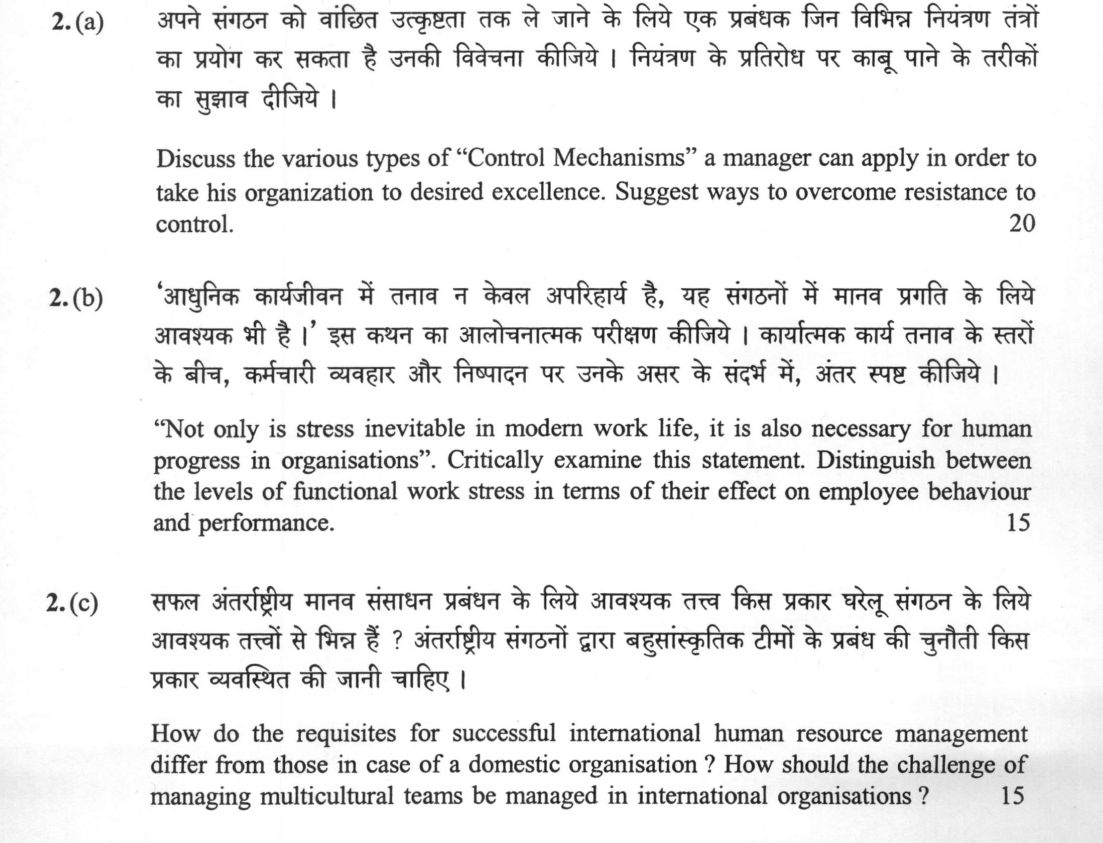
Discuss the various types of "Control Mechanisms" a manager can apply in order to take his organization to desired excellence. Suggest ways to overcome resistance to control. 20 marks
"Not only is stress inevitable in modern work life, it is also necessary for human progress in organisations". Critically examine this statement. Distinguish between the levels of functional work stress in terms of their effect on employee behaviour and performance. 15 marks
How do the requisites for successful international human resource management differ from those in case of a domestic organisation ? How should the challenge of managing multicultural teams be managed in international organisations ? 15 marks
हिंदी में प्रश्न पढ़ें
अपने संगठन को वांछित उत्कृष्टता तक ले जाने के लिये एक प्रबंधक जिन विभिन्न नियंत्रण तंत्रों का प्रयोग कर सकता है उनकी विवेचना कीजिये । नियंत्रण के प्रतिरोध पर काबू पाने के तरीकों का सुझाव दीजिये । 20 अंक
'आधुनिक कार्यजीवन में तनाव न केवल अपरिहार्य है, यह संगठनों में मानव प्रगति के लिये आवश्यक भी है ।' इस कथन का आलोचनात्मक परीक्षण कीजिये । कार्यात्मक कार्य तनाव के स्तरों के बीच, कर्मचारी व्यवहार और निष्पादन पर उनके असर के संदर्भ में, अंतर स्पष्ट कीजिये । 15 अंक
सफल अंतर्राष्ट्रीय मानव संसाधन प्रबंधन के लिये आवश्यक तत्व किस प्रकार घरेलू संगठन के लिये आवश्यक तत्वों से भिन्न हैं ? अंतर्राष्ट्रीय संगठनों द्वारा बहुसांस्कृतिक टीमों के प्रबंध की चुनौती किस प्रकार व्यवस्थित की जानी चाहिए । 15 अंक
Model answer
Written by UPSC Answer Check against this question's marking rubric, to the expected length. UPSC does not publish answers for Mains — this is one way to score well, not an official key.
Organizational excellence requires a calibrated integration of control architectures, human psychological dynamics, and cross-border capabilities.
Control Mechanisms and Overcoming Resistance
Managers deploy control systems across multiple dimensions. By organizational level, controls are categorized into strategic controls (monitoring external assumptions and enterprise direction), tactical controls (evaluating departmental budgets and divisional performance), and operational controls (regulating daily shop-floor schedules and task-level variances). By timing, controls operate as feedforward (preventive input screening, such as supplier audits), concurrent (real-time tracking via supervisory monitoring and digital dashboards), and feedback (post-action financial audits and variance analyses).
Following William Ouchi’s framework, mechanisms also include bureaucratic control (reliance on standard operating procedures, hierarchy, and formal rules), market control (use of price mechanisms, transfer pricing, and profit centers), and clan control (shared organizational values, norms, and peer socialization). Specific managerial techniques provide contextual utility: Peter Drucker’s Management by Objectives (MBO) aligns subordinate targets with enterprise goals in knowledge-intensive settings; Kaplan and Norton’s Balanced Scorecard integrates financial, customer, internal business process, and learning metrics for comprehensive performance tracking; and Quality Control Systems (such as TQM, Six Sigma, and ISO standards) ensure operational consistency in manufacturing and services.
Employee resistance to control typically stems from perceived threats to autonomy, fear of accountability, or rigid metrics. To overcome this, organizations must promote employee participation in standard-setting, foster goal congruence by aligning incentives with performance targets, maintain structural flexibility to accommodate environmental volatility, and institute open, transparent feedback loops.
Stress Dynamics and Employee Performance
Stress is an inherent facet of modern workplaces. As framed by the Yerkes-Dodson Law, the relationship between stress and performance follows an inverted-U curve. Stress acts as a catalyst for human progress when experienced as functional stress (eustress), providing the physiological and cognitive arousal necessary for problem-solving, goal achievement, and adaptation. However, when stress exceeds coping capacities, it turns into dysfunctional stress (distress).
The impact of stress depends heavily on its intensity: Low stress (Under-arousal) manifests in boredom, apathy, and lethargy. Employees lack sufficient motivation, leading to suboptimal output, low engagement, and organizational complacency. Moderate stress (Optimal arousal) represents the functional zone where alertness, focused attention, and creative problem-solving peak. Employees exhibit high task performance, resilience, and personal development. High stress (Over-arousal/Distress) leads to severe cognitive narrowing, chronic anxiety, emotional exhaustion, and physical health deterioration. Behaviorally, it drives elevated absenteeism, higher voluntary turnover, interpersonal friction, and the suppression of innovation due to fear of failure.
International HRM and Multicultural Team Governance
International Human Resource Management (IHRM) differs from domestic HRM due to the complexity of operating across heterogeneous socio-cultural, political, and institutional landscapes. While domestic HRM functions within a unified legal framework and homogeneous cultural assumptions, IHRM requires high Cultural Intelligence (CQ), structured expatriate management systems (rigorous cross-cultural screening, pre-departure training, ongoing field support, and systematic repatriation), equitable global compensation architectures (such as the balance sheet approach to equalize purchasing power), and compliance with varied international labor standards and local statutory mandates.
To manage multicultural teams effectively, multinational enterprises must implement cultural mapping (utilizing Hofstede’s dimensions or Erin Meyer’s framework to decode behavioral differences in hierarchy and decision-making), cultivate inclusive leadership that provides psychological safety, establish explicit communication protocols to bridge high-context and low-context communication styles, and adapt conflict-resolution mechanisms—such as contextualizing the Thomas-Kilmann Conflict Mode Instrument to balance direct assertiveness with indirect, face-saving resolution preferences.
To navigate contemporary market complexities, organizations must integrate adaptive clan and operational controls with proactive stress-optimization strategies and culturally intelligent HR policies, ensuring sustainable performance and workforce well-being.
What "Discuss" is asking you to do
Lay the issue out from more than one side — how it arose, what is claimed for it, what is held against it, and where it now stands. UPSC attaches discuss to broad topics with several live dimensions, so coverage of the dimensions earns more than the strength of your opinion.
Structure that answers it
Set the issue up → the case as it is made → the case against → the dimension both sides leave out → where the balance now lies
Where marks are lost
Listing facts with no thread between them, or arguing one side throughout and calling it a discussion.
How this answer will be evaluated
Approach
Framework: null. (a) discuss: intro > 3-4 dimensions > example > balanced close | (b) examine: intro > how/why with reasoning > evidence > conclusion | (c) compare: paired headings or table > key differences > significance > conclusion Full marks: Comprehensive coverage of all parts with named frameworks, concrete examples, and critical analysis.
Key points expected
- Identify 3-4 types of control (e.g., feedforward, concurrent, feedback)
- Explain the function of each control type in achieving excellence
- List specific ways to overcome resistance to control
- Apply concepts to a concrete organizational scenario
- Critically examine the statement on stress inevitability and necessity
- Distinguish between levels of functional work stress
- Analyze the effect of stress on employee behavior
- Analyze the effect of stress on performance
Evaluation rubric
Each sub-part is marked on its own, against the marks and word limit printed on the paper.
- (a) Classify control mechanisms and propose strategies to overcome resistance to control. 20 marks
discuss— intro → 3-4 dimensions → example → balanced close
Must cover
- Identify 3-4 types of control (e.g., feedforward, concurrent, feedback)
- Explain the function of each control type in achieving excellence
- List specific ways to overcome resistance to control
- Apply concepts to a concrete organizational scenario
Loses marks
- Textbook definitions without application
- Ignoring the 'resistance to control' aspect
- Listing controls without explaining their utility
Earns more
- Mention specific control tools (e.g., budgetary control, MIS)
- Discuss the psychological aspect of resistance
- Suggest participative approaches to reduce resistance
- Balanced conclusion on the role of control
Extra mark
- Real company example of control implementation
- Reference to a specific management framework (e.g., Balanced Scorecard)
- (b) Critically evaluate the necessity of stress and distinguish functional stress levels. 15 marks
examine— intro → how/why with reasoning → evidence → conclusion
Must cover
- Critically examine the statement on stress inevitability and necessity
- Distinguish between levels of functional work stress
- Analyze the effect of stress on employee behavior
- Analyze the effect of stress on performance
Loses marks
- Treating stress only as a negative phenomenon
- Failing to distinguish between functional and dysfunctional stress
- Lack of critical examination of the statement
Earns more
- Reference to the Yerkes-Dodson law or similar model
- Differentiation between eustress and distress
- Discussion of individual vs. organizational stressors
- Evidence-based reasoning for the 'necessity' claim
Extra mark
- Specific organizational example of stress management
- Reference to a recent study or regulatory change on work-life balance
- (c) Compare international vs. domestic HRM requisites and suggest management of multicultural teams. 15 marks
compare— paired headings or table → key differences → significance → conclusion
Must cover
- Identify key differences between international and domestic HRM
- Discuss specific requisites for successful international HRM
- Suggest strategies for managing multicultural teams
- Address the specific challenges of international organizations
Loses marks
- Treating international HRM as identical to domestic HRM
- Ignoring the 'multicultural teams' aspect
- Vague suggestions without specific strategies
Earns more
- Mention specific international HRM functions (e.g., expatriate management)
- Discussion of cultural dimensions (e.g., Hofstede's model)
- Suggest specific training or development programs for multicultural teams
- Balanced conclusion on the importance of cultural sensitivity
Extra mark
- Real company example of international HRM success/failure
- Reference to a specific international labor law or regulation
Practice this exact question
Write your answer and it is marked point by point against the model answer above — what you covered, what you missed, what you got wrong.
Evaluate my answer →More from Management 2024 Paper I
- Q1 (a) Elucidate the three categories of roles which a manager has to perform as suggested b…
- Q2 (a) Discuss the various types of "Control Mechanisms" a manager can apply in order to tak…
- Q3 (a) Discuss the key determinants of organisational structure and design. Among the emergi…
- Q4 (a) How do variables like organisational culture and choice of performance criteria affec…
- Q5 (a) How can Cost-Volume-Profit (CVP) analysis be used to assess the effect of changes in…