Paper I — Q4
(a) How do variables like organisational culture and choice of performance criteria affect the design and functioning of a…
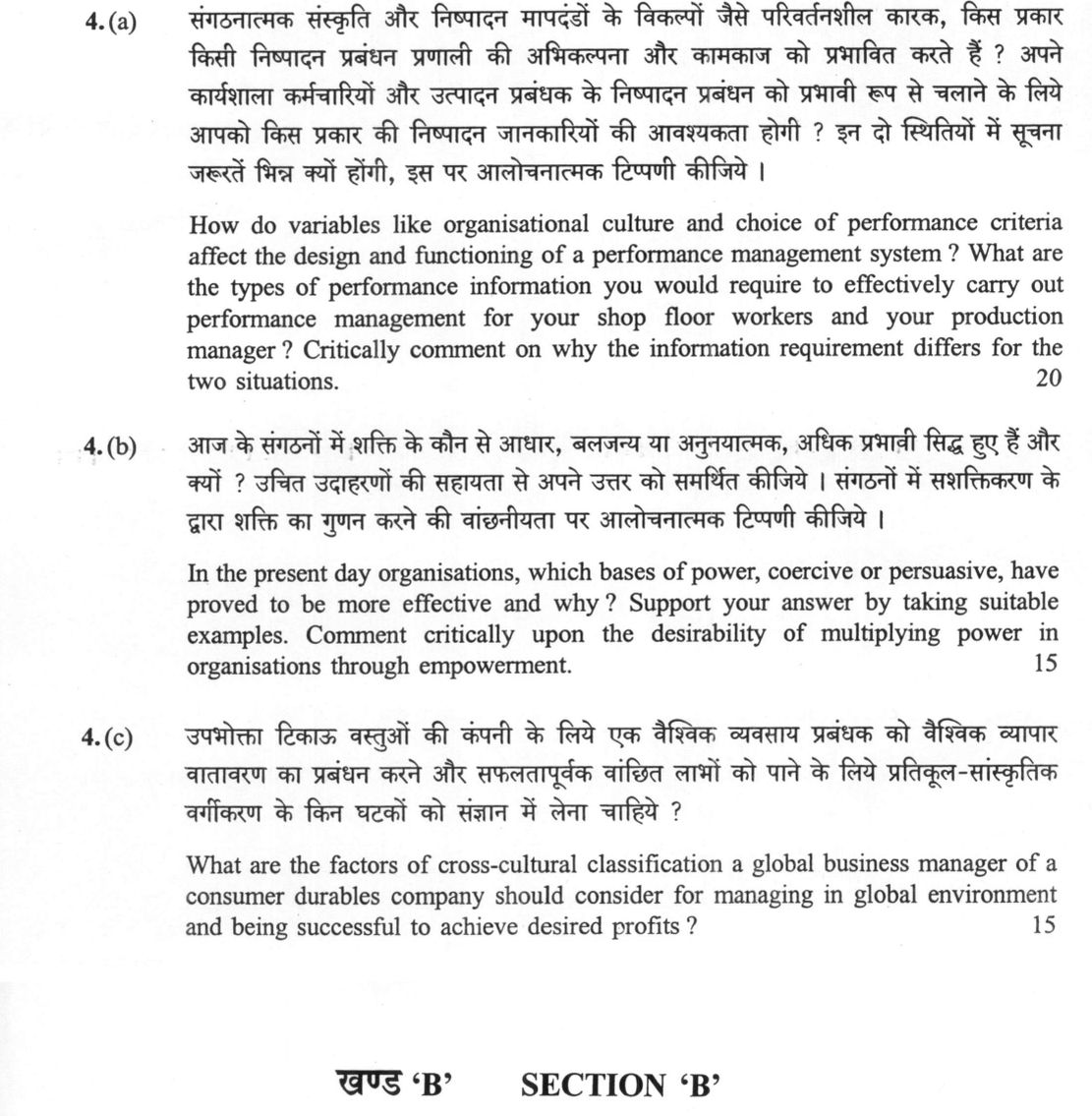
How do variables like organisational culture and choice of performance criteria affect the design and functioning of a performance management system ? What are the types of performance information you would require to effectively carry out performance management for your shop floor workers and your production manager ? Critically comment on why the information requirement differs for the two situations. 20 marks
In the present day organisations, which bases of power, coercive or persuasive, have proved to be more effective and why ? Support your answer by taking suitable examples. Comment critically upon the desirability of multiplying power in organisations through empowerment. 15 marks
What are the factors of cross-cultural classification a global business manager of a consumer durables company should consider for managing in global environment and being successful to achieve desired profits ? 15 marks
हिंदी में प्रश्न पढ़ें
संगठनात्मक संस्कृति और निष्पादन मापदंडों के विकल्पों जैसे परिवर्तनशील कारक, किस प्रकार किसी निष्पादन प्रबंधन प्रणाली की अभिकल्पना और कामकाज को प्रभावित करते हैं ? अपने कार्यशाला कर्मचारियों और उत्पादन प्रबंधक के निष्पादन प्रबंधन को प्रभावी रूप से चलाने के लिये आपको किस प्रकार की निष्पादन जानकारियों की आवश्यकता होगी ? इन दो स्थितियों में सूचना जरूरतें भिन्न क्यों होंगी, इस पर आलोचनात्मक टिप्पणी कीजिये । (20 अंक)
आज के संगठनों में शक्ति के कौन से आधार, बलजन्य या अनुन्यात्मक, अधिक प्रभावी सिद्ध हुए हैं और क्यों ? उचित उदाहरणों की सहायता से अपने उत्तर को समर्थित कीजिये । संगठनों में सशक्तिकरण के द्वारा शक्ति का गुणन करने की वांछनीयता पर आलोचनात्मक टिप्पणी कीजिये । (15 अंक)
उपभोक्ता टिकाऊ वस्तुओं की कंपनी के लिये एक वैश्विक व्यवसाय प्रबंधक को वैश्विक व्यापार वातावरण का प्रबंधन करने और सफलतापूर्वक वांछित लाभों को पाने के लिये प्रतिकूल-सांस्कृतिक वर्गीकरण के किन घटकों को संज्ञान में लेना चाहिये ? (15 अंक)
Model answer
Written by UPSC Answer Check against this question's marking rubric, to the expected length. UPSC does not publish answers for Mains — this is one way to score well, not an official key.
Performance Management Systems (PMS) are socio-technical interventions shaped decisively by organizational culture and the choice of performance criteria. In Cameron and Quinn’s Competing Values Framework, a Clan culture demands developmental, 360-degree feedback; a Hierarchy culture relies on standardized rule compliance; a Market culture prioritizes aggressive, bottom-line metrics; and an Adhocracy values innovation milestones. Selecting criteria across trait (subjective, low acceptance), behavioral (process-oriented, high developmental utility), and results-based dimensions (objective, but prone to gaming) dictates whether a PMS fosters intrinsic motivation or administrative friction.
Differential Information Requirements in PMS
For shop-floor workers, PMS requires high-frequency, deterministic, and quantitative data: task completion rates, cycle times, defect rates (PPM), machine downtime, attendance, and adherence to safety protocols (e.g., Factories Act norms).
For a production manager, the information requirement shifts toward aggregate, strategic, and systemic indicators: cost-per-unit variance, Overall Equipment Effectiveness (OEE), budget adherence, capacity utilization, supply chain agility, inventory turnover, and talent development indices.
Critique: This information divergence is justified by differing loci of control and operational horizons. Shop-floor roles are tightly coupled to routine execution; performance is directly observable, short-cycle, and individual. Conversely, managerial output is loosely coupled, long-horizon, and dependent on cross-functional orchestration under uncertainty. Applying shop-floor micro-metrics to a production manager induces short-sighted firefighting, whereas evaluating workers on aggregate business outcomes destroys line-of-sight accountability.
Power Dynamics: Coercive versus Persuasive Power
In contemporary knowledge-intensive and VUCA environments, persuasive power—rooted in French and Raven’s expert, referent, and informational power bases—proves far more effective than coercive power. Coercion (fear of demotion, dismissal) secures mere public compliance while breeding psychological unsafety, suppressing innovation, and driving talent attrition in modern enterprises like Infosys or Tata Consultancy Services. Persuasive power, by contrast, generates private commitment, discretionary effort, and organizational citizenship behaviors by aligning individual goals with a compelling organizational vision. However, coercive power cannot be abandoned entirely; it remains a necessary, non-negotiable backstop to enforce ethical baselines, statutory governance, and POSH guidelines.
Desirability of Empowerment: Multiplying power through empowerment flattens hierarchies, accelerates localized decision-making, and fosters agile innovation. Yet, empowerment is not universally desirable. In high power-distance and low-readiness contexts, unstructured empowerment generates role ambiguity, decision paralysis, and dilution of accountability. To succeed, power multiplication must be calibrated through bounded delegation matrices (e.g., RACI) alongside rigorous competence development.
Cross-Cultural Factors for a Global Consumer Durables Manager
To ensure profitability across global markets, a manager must evaluate key cross-cultural dimensions derived from Hofstede, GLOBE, and Edward Hall's frameworks: Power Distance & Individualism: Collectivist, high-power-distance markets (e.g., India, Southeast Asia) treat consumer durables as shared family investments and status symbols, requiring durable aesthetics and multi-capacity designs. Uncertainty Avoidance: High uncertainty-avoidance cultures demand extensive warranties, proven brand reliability, and transparent after-sales networks. High vs. Low Context: High-context societies require relationship-driven, trust-based dealer networks rather than purely transactional distribution contracts.
Profit Maximization Strategies: Achieving sustainable profits requires balancing global scale with glocalization and frugal engineering (e.g., Whirlpool’s customized fabric-care cycles or Godrej’s ChotuKool). Furthermore, managing cultural distance in cross-border joint ventures and supplier relationships minimizes transaction costs, transforming cultural intelligence into sustainable competitive advantage.
Ultimately, organizational competitiveness across operational and global boundaries requires structural alignment: calibrating PMS metrics to the employee's genuine locus of control, leading primarily through persuasive influence backed by bounded empowerment, and leveraging cultural intelligence to adapt product architectures to local consumer realities.
What "Critically comment" is asking you to do
Take a position on the statement and support it. Comment usually attaches to a quoted line in the short slots, so the reasoning must be compressed — an opening view, a few load-bearing reasons, and the limit of the claim. “Critically” is not a section added at the end: name the yardstick you are judging by — the evidence, the stated objective, a constitutional principle, a rival explanation — and let a verdict close each part of the body. Where the question quotes a claim, that verdict must land on the claim itself, accepted, qualified or rejected, and not on the theme in general.
Structure that answers it
Unpack what the statement asserts → your stance → two or three supporting reasons → the qualification that limits it
Where marks are lost
Merits in one paragraph, demerits in the next, and a conclusion calling for a balanced and holistic approach. That is a survey with the judgement left out and it holds the answer in the middle band. The opposite error is reading “critically” as permission to attack — and with the odd pairings, critically describe or critically explain, the exposition still carries most of the marks, the judgement being a layer on it rather than a substitute for it.
How this answer will be evaluated
Approach
Framework: Performance Management System (PMS) Design; French & Raven's Bases of Power; Hofstede's Cultural Dimensions. (a) comment: context > arguments both sides > judgment > close | (b) comment: context > arguments both sides > judgment > close | (c) highlight: name the salient points > one line of substance each > close Full marks: Integrates named frameworks with specific role/industry application and critical judgment.
Key points expected
- Link organizational culture to PMS design
- Distinguish performance criteria for shop floor vs. manager
- Identify specific info types for each role
- Critically justify the difference in information requirements
- Define coercive and persuasive power bases
- Argue which is more effective with reasoning
- Provide suitable examples for the argument
- Critically evaluate the desirability of empowerment
Evaluation rubric
Each sub-part is marked on its own, against the marks and word limit printed on the paper.
- (a) Analyze impact of culture/criteria on PMS and contrast information needs for shop floor vs. production manager. 20 marks
comment— context → arguments both sides → judgment → close
Must cover
- Link organizational culture to PMS design
- Distinguish performance criteria for shop floor vs. manager
- Identify specific info types for each role
- Critically justify the difference in information requirements
Loses marks
- Generic definitions without application to roles
- Failing to distinguish between the two roles
- Ignoring the 'critical comment' aspect
Earns more
- Mention specific PMS models (e.g., MBO, BSC)
- Use concrete examples of performance metrics
- Discuss the role of feedback loops
- Reference specific cultural variables (e.g., power distance)
Extra mark
- Cite a specific company's PMS structure
- Reference a recent regulatory change in labor laws
- (b) Compare coercive vs. persuasive power effectiveness and critique empowerment as a multiplier of power. 15 marks
comment— context → arguments both sides → judgment → close
Must cover
- Define coercive and persuasive power bases
- Argue which is more effective with reasoning
- Provide suitable examples for the argument
- Critically evaluate the desirability of empowerment
Loses marks
- Defining terms without comparing effectiveness
- Ignoring the 'critical comment' on empowerment
- Lack of concrete examples
Earns more
- Reference French & Raven's bases of power
- Discuss the psychological impact of power
- Link empowerment to organizational performance
- Mention the limits of persuasive power
Extra mark
- Cite a specific leadership case study
- Reference a specific management theory on empowerment
- (c) Identify cross-cultural classification factors for a global consumer durables manager to achieve profits. 15 marks
highlight— name the salient points → one line of substance each → close
Must cover
- Name specific cross-cultural classification factors
- Apply factors to a consumer durables context
- Link cultural management to profit achievement
- Consider the global business environment
Loses marks
- Listing factors without application to the industry
- Ignoring the 'profit' objective
- Generic cultural descriptions without business relevance
Earns more
- Reference Hofstede's or Trompenaars' dimensions
- Discuss specific cultural barriers to profit
- Mention localization strategies
- Consider legal/regulatory cultural differences
Extra mark
- Cite a specific global company's cultural strategy
- Reference a specific cross-cultural conflict case
Practice this exact question
Write your answer and it is marked point by point against the model answer above — what you covered, what you missed, what you got wrong.
Evaluate my answer →More from Management 2024 Paper I
- Q1 (a) Elucidate the three categories of roles which a manager has to perform as suggested b…
- Q2 (a) Discuss the various types of "Control Mechanisms" a manager can apply in order to tak…
- Q3 (a) Discuss the key determinants of organisational structure and design. Among the emergi…
- Q4 (a) How do variables like organisational culture and choice of performance criteria affec…
- Q5 (a) How can Cost-Volume-Profit (CVP) analysis be used to assess the effect of changes in…
- Q6 (a) A proforma cost sheet of a company provides the following data : | Cost per unit | ₹…
- Q7 (a) Sunder Ltd. is planning an expansion programme which will require ₹30 crores and can…