Paper I — Q1
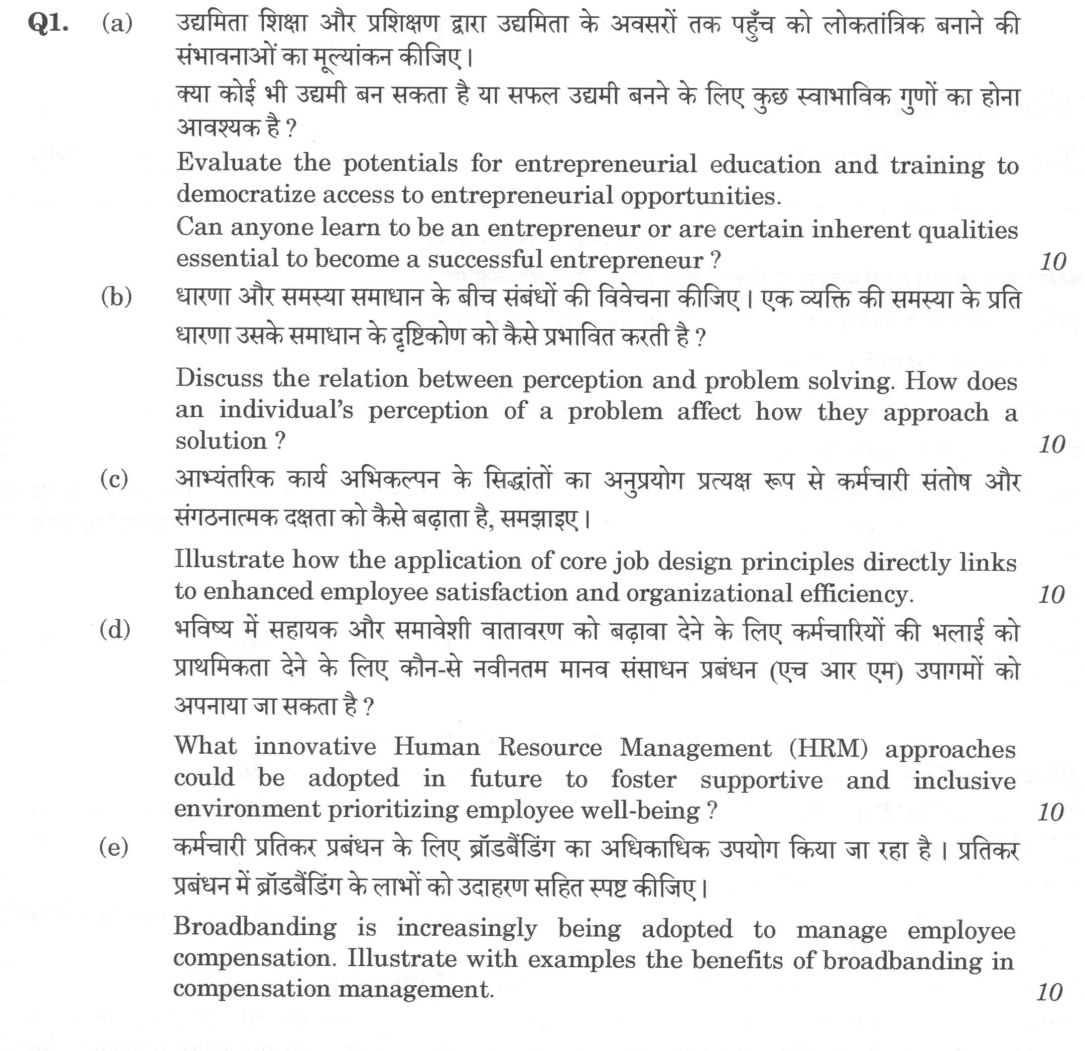
(a) Evaluate the potentials for entrepreneurial education and training to democratize access to entrepreneurial…
Evaluate the potentials for entrepreneurial education and training to democratize access to entrepreneurial opportunities.
Can anyone learn to be an entrepreneur or are certain inherent qualities essential to become a successful entrepreneur ? 10 marks
Discuss the relation between perception and problem solving. How does an individual's perception of a problem affect how they approach a solution ? 10 marks
Illustrate how the application of core job design principles directly links to enhanced employee satisfaction and organizational efficiency. 10 marks
What innovative Human Resource Management (HRM) approaches could be adopted in future to foster supportive and inclusive environment prioritizing employee well-being ? 10 marks
Broadbanding is increasingly being adopted to manage employee compensation. Illustrate with examples the benefits of broadbanding in compensation management. 10 marks
हिंदी में प्रश्न पढ़ें
उद्यमिता शिक्षा और प्रशिक्षण द्वारा उद्यमिता के अवसरों तक पहुंच को लोकतांत्रिक बनाने की संभावनाओं का मूल्यांकन कीजिए।
क्या कोई भी उद्यमी बन सकता है या सफल उद्यमी बनने के लिए कुछ स्वाभाविक गुणों का होना आवश्यक है ? (10 अंक)
धारणा और समस्या समाधान के बीच संबंधों की विवेचना कीजिए । एक व्यक्ति की समस्या के प्रति धारणा उसके समाधान के दृष्टिकोण को कैसे प्रभावित करती है ? (10 अंक)
आभ्यंतरिक कार्य अभिकल्पन के सिद्धांतों का अनुप्रयोग प्रत्यक्ष रूप से कर्मचारी संतोष और संगठनात्मक दक्षता को कैसे बढ़ाता है, समझाइए। (10 अंक)
भविष्य में सहायक और समावेशी वातावरण को बढ़ावा देने के लिए कर्मचारियों की भलाई को प्राथमिकता देने के लिए कौन-से नवीनतम मानव संसाधन प्रबंधन (एच आर एम) उपागमों को अपनाया जा सकता है ? (10 अंक)
कर्मचारी प्रतिकर प्रबंधन के लिए ब्रॉडबैंडिंग का अधिकाधिक उपयोग किया जा रहा है । प्रतिकर प्रबंधन में ब्रॉडबैंडिंग के लाभों को उदाहरण सहित स्पष्ट कीजिए। (10 अंक)
Model answer
Written by UPSC Answer Check against this question's marking rubric, to the expected length. UPSC does not publish answers for Mains — this is one way to score well, not an official key.
Modern organizational management increasingly operates at the intersection of human behavioral dynamics, structural agility, and capability development. Aligning strategic performance with sustainable outcomes requires examining the mechanisms governing entrepreneurial capability, individual cognitive processing, workplace architecture, and adaptive human resource systems.
(a) Entrepreneurial Education and Democratization of Opportunity
Entrepreneurial education acts as a structural equalizer by institutionalizing knowledge that was historically confined to business dynasties or elite networks. Formal frameworks demystify market feasibility analysis, venture capitalization, intellectual property management, and regulatory compliance. In India, public interventions such as NITI Aayog’s Atal Innovation Mission (AIM)—operationalized through Atal Tinkering Labs and Atal Incubation Centres—alongside the Startup India initiative, demonstrate that structured training democratizes access by equipping youth from tier-2 and tier-3 ecosystems with critical design-thinking and commercialization skills.
However, the efficacy of education must be evaluated against classical trait theory. David McClelland’s Theory of Needs underscores that a high Need for Achievement (n-Ach), internal locus of control, tolerance for ambiguity, and an innate risk-taking propensity form the foundational psychological core of successful entrepreneurs. While structured education successfully imparts technical competencies, managerial literacy, and opportunity recognition capabilities, it cannot fully manufacture psychological resilience, intuitive risk calibration, or grit under existential market uncertainty.
Therefore, entrepreneurial education is not a universal substitute for inherent disposition, but a catalyst. It democratizes the opportunity landscape and lowers structural barriers to entry, enabling individuals with latent entrepreneurial qualities to convert intent into viable enterprise.
(b) Perception and Problem Solving
Perception is the cognitive process through which an individual selects, organizes, and interprets environmental stimuli to make sense of reality. The perceptual process comprises three sequential phases: selective attention (filtering environmental cues based on relevance and past experience), perceptual organization (grouping filtered data into coherent mental frameworks), and interpretation (assigning meaning to the organized data). In organizational contexts, problem-solving begins not with an objective problem, but with the perceptual construction of that problem.
An individual's perceptual readiness heavily governs this diagnostic phase. Jerome Bruner’s theory of Perceptual Readiness posits that individuals possess pre-established cognitive categories that make them selectively sensitive to specific inputs while ignoring others. For instance, a finance professional primed by cost control may perceive a drop in market share strictly as an operational cost overrun, whereas a marketing manager perceives the identical data as brand fatigue.
Furthermore, cognitive biases systematically distort problem framing. Framing effects dictate that a problem presented in terms of potential losses triggers risk-seeking solution paths, whereas a gain-framed problem induces risk-averse behavior. Anchoring bias restricts subsequent information search to initial diagnostic clues, while confirmation bias leads decision-makers to discard data that refutes their favored hypothesis. Consequently, perceptual orientation dictates whether a situation is approached as a threat requiring defensive retrenchment or an opportunity demanding strategic innovation.
(c) Job Design Principles, Satisfaction, and Efficiency
The systematic structuring of work tasks directly influences behavioral motivation and operational productivity. Hackman and Oldham’s Job Characteristics Model (JCM) articulates this linkage through five core job dimensions that trigger three critical psychological states, culminating in heightened personal and organizational outcomes.
`` +---------------------+ +------------------------+ +--------------------+ | Core Job Dimensions | ---> | Psychological States | ---> | Personal/Org. | | • Skill Variety | | | | Outcomes | | • Task Identity | ---> | Experienced | ---> | • High Internal | | • Task Significance | | Meaningfulness | | Work Motivation | | • Autonomy | ---> | Experienced | ---> | • High Growth | | | | Responsibility | | Satisfaction | | • Feedback | ---> | Knowledge of | ---> | • High Work | | | | Actual Results | | Effectiveness | +---------------------+ +------------------------+ +--------------------+ ``
First, Skill Variety (deploying multiple capabilities), Task Identity (executing an identifiable, end-to-end task), and Task Significance (perceiving the job's tangible impact on others) collectively generate the critical psychological state of experienced meaningfulness of the work. Second, Autonomy (discretion in scheduling and work methods) induces the experienced responsibility for work outcomes. Third, Feedback (direct, clear information on performance efficacy) provides the knowledge of actual results of work activities.
When work is enriched along these dimensions, it meets higher-order psychological growth needs. Empirically, the activation of these psychological states elevates job satisfaction, internal work motivation, and organizational commitment, while significantly reducing absenteeism and voluntary turnover. Concurrently, organizational efficiency improves as autonomous employees resolve front-line operational bottlenecks proactively, task identity eliminates process redundancies, and continuous feedback minimizes defect rates.
(d) Innovative Human Resource Management for Well-Being and Inclusivity
To navigate evolving workplace demographics and distributed work ecosystems, future HRM must shift from compliance-oriented administration toward empathetic, employee-centric frameworks:
First, institutionalizing proactive mental health architectures that move beyond reactive counselling to include mandatory mental health days, decompressive workloads, and continuous burnout-monitoring algorithms. Second, deploying artificial intelligence for personalized employee wellness, providing tailored health, reskilling, and flexible scheduling recommendations aligned with individual circadian and life-stage needs. Third, formal integration of the gig and blended workforce, establishing equitable compensation structures and social safety nets for contingent labor. Fourth, advancing beyond superficial representation by tying executive compensation to audited Diversity, Equity, and Inclusion (DEI) metrics, neurodiversity hiring programs, and structured mentorship for underrepresented groups. Fifth, experimenting with alternative productivity models, such as four-day work week pilots, which have demonstrated sustained productivity alongside sharp declines in occupational stress.
Indian corporate practices illustrate this progression. Tata Steel has set industry benchmarks through its comprehensive employee assistance frameworks, affirmative action programs, and institutionalized psychological safety policies. Similarly, Infosys has integrated neurodiversity hiring pipelines, equitable LGBTQ+ partner healthcare benefits, and agile pulse-survey platforms that continuously adapt workplace policies to employee sentiment.
(e) Broadbanding in Compensation Management
Broadbanding is a compensation design strategy that consolidates a large number of traditional, narrowly defined pay grades into a few wide salary bands, typically where the maximum pay in a band exceeds the minimum by 100 percent to 200 percent or more.
``` TRADITIONAL NARROW GRADES (Hierarchical) [Grade 1] -> [Grade 2] -> [Grade 3] -> [Grade 4] -> [Grade 5] -> [Grade 6]
BROADBANDING STRUCTURE (Lateral Flexibility) +------------------------------------+ +------------------------------------+ | BAND A | | BAND B | | (Encompasses Grades 1, 2, and 3) | | (Encompasses Grades 4, 5, and 6) | +------------------------------------+ +------------------------------------+ ```
The primary operational benefits of broadbanding include:
- Facilitation of Lateral Mobility: By eliminating narrow salary tiers tied to specific job titles, organizations encourage employees to take lateral postings across functions without the stigma of a non-promotional move, thereby enhancing multi-skilling.
- De-layering and Flatter Hierarchies: It dismantles status-driven hierarchies, aligning compensation with market realities and individual competency rather than vertical job titles.
- Enhanced Managerial Flexibility: Line managers obtain greater discretion to reward specialized skill acquisition and performance variance within the same band without requiring artificial promotions.
In corporate practice, companies such as Hindustan Unilever Limited (HUL) and Wipro have utilized broadbanding to foster agile, cross-functional project teams and build enterprise-wide leadership pipelines. Conversely, public sector undertakings (PSUs) in India face structural hurdles in adopting broadbanding. Centralized pay commission frameworks, rigid statutory cadres, seniority-linked progression cultures, and strict judicial scrutiny regarding wage parity create resistance against discretionary, wide-band compensation structures.
Verdict
Organizational efficacy relies on the synthesis of democratized talent identification, perceptive cognitive clarity, intrinsically motivating job design, inclusive wellness systems, and agile compensation structures. While education provides universal access to entrepreneurial and operational tools, sustainable performance is ultimately realized when management designs work environments that channel innate human potential, accommodate perceptual differences, and reward adaptive competencies within equitable organizational systems.
What "Evaluate" is asking you to do
Judge how well something has performed against the standard it set for itself — its stated aim, mandate or promise — and commit to a verdict. Name the yardstick before you judge; an unanchored judgement reads as opinion.
Structure that answers it
Name the yardstick — stated aim, mandate or benchmark → performance against it → shortfall against it → why the gap exists → verdict
Where marks are lost
Presenting both sides and then declining to decide, or delivering a verdict against a standard you never stated, which makes it look arbitrary.
How this answer will be evaluated
Approach
Framework: null. (a) evaluate: criteria > evidence > balanced judgment | (b) discuss: intro > 3-4 dimensions > example > balanced close | (c) explain: definition/context > points in order > small example > short close | (d) suggest: the problem in one line > implementable measures > who acts > conclusion | (e) explain: definition/context > points in order > small example > short close Full marks: Comprehensive, well-structured, uses named frameworks, concrete examples, and balanced judgment.
Key points expected
- Criteria for democratization (access, skills, mindset)
- Evidence for the 'learned' argument (training, incubators)
- Evidence for 'inherent' traits (risk, creativity)
- Balanced judgment on the interplay of both
- Definition of perception in a management context
- Link to problem identification and framing
- How perception biases (e.g., confirmation bias) affect solutions
- Example of a problem solved via a specific perception
Evaluation rubric
Each sub-part is marked on its own, against the marks and word limit printed on the paper.
- (a) Assess the role of education in democratizing entrepreneurship and the nature vs nurture debate. 10 marks
evaluate— criteria → evidence → balanced judgment
Must cover
- Criteria for democratization (access, skills, mindset)
- Evidence for the 'learned' argument (training, incubators)
- Evidence for 'inherent' traits (risk, creativity)
- Balanced judgment on the interplay of both
Loses marks
- One-sided argument (only nature or only nurture)
- Generic definitions without evaluating potential
Earns more
- Reference to specific entrepreneurial education models
- Mention of government schemes (e.g., Startup India)
Extra mark
- Citation of a specific study on entrepreneurial traits
- Example of a successful incubator program
- (b) Explain the link between perception and problem solving and how perception shapes the solution approach. 10 marks
discuss— intro → 3-4 dimensions → example → balanced close
Must cover
- Definition of perception in a management context
- Link to problem identification and framing
- How perception biases (e.g., confirmation bias) affect solutions
- Example of a problem solved via a specific perception
Loses marks
- Treating perception and problem solving as separate topics
- Lack of concrete example linking the two
Earns more
- Reference to cognitive psychology concepts
- Discussion of 'mental models' or 'frames'
Extra mark
- Reference to a specific cognitive bias (e.g., anchoring)
- Example of a business failure due to perceptual error
- (c) Show how job design principles lead to satisfaction and efficiency with examples. 10 marks
explain— definition/context → points in order → small example → short close
Must cover
- Identification of core job design principles (e.g., variety, autonomy)
- Link to employee satisfaction (motivation, engagement)
- Link to organizational efficiency (productivity, quality)
- Concrete example of a job design change
Loses marks
- Listing principles without illustrating the link
- Ignoring the 'efficiency' aspect of the question
Earns more
- Reference to Job Characteristics Model (Hackman & Oldham)
- Mention of specific job design techniques (e.g., job rotation)
Extra mark
- Example of a specific company's job redesign
- Data on productivity gains from job design
- (d) Propose innovative HRM approaches for a supportive, inclusive, and well-being-focused environment. 10 marks
suggest— the problem in one line → implementable measures → who acts → conclusion
Must cover
- Identification of future-oriented HRM trends
- Focus on employee well-being (mental, physical)
- Focus on inclusivity and diversity
- Specific, implementable measures
Loses marks
- Generic HRM practices (e.g., 'good communication')
- Lack of focus on 'future' or 'innovative' aspects
Earns more
- Mention of technology-driven HRM (e.g., AI for well-being)
- Reference to flexible work arrangements
Extra mark
- Example of a company's innovative well-being program
- Reference to specific HRM technology (e.g., sentiment analysis)
- (e) Explain the benefits of broadbanding in compensation management with examples. 10 marks
explain— definition/context → points in order → small example → short close
Must cover
- Definition of broadbanding (fewer, wider pay bands)
- Benefit: Flexibility in compensation
- Benefit: Reduced internal politics (pay compression)
- Example of a company using broadbanding
Loses marks
- Confusing broadbanding with general pay equity
- Lack of concrete example of broadbanding
Earns more
- Comparison with traditional narrow pay bands
- Mention of 'pay for performance' within bands
Extra mark
- Example of a specific company's broadbanding structure
- Data on cost savings or employee satisfaction from broadbanding
Practice this exact question
Write your answer and it is marked point by point against the model answer above — what you covered, what you missed, what you got wrong.
Evaluate my answer →More from Management 2025 Paper I
- Q1 (a) Evaluate the potentials for entrepreneurial education and training to democratize acc…
- Q2 (a) In what ways can ethical behaviour in management contribute to a company's social res…
- Q3 (a) As a Global Innovation Manager, you have been given a task of leading the new product…
- Q4 (a) You have been recently appointed as the Operations Manager of a mid-sized manufacturi…