Paper I — Q6
(a) A startup company is experiencing rapid growth in sales. However, its net income remains low. Explain the possible causes of…
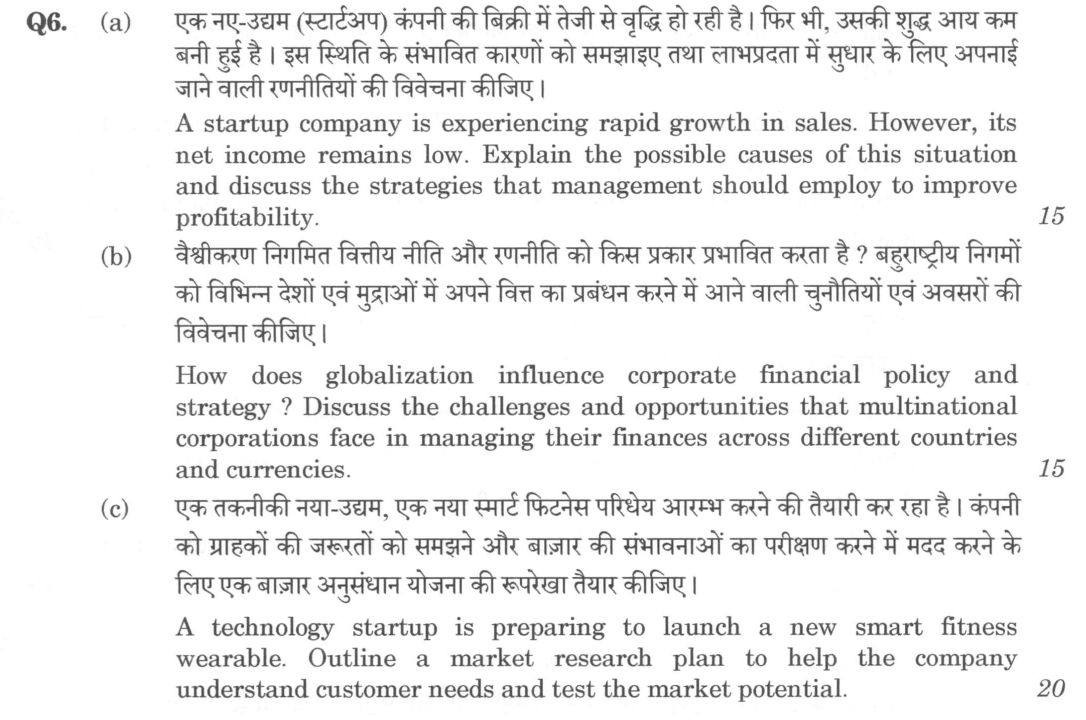
A startup company is experiencing rapid growth in sales. However, its net income remains low. Explain the possible causes of this situation and discuss the strategies that management should employ to improve profitability. 15 marks
How does globalization influence corporate financial policy and strategy ? Discuss the challenges and opportunities that multinational corporations face in managing their finances across different countries and currencies. 15 marks
A technology startup is preparing to launch a new smart fitness wearable. Outline a market research plan to help the company understand customer needs and test the market potential. 20 marks
हिंदी में प्रश्न पढ़ें
एक नए-उद्यम (स्टार्टअप) कंपनी की बिक्री में तेजी से वृद्धि हो रही है। फिर भी, उसकी शुद्ध आय कम बनी हुई है। इस स्थिति के संभावित कारणों को समझाइए तथा लाभप्रदता में सुधार के लिए अपनाई जाने वाली रणनीतियों की विवेचना कीजिए। 15 अंक
वैश्वीकरण निगमित वित्तीय नीति और रणनीति को किस प्रकार प्रभावित करता है ? बहुराष्ट्रीय निगमों को विभिन्न देशों एवं मुद्राओं में अपने वित्त का प्रबंधन करने में आने वाली चुनौतियों एवं अवसरों की विवेचना कीजिए। 15 अंक
एक तकनीकी नया-उद्यम, एक नया स्मार्ट फिटनेस परिधेय आरंभ करने की तैयारी कर रहा है। कंपनी को ग्राहकों की जरूरतों को समझने और बाजार की संभावनाओं का परीक्षण करने में मदद करने के लिए एक बाजार अनुसंधान योजना की रूपरेखा तैयार कीजिए। 20 अंक
Model answer
Written by UPSC Answer Check against this question's marking rubric, to the expected length. UPSC does not publish answers for Mains — this is one way to score well, not an official key.
Part (a) Rapid sales growth with low net income usually means the startup is buying growth faster than it is building profitable unit economics. Causes include high customer acquisition costs, aggressive discounting to win early users, operational inefficiencies in fulfilment, support or supply chain, heavy R&D and marketing spend before scale, a negative cash conversion cycle where receivables and inventory consume cash before collections arrive, and asset-heavy scaling such as warehouses, devices or capacity. Management should diagnose with contribution margin analysis, separating variable costs from fixed costs, and track LTV/CAC ratio to ensure each acquired customer eventually returns more than the cost of acquiring them. Cohort-based profitability analysis should show whether early cohorts become profitable as retention improves. A path-to-profitability framework should set milestones: improve gross margin through pricing or cost control, use operating leverage by spreading fixed costs over larger revenue, reduce CAC through referral and retention, and align hiring and capex with cash flow. The goal is not to stop growth but to make growth self-funding.
Part (b) Globalization changes corporate financial policy by widening the choice of capital, markets and risks. In capital structure, firms can issue debt in global markets and use foreign-currency borrowing such as ECBs when rates or tenors are favourable; ADRs are equity instruments for cross-border listing, while Masala bonds are rupee-denominated offshore instruments, so they must be analysed separately from foreign-currency debt. Investment appraisal must use international NPV/IRR with political risk adjustments: projected cash flows and/or the discount rate are adjusted for country risk, inflation differentials, repatriation limits and tax effects; IRR is then computed from the adjusted cash flows rather than directly altered. Working capital policy must manage cross-border receivables, payables, inventory and cash pools. Tax policy should use transfer pricing for tax optimization, within arm’s-length rules. Challenges include currency translation and transaction exposure, repatriation restrictions, country risk, and regulatory complexity. Opportunities include access to lower cost of capital, diversification benefits that reduce unsystematic or company-specific risk, and arbitrage opportunities in capital, production and customer markets. Indian MNCs illustrate this: Infosys manages global cash and currency exposure across service contracts, while Tata Motors balances export earnings, overseas acquisitions and local currency costs.
Part (c) The market research plan should begin with problem definition: determine whether the smart fitness wearable has enough demand, willingness to pay, and feature fit to justify launch. Research objectives should cover target segments, usage occasions, feature priorities, price acceptance, channel preference and competitive response. The exploratory/qualitative phase should use focus groups and ethnographic studies with health-conscious urban Indians, gym-goers, runners, corporate wellness users and older adults seeking health monitoring. This phase should identify pain points with existing wearables, such as battery life, strap comfort, data accuracy, app clutter and privacy. The descriptive/quantitative phase should use a structured survey with a probability or stratified sample from tier-1 and tier-2 cities, capturing demographics, fitness behaviour, smartphone usage, digital adoption patterns and purchase intent. Competitive analysis should benchmark major global and Indian wearables on price, sensors, battery, app ecosystem and after-sales service. Pricing research should use Van Westendorp to identify points of marginal cheapness and expensiveness, and Gabor-Granger to estimate demand and revenue at different price points. Feature prioritization should use the Kano model to separate basic, performance and delight features. Concept/product testing should show mock-ups or prototypes and measure purchase intent, pre-order likelihood and recommended retail price. Channel preference analysis should test e-commerce, brand stores, gyms and corporate wellness partnerships. The final output should be a go/no-go decision framework: launch if target segment size, price acceptance, CAC assumptions and contribution margin support a viable path to profitability, with Indian market specifics such as price sensitivity, digital adoption and urban fitness culture explicitly tested.
Strategic management in dynamic environments therefore requires linking financial discipline, global risk management and market evidence into one decision process.
What "Outline" is asking you to do
Set out a whole scheme from end to end in its main steps without going into any of them. It is the directive used for protocols and frameworks — a management plan, a reaction mechanism, a statutory scheme — where the mark lies in having the full sequence with nothing missing.
Structure that answers it
What the scheme is for → step one → step two → the remaining steps through to the end point → the condition on which the sequence turns
Where marks are lost
Depth in the wrong place: elaborating the first two steps and never reaching the end of the scheme, which is where completeness is checked.
How this answer will be evaluated
Approach
Framework: Profitability Analysis (Cost-Volume-Profit) & Global Financial Management (MNC). (a) explain: definition/context > points in order > small example > short close | (b) discuss: intro > 3-4 dimensions > example > balanced close | (c) enumerate: list the items in order > one line each > no commentary Full marks: Precise application of financial frameworks to the specific scenarios with clear strategic recommendations.
Key points expected
- Identify high operating costs (COGS/Opex) as a cause
- Identify low pricing or high discounting as a cause
- Discuss working capital management (receivables/inventory)
- Propose specific cost-reduction or pricing strategies
- Explain impact on capital structure (debt/equity)
- Discuss foreign exchange risk management (hedging)
- Identify challenges: political risk, regulatory differences
- Identify opportunities: arbitrage, market diversification
Evaluation rubric
Each sub-part is marked on its own, against the marks and word limit printed on the paper.
- (a) Identify causes of low net income despite high sales and propose profitability strategies. 15 marks
explain— definition/context → points in order → small example → short close
Must cover
- Identify high operating costs (COGS/Opex) as a cause
- Identify low pricing or high discounting as a cause
- Discuss working capital management (receivables/inventory)
- Propose specific cost-reduction or pricing strategies
Loses marks
- Confusing revenue growth with profit growth
- Generic advice without startup context
- Ignoring the 'rapid growth' constraint
Earns more
- Mention 'Growth at all costs' strategy
- Reference contribution margin analysis
- Discuss economies of scale
- Mention customer acquisition cost (CAC)
Extra mark
- Real startup example (e.g., early Uber/Amazon)
- Reference to specific financial ratio (e.g., Net Profit Margin)
- (b) Analyze globalization's impact on financial policy and MNC challenges/opportunities. 15 marks
discuss— intro → 3-4 dimensions → example → balanced close
Must cover
- Explain impact on capital structure (debt/equity)
- Discuss foreign exchange risk management (hedging)
- Identify challenges: political risk, regulatory differences
- Identify opportunities: arbitrage, market diversification
Loses marks
- Treating 'globalization' as just 'international trade'
- Ignoring currency fluctuations
- Vague generalities without financial specifics
Earns more
- Mention transfer pricing strategies
- Reference specific hedging instruments (forwards/swaps)
- Discuss repatriation of funds
- Mention country risk rating
Extra mark
- Reference to specific MNC (e.g., Apple/Tesla)
- Mention recent regulatory change (e.g., BEPS)
- (c) Create a market research plan for a smart fitness wearable launch. 20 marks
enumerate— list the items in order → one line each → no commentary
Must cover
- Define research objectives (needs vs potential)
- Specify primary data collection methods (surveys/focus groups)
- Specify secondary data sources (competitor analysis)
- Include a testing phase (pilot/beta launch)
Loses marks
- Listing methods without a logical sequence
- Ignoring the 'smart' technology aspect
- No plan for testing market potential
Earns more
- Mention specific target demographic (e.g., Gen Z)
- Reference SWOT or PESTLE analysis
- Discuss pricing sensitivity testing
- Mention specific competitor (e.g., Fitbit/Apple)
Extra mark
- Specific sample size or statistical method
- Reference to specific market size data
Practice this exact question
Write your answer and it is marked point by point against the model answer above — what you covered, what you missed, what you got wrong.
Evaluate my answer →More from Management 2025 Paper I
- Q3 (a) As a Global Innovation Manager, you have been given a task of leading the new product…
- Q4 (a) You have been recently appointed as the Operations Manager of a mid-sized manufacturi…
- Q5 (a) How does management accounting information adapt its focus and detail across differen…
- Q6 (a) A startup company is experiencing rapid growth in sales. However, its net income rema…
- Q7 (a) Elaborate the distinctions between job costing and process costing methodologies. Giv…
- Q8 (a) (i) Company X experienced a significant increase in its Current Ratio from 1·5 : 1·0…