Paper I — Q4
(a) You have been recently appointed as the Operations Manager of a mid-sized manufacturing company. Discuss how you would…
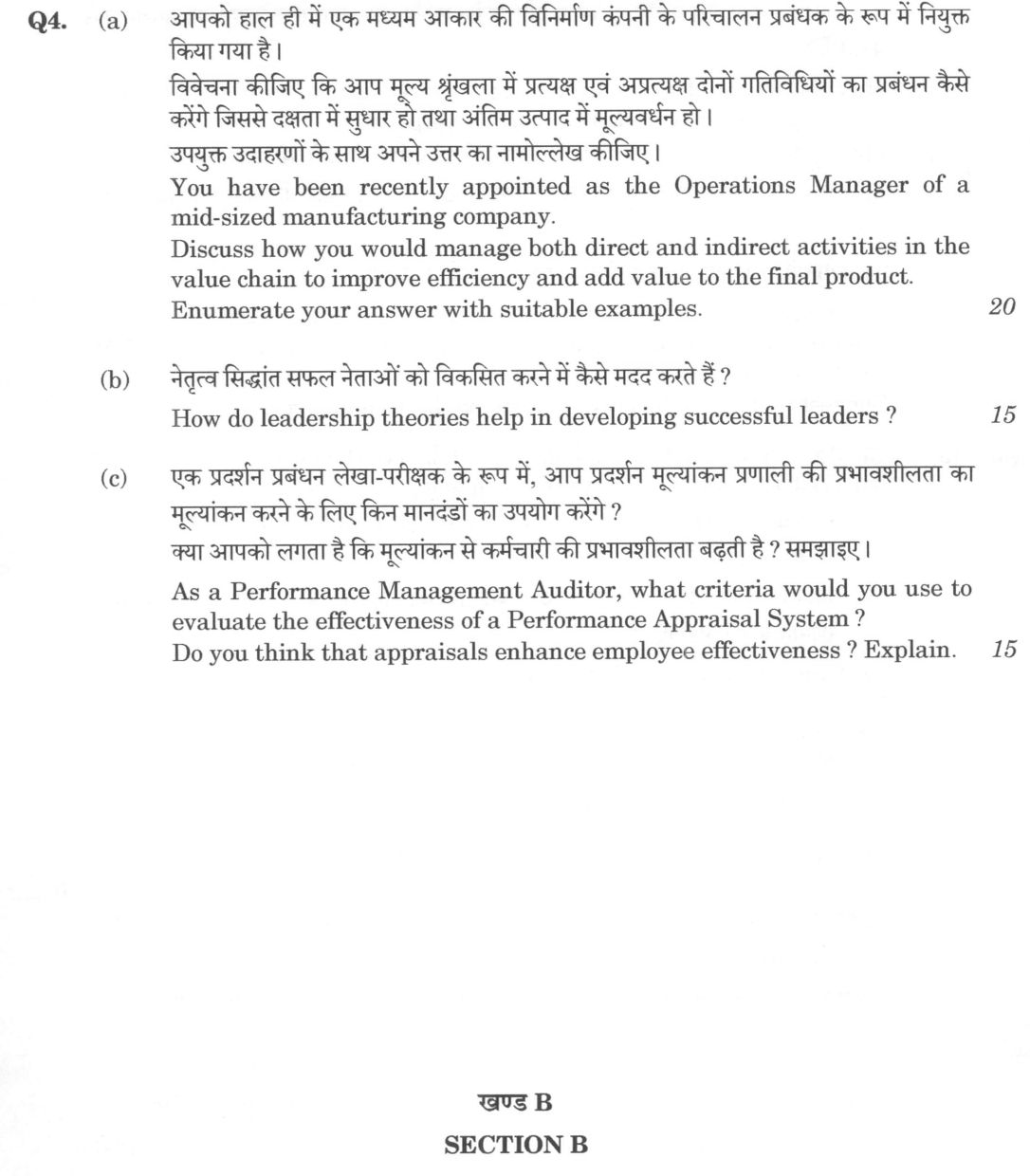
You have been recently appointed as the Operations Manager of a mid-sized manufacturing company.
Discuss how you would manage both direct and indirect activities in the value chain to improve efficiency and add value to the final product.
Enumerate your answer with suitable examples. 20 marks
How do leadership theories help in developing successful leaders ? 15 marks
As a Performance Management Auditor, what criteria would you use to evaluate the effectiveness of a Performance Appraisal System ?
Do you think that appraisals enhance employee effectiveness ? Explain. 15 marks
हिंदी में प्रश्न पढ़ें
आपको हाल ही में एक मध्यम आकार की विनिर्माण कंपनी के परिचालन प्रबंधक के रूप में नियुक्त किया गया है।
विवेचना कीजिए कि आप मूल्य श्रृंखला में प्रत्यक्ष एवं अप्रत्यक्ष दोनों गतिविधियों का प्रबंधन कैसे करेंगे जिससे दक्षता में सुधार हो तथा अंतिम उत्पाद में मूल्यवर्धन हो।
उपयुक्त उदाहरणों के साथ अपने उत्तर का नामोल्लेख कीजिए। (20 अंक)
नेतृत्व सिद्धांत सफल नेताओं को विकसित करने में कैसे मदद करते हैं ? (15 अंक)
एक प्रदर्शन प्रबंधन लेखा-परीक्षक के रूप में, आप प्रदर्शन मूल्यांकन प्रणाली की प्रभावशीलता का मूल्यांकन करने के लिए किन मानदंडों का उपयोग करेंगे ?
क्या आपको लगता है कि मूल्यांकन से कर्मचारी की प्रभावशीलता बढ़ती है ? समझाइए। (15 अंक)
Model answer
Written by UPSC Answer Check against this question's marking rubric, to the expected length. UPSC does not publish answers for Mains — this is one way to score well, not an official key.
The value chain, leadership and performance appraisal are interdependent: operations create value, leaders enable execution, and appraisal aligns effort. As Operations Manager, I would use Porter’s value chain to manage direct and indirect activities as one system. For a mid-sized manufacturer, I would set KPIs—inventory turns, overall equipment effectiveness, order-cycle time and customer complaints—and review them monthly.
First, direct activities add value through inbound logistics, operations, outbound logistics, marketing/sales and service. In inbound logistics, I would introduce just-in-time delivery, vendor scorecards and safety-stock norms, as Tata Motors has used JIT to cut inventory while improving material availability. In operations, lean, total productive maintenance, Six Sigma and quality circles would reduce defects, downtime and cycle time. Outbound logistics would use route optimisation, third-party logistics and better packaging to lower cost and improve delivery. Marketing/sales would rely on CRM and market intelligence to segment customers, while service would use warranty data and after-sales response to enhance product value.
Second, indirect activities support these primary links. Procurement would be centralised through e-procurement and supplier development. Technology development would fund process innovation, automation and product design; Bharat Forge’s investment in forging technology and process development shows how support activities can create competitive advantage. HRM would focus on training, succession planning and skill mapping, while firm infrastructure would use ERP, financial controls and compliance systems to coordinate the chain. I would link procurement savings and technology projects to product cost, quality and delivery targets. The aim is not merely cost reduction but differentiation, speed and reliability.
Leadership theories help develop successful leaders by offering diagnostic lenses. Trait theory identifies qualities such as integrity and decisiveness, but it cannot explain how leaders act in different situations. Behavioural theories, including the Ohio State and Michigan studies and Blake-Mouton’s Managerial Grid, show that effective leaders balance concern for production with concern for people. Contingency theories are more nuanced: Fiedler assumes leader style is relatively fixed and argues that effectiveness depends on situational favourability—leader-member relations, task structure and position power—while Hersey-Blanchard’s situational leadership teaches leaders to adapt directing, coaching, supporting or delegating to follower readiness. Transformational and transactional theories add vision, inspiration, intellectual stimulation and individualised consideration, along with contingent rewards; servant leadership emphasises empowerment and listening. Their limitations are cultural specificity, over-generalisation and neglect of ethics. No single theory is sufficient. A successful leader combines transformational vision, situational flexibility, transactional accountability and ethical behaviour.
As a Performance Management Auditor, I would evaluate an appraisal system on validity, reliability, fairness, acceptability, practicality and strategic congruence. Validity includes criterion validity, meaning the correlation between appraisal scores and an external performance criterion, as well as content and construct validity. Reliability means consistent ratings across raters and time. Fairness requires freedom from bias, legal compliance and transparent standards. Acceptability depends on employee trust and perceived justice. Practicality considers cost, time and data availability. Strategic congruence checks whether appraisal links to Balanced Scorecard objectives and whether Kirkpatrick’s levels—reaction, learning, behaviour and results—show that appraisal improves performance. I would also test calibration, appeals and use of ratings in promotion and pay.
Appraisals can enhance employee effectiveness when they provide goal alignment, feedback, development and credible rewards. However, they can also create dysfunctions such as halo/horns effects, central tendency, rating inflation and demotivation. In some PSUs, annual performance contracts have suffered from inflated ratings, weakening differentiation; in Indian IT firms, 360-degree appraisal linked to OKRs can improve effectiveness when feedback is developmental and ratings are calibrated.
Thus, value-chain efficiency, leadership quality and appraisal effectiveness form a coherent management system. The way forward is to integrate operations, leadership development and performance management so that each reinforces the other.
What "Discuss" is asking you to do
Lay the issue out from more than one side — how it arose, what is claimed for it, what is held against it, and where it now stands. UPSC attaches discuss to broad topics with several live dimensions, so coverage of the dimensions earns more than the strength of your opinion.
Structure that answers it
Set the issue up → the case as it is made → the case against → the dimension both sides leave out → where the balance now lies
Where marks are lost
Listing facts with no thread between them, or arguing one side throughout and calling it a discussion.
How this answer will be evaluated
Approach
Framework: Porter's Value Chain. (a) discuss: intro > 3-4 dimensions > example > balanced close | (b) explain: definition/context > points in order > small example > short close | (c) evaluate: criteria > evidence > balanced judgment Full marks: Comprehensive application of frameworks with specific examples and balanced judgment.
Key points expected
- Distinguish between primary and support activities
- Apply specific efficiency measures to direct activities
- Apply specific value-addition measures to indirect activities
- Provide suitable examples for the mid-sized manufacturing context
- Reference specific leadership theories (e.g., Trait, Behavioral, Situational)
- Explain the mechanism of how theory guides development
- Link theory to practical leadership skills
- Provide a brief example of application
Evaluation rubric
Each sub-part is marked on its own, against the marks and word limit printed on the paper.
- (a) Management strategy for direct and indirect value chain activities to improve efficiency and value. 20 marks
discuss— intro → 3-4 dimensions → example → balanced close
Must cover
- Distinguish between primary and support activities
- Apply specific efficiency measures to direct activities
- Apply specific value-addition measures to indirect activities
- Provide suitable examples for the mid-sized manufacturing context
Loses marks
- Textbook definitions without application to the scenario
- Ignoring the distinction between direct and indirect activities
- Lack of specific examples
Earns more
- Mention of Porter's Value Chain model explicitly
- Linkage between support and primary activities
- Discussion of cost reduction vs value addition
- Reference to specific manufacturing processes (e.g., JIT, TQM)
Extra mark
- Reference to a specific real-world manufacturing company
- Mention of recent regulatory or technological changes
- (b) How leadership theories contribute to the development of successful leaders. 15 marks
explain— definition/context → points in order → small example → short close
Must cover
- Reference specific leadership theories (e.g., Trait, Behavioral, Situational)
- Explain the mechanism of how theory guides development
- Link theory to practical leadership skills
- Provide a brief example of application
Loses marks
- Listing theories without explaining their developmental utility
- Vague generalizations about 'good leadership'
- Ignoring the 'how' aspect of the question
Earns more
- Comparison of different theoretical approaches
- Mention of modern leadership styles (e.g., Transformational)
- Discussion of the limitations of specific theories
- Reference to specific leadership traits or behaviors
Extra mark
- Reference to a specific named leader or case study
- Mention of a specific leadership development program
- (c) Criteria for evaluating Performance Appraisal System effectiveness and their impact on employee effectiveness. 15 marks
evaluate— criteria → evidence → balanced judgment
Must cover
- List specific criteria for evaluating appraisal systems (e.g., validity, reliability)
- Provide a reasoned judgment on whether appraisals enhance effectiveness
- Explain the link between appraisal and employee performance
- Discuss potential negative impacts or limitations
Loses marks
- Failing to provide specific evaluation criteria
- One-sided view without considering limitations
- Vague statements about 'improving performance' without explanation
Earns more
- Mention of specific appraisal methods (e.g., 360-degree, MBO)
- Discussion of the psychological impact on employees
- Reference to legal or compliance aspects of appraisals
- Balanced view of pros and cons
Extra mark
- Reference to a specific study or statistic on appraisal effectiveness
- Mention of a specific company's appraisal policy
Practice this exact question
Write your answer and it is marked point by point against the model answer above — what you covered, what you missed, what you got wrong.
Evaluate my answer →More from Management 2025 Paper I
- Q1 (a) Evaluate the potentials for entrepreneurial education and training to democratize acc…
- Q2 (a) In what ways can ethical behaviour in management contribute to a company's social res…
- Q3 (a) As a Global Innovation Manager, you have been given a task of leading the new product…
- Q4 (a) You have been recently appointed as the Operations Manager of a mid-sized manufacturi…
- Q5 (a) How does management accounting information adapt its focus and detail across differen…
- Q6 (a) A startup company is experiencing rapid growth in sales. However, its net income rema…
- Q7 (a) Elaborate the distinctions between job costing and process costing methodologies. Giv…