Paper I — Q8
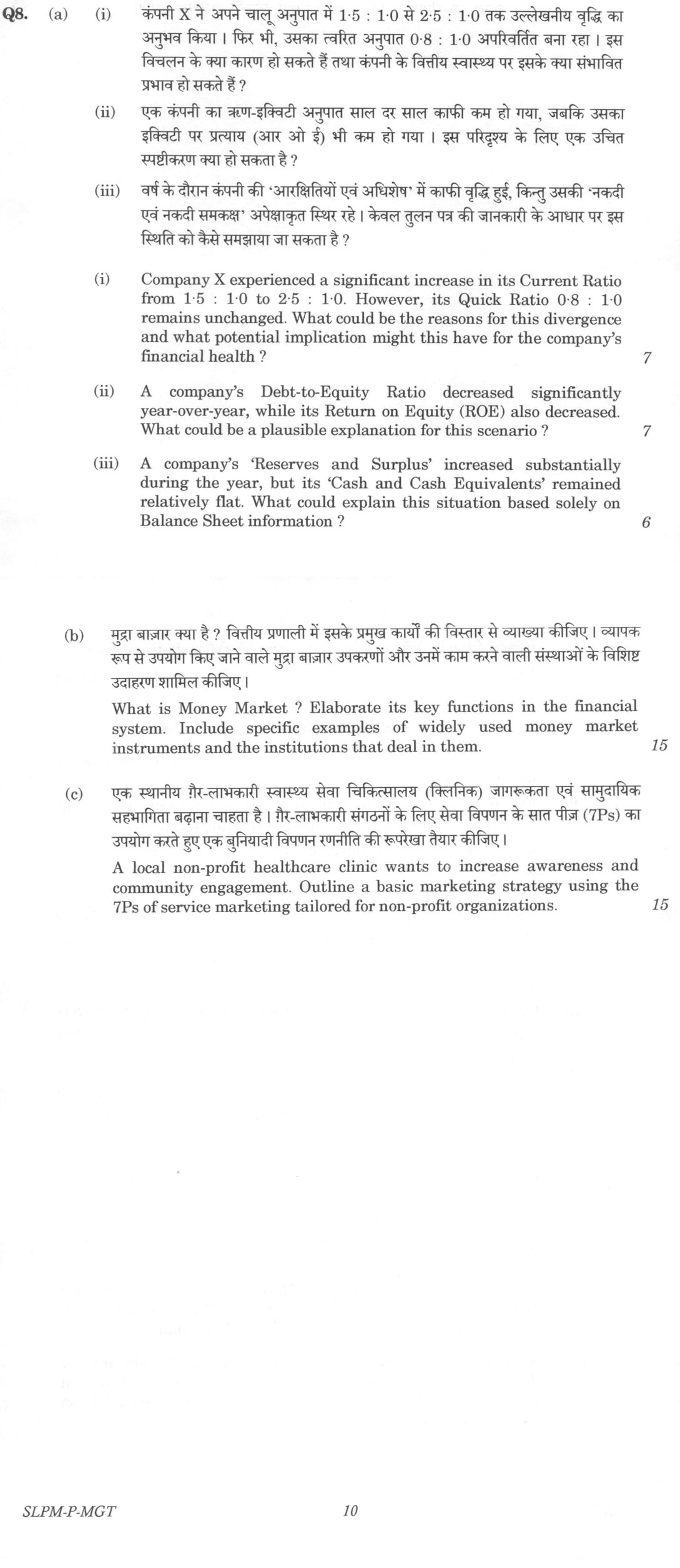
(a) (i) Company X experienced a significant increase in its Current Ratio from 1·5 : 1·0 to 2·5 : 1·0. However, its Quick Ratio…
Company X experienced a significant increase in its Current Ratio from 1·5 : 1·0 to 2·5 : 1·0. However, its Quick Ratio 0·8 : 1·0 remains unchanged. What could be the reasons for this divergence and what potential implication might this have for the company's financial health? 7 marks
A company's Debt-to-Equity Ratio decreased significantly year-over-year, while its Return on Equity (ROE) also decreased. What could be a plausible explanation for this scenario? 7 marks
A company's 'Reserves and Surplus' increased substantially during the year, but its 'Cash and Cash Equivalents' remained relatively flat. What could explain this situation based solely on Balance Sheet information? 6 marks
What is Money Market ? Elaborate its key functions in the financial system. Include specific examples of widely used money market instruments and the institutions that deal in them. 15 marks
A local non-profit healthcare clinic wants to increase awareness and community engagement. Outline a basic marketing strategy using the 7Ps of service marketing tailored for non-profit organizations. 15 marks
हिंदी में प्रश्न पढ़ें
कंपनी X ने अपने चालू अनुपात में 1·5 : 1·0 से 2·5 : 1·0 तक उल्लेखनीय वृद्धि का अनुभव किया। फिर भी, उसका त्वरित अनुपात 0·8 : 1·0 अपरिवर्तित बना रहा। इस विचलन के क्या कारण हो सकते हैं तथा कंपनी के वित्तीय स्वास्थ्य पर इसके क्या संभावित प्रभाव हो सकते हैं? (7 अंक)
एक कंपनी का ऋण-इक्विटी अनुपात साल दर साल काफी कम हो गया, जबकि उसका इक्विटी पर प्रत्यय (आर ओ ई) भी कम हो गया। इस परिदृश्य के लिए एक उचित स्पष्टीकरण क्या हो सकता है? (7 अंक)
वर्ष के दौरान कंपनी की 'आरक्षितियों एवं अधिशेष' में काफी वृद्धि हुई, किन्तु उसकी 'नकदी एवं नकदी समकक्ष' अपेक्षाकृत स्थिर रहे। केवल तुलन पत्र की जानकारी के आधार पर इस स्थिति को कैसे समझाया जा सकता है? (6 अंक)
मुद्रा बाजार क्या है ? वित्तीय प्रणाली में इसके प्रमुख कार्यों की विस्तार से व्याख्या कीजिए । व्यापक रूप से उपयोग किए जाने वाले मुद्रा बाजार उपकरणों और उनमें काम करने वाली संस्थाओं के विशिष्ट उदाहरण शामिल कीजिए । (15 अंक)
एक स्थानीय गैर-लाभकारी स्वास्थ्य सेवा चिकित्सालय (क्लिनिक) जागरूकता एवं सामुदायिक सहभागिता बढ़ाना चाहता है । गैर-लाभकारी संगठनों के लिए सेवा विपणन के सात पीज (7Ps) का उपयोग करते हुए एक बुनियादी विपणन रणनीति की रूपरेखा तैयार कीजिए । (15 अंक)
Model answer
Written by UPSC Answer Check against this question's marking rubric, to the expected length. UPSC does not publish answers for Mains — this is one way to score well, not an official key.
Financial Ratio and Balance Sheet Dynamics
The divergence between an increasing Current Ratio (1.5 to 2.5) and a stagnant Quick Ratio (0.8) occurs because the Quick Ratio excludes illiquid current assets: Quick Assets = Current Assets - (Inventory + Prepaid Expenses). The increase in current assets is entirely driven by an inventory build-up or large increases in prepaid expenses. This creates a liquidity illusion, as headline liquidity appears robust while real solvency remains constrained at 0.8:1. Operationally, it signals working capital inefficiencies, high carrying costs, cash tied up in unsellable stock, and risk of inventory obsolescence.
A simultaneous decline in Debt-to-Equity and Return on Equity (ROE) is explained via the DuPont framework: ROE = Net Profit Margin × Asset Turnover × Equity Multiplier. A lower Debt-to-Equity ratio compresses the Equity Multiplier (financial leverage). If the company raised fresh equity or retired low-cost debt when Return on Capital Employed (ROCE) exceeded the post-tax cost of debt, the loss of positive financial leverage reduces ROE. Alternatively, substantial equity retention without a proportional expansion in operating profit, or operational margin compression coinciding with deleveraging, drives both ratios down.
A substantial increase in Reserves and Surplus alongside flat Cash and Cash Equivalents reflects balance sheet adjustments under accrual accounting. Net profits credited to retained earnings may be locked in non-cash current assets (increased trade receivables) or deployed to fund non-current capital expenditure (property, plant, and equipment). Furthermore, non-cash accounting entries—such as revaluation reserves from upward asset revaluations, capital reserves, or unrealized foreign currency translation gains—increase reserves without generating cash inflows.
The Money Market: Functions, Instruments, and Institutions
The money market is a wholesale institutional market for borrowing and lending short-term funds with maturities up to one year. It performs vital systemic functions: providing liquidity management for banks and corporates, facilitating monetary policy transmission via the Reserve Bank of India’s (RBI) policy corridor, enabling price discovery for short-term interest rates, and offering non-inflationary short-term deficit financing for the government.
Key instruments include Treasury Bills (91-day, 182-day, and 364-day zero-coupon sovereign debt issued at a discount), Commercial Paper (unsecured promissory notes issued by highly rated corporates for working capital), Certificates of Deposit (negotiable, term-deposit receipts issued by commercial banks), Call/Notice Money (interbank overnight to 14-day borrowing), and Tri-party Repos (TREPS) collateralized by government securities. Key dealing institutions comprise the Reserve Bank of India (regulator and liquidity provider), Primary Dealers (such as SBI DFHI), commercial banks, cooperative banks, and Money Market Mutual Funds (MMMFs).
7Ps Marketing Strategy for a Non-Profit Healthcare Clinic
A mission-driven service mix tailored for community awareness and healthcare engagement incorporates:
- Product: Preventive care bundles, maternal-child health clinics, regular immunization, and chronic lifestyle disease screenings tailored to community needs.
- Price: Sliding-scale pricing, cross-subsidized fee structures, and free services for Below Poverty Line (BPL) families to eliminate economic barriers to access.
- Place: Centrally located community clinics supported by weekly mobile health vans operating in underserved habitations.
- Promotion: Grassroots engagement through ASHA and Anganwadi networks, local-language health awareness drives, and free neighborhood screening camps.
- People: Empathetic, culturally sensitive healthcare staff and community health volunteers who build trust and overcome social stigmas.
- Process: Simplified token systems, paperless single-window registration, and dignified, low-wait patient triage flows.
- Physical Evidence: Clean, sterile, and welcoming clinic environments with vernacular signage, transparent charter of patient rights, and visible accreditation badges.
Integrating disciplined financial stewardship with targeted marketing frameworks ensures that organizations balance financial sustainability, operational liquidity, and community-centric stakeholder value.
What "Elaborate" is asking you to do
Give the full detailed account the question has compressed into a line — every dimension of it, with specifics. Elaborate rewards completeness and detail rather than clarification or argument: the examiner is checking whether you can fill out a topic without being told what its parts are.
Structure that answers it
State the proposition → first dimension in detail → second dimension in detail → the part the statement leaves implicit → the consolidated picture
Where marks are lost
Repeating the statement at greater length instead of adding substance. Elaborate also punishes narrowness: omitting a whole dimension costs more here than anywhere else in this family.
How this answer will be evaluated
Approach
Framework: 7Ps of Service Marketing. (a(i)) analyse: intro > causes > effects > stakeholders/linkages > way forward | (a(ii)) explain: definition/context > points in order > small example > short close | (a(iii)) explain: definition/context > points in order > small example > short close | (b) describe: define > structure or process in order > labelled diagram > significance | (c) suggest: the problem in one line > implementable measures > who acts > conclusion Full marks: Precise application of frameworks to specific scenarios with clear logical links and relevant examples.
Key points expected
- Identify increase in Inventory as the cause
- Define Quick Ratio as excluding Inventory
- Link divergence to inventory buildup
- Assess impact on liquidity/working capital
- Link D/E decrease to debt repayment or equity issuance
- Explain loss of financial leverage effect
- Connect reduced leverage to lower ROE
- Mention potential drop in Net Profit
Evaluation rubric
Each sub-part is marked on its own, against the marks and word limit printed on the paper.
- (a(i)) Explain the divergence between rising Current Ratio and static Quick Ratio and its financial implications. 7 marks
analyse— intro → causes → effects → stakeholders/linkages → way forward
Must cover
- Identify increase in Inventory as the cause
- Define Quick Ratio as excluding Inventory
- Link divergence to inventory buildup
- Assess impact on liquidity/working capital
Loses marks
- Confusing Current and Quick Ratio definitions
- Ignoring the 'unchanged' Quick Ratio constraint
Earns more
- Mention potential obsolescence risk
- Reference working capital management
Extra mark
- Cite a specific industry example
- (a(ii)) Provide a plausible explanation for simultaneous decrease in Debt-to-Equity and ROE. 7 marks
explain— definition/context → points in order → small example → short close
Must cover
- Link D/E decrease to debt repayment or equity issuance
- Explain loss of financial leverage effect
- Connect reduced leverage to lower ROE
- Mention potential drop in Net Profit
Loses marks
- Treating D/E and ROE as independent variables
- Failing to explain the mechanism of leverage
Earns more
- Discuss cost of capital implications
- Mention risk profile change
Extra mark
- Reference a specific corporate restructuring case
- (a(iii)) Explain how Reserves increase while Cash remains flat using Balance Sheet logic. 6 marks
explain— definition/context → points in order → small example → short close
Must cover
- Identify reinvestment in Fixed Assets
- Mention non-cash items (e.g., depreciation)
- Reference asset expansion (PPE/Investments)
- Note that profit was retained, not distributed
Loses marks
- Suggesting cash was lost or stolen
- Ignoring the 'Balance Sheet information' constraint
Earns more
- Mention capital expenditure (CapEx)
- Reference cash flow from investing activities
Extra mark
- Cite a specific company's balance sheet trend
- (b) Define Money Market, elaborate its functions, and list instruments and institutions. 15 marks
describe— define → structure or process in order → labelled diagram → significance
Must cover
- Define Money Market (short-term, <1 year)
- List key functions (liquidity, transmission of policy)
- Name specific instruments (T-Bills, CP, CDs)
- Name specific institutions (RBI, Banks, NBFCs)
Loses marks
- Confusing Money Market with Capital Market
- Listing only instruments without functions
Earns more
- Mention Repo/Reverse Repo mechanisms
- Discuss role in monetary policy
Extra mark
- Reference recent RBI circulars on MM
- Mention specific current rates (if accurate)
- (c) Outline a marketing strategy for a non-profit clinic using the 7Ps. 15 marks
suggest— the problem in one line → implementable measures → who acts → conclusion
Must cover
- Apply all 7Ps (Product, Price, Place, Promotion, People, Process, Physical Evidence)
- Tailor strategy to non-profit context (awareness/engagement)
- Provide specific examples for each P
- Focus on community engagement
Loses marks
- Using generic 7Ps without non-profit tailoring
- Missing any of the 7Ps
Earns more
- Mention CSR or government tie-ups
- Suggest specific digital marketing channels
Extra mark
- Reference a specific NGO's successful campaign
- Mention specific local community initiatives
Practice this exact question
Write your answer and it is marked point by point against the model answer above — what you covered, what you missed, what you got wrong.
Evaluate my answer →More from Management 2025 Paper I
- Q5 (a) How does management accounting information adapt its focus and detail across differen…
- Q6 (a) A startup company is experiencing rapid growth in sales. However, its net income rema…
- Q7 (a) Elaborate the distinctions between job costing and process costing methodologies. Giv…
- Q8 (a) (i) Company X experienced a significant increase in its Current Ratio from 1·5 : 1·0…