Paper I — Q2
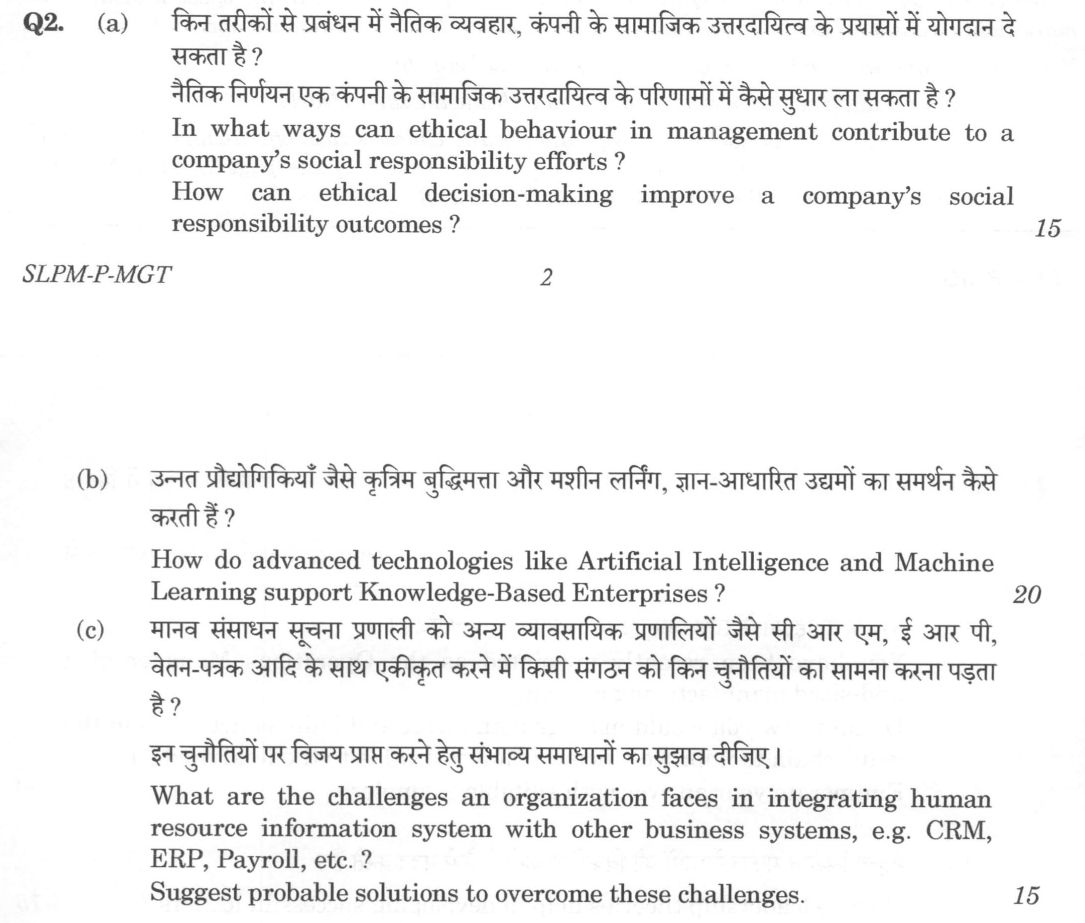
(a) In what ways can ethical behaviour in management contribute to a company's social responsibility efforts ? How can ethical…
In what ways can ethical behaviour in management contribute to a company's social responsibility efforts ?
How can ethical decision-making improve a company's social responsibility outcomes ? 15 marks
How do advanced technologies like Artificial Intelligence and Machine Learning support Knowledge-Based Enterprises ? 20 marks
What are the challenges an organization faces in integrating human resource information system with other business systems, e.g. CRM, ERP, Payroll, etc. ?
Suggest probable solutions to overcome these challenges. 15 marks
हिंदी में प्रश्न पढ़ें
किन तरीकों से प्रबंधन में नैतिक व्यवहार, कंपनी के सामाजिक उत्तरदायित्व के प्रयासों में योगदान दे सकता है ?
नैतिक निर्णयन एक कंपनी के सामाजिक उत्तरदायित्व के परिणामों में कैसे सुधार ला सकता है ? (15 अंक)
उन्नत प्रौद्योगिकियाँ जैसे कृत्रिम बुद्धिमत्ता और मशीन लर्निंग, ज्ञान-आधारित उद्यमों का समर्थन कैसे करती हैं ? (20 अंक)
मानव संसाधन सूचना प्रणाली को अन्य व्यावसायिक प्रणालियों जैसे सी आर एम, ई आर पी, वेतन-पत्रक आदि के साथ एकीकृत करने में किसी संगठन को किन चुनौतियों का सामना करना पड़ता है ?
इन चुनौतियों पर विजय प्राप्त करने हेतु संभाव्य समाधानों का सुझाव दीजिए। (15 अंक)
Model answer
Written by UPSC Answer Check against this question's marking rubric, to the expected length. UPSC does not publish answers for Mains — this is one way to score well, not an official key.
Ethical management provides the cognitive and structural foundation for meaningful Corporate Social Responsibility (CSR), shifting an enterprise from superficial statutory compliance to sustainable value creation. Rooted in Freeman’s Stakeholder Theory and Elkington’s Triple Bottom Line framework, ethical behaviour requires managers to treat external externalities—such as environmental degradation and community welfare—as core business liabilities. When managerial decision-making operates at Kohlberg’s post-conventional stage and incorporates Treviño’s interactionist perspective, leadership moves beyond compliance-based programs that merely avoid penalties under Section 135 of the Companies Act, 2013. Instead, it adopts integrity-based ethics programs (Paine) that cascade across the value chain. Ethical sourcing, transparent governance, and fair labour practices directly improve social responsibility outcomes, converting operational probity into higher stakeholder trust, reputational equity, and an unassailable social license to operate, as seen in the enduring institutional legacy of the Tata Group.
AI and Machine Learning in Knowledge-Based Enterprises
Knowledge-Based Enterprises (KBEs) derive their core competitive advantage from intellectual capital and dynamic capabilities. Advanced technologies like Artificial Intelligence (AI) and Machine Learning (ML) fundamentally accelerate the organizational knowledge lifecycle: creation, codification, sharing, and utilization.
In knowledge creation and codification, Knowledge Discovery in Databases (KDD) and unsupervised ML algorithms process vast, fragmented data streams to uncover latent operational patterns and market shifts. Natural Language Processing (NLP) models capture and structure unstructured tacit knowledge embedded in emails, project notes, and customer interactions, converting them into explicit, reusable institutional memory (Nonaka and Takeuchi’s SECI framework).
In knowledge utilization and transfer, ML-powered predictive analytics and expert systems support high-velocity decision-making by simulating complex operational scenarios. These systems foster Argyris’ double-loop organizational learning, where algorithms not only correct transactional errors (single-loop) but also question underlying operational assumptions and strategic models. Furthermore, AI-driven collaborative platforms foster open innovation ecosystems across global teams. However, sustaining a KBE requires institutionalizing digital ethics and responsible automation, ensuring that algorithmic governance remains transparent, bias-free, and aligned with human-centric organizational values.
HRIS Integration: Challenges and Solutions
Integrating a Human Resource Information System (HRIS) with core enterprise architectures like Enterprise Resource Planning (ERP), Customer Relationship Management (CRM), and Payroll creates several technical and structural friction points:
Technical Challenges: Legacy architectures and heterogeneous databases often use incompatible data taxonomies, resulting in poor semantic interoperability. A lack of standardized Application Programming Interfaces (APIs) leads to data silos and latency in real-time cross-functional synchronization, such as CRM performance metrics failing to dynamically trigger Payroll variable compensation.
Organizational Challenges: Integration disrupts entrenched functional workflows, triggering employee resistance to new interfaces. Cross-system data sharing also escalates cybersecurity vulnerabilities and legal compliance risks under the Digital Personal Data Protection (DPDP) Act, 2023, while high integration costs frequently generate corporate skepticism regarding immediate return on investment.
Solutions: Organizations must implement robust middleware solutions via Enterprise Application Integration (EAI) and microservices-based API architectures to achieve seamless, real-time data exchange without overhauling legacy backbones. Migrating toward unified, cloud-based Human Capital Management (HCM) suites (such as SAP SuccessFactors or Oracle Cloud) eliminates database fragmentation. Organizationally, enterprises should adopt a phased, agile rollout backed by Kotter’s change management model, alongside establishing a cross-functional Data Governance Council to enforce strict role-based access control, secure employee privacy, and ensure audit-compliant synchronization across all enterprise platforms.
Ultimately, long-term organizational competitiveness depends on harmonizing technological capability with ethical governance. By embedding responsible AI frameworks within knowledge systems and establishing seamless, secure enterprise architectures, firms achieve operational agility while upholding the ethical integrity that underpins sustainable corporate citizenship.
What "Explain" is asking you to do
Make the working of something clear — what sets it off, what follows from what, and what it produces. Explain is the Commission's mechanism word: it dominates the technical papers and the “explain why” stems, where the marks sit in the causal chain and not in the label.
Structure that answers it
State what it is → the initiating condition → the chain of cause, step by step → an instance where it plays out → what the chain produces
Where marks are lost
Describing what something looks like instead of why it works that way. Naming the stages without linking them reads as description too.
How this answer will be evaluated
Approach
Framework: Stakeholder Theory / Triple Bottom Line (for a); Knowledge Management Cycle (for b); Systems Integration Framework (for c). (a) discuss: intro > 3-4 dimensions > example > balanced close | (b) explain: definition/context > points in order > small example > short close | (c) challenges: 3-4 challenges > solutions mapped to them > conclusion Full marks: Applies named frameworks to concrete situations with real examples and regulatory references
Key points expected
- Define ethical behavior in management context
- Explain contribution to social responsibility efforts
- Show how ethical decision-making improves outcomes
- Provide concrete organizational example
- Define Knowledge-Based Enterprise
- Explain AI/ML role in knowledge creation
- Explain AI/ML role in knowledge sharing
- Explain AI/ML role in knowledge application
Evaluation rubric
Each sub-part is marked on its own, against the marks and word limit printed on the paper.
- (a) Link ethical management behavior to social responsibility outcomes. 15 marks
discuss— intro → 3-4 dimensions → example → balanced close
Must cover
- Define ethical behavior in management context
- Explain contribution to social responsibility efforts
- Show how ethical decision-making improves outcomes
- Provide concrete organizational example
Loses marks
- Textbook definitions without application
- Framework without a verdict
- Ignoring the decision-making aspect
Earns more
- Reference to CSR frameworks (e.g., Carroll's Pyramid)
- Mention of stakeholder theory
- Discussion of long-term vs short-term ethics
- Link to corporate governance
Extra mark
- Real company example of ethical CSR
- Reference to recent regulatory change
- (b) Explain how AI and ML support Knowledge-Based Enterprises. 20 marks
explain— definition/context → points in order → small example → short close
Must cover
- Define Knowledge-Based Enterprise
- Explain AI/ML role in knowledge creation
- Explain AI/ML role in knowledge sharing
- Explain AI/ML role in knowledge application
Loses marks
- Generic AI description without KBE context
- Ignoring the 'knowledge' aspect
- No link to enterprise support
Earns more
- Mention of specific AI/ML techniques (NLP, predictive analytics)
- Discussion of data vs knowledge distinction
- Reference to knowledge management systems
- Example of industry application
Extra mark
- Specific technology example (e.g., IBM Watson)
- Reference to recent AI advancement
- (c) Identify HRIS integration challenges and suggest solutions. 15 marks
challenges— 3-4 challenges → solutions mapped to them → conclusion
Must cover
- Identify 3-4 specific integration challenges
- Map solutions to each challenge
- Mention specific systems (CRM, ERP, Payroll)
- Provide probable solutions
Loses marks
- Listing challenges without solutions
- Generic IT problems without HRIS context
- Ignoring the specific systems mentioned
Earns more
- Discussion of data compatibility issues
- Mention of API integration
- Reference to data security concerns
- Discussion of change management
Extra mark
- Specific integration tool example
- Reference to recent integration standard
Practice this exact question
Write your answer and it is marked point by point against the model answer above — what you covered, what you missed, what you got wrong.
Evaluate my answer →More from Management 2025 Paper I
- Q1 (a) Evaluate the potentials for entrepreneurial education and training to democratize acc…
- Q2 (a) In what ways can ethical behaviour in management contribute to a company's social res…
- Q3 (a) As a Global Innovation Manager, you have been given a task of leading the new product…
- Q4 (a) You have been recently appointed as the Operations Manager of a mid-sized manufacturi…
- Q5 (a) How does management accounting information adapt its focus and detail across differen…