Paper I — Q7
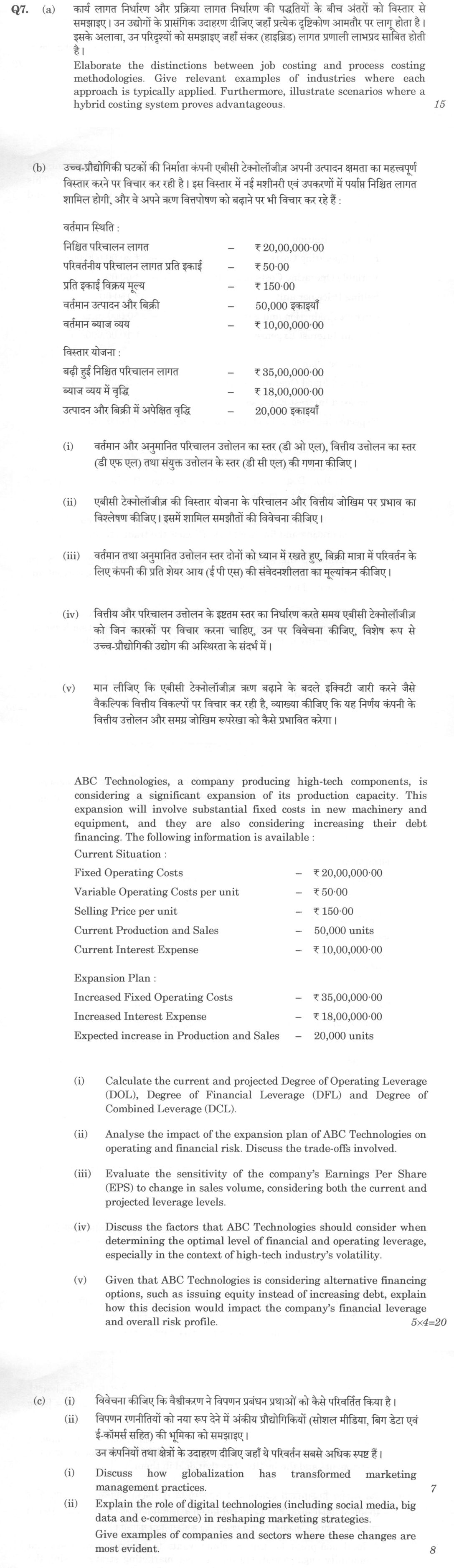
(a) Elaborate the distinctions between job costing and process costing methodologies. Give relevant examples of industries where…
Elaborate the distinctions between job costing and process costing methodologies. Give relevant examples of industries where each approach is typically applied. Furthermore, illustrate scenarios where a hybrid costing system proves advantageous. 15 marks
ABC Technologies, a company producing high-tech components, is considering a significant expansion of its production capacity. This expansion will involve substantial fixed costs in new machinery and equipment, and they are also considering increasing their debt financing. The following information is available :
Current Situation : Fixed Operating Costs – ₹ 20,00,000.00 Variable Operating Costs per unit – ₹ 50.00 Selling Price per unit – ₹ 150.00 Current Production and Sales – 50,000 units Current Interest Expense – ₹ 10,00,000.00
Expansion Plan : Increased Fixed Operating Costs – ₹ 35,00,000.00 Increased Interest Expense – ₹ 18,00,000.00 Expected increase in Production and Sales – 20,000 units
Calculate the current and projected Degree of Operating Leverage (DOL), Degree of Financial Leverage (DFL) and Degree of Combined Leverage (DCL).
Analyse the impact of the expansion plan of ABC Technologies on operating and financial risk. Discuss the trade-offs involved.
Evaluate the sensitivity of the company's Earnings Per Share (EPS) to change in sales volume, considering both the current and projected leverage levels.
Discuss the factors that ABC Technologies should consider when determining the optimal level of financial and operating leverage, especially in the context of high-tech industry's volatility.
Given that ABC Technologies is considering alternative financing options, such as issuing equity instead of increasing debt, explain how this decision would impact the company's financial leverage and overall risk profile. (5×4=20 marks)
Discuss how globalization has transformed marketing management practices. 7 marks
Explain the role of digital technologies (including social media, big data and e-commerce) in reshaping marketing strategies.
Give examples of companies and sectors where these changes are most evident. 8 marks
हिंदी में प्रश्न पढ़ें
कार्य लागत निर्धारण और प्रक्रिया लागत निर्धारण की पद्धतियों के बीच अंतरों को विस्तार से समझाइए। उन उद्योगों के प्रासंगिक उदाहरण दीजिए जहां प्रत्येक दृष्टिकोण आमतौर पर लागू होता है। इसके अलावा, उन परिदृश्यों को समझाइए जहां संकर (हाइब्रिड) लागत प्रणाली लाभप्रद साबित होती है। (15 अंक)
उच्च-प्रौद्योगिकी घटकों की निर्माता कंपनी एबीसी टेक्नोलॉजीज अपनी उत्पादन क्षमता का महत्वपूर्ण विस्तार करने पर विचार कर रही है। इस विस्तार में नई मशीनरी एवं उपकरणों में पर्याप्त निश्चित लागत शामिल होगी, और वे अपने ऋण वितपोषण को बढ़ाने पर भी विचार कर रहे हैं :
वर्तमान स्थिति : निश्चित परिचालन लागत – ₹ 20,00,000.00 परिवर्तनीय परिचालन लागत प्रति इकाई – ₹ 50.00 प्रति इकाई विक्रय मूल्य – ₹ 150.00 वर्तमान उत्पादन और बिक्री – 50,000 इकाइयाँ वर्तमान ब्याज व्यय – ₹ 10,00,000.00
विस्तार योजना : बढ़ी हुई निश्चित परिचालन लागत – ₹ 35,00,000.00 ब्याज व्यय में वृद्धि – ₹ 18,00,000.00 उत्पादन और बिक्री में अपेक्षित वृद्धि – 20,000 इकाइयाँ
वर्तमान और अनुमानित परिचालन उत्तोलन का स्तर (डी ओ एल), वित्तीय उत्तोलन का स्तर (डी एफ एल) तथा संयुक्त उत्तोलन के स्तर (डी सी एल) की गणना कीजिए।
एबीसी टेक्नोलॉजीज की विस्तार योजना के परिचालन और वित्तीय जोखिम पर प्रभाव का विश्लेषण कीजिए। इसमें शामिल समझौतों की विवेचना कीजिए।
वर्तमान तथा अनुमानित उत्तोलन स्तर दोनों को ध्यान में रखते हुए, बिक्री मात्रा में परिवर्तन के लिए कंपनी की प्रति शेयर आय (ई पी एस) की संवेदनशीलता का मूल्यांकन कीजिए।
वित्तीय और परिचालन उत्तोलन के इष्टतम स्तर का निर्धारण करते समय एबीसी टेक्नोलॉजीज को जिन कारकों पर विचार करना चाहिए, उन पर विवेचना कीजिए, विशेष रूप से उच्च-प्रौद्योगिकी उद्योग की अस्थिरता के संदर्भ में।
मान लीजिए कि एबीसी टेक्नोलॉजीज ऋण बढ़ाने के बदले इक्विटी जारी करने जैसे वैकल्पिक वित्तीय विकल्पों पर विचार कर रही है, व्याख्या कीजिए कि यह निर्णय कंपनी के वित्तीय उत्तोलन और समग्र जोखिम रूपरेखा को कैसे प्रभावित करेगा। (5×4=20 अंक)
विवेचना कीजिए कि वैश्वीकरण ने विपणन प्रबंधन प्रथाओं को कैसे परिवर्तित किया है। (7 अंक)
विपणन रणनीतियों को नया रूप देने में अंकीय प्रौद्योगिकियों (सोशल मीडिया, बिग डेटा एवं ई-कॉमर्स सहित) की भूमिका को समझाइए।
उन कंपनियों तथा क्षेत्रों के उदाहरण दीजिए जहां ये परिवर्तन सबसे अधिक स्पष्ट हैं। (8 अंक)
Model answer
Written by UPSC Answer Check against this question's marking rubric, to the expected length. UPSC does not publish answers for Mains — this is one way to score well, not an official key.
Job costing tracks expenditures for unique, discrete jobs or small batches of heterogeneous products where costs can be directly identified with specific contracts, such as in construction, custom shipbuilding, and specialized printing. Process costing, conversely, aggregates costs over continuous, homogeneous, mass-production processes, assigning an average cost per unit across standardized stages, as seen in petroleum refining, cement, and chemical manufacturing. A hybrid costing system, such as operation costing, proves advantageous when products share standardized manufacturing processes but incorporate unique materials or custom specifications. For example, in readymade apparel or modular furniture manufacturing, standardized cutting and assembly follow process costing, while custom fabrics, hardware, and finishes are tracked via job-order costing.
Leverage Analysis for ABC Technologies
Current Metrics: Contribution = 50,000 × (₹150 − ₹50) = ₹50,00,000 EBIT = ₹50,00,000 − ₹20,00,000 = ₹30,00,000 EBT = ₹30,00,000 − ₹10,00,000 = ₹20,00,000 Degree of Operating Leverage (DOL) = Contribution / EBIT = ₹50,00,000 / ₹30,00,000 = 1.67 Degree of Financial Leverage (DFL) = EBIT / EBT = ₹30,00,000 / ₹20,00,000 = 1.50 Degree of Combined Leverage (DCL) = DOL × DFL = 1.67 × 1.50 = 2.50
Projected Metrics (Sales = 70,000 units): Contribution = 70,000 × ₹100 = ₹70,00,000 EBIT = ₹70,00,000 − ₹35,00,000 = ₹35,00,000 EBT = ₹35,00,000 − ₹18,00,000 = ₹17,00,000 Projected DOL = ₹70,00,000 / ₹35,00,000 = 2.00 Projected DFL = ₹35,00,000 / ₹17,00,000 = 2.06 Projected DCL = DOL × DFL = 2.00 × 2.06 = 4.12
The expansion increases fixed operating costs and fixed debt commitments, escalating both operating risk (higher operating breakeven point) and financial risk (higher debt servicing obligations). The core trade-off lies between higher expected operating profits from scale versus heightened vulnerability to sales contractions.
EPS sensitivity to sales fluctuations is measured by DCL (%ΔEPS / %ΔSales). Under current leverage, a 1% change in sales causes a 2.50% change in EPS. Under the projected structure, a 1% shift in sales leads to a 4.12% change in EPS, sharply magnifying downside volatility.
When setting leverage in the high-tech sector, ABC Technologies must evaluate high demand uncertainty, rapid technological obsolescence, short product life cycles, and substantial ongoing R&D requirements. High operating leverage in tech leaves little room for heavy financial leverage.
If ABC chooses equity financing instead of debt, interest remains at ₹10,00,000, reducing projected DFL to 1.40 (₹35,00,000 / ₹25,00,000) and DCL to 2.80. While equity dilutes existing shareholding and foregoes the debt tax shield, it lowers fixed cash outflows, suppresses default risk, and preserves solvency during industry downturns.
Globalization and Digital Transformation in Marketing
Globalization has transformed marketing from isolated domestic strategies into global product development and "Glocalization"—reconciling Theodore Levitt’s standardization for economies of scale with local market adaptation. Multinational firms like Unilever standardize core brand propositions while adapting formulations and packaging to local purchasing power, while Tata Motors' acquisition of Jaguar Land Rover exemplifies global brand integration combined with cross-border supply chains.
Digital technologies have replaced mass marketing with data-driven, direct-to-consumer (D2C) ecosystems. Big data analytics allows real-time predictive segmentation and dynamic pricing; social media enables targeted influencer-led brand discovery; and e-commerce platforms streamline fulfillment. In India, Nykaa leverages specialized digital content and direct brand onboarding, Zomato deploys algorithmic geo-targeting, Reliance JioMart integrates digital storefronts with local physical retail, and Flipkart utilizes machine learning to deliver personalized product discovery.
Sustaining competitive advantage requires firms to harmonize flexible cost structures, prudent leverage calibrated to industry volatility, and responsive, technology-enabled marketing strategies.
What "Elaborate" is asking you to do
Give the full detailed account the question has compressed into a line — every dimension of it, with specifics. Elaborate rewards completeness and detail rather than clarification or argument: the examiner is checking whether you can fill out a topic without being told what its parts are.
Structure that answers it
State the proposition → first dimension in detail → second dimension in detail → the part the statement leaves implicit → the consolidated picture
Where marks are lost
Repeating the statement at greater length instead of adding substance. Elaborate also punishes narrowness: omitting a whole dimension costs more here than anywhere else in this family.
How this answer will be evaluated
Approach
Framework: Operating, Financial, and Combined Leverage (DOL, DFL, DCL). (a) discuss: intro > 3-4 dimensions > example > balanced close | (b(i)) calculate: given > formula > substitution > result with units > interpretation | (b(ii)) analyse: intro > causes > effects > stakeholders/linkages > way forward | (b(iii)) evaluate: criteria > evidence > balanced judgment | (b(iv)) discuss: intro > 3-4 dimensions > example > balanced close | (b(v)) explain: definition/context > points in order > small example > short close | (c(i)) discuss: intro > 3-4 dimensions > example > balanced close | (c(ii)) explain: definition/context > points in order > small example > short close Full marks: Accurate calculations with correct interpretation of negative EBT; clear distinction of costing methods; specific high-tech and digital marketing examples.
Key points expected
- Define job costing (unique, discrete units)
- Define process costing (continuous, homogeneous units)
- Provide industry examples for both (e.g., shipbuilding vs oil refining)
- Explain hybrid costing (e.g., batch processing in pharma)
- Current DOL = 1.67 (Contribution/EBIT)
- Current DFL = 1.50 (EBIT/EBT)
- Projected DOL = 4.67 (Contribution/EBIT)
- Projected DFL = -1.15 (EBIT/EBT)
Evaluation rubric
Each sub-part is marked on its own, against the marks and word limit printed on the paper.
- (a) Distinguish job vs process costing and illustrate hybrid application. 15 marks
discuss— intro → 3-4 dimensions → example → balanced close
Must cover
- Define job costing (unique, discrete units)
- Define process costing (continuous, homogeneous units)
- Provide industry examples for both (e.g., shipbuilding vs oil refining)
- Explain hybrid costing (e.g., batch processing in pharma)
Loses marks
- Confusing job costing with standard costing
- Failing to provide industry examples
- Ignoring the hybrid costing requirement
Earns more
- Mention cost accumulation methods (job cards vs process sheets)
- Reference overhead allocation differences
- Discuss inventory valuation impact
Extra mark
- Cite specific accounting standards (e.g., AS-2/Ind AS 2)
- (b(i)) Compute DOL, DFL, and DCL for current and projected scenarios. 4 marks
calculate— given → formula → substitution → result with units → interpretation
Must cover
- Current DOL = 1.67 (Contribution/EBIT)
- Current DFL = 1.50 (EBIT/EBT)
- Projected DOL = 4.67 (Contribution/EBIT)
- Projected DFL = -1.15 (EBIT/EBT)
Loses marks
- Arithmetic errors in EBIT or EBT calculation
- Using wrong denominator for DFL (EBIT instead of EBT)
- Failing to calculate DCL
Earns more
- Show working for Contribution (Sales - Variable Costs)
- Show working for EBIT (Contribution - Fixed Costs)
- Calculate DCL as product of DOL and DFL
Extra mark
- Explicitly state the formulas used
- (b(ii)) Assess impact of expansion on operating and financial risk. 4 marks
analyse— intro → causes → effects → stakeholders/linkages → way forward
Must cover
- Identify increased operating risk (higher fixed costs)
- Identify increased financial risk (higher debt/interest)
- Link risk increase to leverage ratios (DOL/DFL)
- Discuss trade-off between risk and potential return
Loses marks
- Treating operating and financial risk as identical
- Ignoring the 'trade-off' aspect of the question
- Failing to link risk to the calculated leverage figures
Earns more
- Mention break-even point shift
- Discuss cash flow volatility
- Reference business cycle sensitivity
Extra mark
- Mention specific high-tech industry risks (e.g., obsolescence)
- (b(iii)) Evaluate EPS sensitivity to sales volume changes. 4 marks
evaluate— criteria → evidence → balanced judgment
Must cover
- Explain DOL's effect on EBIT sensitivity
- Explain DFL's effect on EPS sensitivity
- Compare current vs projected sensitivity levels
- Note that projected EPS is highly volatile (or negative)
Loses marks
- Confusing EBIT sensitivity with EPS sensitivity
- Failing to compare current and projected scenarios
- Ignoring the negative EBT in the projected scenario
Earns more
- Use DCL to summarize total sensitivity
- Mention 'operating break-even' vs 'financial break-even'
- Discuss impact of a 1% sales change on EPS
Extra mark
- Provide a small numerical example of EPS change
- (b(iv)) Discuss factors for optimal leverage in high-tech industry. 4 marks
discuss— intro → 3-4 dimensions → example → balanced close
Must cover
- Mention industry volatility (demand/technology)
- Discuss tax shield benefits of debt
- Consider cost of equity vs cost of debt
- Reference financial flexibility for R&D
Loses marks
- Generic discussion not specific to high-tech volatility
- Ignoring the 'optimal' level concept (WACC minimization)
- Failing to balance risk and return
Earns more
- Mention agency costs of debt
- Discuss signaling effect of capital structure
- Reference pecking order theory
Extra mark
- Cite a specific high-tech company's capital structure
- (b(v)) Explain impact of equity financing on leverage and risk. 4 marks
explain— definition/context → points in order → small example → short close
Must cover
- State that equity reduces financial leverage (DFL)
- Explain dilution of existing shareholders
- Discuss lower financial risk (no fixed interest)
- Mention impact on overall risk profile (lower DCL)
Loses marks
- Failing to link equity to DFL reduction
- Ignoring the dilution effect on EPS
- Treating equity as risk-free (ignoring cost of equity)
Earns more
- Compare cost of equity vs cost of debt
- Discuss impact on EPS (dilution vs leverage)
- Mention signaling effect of equity issuance
Extra mark
- Mention specific equity instruments (e.g., rights issue)
- (c(i)) Discuss how globalization transformed marketing management. 7 marks
discuss— intro → 3-4 dimensions → example → balanced close
Must cover
- Mention shift from local to global strategy
- Discuss standardization vs adaptation (Glocalization)
- Reference global supply chain integration
- Mention cultural and regulatory challenges
Loses marks
- Focusing only on trade/economics, not marketing
- Ignoring the 'transformation' aspect (before/after)
- Generic statements without specific marketing practices
Earns more
- Discuss digital globalization (internet)
- Mention emerging markets entry strategies
- Reference global brand management
Extra mark
- Cite a specific global marketing campaign (e.g., Coca-Cola)
- (c(ii)) Explain role of digital tech in reshaping marketing strategies. 8 marks
explain— definition/context → points in order → small example → short close
Must cover
- Discuss social media's role in engagement/branding
- Explain big data's role in personalization/targeting
- Mention e-commerce's impact on distribution/sales
- Provide examples of companies/sectors
Loses marks
- Listing technologies without explaining their strategic role
- Failing to provide company/sector examples
- Ignoring the 'reshaping' aspect (how strategies changed)
Earns more
- Discuss AI/ML in marketing automation
- Mention omnichannel marketing strategies
- Reference customer journey mapping
Extra mark
- Cite a specific digital marketing case study (e.g., Netflix, Amazon)
Practice this exact question
Write your answer and it is marked point by point against the model answer above — what you covered, what you missed, what you got wrong.
Evaluate my answer →More from Management 2025 Paper I
- Q4 (a) You have been recently appointed as the Operations Manager of a mid-sized manufacturi…
- Q5 (a) How does management accounting information adapt its focus and detail across differen…
- Q6 (a) A startup company is experiencing rapid growth in sales. However, its net income rema…
- Q7 (a) Elaborate the distinctions between job costing and process costing methodologies. Giv…
- Q8 (a) (i) Company X experienced a significant increase in its Current Ratio from 1·5 : 1·0…