Paper I — Q5
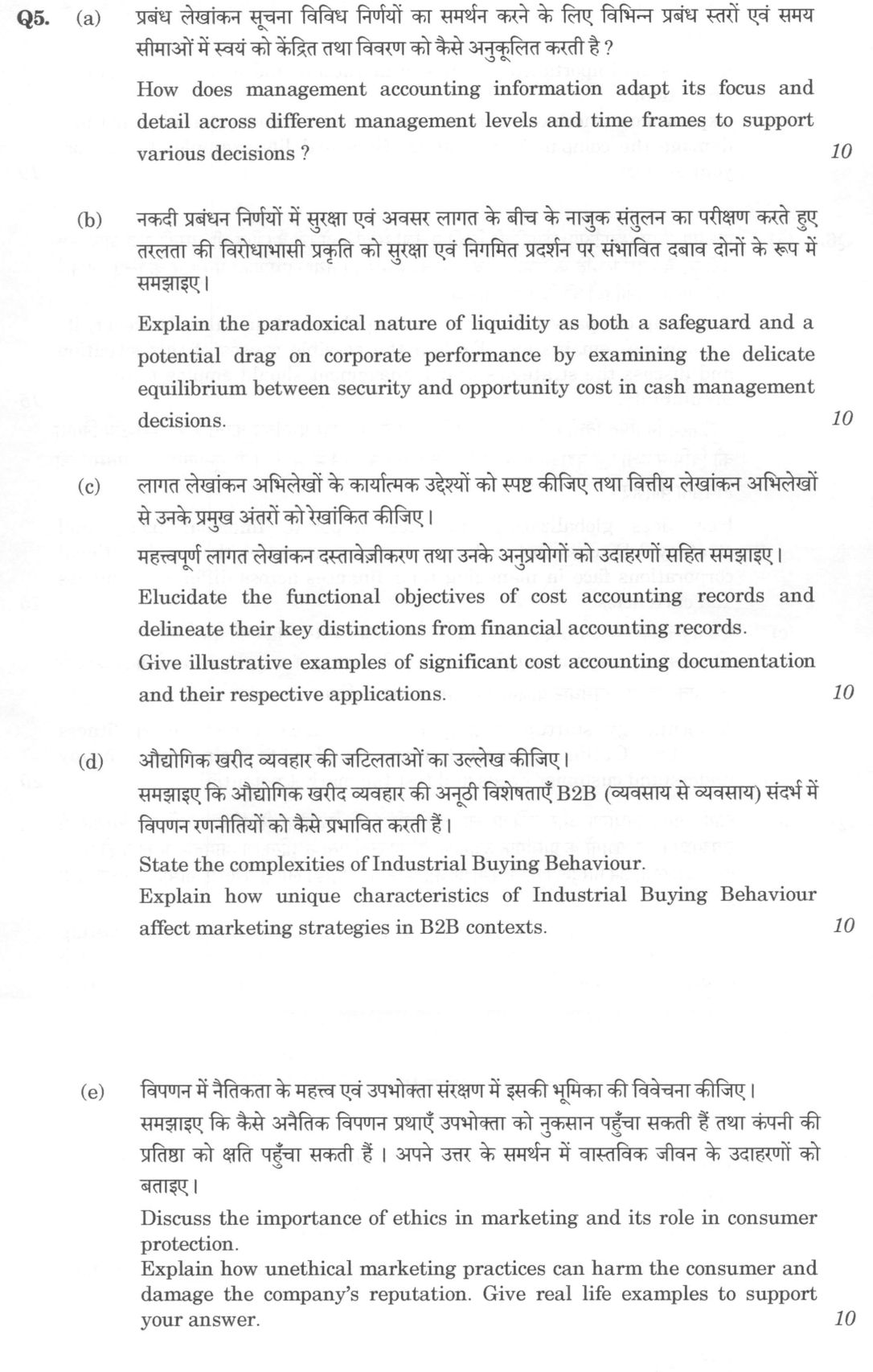
(a) How does management accounting information adapt its focus and detail across different management levels and time frames to…
How does management accounting information adapt its focus and detail across different management levels and time frames to support various decisions ? 10 marks
Explain the paradoxical nature of liquidity as both a safeguard and a potential drag on corporate performance by examining the delicate equilibrium between security and opportunity cost in cash management decisions. 10 marks
Elucidate the functional objectives of cost accounting records and delineate their key distinctions from financial accounting records.
Give illustrative examples of significant cost accounting documentation and their respective applications. 10 marks
State the complexities of Industrial Buying Behaviour.
Explain how unique characteristics of Industrial Buying Behaviour affect marketing strategies in B2B contexts. 10 marks
Discuss the importance of ethics in marketing and its role in consumer protection. Explain how unethical marketing practices can harm the consumer and damage the company's reputation. Give real life examples to support your answer. 10 marks
हिंदी में प्रश्न पढ़ें
प्रबंध लेखांकन सूचना विविध निर्णयों का समर्थन करने के लिए विभिन्न प्रबंध स्तरों एवं समय सीमाओं में स्वयं को केंद्रित तथा विवरण को कैसे अनुकूलित करती है ? 10 अंक
नकदी प्रबंधन निर्णयों में सुरक्षा एवं अवसर लागत के बीच के नाजुक संतुलन का परीक्षण करते हुए तरलता की विरोधाभासी प्रकृति को सुरक्षा एवं निगमित प्रदर्शन पर संभावित दबाव दोनों के रूप में समझाइए। 10 अंक
लागत लेखांकन अभिलेखों के कार्यात्मक उद्देश्यों को स्पष्ट कीजिए तथा वित्तीय लेखांकन अभिलेखों से उनके प्रमुख अंतरों को रेखांकित कीजिए।
महत्वपूर्ण लागत लेखांकन दस्तावेजीकरण तथा उनके अनुप्रयोगों को उदाहरणों सहित समझाइए। 10 अंक
औद्योगिक खरीद व्यवहार की जटिलताओं का उल्लेख कीजिए।
समझाइए कि औद्योगिक खरीद व्यवहार की अनूठी विशेषताएं B2B (व्यवसाय से व्यवसाय) संदर्भ में विपणन रणनीतियों को कैसे प्रभावित करती हैं। 10 अंक
विपणन में नैतिकता के महत्व एवं उपभोक्ता संरक्षण में इसकी भूमिका की विवेचना कीजिए। समझाइए कि कैसे अनैतिक विपणन प्रथाएं उपभोक्ता को नुकसान पहुंचा सकती हैं तथा कंपनी की प्रतिष्ठा को क्षति पहुंचा सकती हैं। अपने उत्तर के समर्थन में वास्तविक जीवन के उदाहरणों को बताइए। 10 अंक
Model answer
Written by UPSC Answer Check against this question's marking rubric, to the expected length. UPSC does not publish answers for Mains — this is one way to score well, not an official key.
Management accounting serves as an internal information architecture designed to support planning, control, and decision-making by adapting its scope, aggregation, and temporal horizon across hierarchical tiers.
Hierarchical Adaptation of Management Accounting Information
At the strategic level, top management confronts unstructured decisions involving long-term capital allocation, market diversification, and competitive positioning. Consequently, the information required is highly aggregated, forward-looking, qualitative, and externally focused—encompassing market intelligence, lifecycle costing, competitor benchmarking, and capital expenditure appraisal using discounted cash flow models.
At the tactical level, middle management translates broad strategic goals into departmental plans over a medium-term horizon. The required information is semi-aggregated, departmentalized, and internal, utilizing budgetary control reports, divisional profitability analyses, and transfer pricing mechanisms to evaluate performance and allocate operational resources.
At the operational level, front-line supervisors govern routine, short-term shop-floor activities (daily, weekly, or monthly). Information at this tier is granular, real-time, highly standardized, and predominantly quantitative (both monetary and physical). Front-line managers rely on standard costing systems, variance analysis (direct materials usage and labor efficiency variances), scrap reports, and machine downtime trackers to take immediate corrective actions. Thus, moving down the managerial hierarchy, information transforms from strategic, external synthesis into operational, internal precision.
The Liquidity Paradox: Safeguard versus Profitability Drag
Liquidity presents a fundamental corporate finance trade-off: it is essential for corporate survival yet destructive to profitability if accumulated excessively. As a safeguard, liquid assets ensure uninterrupted solvency and shield the enterprise from operational disruptions. This defensive capacity corresponds to Keynes’ three motives for holding cash: the transaction motive to settle scheduled liabilities (payroll, supplier bills), the precautionary motive to buffer against unexpected supply shocks or cash-flow fluctuations, and the speculative motive to exploit opportunistic, unpredicted bargains such as distressed asset sales or bulk cash discounts.
Conversely, holding excessive cash imposes a direct opportunity cost because cash is an idle asset with zero or negligible yield. Excessive liquidity depresses the firm's Return on Capital Employed (ROCE) and Return on Equity (ROE), diluting shareholder value. To resolve this friction, firms deploy cash management models that equilibrate holding costs against transaction or shortage costs. The Baumol-Tobin Model treats cash conversion analogously to inventory management under deterministic cash outflows to pinpoint the optimal transaction size. In environments characterized by stochastic, fluctuating cash flows, the Miller-Orr Model establishes mathematically determined upper and lower control limits; when cash breaches the upper band, surplus funds are automatically swept into yield-bearing marketable securities, thereby securing a disciplined balance between solvency safety and capital productivity.
Functional Objectives of Cost Accounting and Key Distinctions
Cost accounting is an internal managerial discipline with four core functional objectives: precise cost ascertainment of products, services, and activities; cost control through pre-determined benchmarks; systemic cost reduction via continuous value engineering; and the provision of relevant cost data for strategic pricing and short-term operational decisions (such as make-or-buy or export pricing).
Cost accounting differs distinctly from financial accounting across multiple parameters. Financial accounting is mandatory, governed strictly by statutory frameworks (such as the Companies Act, 2013 and Ind AS/GAAP), historical in orientation, and geared toward reporting aggregate enterprise performance to external stakeholders (shareholders, creditors, revenue authorities). In contrast, cost accounting is non-statutory (except where specific cost audit records are mandated), forward-looking, flexible, and reports disaggregated, activity-level data strictly to internal decision-makers.
Key illustrative cost accounting documents include: First, the Cost Sheet, which is an analytical statement compiling the constituent elements of total cost—Prime Cost, Factory Overheads, Cost of Production, and Cost of Sales. It is applied to track element-wise cost inflation and establish baseline pricing for competitive tenders. Second, the Job Cost Card, which records direct material requisitions, direct labor time tickets, and allocated manufacturing overheads for an individual, identifiable production order. It is deployed extensively in heavy engineering, batch manufacturing, and customized fabrication to determine job-specific margins. Third, the Process Cost Account, which is a ledger account utilized in continuous manufacturing environments (such as chemicals, oil refining, and cement) to track input quantities, normal and abnormal losses, equivalent units of work-in-progress, and unit conversion costs as material moves through sequential stages of transformation.
Industrial Buying Behaviour: Complexities and Marketing Implications
Industrial (B2B) buying behavior involves organizational procurement dynamics that are structurally more complex than consumer purchasing. Industrial demand is derived demand, meaning it depends directly on end-consumer demand in downstream markets, and is characteristically price-inelastic in the short run yet prone to wide cyclical fluctuations driven by the accelerator principle.
Furthermore, industrial purchasing is rarely an individual decision; it is executed by a complex, multi-member Buying Center (comprising initiators, gatekeepers, technical influencers, buyers, deciders, and shop-floor users). The procurement process is highly professionalized, protracted, and governed by formal Request for Proposals (RFPs), technical compliance audits, vendor rating matrices, and calculations of Total Cost of Ownership (TCO).
These unique characteristics reshape B2B marketing strategies in distinct ways: First, marketing communication cannot rely on generic mass-media appeals; it demands tailored value propositions that quantify operational uptime, payback periods, and lifecycle savings for distinct members of the buying center. Second, firms must implement Key Account Management (KAM) and Relationship Marketing, deploying dedicated multi-functional teams to build long-term relational assets and safeguard against high switching costs. Third, sales forces must shift from transactional selling to Consultative Selling, where technical sales engineers co-create bespoke technical solutions directly with client R&D teams. Fourth, marketing strategy must integrate deeply with operations through Vendor-Managed Inventory (VMI), Just-in-Time (JIT) deliveries, and binding Service Level Agreements (SLAs) to guarantee supply continuity.
Marketing Ethics, Consumer Protection, and Reputational Consequences
Marketing ethics requires strict compliance with truthfulness, fairness, transparency, and social responsibility across all promotional, pricing, and product strategies. Because of pervasive information asymmetry between corporations and buyers, ethical conduct is the cornerstone of consumer protection. It operationalizes the core consumer rights to safety, information, and redressal, which are legally protected under India's Consumer Protection Act, 2019 and monitored by statutory bodies like the Central Consumer Protection Authority (CCPA) alongside self-regulatory watchdogs like the Advertising Standards Council of India (ASCI).
Unethical practices—such as deceptive health claims, hidden fees, planned obsolescence, and surrogate promotions—impose severe financial, physical, and psychological harm on consumers. Concurrently, when unethical conduct is exposed, the enterprise faces catastrophic reputational damage, consumer boycotts, severe regulatory fines, and equity erosion.
In India, this causal chain was demonstrated during the 2015 Nestlé Maggi controversy, where allegations of excessive lead content and non-compliance with labelling requirements regarding Monosodium Glutamate (MSG) led to nationwide product bans by the Food Safety and Standards Authority of India (FSSAI), extensive inventory destruction, and a massive loss of brand equity that required years of remediation. Similarly, in 2024, the Supreme Court of India initiated contempt proceedings and strict regulatory crackdowns against Patanjali Ayurved for issuing persistent, misleading advertisements that claimed absolute cures for chronic illnesses in direct violation of the Drugs and Magic Remedies (Objectionable Advertisements) Act, 1954, resulting in product manufacturing suspensions and major damage to public credibility.
A high-performing enterprise maintains resilience when it synchronizes its internal management controls with disciplined external engagements. Harmonizing tailored cost and management accounting with dynamic cash management models safeguards operational efficiency and solvency, while navigating organizational purchasing dynamics and upholding uncompromised marketing ethics establishes sustainable competitive advantage and institutional trust.
What "Explain" is asking you to do
Make the working of something clear — what sets it off, what follows from what, and what it produces. Explain is the Commission's mechanism word: it dominates the technical papers and the “explain why” stems, where the marks sit in the causal chain and not in the label.
Structure that answers it
State what it is → the initiating condition → the chain of cause, step by step → an instance where it plays out → what the chain produces
Where marks are lost
Describing what something looks like instead of why it works that way. Naming the stages without linking them reads as description too.
How this answer will be evaluated
Approach
Framework: null. (a) explain: definition/context > points in order > small example > short close | (b) explain: definition/context > points in order > small example > short close | (c) explain: definition/context > points in order > small example > short close | (d) enumerate: list the items in order > one line each > no commentary | (e) discuss: intro > 3-4 dimensions > example > balanced close Full marks: Comprehensive, well-structured, with named frameworks, concrete examples, and clear application to the specific question.
Key points expected
- Define management accounting information
- Link focus/detail to management levels (top/middle/operational)
- Link focus/detail to time frames (short/medium/long-term)
- Show how adaptation supports specific decisions
- Define liquidity in corporate context
- Explain liquidity as a safeguard (security)
- Explain liquidity as a drag (opportunity cost)
- Examine the equilibrium between security and opportunity cost
Evaluation rubric
Each sub-part is marked on its own, against the marks and word limit printed on the paper.
- (a) Explain how management accounting information adapts focus and detail across levels and time frames. 10 marks
explain— definition/context → points in order → small example → short close
Must cover
- Define management accounting information
- Link focus/detail to management levels (top/middle/operational)
- Link focus/detail to time frames (short/medium/long-term)
- Show how adaptation supports specific decisions
Loses marks
- Textbook definitions without application
- Failing to distinguish between levels or time frames
- Framework without a verdict or application
Earns more
- Mention specific reports (e.g., P&L, budget, variance analysis)
- Reference a named framework (e.g., Balanced Scorecard)
- Provide a concrete organizational example
- Discuss the trade-off between detail and usability
Extra mark
- Cite a recent regulatory change affecting reporting
- Provide a real company example of information adaptation
- (b) Explain the paradoxical nature of liquidity as safeguard and drag on performance. 10 marks
explain— definition/context → points in order → small example → short close
Must cover
- Define liquidity in corporate context
- Explain liquidity as a safeguard (security)
- Explain liquidity as a drag (opportunity cost)
- Examine the equilibrium between security and opportunity cost
Loses marks
- Ignoring the 'paradoxical' or 'delicate equilibrium' aspect
- Failing to link to corporate performance
- Textbook definitions without application
Earns more
- Reference cash management decisions
- Discuss the cost of holding idle cash
- Mention specific liquidity metrics (e.g., current ratio)
- Provide a concrete example of the trade-off
Extra mark
- Cite a real company example of liquidity management
- Reference a specific cash management model
- (c) Elucidate functional objectives of cost accounting records and their distinctions from financial accounting. 10 marks
explain— definition/context → points in order → small example → short close
Must cover
- State functional objectives of cost accounting records
- Delineate key distinctions from financial accounting records
- Provide illustrative examples of cost accounting documentation
- Explain the respective applications of these documents
Loses marks
- Failing to distinguish between cost and financial accounting
- Lack of illustrative examples
- Textbook definitions without application
Earns more
- Mention specific cost records (e.g., job cost sheets, process cost sheets)
- Contrast with financial records (e.g., general ledger, trial balance)
- Discuss internal vs. external reporting focus
- Provide a concrete example of application
Extra mark
- Cite a specific industry example
- Reference a specific cost accounting standard
- (d) State complexities of Industrial Buying Behaviour and explain their effect on B2B marketing strategies. 10 marks
enumerate— list the items in order → one line each → no commentary
Must cover
- State complexities of Industrial Buying Behaviour
- Explain unique characteristics of Industrial Buying Behaviour
- Explain how these characteristics affect marketing strategies
- Contextualize within B2B contexts
Loses marks
- Failing to link complexities to marketing strategies
- Ignoring the B2B context
- Textbook definitions without application
Earns more
- Mention specific complexities (e.g., multiple buyers, derived demand)
- Discuss B2B marketing strategies (e.g., relationship marketing, technical support)
- Provide a concrete example of a B2B strategy
- Reference a named framework (e.g., Buying Center)
Extra mark
- Cite a real B2B company example
- Reference a specific B2B marketing model
- (e) Discuss importance of ethics in marketing and its role in consumer protection, including harm from unethical practices. 10 marks
discuss— intro → 3-4 dimensions → example → balanced close
Must cover
- Discuss importance of ethics in marketing
- Explain role of ethics in consumer protection
- Explain how unethical practices harm consumers
- Explain how unethical practices damage company reputation
Loses marks
- Lack of real-life examples
- Failing to link ethics to consumer protection
- Textbook definitions without application
Earns more
- Provide real-life examples of unethical marketing
- Mention specific unethical practices (e.g., false advertising, greenwashing)
- Discuss the long-term impact on brand reputation
- Reference consumer protection laws or regulations
Extra mark
- Cite a specific recent case study
- Reference a specific consumer protection statute
Practice this exact question
Write your answer and it is marked point by point against the model answer above — what you covered, what you missed, what you got wrong.
Evaluate my answer →More from Management 2025 Paper I
- Q2 (a) In what ways can ethical behaviour in management contribute to a company's social res…
- Q3 (a) As a Global Innovation Manager, you have been given a task of leading the new product…
- Q4 (a) You have been recently appointed as the Operations Manager of a mid-sized manufacturi…
- Q5 (a) How does management accounting information adapt its focus and detail across differen…
- Q6 (a) A startup company is experiencing rapid growth in sales. However, its net income rema…
- Q7 (a) Elaborate the distinctions between job costing and process costing methodologies. Giv…
- Q8 (a) (i) Company X experienced a significant increase in its Current Ratio from 1·5 : 1·0…