Paper I — Q3
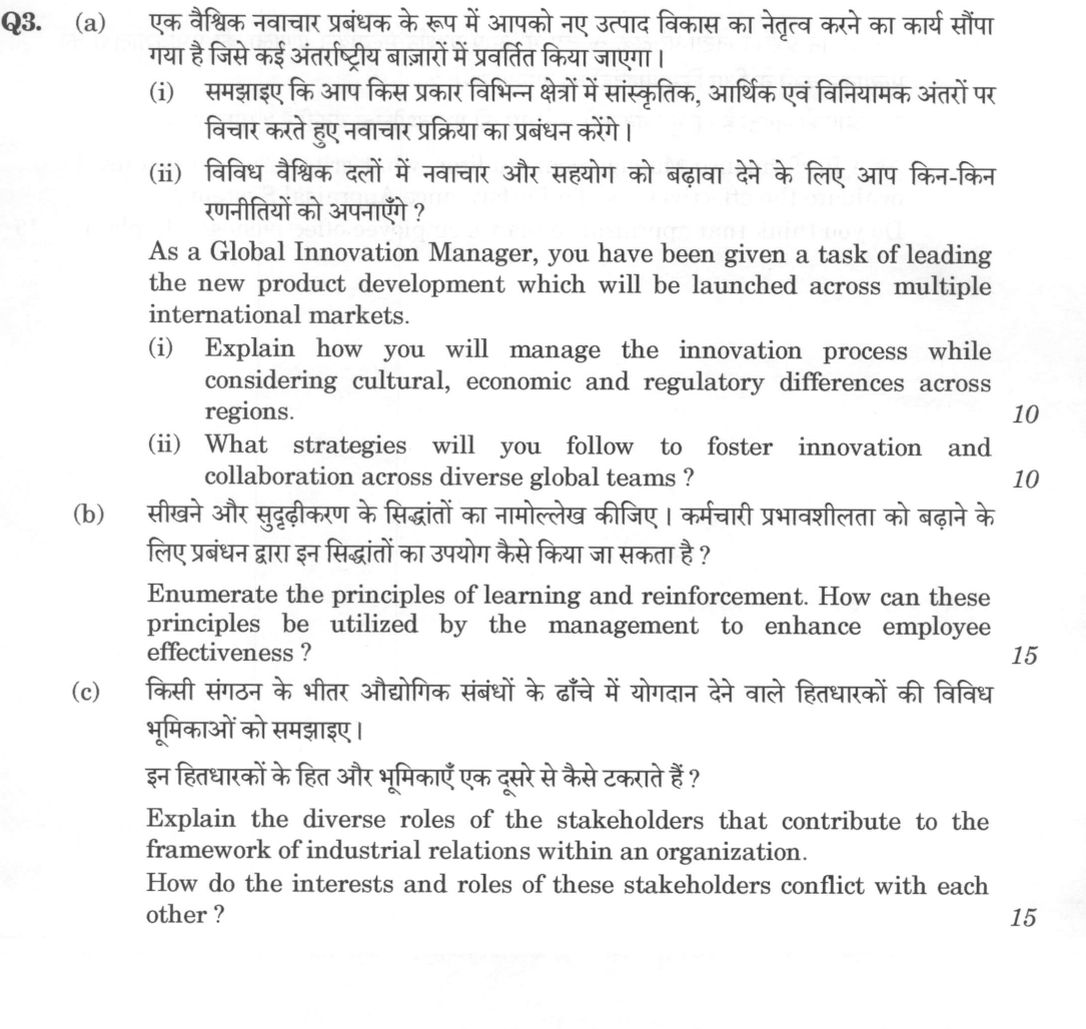
(a) As a Global Innovation Manager, you have been given a task of leading the new product development which will be launched…
As a Global Innovation Manager, you have been given a task of leading the new product development which will be launched across multiple international markets.
Explain how you will manage the innovation process while considering cultural, economic and regulatory differences across regions. 10 marks
What strategies will you follow to foster innovation and collaboration across diverse global teams ? 10 marks
Enumerate the principles of learning and reinforcement. How can these principles be utilized by the management to enhance employee effectiveness ? 15 marks
Explain the diverse roles of the stakeholders that contribute to the framework of industrial relations within an organization.
How do the interests and roles of these stakeholders conflict with each other ? 15 marks
हिंदी में प्रश्न पढ़ें
एक वैश्विक नवाचार प्रबंधक के रूप में आपको नए उत्पाद विकास का नेतृत्व करने का कार्य सौंपा गया है जिसे कई अंतर्राष्ट्रीय बाजारों में प्रवर्तित किया जाएगा।
समझाइए कि आप किस प्रकार विभिन्न क्षेत्रों में सांस्कृतिक, आर्थिक एवं विनियामक अंतरों पर विचार करते हुए नवाचार प्रक्रिया का प्रबंधन करेंगे। (10 अंक)
विविध वैश्विक दलों में नवाचार और सहयोग को बढ़ावा देने के लिए आप किन-किन रणनीतियों को अपनाएँगे ? (10 अंक)
सीखने और सुदृढ़ीकरण के सिद्धांतों का नामोल्लेख कीजिए। कर्मचारी प्रभावशीलता को बढ़ाने के लिए प्रबंधन द्वारा इन सिद्धांतों का उपयोग कैसे किया जा सकता है ? (15 अंक)
किसी संगठन के भीतर औद्योगिक संबंधों के ढाँचे में योगदान देने वाले हितधारकों की विविध भूमिकाओं को समझाइए।
इन हितधारकों के हित और भूमिकाएँ एक दूसरे से कैसे टकराते हैं ? (15 अंक)
Model answer
Written by UPSC Answer Check against this question's marking rubric, to the expected length. UPSC does not publish answers for Mains — this is one way to score well, not an official key.
Managing international New Product Development (NPD) requires harmonizing global scale with local market specificities across cultural, economic, and institutional environments.
Managing Global Innovation Across Regional Differences Managing cross-border NPD demands a glocalization strategy integrated into an adapted Stage-Gate process, where regional gates validate contextual viability before commercial scale-up:
- Cultural Alignment: Applying Hofstede’s cultural dimensions helps tailor product architectures. High uncertainty avoidance markets demand extensive safety certifications and familiar user interfaces, whereas collectivist societies prioritize collaborative, sharing-oriented product features.
- Economic Segmentation: Product tiers are bifurcated: emerging markets require frugal engineering and value-tier functionality to meet lower purchasing power parity, whereas developed markets absorb high-margin, feature-dense innovations.
- Regulatory Compliance vs. Arbitrage: NPD pipelines must align early with stringent regional mandates (such as the EU’s GDPR or India’s CDSCO guidelines). While firms avoid non-compliant regulatory arbitrage, they leverage regional sandboxes to accelerate testing without compromising global safety and compliance baselines.
Fostering Global Innovation and Collaboration Cross-functional synergy across dispersed teams is sustained through structured organizational mechanisms:
- Virtual Architectures and KMS: Implementing decentralized virtual team architectures backed by enterprise Knowledge Management Systems (KMS) enables 24/7 follow-the-sun development cycles and cross-regional knowledge codification.
- Transnational Networks & Boundary Spanning: Establishing transnational innovation networks led by boundary-spanning leaders bridges functional silos, translating local market signals into core R&D priorities.
- Psychological Safety: Fostering psychological safety within multicultural teams encourages cognitive diversity, mitigating the fear of failure and promoting iterative experimentation across hierarchical boundaries.
Principles of Learning, Reinforcement, and Employee Effectiveness Employee capability development rests on foundational behavioral mechanisms:
- Theoretical Foundations: Classical conditioning establishes associative workplace cues; operant conditioning (Skinner) shapes action through consequence management; Bandura’s Social Learning Theory operationalizes observational learning and vicarious modeling.
- Reinforcement Schedules: Continuous reinforcement accelerates initial skill acquisition during onboarding, whereas intermittent schedules (variable ratio and variable interval) prevent extinction and sustain long-term engagement.
- Managerial Applications:
- Training: Designing simulation-based behavioral modeling programs to standardize complex skills.
- Performance Management: Applying Organizational Behavior Modification (O.B. Mod.) by coupling target metrics with immediate positive reinforcement (recognition, incentives) while using extinction for counterproductive behaviors.
- Organizational Development (OD): Institutionalizing transparent reward systems to embed continuous learning, psychological contract fulfillment, and agility into organizational culture.
Stakeholder Roles and Structural Conflicts in Industrial Relations Industrial Relations (IR) functions through bipartite (employer–union) and tripartite (state–employer–union) institutional frameworks:
- Stakeholder Roles: Workers supply labour; Trade Unions aggregate collective voice and negotiate terms via collective bargaining; Employers and Employer Associations optimize capital utilization and operational efficiency; the State (via legislative frameworks like India's Industrial Relations Code, 2020) acts as standard-setter, regulator, and dispute adjudicator.
- Conflict Dimensions:
- Wage vs. Productivity: Unions demand real-wage protection and living standards, whereas management links compensations strictly to unit labour productivity and profit margins.
- Job Security vs. Flexibility: Workers seek tenure and protection from retrenchment, clashing with employers' demands for flexible staffing, fixed-term contracts, and lean operational models.
- Job Control vs. Automation: Technological modernization risks worker displacement and deskilling, generating friction between managerial prerogatives to automate and union efforts to preserve traditional shop-floor control.
- Statutory Compliance vs. Cost Pressures: Stringent state mandates on safety, severance, and social security increase overheads, creating tension when firms operate under intense global cost-competitiveness.
Integrating disciplined stage-gate product innovation with behavioral reinforcement principles ensures internal operational capability, while structured collective bargaining institutionalizes industrial peace, aligning operational agility with systemic organizational stability.
What "Explain" is asking you to do
Make the working of something clear — what sets it off, what follows from what, and what it produces. Explain is the Commission's mechanism word: it dominates the technical papers and the “explain why” stems, where the marks sit in the causal chain and not in the label.
Structure that answers it
State what it is → the initiating condition → the chain of cause, step by step → an instance where it plays out → what the chain produces
Where marks are lost
Describing what something looks like instead of why it works that way. Naming the stages without linking them reads as description too.
How this answer will be evaluated
Approach
Framework: Stakeholder Theory / Organizational Behavior Frameworks. (a) explain: definition/context > points in order > small example > short close | (b) explain: definition/context > points in order > small example > short close | (c) explain: definition/context > points in order > small example > short close Full marks: Named frameworks applied to concrete situations with verdicts
Key points expected
- Global innovation management across regions
- Learning and reinforcement principles
- Industrial relations stakeholder conflicts
- Concrete organizational applications
- Named frameworks with verdicts
Evaluation rubric
Each sub-part is marked on its own, against the marks and word limit printed on the paper.
- (a) Manage innovation across regions and foster global team collaboration. 10 marks
explain— definition/context → points in order → small example → short close
Must cover
- Address cultural, economic, regulatory differences
- Strategies for global team collaboration
- Concrete organizational application
- Verdict on innovation management
Loses marks
- Textbook definitions without application
- Ignoring regulatory differences
- Generic collaboration advice
Earns more
- Named global innovation framework
- Specific regional regulatory examples
- Cross-cultural team management tools
- Real company launch example
Extra mark
- Recent regulatory change example
- Specific global team tool name
- (b) List learning principles and explain management use for effectiveness. 15 marks
explain— definition/context → points in order → small example → short close
Must cover
- Principles of learning and reinforcement
- Management utilization for effectiveness
- Concrete organizational application
- Verdict on employee enhancement
Loses marks
- Listing principles without application
- Ignoring reinforcement aspect
- Generic motivation talk
Earns more
- Skinner's reinforcement theory
- Operant conditioning examples
- Specific HR policy application
- Behavioral modification techniques
Extra mark
- Named behavioral psychologist
- Specific corporate training program
- (c) Explain stakeholder roles in industrial relations and their conflicts. 15 marks
explain— definition/context → points in order → small example → short close
Must cover
- Diverse stakeholder roles in IR
- Interests and role conflicts
- Concrete organizational application
- Verdict on conflict management
Loses marks
- Listing stakeholders without conflict analysis
- Ignoring role interactions
- Generic stakeholder theory
Earns more
- Stakeholder theory application
- Specific conflict examples
- Labor-management dynamics
- Government/union roles
Extra mark
- Named IR framework
- Specific labor law reference
Practice this exact question
Write your answer and it is marked point by point against the model answer above — what you covered, what you missed, what you got wrong.
Evaluate my answer →More from Management 2025 Paper I
- Q1 (a) Evaluate the potentials for entrepreneurial education and training to democratize acc…
- Q2 (a) In what ways can ethical behaviour in management contribute to a company's social res…
- Q3 (a) As a Global Innovation Manager, you have been given a task of leading the new product…
- Q4 (a) You have been recently appointed as the Operations Manager of a mid-sized manufacturi…
- Q5 (a) How does management accounting information adapt its focus and detail across differen…
- Q6 (a) A startup company is experiencing rapid growth in sales. However, its net income rema…