Paper II — Q3
3.(a) A company has an annual demand of 1600 units for an item, whose unit cost is ₹70/-. The annual holding cost comprises 18%…
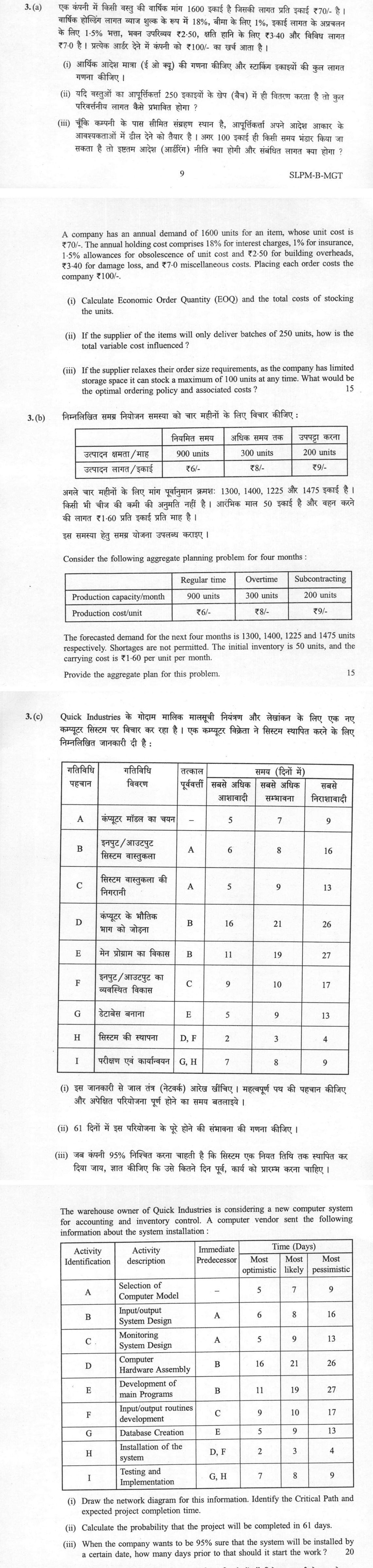
3.(a) A company has an annual demand of 1600 units for an item, whose unit cost is ₹70/-. The annual holding cost comprises 18% for interest charges, 1% for insurance, 1·5% allowances for obsolescence of unit cost and ₹2·50 for building overheads, ₹3·40 for damage loss, and ₹7·0 miscellaneous costs. Placing each order costs the company ₹100/-.
Calculate Economic Order Quantity (EOQ) and the total costs of stocking the units.
If the supplier of the items will only deliver batches of 250 units, how is the total variable cost influenced ?
If the supplier relaxes their order size requirements, as the company has limited storage space it can stock a maximum of 100 units at any time. What would be the optimal ordering policy and associated costs ? 15 marks
Consider the following aggregate planning problem for four months :
| Regular time | Overtime | Subcontracting | |
|---|---|---|---|
| Production capacity/month | 900 units | 300 units | 200 units |
| Production cost/unit | ₹6/- | ₹8/- | ₹9/- |
The forecasted demand for the next four months is 1300, 1400, 1225 and 1475 units respectively. Shortages are not permitted. The initial inventory is 50 units, and the carrying cost is ₹1·60 per unit per month.
Provide the aggregate plan for this problem. 15 marks
The warehouse owner of Quick Industries is considering a new computer system for accounting and inventory control. A computer vendor sent the following information about the system installation :
| Activity Identification | Activity description | Immediate Predecessor | Time (Days) Most optimistic | Time (Days) Most likely | Time (Days) Most pessimistic |
|---|---|---|---|---|---|
| A | Selection of Computer Model | – | 5 | 7 | 9 |
| B | Input/output System Design | A | 6 | 8 | 16 |
| C | Monitoring System Design | A | 5 | 9 | 13 |
| D | Computer Hardware Assembly | B | 16 | 21 | 26 |
| E | Development of main Programs | B | 11 | 19 | 27 |
| F | Input/output routines development | C | 9 | 10 | 17 |
| G | Database Creation | E | 5 | 9 | 13 |
| H | Installation of the system | D, F | 2 | 3 | 4 |
| I | Testing and Implementation | G, H | 7 | 8 | 9 |
Draw the network diagram for this information. Identify the Critical Path and expected project completion time.
Calculate the probability that the project will be completed in 61 days.
When the company wants to be 95% sure that the system will be installed by a certain date, how many days prior to that should it start the work ? 20 marks
हिंदी में प्रश्न पढ़ें
3.(a) एक कंपनी में किसी वस्तु की वार्षिक मांग 1600 इकाई है जिसकी लागत प्रति इकाई ₹70/- है। वार्षिक होल्डिंग लागत ब्याज शुल्क के रूप में 18%, बीमा के लिए 1%, इकाई लागत के अपचलन के लिए 1.5% भत्ता, भवन उपरिव्यय ₹2.50, क्षति हानि के लिए ₹3.40 और विविध लागत ₹7.0 है। प्रत्येक आर्डर देने में कंपनी को ₹100/- का खर्च आता है।
आर्थिक आदेश मात्रा (ई ओ क्यू) की गणना कीजिए और स्टॉकिंग इकाइयों की कुल लागत गणना कीजिए।
यदि वस्तुओं का आपूर्तिकर्ता 250 इकाइयों के बैच (बैच) में ही वितरण करता है तो कुल परिवर्तनीय लागत कैसे प्रभावित होगा ?
चूंकि कंपनी के पास सीमित संग्रहण स्थान है, आपूर्तिकर्ता अपने आदेश आकार के आवश्यकताओं में ढील देने को तैयार है। अगर 100 इकाई ही किसी समय भंडार किया जा सकता है तो इष्टतम आदेश (आर्डरिंग) नीति क्या होगी और संबंधित लागत क्या होगी ? 9 marks
निम्नलिखित समग्र नियोजन समस्या को चार महीनों के लिए विचार कीजिए :
| नियमित समय | अधिक समय तक | उपपठा करना | |
|---|---|---|---|
| उत्पादन क्षमता/माह | 900 units | 300 units | 200 units |
| उत्पादन लागत/इकाई | ₹6/- | ₹8/- | ₹9/- |
अगले चार महीनों के लिए मांग पूर्वानुमान क्रमशः: 1300, 1400, 1225 और 1475 इकाई है । किसी भी चीज की कमी की अनुमति नहीं है । आरंभिक माल 50 इकाई है और वहन करने की लागत ₹1·60 प्रति इकाई प्रति माह है ।
इस समस्या हेतु समग्र योजना उपलब्ध कराइए । 15
Quick Industries के गोदाम मालिक मालसूची नियंत्रण और लेखांकन के लिए एक नए कम्प्यूटर सिस्टम पर विचार कर रहा है। एक कम्प्यूटर विक्रेता ने सिस्टम स्थापित करने के लिए निम्नलिखित जानकारी दी है :
इस जानकारी से जाल तंत्र (नेटवर्क) आरेख खींचिए। महत्वपूर्ण पथ की पहचान कीजिए और अपेक्षित परियोजना पूर्ण होने का समय बतलाइए।
61 दिनों में इस परियोजना के पूरे होने की संभावना की गणना कीजिए।
जब कम्पनी 95% निश्चित करना चाहती है कि सिस्टम एक नियत तिथि तक स्थापित कर दिया जाए, ज्ञात कीजिए कि उसे कितने दिन पूर्व, कार्य को प्रारम्भ करना चाहिए। 11
Model answer
Written by UPSC Answer Check against this question's marking rubric, to the expected length. UPSC does not publish answers for Mains — this is one way to score well, not an official key.
3.(a)(i) Annual holding cost H = 0.18×70 + 0.01×70 + 0.015×70 + 2.50 + 3.40 + 7.00 = ₹27.25 per unit per year. Using EOQ = √(2DS/H): EOQ = √(2×1600×100/27.25) = √(1,280,000/109) ≈ 108.37 units. Total variable stocking cost = D S/Q + H Q/2 = √(2DSH) = √(8,720,000) = 200√218 ≈ ₹2,952.96/year. Purchase cost = 1600×70 = ₹112,000/year. Total stocking cost including purchase ≈ ₹114,952.96/year.
3.(a)(ii) If Q = 250 units: TVC = 1600×100/250 + 27.25×250/2 = 640 + 3,406.25 = ₹4,046.25/year. Increase over EOQ cost = 4,046.25 − 2,952.96 = ₹1,093.29/year.
3.(a)(iii) Since EOQ 108.37 > 100, the storage constraint is binding, so optimal Q* = 100 units. TVC = 1600×100/100 + 27.25×100/2 = 1,600 + 1,362.50 = ₹2,962.50/year. Orders per year = 1600/100 = 16; order interval = 365/16 ≈ 22.81 days. Total including purchase = 112,000 + 2,962.50 = ₹114,962.50/year.
3.(b) Net month-1 demand after initial stock = 1300 − 50 = 1250. Total production needed = 5400 − 50 = 5350 units. Use all regular and overtime: 3600 + 1200 = 4800 units; hence subcontracting = 550 units. Month 4 demand exceeds capacity by 75 units, so carry 75 units from month 3.
- Month 1: Regular 900, Overtime 300, Subcontract 50; cost = 900×6 + 300×8 + 50×9 = ₹8,250.
- Month 2: Regular 900, Overtime 300, Subcontract 200; cost = ₹9,600.
- Month 3: Regular 900, Overtime 300, Subcontract 100; cost = ₹8,700; ending inventory = 1300 − 1225 = 75 units.
- Month 4: Regular 900, Overtime 300, Subcontract 200; opening inventory 75; cost = ₹9,600.
Total production cost = 8,250 + 9,600 + 8,700 + 9,600 = ₹36,150. Carrying cost = 75×1.60 = ₹120. Total aggregate-plan cost = ₹36,270.
3.(c)(i) Expected times using te = (a + 4m + b)/6: A = 7, B = 9, C = 9, D = 21, E = 19, F = 11, G = 9, H = 3, I = 8 days. Network arrows: A→B,C; B→D,E; C→F; E→G; D,F→H; G,H→I. Paths: A-B-D-H-I = 48 days; A-B-E-G-I = 52 days; A-C-F-H-I = 38 days. Critical path = A→B→E→G→I; expected completion time = 52 days. Critical-path variance = 4/9 + 25/9 + 64/9 + 16/9 + 1/9 = 110/9, so σ = √110/3 ≈ 3.496 days. This uses the PERT normal approximation with independent activity times.
3.(c)(ii) z = (61 − 52)/(√110/3) = 27/√110 ≈ 2.574. P(T ≤ 61) = Φ(2.574) ≈ 0.9950. Probability ≈ 99.50%.
3.(c)(iii) For 95% confidence, z = 1.645. Required duration = 52 + 1.645×(√110/3) ≈ 52 + 5.75 = 57.75 days. Start about 58 days before the target installation date.
What "Calculate" is asking you to do
Apply the standard formula or schedule to data the question has already supplied — a table of readings, cost records, a balance sheet — and produce the number. The method is rarely in doubt; the marks sit in the named intermediate quantities, each of which has to appear as a labelled line.
Structure that answers it
Data as given → formula or standard treatment, named → substitution → each intermediate, labelled → result with units
Where marks are lost
Omitting an intermediate the marking scheme pays for separately, or rounding at an intermediate line so the final figure drifts. In commerce and accountancy, any figure in a statement that no numbered working note supports is treated as unearned.
How this answer will be evaluated
Approach
Framework: EOQ Model, Aggregate Planning, PERT. (a(i)) calculate: given > formula > substitution > result with units > interpretation | (a(ii)) calculate: given > formula > substitution > result with units > interpretation | (a(iii)) calculate: given > formula > substitution > result with units > interpretation | (b) calculate: given > formula > substitution > result with units > interpretation | (c(i)) describe: define > structure or process in order > labelled diagram > significance | (c(ii)) calculate: given > formula > substitution > result with units > interpretation | (c(iii)) calculate: given > formula > substitution > result with units > interpretation Full marks: Accurate calculations, clear frameworks, practical insights, and correct application of all models.
Key points expected
- Calculate holding cost per unit (H)
- Apply EOQ formula √(2DS/H)
- Compute total variable cost (ordering + holding)
- Compare cost at Q=250 vs EOQ
- Calculate new total variable cost
- Identify Q=100 as optimal
- Calculate associated total cost
- Use regular, overtime, subcontracting capacities
Evaluation rubric
Each sub-part is marked on its own, against the marks and word limit printed on the paper.
- (a(i)) Compute EOQ and total stocking cost using given data.
calculate— given → formula → substitution → result with units → interpretation
Must cover
- Calculate holding cost per unit (H)
- Apply EOQ formula √(2DS/H)
- Compute total variable cost (ordering + holding)
Loses marks
- Incorrect holding cost calculation
- Missing total cost formula
Earns more
- Correct breakdown of holding cost components
- Explicit statement of assumptions
Extra mark
- Sensitivity analysis on H
- (a(ii)) Determine impact of 250-unit batch constraint on total variable cost.
calculate— given → formula → substitution → result with units → interpretation
Must cover
- Compare cost at Q=250 vs EOQ
- Calculate new total variable cost
Loses marks
- Ignoring the constraint
- Incorrect cost comparison
Earns more
- Quantify the cost increase
- Explain why cost rises
Extra mark
- Graphical representation of cost curve
- (a(iii)) Find optimal policy and cost with 100-unit storage limit.
calculate— given → formula → substitution → result with units → interpretation
Must cover
- Identify Q=100 as optimal
- Calculate associated total cost
Loses marks
- Ignoring storage limit
- Incorrect cost calculation
Earns more
- Justification for Q=100
- Comparison with previous scenarios
Extra mark
- Discussion of storage constraints
- (b) Develop aggregate plan for 4 months meeting demand without shortages. 15 marks
calculate— given → formula → substitution → result with units → interpretation
Must cover
- Use regular, overtime, subcontracting capacities
- Minimize total cost (production + inventory)
- Ensure no shortages in any month
Loses marks
- Shortages in any month
- Ignoring carrying cost
Earns more
- Step-by-step allocation logic
- Inventory balance sheet
Extra mark
- Alternative plan comparison
- (c(i)) Draw network diagram, identify critical path and expected completion time.
describe— define → structure or process in order → labelled diagram → significance
Must cover
- Correct network diagram with activities
- Identify critical path
- Calculate expected project duration
Loses marks
- Incorrect network structure
- Missing critical path identification
Earns more
- Clear labeling of nodes/activities
- Show slack for non-critical paths
Extra mark
- Gantt chart representation
- (c(ii)) Calculate probability of project completion in 61 days.
calculate— given → formula → substitution → result with units → interpretation
Must cover
- Compute standard deviation of project duration
- Use Z-score formula
- Find probability from normal distribution
Loses marks
- Incorrect variance calculation
- Missing Z-score step
Earns more
- Show variance calculation for each activity
- Correct Z-value lookup
Extra mark
- Confidence interval discussion
- (c(iii)) Determine start date for 95% confidence of on-time completion.
calculate— given → formula → substitution → result with units → interpretation
Must cover
- Find Z-value for 95% confidence
- Calculate required buffer time
- Determine start date
Loses marks
- Incorrect Z-value usage
- Missing buffer calculation
Earns more
- Clear explanation of buffer calculation
- Practical scheduling recommendation
Extra mark
- Risk mitigation strategies
Practice this exact question
Write your answer and it is marked point by point against the model answer above — what you covered, what you missed, what you got wrong.
Evaluate my answer →More from Management 2025 Paper II
- Q1 (a) A train is scheduled to arrive at a station at a random time between 09:00 AM and 09:…
- Q2 (a) The electrical power demand of TATA Power Corporation from 2018 to 2024, measured in…
- Q3 3.(a) A company has an annual demand of 1600 units for an item, whose unit cost is ₹70/-.…
- Q4 4.(a) (i) "Expert Systems play a significant role in Organisations." Discuss it giving at…
- Q5 (a) "Have various Chambers of Commerce and other Industry Associations played their desir…
- Q6 (a) (i) "Small-Scale Industries play a vital role in the growth of economic activities of…