Paper II — Q7
(a) Define Strategic Alliances. Discuss the reasons for strategic alliances. Also discuss types of strategic alliances with…
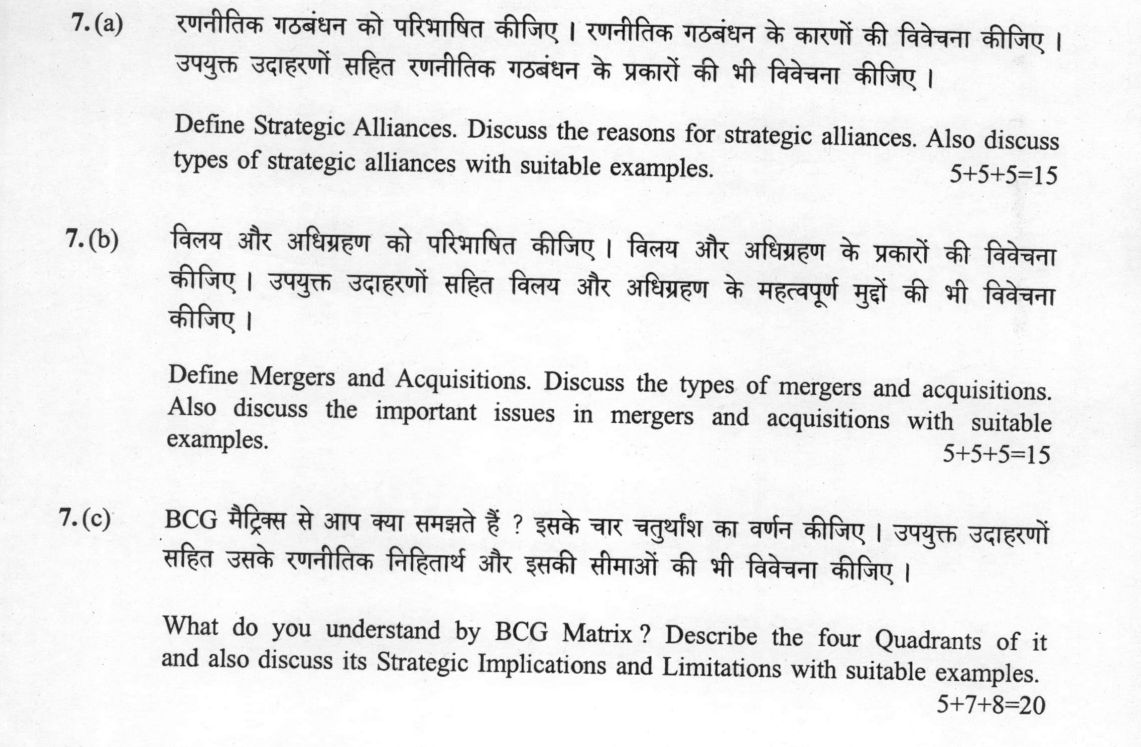
Define Strategic Alliances. Discuss the reasons for strategic alliances. Also discuss types of strategic alliances with suitable examples. (5+5+5=15 marks)
Define Mergers and Acquisitions. Discuss the types of mergers and acquisitions. Also discuss the important issues in mergers and acquisitions with suitable examples. (5+5+5=15 marks)
What do you understand by BCG Matrix ? Describe the four Quadrants of it and also discuss its Strategic Implications and Limitations with suitable examples. (5+7+8=20 marks)
हिंदी में प्रश्न पढ़ें
रणनीतिक गठबंधन को परिभाषित कीजिए। रणनीतिक गठबंधन के कारणों की विवेचना कीजिए। उपयुक्त उदाहरणों सहित रणनीतिक गठबंधन के प्रकारों की भी विवेचना कीजिए। (5+5+5=15)
विलय और अधिग्रहण को परिभाषित कीजिए। विलय और अधिग्रहण के प्रकारों की विवेचना कीजिए। उपयुक्त उदाहरणों सहित विलय और अधिग्रहण के महत्वपूर्ण मुद्दों की भी विवेचना कीजिए। (5+5+5=15)
BCG मैट्रिक्स से आप क्या समझते हैं ? इसके चार चतुर्थांश का वर्णन कीजिए। उपयुक्त उदाहरणों सहित उसके रणनीतिक निहितार्थ और इसकी सीमाओं की भी विवेचना कीजिए। (5+7+8=20)
Model answer
Written by UPSC Answer Check against this question's marking rubric, to the expected length. UPSC does not publish answers for Mains — this is one way to score well, not an official key.
Strategic Alliances. A strategic alliance is a cooperative arrangement between two or more firms to pursue shared strategic objectives while remaining legally and operationally independent. It differs from M&A because no firm acquires control or combines legally; instead, partners coordinate selected activities. Firms form alliances to share risk in large or uncertain investments, gain market access, and combine complementary resources such as technology, distribution, brand, or regulatory capability. Types include joint ventures, equity alliances, and non-equity alliances. A joint venture creates a separate entity with shared ownership; Maruti Suzuki India Ltd, with Suzuki and Maruti Udyog, is a classic Indian equity JV. An equity alliance involves minority shareholding without control, as when Microsoft took a 10% stake in Reliance Retail to deepen e-commerce, cloud, and technology cooperation. A non-equity alliance is contractual, such as TCS and IBM’s partnership for AI and enterprise solutions, where firms collaborate without taking equity.
Mergers and Acquisitions. Mergers are voluntary combinations of two firms into one legal entity, while acquisitions involve purchase of control of another firm, often through share or asset purchase. Types are horizontal (same industry), vertical (upstream/downstream), congeneric (related products), and conglomerate (unrelated). HDFC Ltd and HDFC Bank merger was horizontal in financial services; Tata Consumer Products’ acquisition of Tetley was congeneric in consumer products; a steelmaker buying a coking-coal supplier illustrates vertical integration, as Tata Steel’s upstream coal/iron-ore investments show; Reliance’s consolidation of Jio is a conglomerate-style control move. Important issues include valuation, cultural integration, regulatory approval, and due diligence. The HDFC-HDFC Bank merger required CCI clearance and careful valuation fairness; Tata Motors’ JLR integration highlighted cultural and operational integration; due diligence is critical in cross-border deals like Tata’s JLR acquisition.
BCG Matrix. The BCG Matrix is a portfolio planning tool that classifies strategic business units by market growth rate and relative market share. Stars have high growth and high share, requiring investment; Cash Cows have low growth and high share, generating cash; Question Marks have high growth and low share, needing selective investment; Dogs have low growth and low share, candidates for divestment. In ITC, FMCG is a cash cow, hotels and agri-business can be stars/question marks, and some legacy units may be dogs. In Reliance, Jio is a star, oil-to-chemicals a cash cow, retail and new energy question marks. Strategic implications are resource allocation, portfolio balance, and divestment: ITC can use FMCG cash to fund hotels/agri-business; Reliance can use oil-to-chemicals cash to fund Jio/retail; weak dogs can be exited. Limitations include over-reliance on market share, snapshot nature, and ignoring synergies. BCG may misread Jio’s network effects and data monetization as mere share; ITC’s hotels and FMCG share brand/distribution synergies not captured; a snapshot may misclassify ITC’s agri-business as a question mark despite long-term strategic value.
Synthesis. These tools serve different strategic purposes. Alliances offer flexibility and lower commitment, useful for firms entering new markets or technologies without full ownership, as in Microsoft-Reliance Retail or TCS-IBM. M&A provides control and faster scale, but carries valuation, integration, and regulatory risks, as seen in HDFC-HDFC Bank and Tata-JLR. The BCG Matrix helps manage the resulting portfolio by directing cash from mature units to growth units and pruning weak ones. In India’s Make in India and Atmanirbhar Bharat context, companies may use alliances to access global technology, M&A to consolidate domestic champions, and BCG to balance cash-generating businesses with emerging sectors such as new energy, digital services, and advanced manufacturing. This is especially relevant as Indian firms face global competition, technology shifts, and consolidation pressure, and the need to build self-reliant industrial ecosystems. A prudent strategy therefore combines alliance flexibility, acquisition control, and portfolio discipline.
What "Discuss" is asking you to do
Lay the issue out from more than one side — how it arose, what is claimed for it, what is held against it, and where it now stands. UPSC attaches discuss to broad topics with several live dimensions, so coverage of the dimensions earns more than the strength of your opinion.
Structure that answers it
Set the issue up → the case as it is made → the case against → the dimension both sides leave out → where the balance now lies
Where marks are lost
Listing facts with no thread between them, or arguing one side throughout and calling it a discussion.
How this answer will be evaluated
Approach
Framework: Strategic Management Frameworks (Alliances, M&A, BCG Matrix). (a) discuss: intro > 3-4 dimensions > example > balanced close | (b) discuss: intro > 3-4 dimensions > example > balanced close | (c) discuss: intro > 3-4 dimensions > example > balanced close Full marks: Clear definitions, accurate classification, and critical analysis of limitations.
Key points expected
- Strategic Alliance definition and types
- M&A types (horizontal/vertical) and integration issues
- BCG Matrix quadrants (Stars, Cash Cows, etc.)
- Limitations of BCG Matrix
Evaluation rubric
Each sub-part is marked on its own, against the marks and word limit printed on the paper.
- (a) Define alliances, list reasons, and categorize types with examples. 15 marks
discuss— intro → 3-4 dimensions → example → balanced close
Must cover
- Definition of strategic alliance
- Reasons: resource sharing, risk reduction
- Types: joint ventures, R&D, marketing
- Suitable examples for each type
Loses marks
- Defining alliance as just a contract
- Listing types without examples
Earns more
- Distinction between equity and non-equity alliances
- Mention of 'co-opetition' concept
Extra mark
- Specific recent alliance example (e.g., Apple-Samsung)
- (b) Define M&A, classify types, and analyze key issues. 15 marks
discuss— intro → 3-4 dimensions → example → balanced close
Must cover
- Definitions of merger and acquisition
- Types: horizontal, vertical, conglomeration
- Issues: valuation, cultural integration
- Suitable examples for types/issues
Loses marks
- Treating merger and acquisition as identical
- Ignoring the 'issues' part of the question
Earns more
- Distinction between 'merger of equals' and absorption
- Mention of 'synergy' in valuation
Extra mark
- Reference to specific regulatory body (e.g., CCI)
- (c) Explain BCG Matrix, its quadrants, implications, and limits. 20 marks
discuss— intro → 3-4 dimensions → example → balanced close
Must cover
- Definition of BCG Matrix (2x2 grid)
- Four quadrants: Stars, Cash Cows, Dogs, Question Marks
- Strategic implications for resource allocation
- Limitations: oversimplification, static view
Loses marks
- Confusing 'Question Marks' with 'Dogs'
- Failing to mention limitations
Earns more
- Drawing the 2x2 matrix diagram
- Linking quadrants to cash flow cycles
Extra mark
- Example of a company's portfolio using BCG
Practice this exact question
Write your answer and it is marked point by point against the model answer above — what you covered, what you missed, what you got wrong.
Evaluate my answer →More from Management 2025 Paper II
- Q4 4.(a) (i) "Expert Systems play a significant role in Organisations." Discuss it giving at…
- Q5 (a) "Have various Chambers of Commerce and other Industry Associations played their desir…
- Q6 (a) (i) "Small-Scale Industries play a vital role in the growth of economic activities of…
- Q7 (a) Define Strategic Alliances. Discuss the reasons for strategic alliances. Also discuss…
- Q8 (a) Explain Joint Venture with suitable examples. Discuss the Life Cycle of a Joint Ventu…