Paper II — Q4
4.(a) (i) "Expert Systems play a significant role in Organisations." Discuss it giving at least four benefits of Expert Systems…
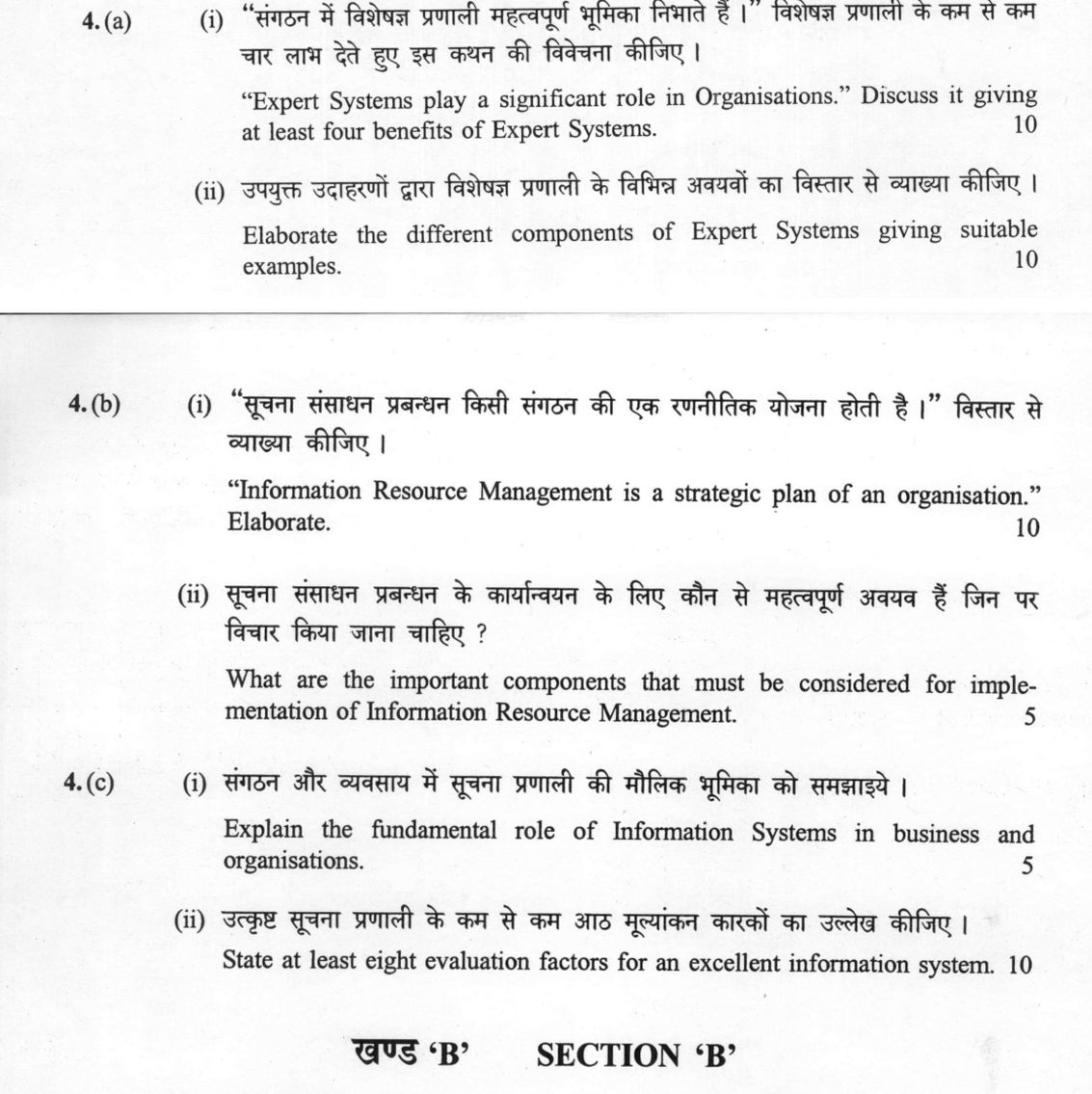
4.(a) (i) "Expert Systems play a significant role in Organisations." Discuss it giving at least four benefits of Expert Systems. 10 marks
Elaborate the different components of Expert Systems giving suitable examples. 10 marks
"Information Resource Management is a strategic plan of an organisation." Elaborate. 10 marks
What are the important components that must be considered for implementation of Information Resource Management. 5 marks
Explain the fundamental role of Information Systems in business and organisations. 5 marks
State at least eight evaluation factors for an excellent information system. 10 marks
हिंदी में प्रश्न पढ़ें
4.(a) (i) "संगठन में विशेषज्ञ प्रणाली महत्त्वपूर्ण भूमिका निभाते हैं।" विशेषज्ञ प्रणाली के कम से कम चार लाभ देते हुए इस कथन की विवेचना कीजिए । 10
उपयुक्त उदाहरणों द्वारा विशेषज्ञ प्रणाली के विभिन्न अवयवों का विस्तार से व्याख्या कीजिए । 10
"सूचना संसाधन प्रबंधन किसी संगठन की एक रणनीतिक योजना होती है।" विस्तार से व्याख्या कीजिए। 10
सूचना संसाधन प्रबंधन के कार्यान्वयन के लिए कौन से महत्वपूर्ण अवयव हैं जिन पर विचार किया जाना चाहिए ? 5 marks
संगठन और व्यवसाय में सूचना प्रणाली की मौलिक भूमिका को समझाइये। 5
उत्कृष्ट सूचना प्रणाली के कम से कम आठ मूल्यांकन कारकों का उल्लेख कीजिए। 10
Model answer
Written by UPSC Answer Check against this question's marking rubric, to the expected length. UPSC does not publish answers for Mains — this is one way to score well, not an official key.
Expert Systems in Organisations
Expert Systems (ES) replicate human domain expertise through computational logic, providing four key organizational benefits:
- Preservation of institutional expertise: Captures tacit heuristics of veteran personnel, mitigating attrition risks.
- 24/7 availability: Enables continuous automated problem-solving without human fatigue.
- Consistency in decision-making: Eliminates subjective bias and emotional errors in complex evaluations.
- Training and learning support: Acts as an interactive pedagogical tool for onboarding junior professionals.
The architecture of an Expert System comprises five core components:
- Knowledge Base: Stores domain-specific rules and facts (e.g., credit-scoring rules in State Bank of India's underwriting systems).
- Inference Engine: Applies logical algorithms, such as forward or backward chaining, to deduce conclusions from inputs (e.g., inference logic in MYCIN or medical triage systems).
- User Interface: Facilitates seamless interaction between non-technical users and the system via natural language queries.
- Explanation Facility: Explains the rationale ("how" and "why") behind a specific recommendation to build user trust.
- Knowledge Acquisition Subsystem: Allows knowledge engineers and domain experts to update facts, heuristics, and evolving compliance mandates.
Information Resource Management (IRM)
IRM conceptualizes information as a strategic corporate asset rather than an operational overhead. It aligns information strategy with overarching business goals, promotes resource optimization by breaking data silos, yields competitive advantage through analytics-driven responsiveness, and establishes a robust governance framework ensuring regulatory compliance and data integrity across the enterprise.
Successful implementation of IRM requires five essential components: top management commitment to champion data governance, scalable IT infrastructure, comprehensive human resource development and digital upskilling, structured change management to address cultural inertia, and rigorous performance metrics (such as data quality indices and SLAs) to evaluate effectiveness.
Information Systems (IS) and Evaluation
Information Systems serve four fundamental roles in business: enhancing operational efficiency via transaction automation, providing decision support through predictive modelling, steering strategic management via environmental scanning, and enabling seamless communication and coordination across functional silos (e.g., ERP systems in manufacturing).
An excellent Information System is evaluated against eight critical parameters:
- Reliability: High uptime and consistent system performance.
- Timeliness: Real-time data availability for prompt action.
- Accuracy: Precision and error-free output generation.
- Completeness: Provision of all necessary parameters without critical omissions.
- Relevance: Tailored outputs addressing specific management needs.
- Usability: Intuitive user navigation and ergonomic interface design.
- Security: Robust data protection, access controls, and cyber resilience.
- Cost-effectiveness: Favourable return on investment relative to total cost of ownership.
Moving forward, integrating Expert Systems within a coherent IRM framework ensures that information assets translate into sustained competitive advantage, organizational agility, and resilient decision architectures.
What "Discuss" is asking you to do
Lay the issue out from more than one side — how it arose, what is claimed for it, what is held against it, and where it now stands. UPSC attaches discuss to broad topics with several live dimensions, so coverage of the dimensions earns more than the strength of your opinion.
Structure that answers it
Set the issue up → the case as it is made → the case against → the dimension both sides leave out → where the balance now lies
Where marks are lost
Listing facts with no thread between them, or arguing one side throughout and calling it a discussion.
How this answer will be evaluated
Approach
Framework: null. (a(i)) discuss: intro > 3-4 dimensions > example > balanced close | (a(ii)) describe: define > structure or process in order > labelled diagram > significance | (b(i)) explain: definition/context > points in order > small example > short close | (b(ii)) enumerate: list the items in order > one line each > no commentary | (c(i)) explain: definition/context > points in order > small example > short close | (c(ii)) enumerate: list the items in order > one line each > no commentary Full marks: Comprehensive, well-structured answers with specific examples, frameworks, and balanced analysis.
Key points expected
- Define Expert Systems (ES) briefly
- List at least four distinct benefits
- Apply benefits to a concrete organisational context
- Provide a balanced closing statement
- Identify key components (Knowledge Base, Inference Engine, etc.)
- Explain the function of each component
- Provide a suitable example for each component
- Show how components interact (process flow)
Evaluation rubric
Each sub-part is marked on its own, against the marks and word limit printed on the paper.
- (a(i)) Discuss the role of Expert Systems in organisations with at least four benefits. 10 marks
discuss— intro → 3-4 dimensions → example → balanced close
Must cover
- Define Expert Systems (ES) briefly
- List at least four distinct benefits
- Apply benefits to a concrete organisational context
- Provide a balanced closing statement
Loses marks
- Textbook definitions without application
- Listing benefits without explaining them
- Failing to provide at least four benefits
Earns more
- Mention specific ES applications (e.g., medical diagnosis, credit scoring)
- Reference a real company using ES
- Discuss limitations of ES
- Compare ES with traditional systems
Extra mark
- Cite a recent regulatory change affecting ES
- Provide a specific statistic on ES efficiency
- (a(ii)) Elaborate the different components of Expert Systems with suitable examples. 10 marks
describe— define → structure or process in order → labelled diagram → significance
Must cover
- Identify key components (Knowledge Base, Inference Engine, etc.)
- Explain the function of each component
- Provide a suitable example for each component
- Show how components interact (process flow)
Loses marks
- Listing components without explanation
- Failing to provide examples for components
- Confusing ES components with general IS components
Earns more
- Draw a labelled diagram of ES architecture
- Mention specific knowledge representation techniques
- Discuss the role of the User Interface
- Reference a specific ES software or system
Extra mark
- Cite a specific ES case study (e.g., MYCIN, DENDRAL)
- Mention a recent development in ES components
- (b(i)) Explain why Information Resource Management is a strategic plan of an organisation. 10 marks
explain— definition/context → points in order → small example → short close
Must cover
- Define Information Resource Management (IRM)
- Explain the strategic nature of IRM
- Link IRM to organisational goals and objectives
- Provide a small example of strategic IRM
Loses marks
- Defining IRM without explaining its strategic role
- Failing to link IRM to organisational strategy
- Treating IRM as purely operational
Earns more
- Discuss the role of IRM in competitive advantage
- Mention specific IRM frameworks or models
- Reference a real company's IRM strategy
- Discuss the alignment of IT with business strategy
Extra mark
- Cite a specific IRM policy or regulation
- Provide a statistic on IRM investment
- (b(ii)) List the important components for implementation of Information Resource Management. 5 marks
enumerate— list the items in order → one line each → no commentary
Must cover
- List at least 3-4 key components of IRM implementation
- Provide one line of substance for each component
Loses marks
- Listing components without any explanation
- Confusing IRM components with general IT components
- Failing to list at least 3-4 components
Earns more
- Mention specific implementation challenges
- Reference a specific IRM implementation framework
- Discuss the role of human resources in IRM
Extra mark
- Cite a specific IRM implementation case study
- Mention a recent technology enabling IRM
- (c(i)) Explain the fundamental role of Information Systems in business and organisations. 5 marks
explain— definition/context → points in order → small example → short close
Must cover
- Define Information Systems (IS)
- Explain the fundamental role of IS in business
- Provide a small example of IS in an organisation
- Short closing statement on IS importance
Loses marks
- Defining IS without explaining its role
- Failing to provide an example
- Treating IS as purely technical
Earns more
- Mention specific types of IS (MIS, DSS, etc.)
- Reference a real company's use of IS
- Discuss the impact of IS on business processes
- Mention specific IS technologies
Extra mark
- Cite a specific IS regulation or standard
- Provide a statistic on IS adoption
- (c(ii)) State at least eight evaluation factors for an excellent information system. 10 marks
enumerate— list the items in order → one line each → no commentary
Must cover
- List at least eight distinct evaluation factors
- Provide one line of substance for each factor
- Ensure factors are relevant to information systems
Loses marks
- Listing fewer than eight factors
- Listing factors without any explanation
- Confusing evaluation factors with design factors
Earns more
- Group factors into logical categories (e.g., technical, user, business)
- Mention specific evaluation methodologies
- Reference a specific IS evaluation framework
- Discuss the importance of each factor
Extra mark
- Cite a specific IS evaluation case study
- Mention a recent change in IS evaluation practices
Practice this exact question
Write your answer and it is marked point by point against the model answer above — what you covered, what you missed, what you got wrong.
Evaluate my answer →More from Management 2025 Paper II
- Q1 (a) A train is scheduled to arrive at a station at a random time between 09:00 AM and 09:…
- Q2 (a) The electrical power demand of TATA Power Corporation from 2018 to 2024, measured in…
- Q3 3.(a) A company has an annual demand of 1600 units for an item, whose unit cost is ₹70/-.…
- Q4 4.(a) (i) "Expert Systems play a significant role in Organisations." Discuss it giving at…
- Q5 (a) "Have various Chambers of Commerce and other Industry Associations played their desir…
- Q6 (a) (i) "Small-Scale Industries play a vital role in the growth of economic activities of…
- Q7 (a) Define Strategic Alliances. Discuss the reasons for strategic alliances. Also discuss…