Paper II — Q5
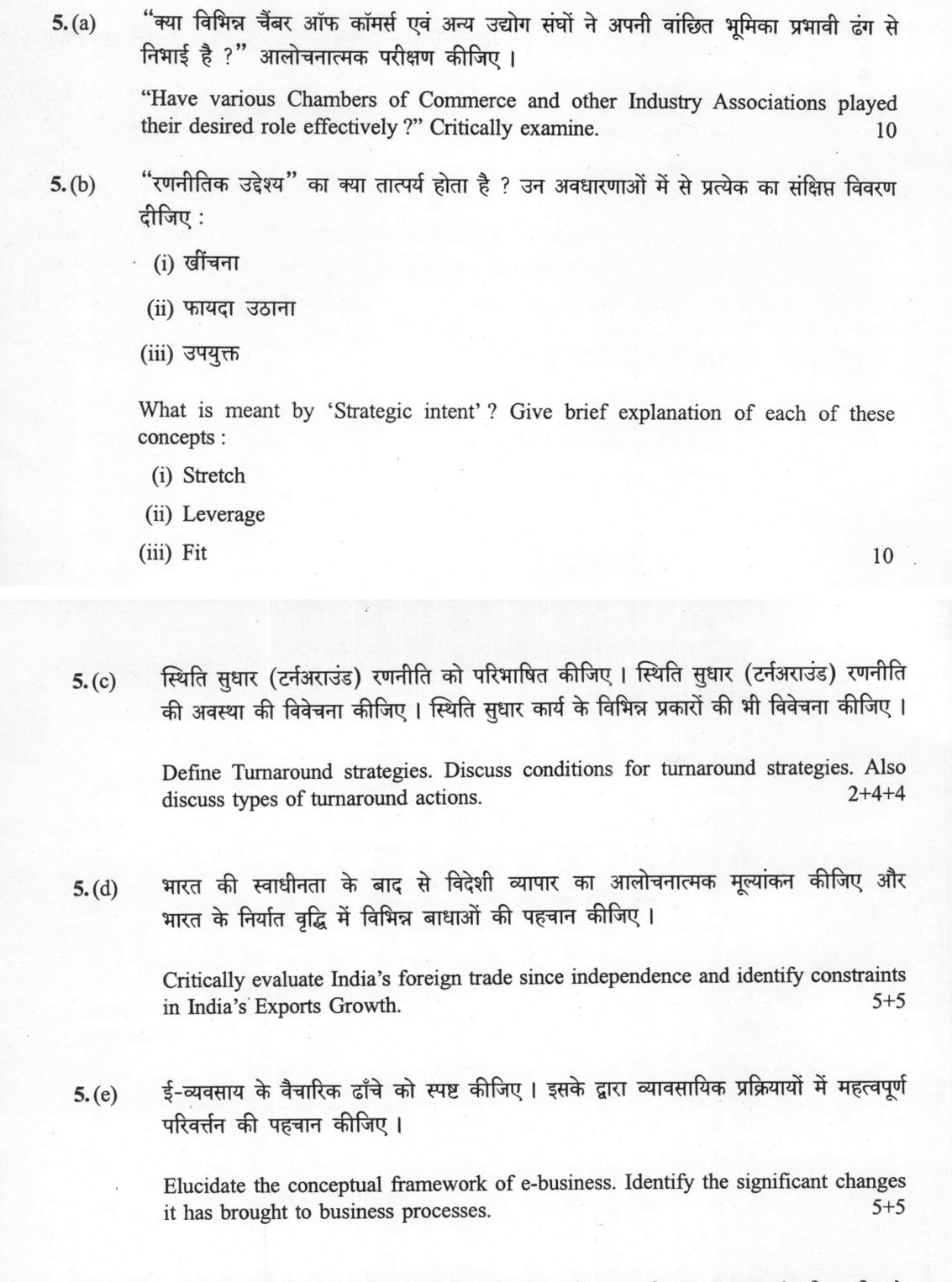
(a) "Have various Chambers of Commerce and other Industry Associations played their desired role effectively ?" Critically…
"Have various Chambers of Commerce and other Industry Associations played their desired role effectively ?" Critically examine. 10 marks
What is meant by 'Strategic intent' ? Give brief explanation of each of these concepts : Stretch
Leverage
Fit 10 marks
Define Turnaround strategies. Discuss conditions for turnaround strategies. Also discuss types of turnaround actions. (2+4+4 marks)
Critically evaluate India's foreign trade since independence and identify constraints in India's Exports Growth. (5+5 marks)
Elucidate the conceptual framework of e-business. Identify the significant changes it has brought to business processes. (5+5 marks)
हिंदी में प्रश्न पढ़ें
"क्या विभिन्न चैंबर ऑफ कॉमर्स एवं अन्य उद्योग संघों ने अपनी वांछित भूमिका प्रभावी ढंग से निभाई है ?" आलोचनात्मक परीक्षण कीजिए। (10 अंक)
"रणनीतिक उद्देश्य" का क्या तात्पर्य होता है ? उन अवधारणाओं में से प्रत्येक का संक्षिप्त विवरण दीजिए : खींचना
फायदा उठाना
उपयुक्त (10 अंक)
स्थिति सुधार (टर्नअराउंड) रणनीति को परिभाषित कीजिए। स्थिति सुधार (टर्नअराउंड) रणनीति की अवस्था की विवेचना कीजिए। स्थिति सुधार कार्य के विभिन्न प्रकारों की भी विवेचना कीजिए। (2+4+4 अंक)
भारत की स्वाधीनता के बाद से विदेशी व्यापार का आलोचनात्मक मूल्यांकन कीजिए और भारत के निर्यात वृद्धि में विभिन्न बाधाओं की पहचान कीजिए। (5+5 अंक)
ई-व्यवसाय के वैचारिक ढांचे को स्पष्ट कीजिए। इसके द्वारा व्यावसायिक प्रक्रियाओं में महत्वपूर्ण परिवर्तन की पहचान कीजिए। (5+5 अंक)
Model answer
Written by UPSC Answer Check against this question's marking rubric, to the expected length. UPSC does not publish answers for Mains — this is one way to score well, not an official key.
(a) Role of Chambers of Commerce and Industry Associations
Apex industry bodies such as the Confederation of Indian Industry (CII), Federation of Indian Chambers of Commerce and Industry (FICCI), and Associated Chambers of Commerce and Industry of India (ASSOCHAM) were conceived to bridge the gap between business and government.
In terms of positive contributions, these associations have played a central role in macroeconomic policy advocacy. They provided critical technical inputs for the rollout of the Goods and Services Tax (GST), the Insolvency and Bankruptcy Code (IBC), and Foreign Direct Investment (FDI) liberalisation. They regularly interface with ministries to improve the Ease of Doing Business, organize global investment summits (such as Vibrant Gujarat and Make in India), and lead bilateral trade delegations. In corporate governance, committees constituted under CII auspices (such as the Rahul Bajaj Committee and inputs to the Uday Kotak Committee) helped shape modern governance norms.
However, their effectiveness is constrained by significant structural biases. First, these chambers have historically suffered from elite capture, disproportionately advancing the interests of large conglomerates while neglecting the Micro, Small, and Medium Enterprises (MSMEs) that generate the bulk of industrial employment. Second, their presence remains concentrated in metropolitan industrial hubs, leaving tier-2 and tier-3 industrial clusters unrepresented. Third, policy advocacy often degenerates into protectionist lobbying against tariff rationalization, Free Trade Agreements (FTAs), or environmental regulations. Finally, their alternate dispute resolution (ADR) and arbitration mechanisms remain underutilized compared to international counterparts like the ICC.
Therefore, while these associations have functioned effectively as macro-level consultative partners to the Union Government, their failure to democratize representation across smaller enterprises and resolve sector-specific structural bottlenecks means their desired developmental role is only partially realized.
(b) Strategic Intent: Stretch, Leverage, and Fit
Formulated by Gary Hamel and C.K. Prahalad, 'Strategic Intent' refers to an ambitious, long-term purposeful stance—an obsession with winning that commands the emotional and intellectual energy of an organization, transcending current resource limitations.
Stretch: Stretch represents the intentional gap between an organization's existing resources and its aggressive strategic aspirations. It forces the firm to abandon incrementalism and innovate. For instance, Reliance Jio exhibited stretch by investing over two lakh crore rupees ahead of revenue to build a pan-India, purely 4G digital ecosystem from scratch, aiming for market dominance rather than marginal entry.
Leverage: Leverage is the managerial process of multiplying the productivity of limited resources to accomplish ambitious goals. Hamel and Prahalad identify five mechanisms of resource leverage: concentrating resources on key strategic goals, accumulating them efficiently, complementing one resource with another, conserving them where possible, and recovering them rapidly from the market. An example is the Indian Space Research Organisation (ISRO) or Mahindra & Mahindra, which uses modular vehicle platforms to develop multiple automotive models at a fraction of global development costs.
Fit: Fit is the traditional strategic positioning paradigm (associated with Michael Porter), which emphasizes achieving alignment between internal organizational capabilities and external environmental opportunities. While 'fit' focuses on harmony and risk minimization within the current industry structure (such as ITC diversifying into packaged foods to utilize its existing rural distribution network), 'stretch' and 'leverage' focus on creating new industry space by defying existing resource boundaries.
(c) Turnaround Strategies: Definition, Conditions, and Actions
A turnaround strategy is a planned, analytical set of managerial and operational interventions designed to arrest business decline, reverse persistent negative cash flows, and restore a distressed firm to long-term profitability and competitive solvency.
Conditions for Turnaround Strategies: A turnaround becomes necessary when a firm exhibits deep-rooted systemic distress rather than transient cyclical downturns. These conditions include:
- Sustained financial losses, typically marked by consecutive quarters of negative operating margins and severe working capital shortages.
- Progressive loss of market share to competitors due to technological obsolescence or cost disadvantages.
- High debt-servicing burdens leading to interest coverage ratios falling below unity and impending default.
- Internal operational decay, including uncompetitive overheads, low asset turnover, poor inventory management, and declining employee morale.
- External shocks, such as sudden regulatory changes or demand shifts, which the legacy business model cannot withstand.
Types of Turnaround Actions:
- Cost Reduction Actions: Rapid operational retrenchment to stop cash burn. This involves cutting non-essential administrative overheads, rationalizing headcount via voluntary retirement schemes, renegotiating supplier terms, and freezing non-critical capital expenditures.
- Asset Reduction and Divestment Actions: Generating immediate liquidity by selling underutilized plants, spinning off non-core subsidiaries, and undertaking sale-and-leaseback transactions on real estate, as seen in GMR Infrastructure’s asset sales to pare down debt.
- Revenue Generation Actions: Boosting top-line revenues rapidly through revised pricing models, aggressive marketing of high-margin product lines, discounting dead inventory, and re-engaging lapsed accounts.
- Combination and Structural Reorientation: Comprehensive overhaul involving leadership change, balance-sheet restructuring under bank-led resolution or IBC frameworks, and cultural re-engineering, as demonstrated in the ongoing operational turnaround of Air India under Tata Group management.
(d) Evaluation of India’s Foreign Trade and Export Constraints
Evolution Since Independence: At independence, India adopted an inward-looking, state-led import substitution industrialization model, guided by export pessimism and the Mahalanobis framework. Trade policy relied on rigid import licensing, high tariffs, and the 'License Raj', leading to a stagnant share in world merchandise trade (falling from over 2% in 1948 to below 0.5% by 1990) and persistent balance of payments crises.
The balance of payments crisis of 1991 led to systemic trade liberalization. India slashed peak customs tariffs, abolished the quantitative import licensing regime, moved to a market-determined exchange rate, and introduced export-promotion initiatives like Special Economic Zones (SEZs), Export Promotion Capital Goods (EPCG), and the RoDTEP scheme. Consequently, India's trade basket shifted from raw commodities (tea, jute, textiles) to refined petroleum products, pharmaceuticals, automobiles, and engineering goods. Most notably, India established a global competitive advantage in services trade (IT, ITES, and Global Capability Centres), which consistently generates a trade surplus that partly offsets the merchandise trade deficit.
Constraints in India's Export Growth:
- Logistics and Infrastructure Bottlenecks: India's logistics cost remains around 12–14% of GDP compared to the global benchmark of 8%, driven by freight rail delays, port turnaround times, and coastal shipping deficits.
- Low Integration into Global Value Chains (GVCs): Unlike East Asian economies, India's participation in complex GVC networks (electronics, machinery) remains limited due to inverted duty structures and high import tariffs on intermediate inputs.
- High Cost of Factor Inputs: Elevated industrial power tariffs, cross-subsidization of passenger railways by freight, high land acquisition costs, and elevated domestic interest rates render manufacturing uncompetitive against Vietnam, Bangladesh, and China.
- Non-Tariff Barriers (NTBs) and Compliance: Stringent sanitary and phytosanitary (SPS) measures, technical standards in Western markets, and impending carbon border adjustments (such as the EU's CBAM) challenge Indian exporters.
- Product and Market Concentration: Over 70% of India's merchandise exports remain concentrated in low-to-medium-technology categories, with high geographic dependence on the US and EU markets.
(e) Conceptual Framework of E-Business and Changes in Business Processes
Conceptual Framework of E-Business: E-business extends beyond electronic buying and selling (e-commerce) to encompass the transformation of all core business processes through ubiquitous internet and digital information architectures. The framework is structured across four primary transaction models:
- Business-to-Business (B2B): Electronic integration of supply chains, procurement, and wholesale trading (e.g., IndiaMART, Udaan).
- Business-to-Consumer (B2C): Direct digital interfaces between enterprises and retail end-users for products and services (e.g., Flipkart, MakeMyTrip).
- Consumer-to-Consumer (C2C): Decentralized digital platforms facilitating transactions directly between private individuals (e.g., OLX, eBay).
- Government-to-Business / Citizen (G2B/G2C): Public digital platforms facilitating regulatory filings, tax compliance, and public procurement (e.g., Government e-Marketplace - GeM, GSTN).
Significant Changes in Business Processes:
- Supply Chain Digitization: Transition from reactive, batch-driven inventory systems to dynamic, pull-based supply networks. Technologies like Electronic Data Interchange (EDI), IoT tracking, and automated warehouse management systems enable Just-In-Time (JIT) replenishment and minimal buffer stocks.
- CRM Transformation and Hyper-Personalization: Customer relationship management has shifted from mass marketing to algorithmic segmentation. Clickstream data, purchase histories, and predictive AI enable dynamic real-time pricing and hyper-personalized product recommendations.
- Disintermediation: E-business bypasses traditional multi-tier distribution channels (wholesalers, stockists, retailers). Direct-to-Consumer (D2C) brands capture higher operating margins while maintaining direct ownership of consumer data.
- 24/7 Operations and Process Agility: Business processes have moved from geographically bounded, business-hour-dependent workflows to continuous, automated operations. Cloud platforms, automated payment gateways (UPI, payment aggregators), and AI-driven conversational bots handle transactions, order routing, and dispute resolution continuously with minimal human intervention.
What "Critically examine" is asking you to do
Test the proposition the question puts to you and return a finding on how far it holds. Examine stems carry a claim, or ask whether something has happened, and expect evidence weighed both ways before the extent is stated — often with remedial measures attached. “Critically” is not a section added at the end: name the yardstick you are judging by — the evidence, the stated objective, a constitutional principle, a rival explanation — and let a verdict close each part of the body. Where the question quotes a claim, that verdict must land on the claim itself, accepted, qualified or rejected, and not on the theme in general.
Structure that answers it
Restate the claim as the question frames it → evidence that supports it → evidence that undercuts it → the conditions under which it holds → verdict on how far it stands
Where marks are lost
Merits in one paragraph, demerits in the next, and a conclusion calling for a balanced and holistic approach. That is a survey with the judgement left out and it holds the answer in the middle band. The opposite error is reading “critically” as permission to attack — and with the odd pairings, critically describe or critically explain, the exposition still carries most of the marks, the judgement being a layer on it rather than a substitute for it.
How this answer will be evaluated
Approach
Framework: Strategic Intent (Stretch, Leverage, Fit); Turnaround Strategy Framework; E-Business Conceptual Framework. (a) examine: intro > how/why with reasoning > evidence > conclusion | (b) explain: definition/context > points in order > small example > short close | (c) discuss: intro > 3-4 dimensions > example > balanced close | (d) critically evaluate: positives > negatives/limits > conditions/safeguards > conclusion | (e) explain: definition/context > points in order > small example > short close Full marks: Comprehensive, well-structured answers with named frameworks, concrete applications, and balanced judgments.
Key points expected
- Define the desired role of Chambers of Commerce
- Provide evidence of effective performance
- Identify specific failures or limitations
- Conclude with a balanced judgment on effectiveness
- Provide a clear definition of Strategic Intent
- Explain the concept of Stretch
- Explain the concept of Leverage
- Explain the concept of Fit
Evaluation rubric
Each sub-part is marked on its own, against the marks and word limit printed on the paper.
- (a) Assess the effectiveness of industry associations in fulfilling their intended roles. 10 marks
examine— intro → how/why with reasoning → evidence → conclusion
Must cover
- Define the desired role of Chambers of Commerce
- Provide evidence of effective performance
- Identify specific failures or limitations
- Conclude with a balanced judgment on effectiveness
Loses marks
- Textbook definitions without application to Indian context
- Framework without a verdict on effectiveness
- Ignoring the 'critically' aspect by only listing roles
Earns more
- Reference to specific Indian industry associations
- Mention of recent policy advocacy successes
- Comparison with international best practices
Extra mark
- Citation of a specific recent regulatory change influenced by associations
- Reference to a specific committee report on industry associations
- (b) Define Strategic Intent and explain the concepts of Stretch, Leverage, and Fit. 10 marks
explain— definition/context → points in order → small example → short close
Must cover
- Provide a clear definition of Strategic Intent
- Explain the concept of Stretch
- Explain the concept of Leverage
- Explain the concept of Fit
Loses marks
- Textbook definitions with no application
- Confusing the three concepts
- Failing to define Strategic Intent before explaining components
Earns more
- Use of a named framework for Strategic Intent
- Application to a concrete organisational situation
- Clear distinction between the three concepts
Extra mark
- Real company example illustrating Strategic Intent
- Reference to a specific strategic management theory
- (c) Define Turnaround strategies, discuss conditions for them, and discuss types of turnaround actions. 10 marks
discuss— intro → 3-4 dimensions → example → balanced close
Must cover
- Provide a precise definition of Turnaround strategies
- Discuss the conditions under which turnaround strategies are applied
- Discuss the types of turnaround actions
- Maintain a balanced discussion across all three aspects
Loses marks
- Textbook definitions with no application
- Failing to distinguish between conditions and actions
- Ignoring the 'discuss' aspect by only listing points
Earns more
- Use of a named framework for Turnaround strategies
- Application to a concrete organisational situation
- Clear categorization of turnaround actions
Extra mark
- Real company example of a successful turnaround
- Reference to a specific turnaround strategy model
- (d) Critically evaluate India's foreign trade since independence and identify constraints in India's Exports Growth. 10 marks
critically evaluate— positives → negatives/limits → conditions/safeguards → conclusion
Must cover
- Provide a critical evaluation of India's foreign trade since independence
- Identify specific constraints in India's Exports Growth
- Balance positives and negatives in the evaluation
- Conclude with a judgment on the overall trade performance
Loses marks
- Textbook definitions with no application to India
- Failing to 'critically evaluate' by only listing facts
- Ignoring the 'constraints' aspect by only discussing trade volume
Earns more
- Use of specific trade data or statistics
- Reference to key trade policies or agreements
- Clear identification of structural constraints
Extra mark
- Citation of a specific recent trade agreement or policy change
- Reference to a specific report on India's trade performance
- (e) Elucidate the conceptual framework of e-business and identify significant changes it has brought to business processes. 10 marks
explain— definition/context → points in order → small example → short close
Must cover
- Provide a clear conceptual framework of e-business
- Identify significant changes brought to business processes
- Link the framework to the identified changes
- Conclude with the impact of e-business on modern business
Loses marks
- Textbook definitions with no application
- Failing to 'elucidate' by only listing features
- Ignoring the 'business processes' aspect by only discussing technology
Earns more
- Use of a named framework for e-business
- Application to a concrete business process
- Clear distinction between different types of e-business
Extra mark
- Real company example of e-business transformation
- Reference to a specific e-business model or platform
Practice this exact question
Write your answer and it is marked point by point against the model answer above — what you covered, what you missed, what you got wrong.
Evaluate my answer →More from Management 2025 Paper II
- Q2 (a) The electrical power demand of TATA Power Corporation from 2018 to 2024, measured in…
- Q3 3.(a) A company has an annual demand of 1600 units for an item, whose unit cost is ₹70/-.…
- Q4 4.(a) (i) "Expert Systems play a significant role in Organisations." Discuss it giving at…
- Q5 (a) "Have various Chambers of Commerce and other Industry Associations played their desir…
- Q6 (a) (i) "Small-Scale Industries play a vital role in the growth of economic activities of…
- Q7 (a) Define Strategic Alliances. Discuss the reasons for strategic alliances. Also discuss…
- Q8 (a) Explain Joint Venture with suitable examples. Discuss the Life Cycle of a Joint Ventu…