Paper II — Q6
(a) (i) "Small-Scale Industries play a vital role in the growth of economic activities of a country." Explain giving examples…
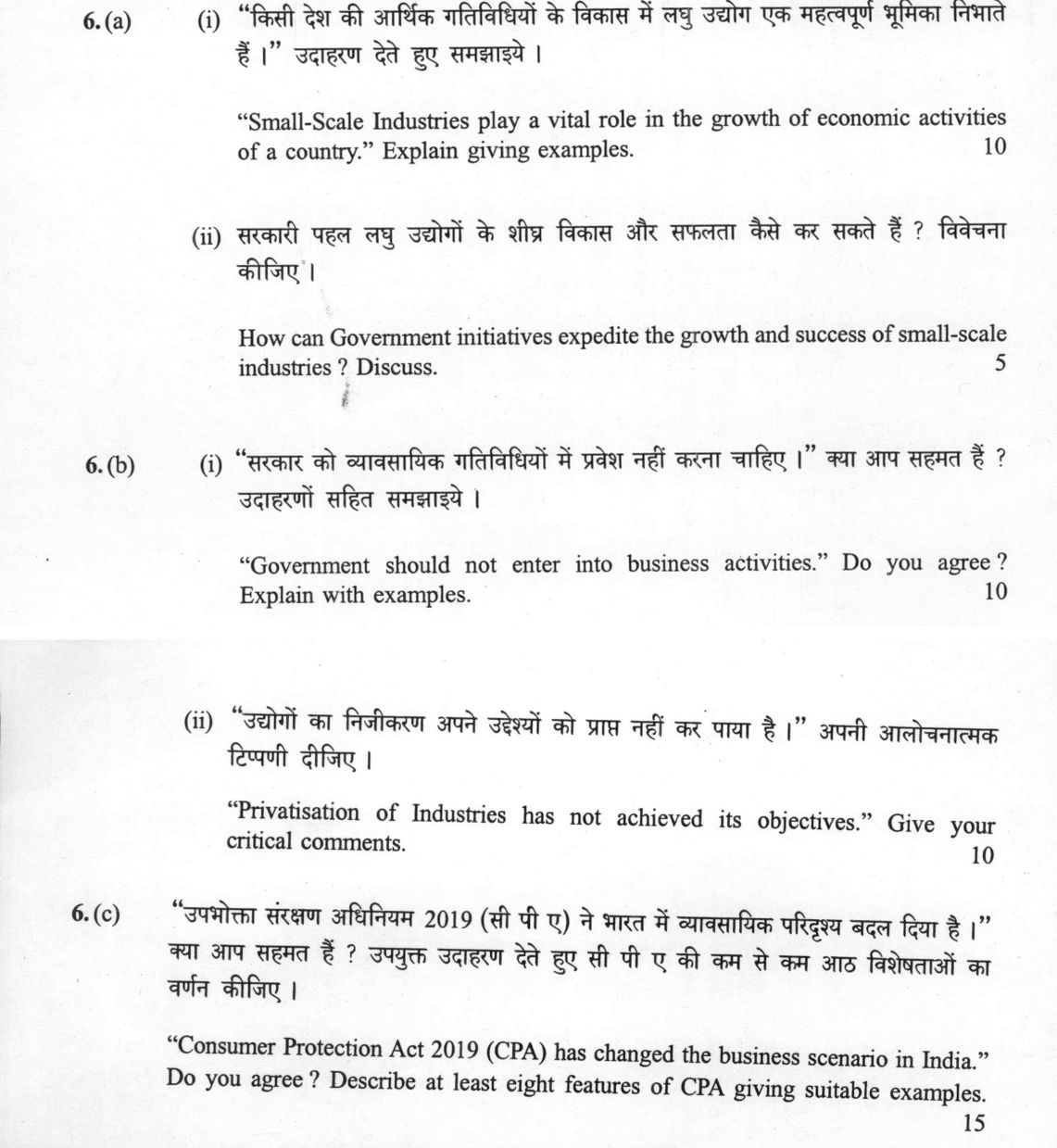
"Small-Scale Industries play a vital role in the growth of economic activities of a country." Explain giving examples. 10 marks
How can Government initiatives expedite the growth and success of small-scale industries ? Discuss. 5 marks
"Government should not enter into business activities." Do you agree ? Explain with examples. 10 marks
"Privatisation of Industries has not achieved its objectives." Give your critical comments. 10 marks
"Consumer Protection Act 2019 (CPA) has changed the business scenario in India." Do you agree ? Describe at least eight features of CPA giving suitable examples. 15 marks
हिंदी में प्रश्न पढ़ें
"किसी देश की आर्थिक गतिविधियों के विकास में लघु उद्योग एक महत्वपूर्ण भूमिका निभाते हैं।" उदाहरण देते हुए समझाइये। (10 अंक)
सरकारी पहल लघु उद्योगों के शीघ्र विकास और सफलता कैसे कर सकते हैं ? विवेचना कीजिए। (5 अंक)
"सरकार को व्यावसायिक गतिविधियों में प्रवेश नहीं करना चाहिए।" क्या आप सहमत हैं ? उदाहरणों सहित समझाइये। (10 अंक)
"उद्योगों का निजीकरण अपने उद्देश्यों को प्राप्त नहीं कर पाया है।" अपनी आलोचनात्मक टिप्पणी दीजिए। (10 अंक)
"उपभोक्ता संरक्षण अधिनियम 2019 (सी पी ए) ने भारत में व्यावसायिक परिदृश्य बदल दिया है।" क्या आप सहमत हैं ? उपयुक्त उदाहरण देते हुए सी पी ए की कम से कम आठ विशेषताओं का वर्णन कीजिए। (15 अंक)
Model answer
Written by UPSC Answer Check against this question's marking rubric, to the expected length. UPSC does not publish answers for Mains — this is one way to score well, not an official key.
SSIs and state support Small-scale industries are vital because they convert local skills into marketable output while absorbing labour that large capital-intensive units cannot. They generate employment in Khadi and village industries, disperse industry to Coimbatore’s textile SMEs and Moradabad’s brassware clusters, support exports through handicrafts and engineering goods, and nurture entrepreneurship by lowering entry barriers. Their capital-light nature makes them accessible to small entrepreneurs, while cluster production lowers costs and improves market access. Government initiatives expedite this growth: PMEGP provides subsidised credit for micro-enterprises, MUDRA offers collateral-free loans up to ₹10 lakh, CGTMSE guarantees bank credit, the MSME Development Act 2006 mandates payment within 45 days and promotes procurement, single-window clearance reduces delays, and MSME-Technology Centres help upgradation.
Government in business and privatisation The view that government should not enter business is partly correct but not absolute. State entry can correct market failure, provide strategic and defence goods, ensure social welfare where private firms find returns inadequate, or regulate natural monopolies; ISRO and SAIL show that public ownership can deliver national objectives and scale. Yet commercial PSUs can suffer inefficiency, overstaffing and political interference, as seen in Air India’s losses and BSNL’s competitive weakness. Hence the test is sector and performance, not blanket exclusion. Privatisation has achieved some objectives: disinvestment proceeds have helped fiscal consolidation, and efficiency gains are visible in Maruti Suzuki and VSNL’s market response. But its record is mixed: job losses, asset stripping, strategic sale controversies, and limited revenue generation show that transfer of ownership alone does not guarantee consumer welfare or public accountability. The Air India and BSNL divestments show that strategic intent must be matched with execution discipline. A critical verdict is that privatisation should be selective, with performance contracts, labour safeguards and transparent bidding.
CPA 2019 and consumer scenario I agree that the Consumer Protection Act 2019 has materially changed India’s business scenario because it brings digital markets, product safety and advertising accountability within consumer law. Eight features illustrate this. First, e-commerce inclusion covers online sales, as in Amazon or Flipkart disputes over non-delivery. Second, product liability introduces strict liability for manufacturers for harm caused by defective products, while sellers are liable only on specified grounds such as substantial control, alteration, failure to exercise reasonable care, or express warranty; a defective pressure cooker example shows manufacturer liability. Third, mediation allows consumer commissions to refer matters for settlement, such as settling an insurance claim delay. Fourth, enhanced pecuniary jurisdiction lets District Commissions hear cases up to ₹50 lakh, so a ₹40 lakh complaint need not go to State Commission. Fifth, the Central Consumer Protection Authority can act against unfair trade practices and misleading advertisements, such as false health-product claims. Sixth, penalties for misleading advertisements, up to ₹10 crore and two years’ imprisonment, deter celebrity endorsements of false claims. Seventh, class action suits, available since 1986 and continued, allow groups of consumers to litigate common issues, such as a housing project’s defective construction. Eighth, online dispute redressal through the e-Daakhil portal enables consumers to file against e-commerce sellers from home. Together, these features shift business conduct from after-the-fact complaints to preventive compliance. This is visible in e-commerce return policies and clearer product warnings.
Conclusion The balanced position is that SSIs need state facilitation, government business should be confined to sectors where public interest justifies it, privatisation must be judged by outcomes rather than ideology, and CPA 2019 has strengthened the consumer-state-market balance by making firms answerable for digital, product and advertising harms. In short, the state should facilitate, markets should be regulated, and consumers should be empowered for a more inclusive economy.
What "Critically evaluate" is asking you to do
Judge how well something has performed against the standard it set for itself — its stated aim, mandate or promise — and commit to a verdict. Name the yardstick before you judge; an unanchored judgement reads as opinion. “Critically” is not a section added at the end: name the yardstick you are judging by — the evidence, the stated objective, a constitutional principle, a rival explanation — and let a verdict close each part of the body. Where the question quotes a claim, that verdict must land on the claim itself, accepted, qualified or rejected, and not on the theme in general.
Structure that answers it
Name the yardstick — stated aim, mandate or benchmark → performance against it → shortfall against it → why the gap exists → verdict
Where marks are lost
Merits in one paragraph, demerits in the next, and a conclusion calling for a balanced and holistic approach. That is a survey with the judgement left out and it holds the answer in the middle band. The opposite error is reading “critically” as permission to attack — and with the odd pairings, critically describe or critically explain, the exposition still carries most of the marks, the judgement being a layer on it rather than a substitute for it.
How this answer will be evaluated
Approach
(a(i)) explain: definition/context > points in order > small example > short close | (a(ii)) discuss: intro > 3-4 dimensions > example > balanced close | (b(i)) comment: context > arguments both sides > judgment > close | (b(ii)) critique: the claim > its strengths > its weaknesses > your judgment | (c) describe: define > structure or process in order > labelled diagram > significance Full marks: Comprehensive, well-structured, specific examples, balanced arguments, clear judgment
Key points expected
- Context of small-scale industries in economy
- Points on employment generation
- Points on regional development
- Concrete examples of SSI contribution
- Intro to government role
- 3-4 dimensions of government initiatives
- Example of a specific initiative
- Balanced close on impact
Evaluation rubric
Each sub-part is marked on its own, against the marks and word limit printed on the paper.
- (a(i)) Explain the role of small-scale industries in economic growth with examples. 10 marks
explain— definition/context → points in order → small example → short close
Must cover
- Context of small-scale industries in economy
- Points on employment generation
- Points on regional development
- Concrete examples of SSI contribution
Loses marks
- Textbook definitions without application
- No examples provided
- Vague generalizations without specific points
Earns more
- Mention of MSME definition
- Link to GDP contribution
- Reference to export promotion
- Mention of rural industrialization
Extra mark
- Specific statistic on SSI employment share
- Reference to specific government scheme
- (a(ii)) Discuss how government initiatives expedite growth of small-scale industries. 5 marks
discuss— intro → 3-4 dimensions → example → balanced close
Must cover
- Intro to government role
- 3-4 dimensions of government initiatives
- Example of a specific initiative
- Balanced close on impact
Loses marks
- No specific initiatives named
- Vague discussion without dimensions
- No example provided
Earns more
- Mention of credit facilities
- Reference to infrastructure support
- Link to policy support
- Mention of skill development
Extra mark
- Reference to specific recent scheme
- Mention of specific regulatory body
- (b(i)) Comment on whether government should enter business activities with examples. 10 marks
comment— context → arguments both sides → judgment → close
Must cover
- Context of government in business
- Arguments for government entry
- Arguments against government entry
- Judgment with examples
Loses marks
- One-sided argument without balance
- No examples provided
- Vague judgment without reasoning
Earns more
- Mention of natural monopoly
- Reference to strategic industries
- Link to public welfare
- Mention of efficiency concerns
Extra mark
- Specific example of successful PSU
- Reference to specific privatization case
- (b(ii)) Critique the claim that privatisation has not achieved its objectives. 10 marks
critique— the claim → its strengths → its weaknesses → your judgment
Must cover
- The claim of failed privatisation
- Strengths of privatisation
- Weaknesses of privatisation
- Judgment on overall impact
Loses marks
- No strengths or weaknesses discussed
- Vague judgment without evidence
- No specific examples
Earns more
- Mention of efficiency gains
- Reference to job losses
- Link to price increases
- Mention of service quality changes
Extra mark
- Specific example of privatized company
- Reference to specific study or report
- (c) Describe at least eight features of Consumer Protection Act 2019 with examples. 15 marks
describe— define → structure or process in order → labelled diagram → significance
Must cover
- Definition of CPA 2019
- Structure of the Act
- At least eight features listed
- Suitable examples for features
Loses marks
- Less than eight features
- No examples provided
- Vague descriptions without specifics
Earns more
- Mention of e-commerce provisions
- Reference to consumer commissions
- Link to product liability
- Mention of mediation
Extra mark
- Specific example of e-commerce dispute
- Reference to specific commission structure
Practice this exact question
Write your answer and it is marked point by point against the model answer above — what you covered, what you missed, what you got wrong.
Evaluate my answer →More from Management 2025 Paper II
- Q3 3.(a) A company has an annual demand of 1600 units for an item, whose unit cost is ₹70/-.…
- Q4 4.(a) (i) "Expert Systems play a significant role in Organisations." Discuss it giving at…
- Q5 (a) "Have various Chambers of Commerce and other Industry Associations played their desir…
- Q6 (a) (i) "Small-Scale Industries play a vital role in the growth of economic activities of…
- Q7 (a) Define Strategic Alliances. Discuss the reasons for strategic alliances. Also discuss…
- Q8 (a) Explain Joint Venture with suitable examples. Discuss the Life Cycle of a Joint Ventu…