Paper II — Q8
(a) Explain Joint Venture with suitable examples. Discuss the Life Cycle of a Joint Venture. (7+8=15 marks) (b) What is Foreign…
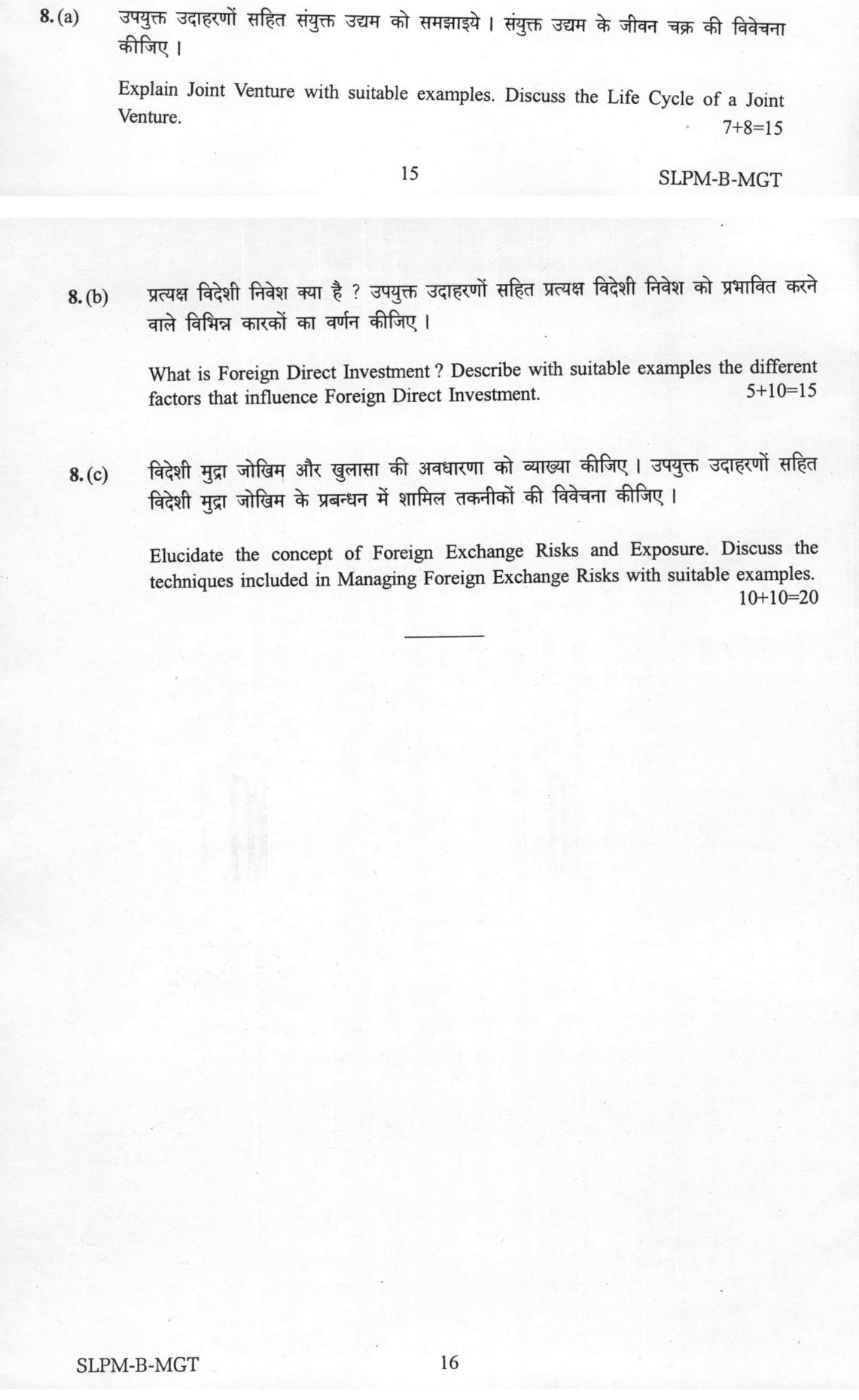
Explain Joint Venture with suitable examples. Discuss the Life Cycle of a Joint Venture. (7+8=15 marks)
What is Foreign Direct Investment ? Describe with suitable examples the different factors that influence Foreign Direct Investment. (5+10=15 marks)
Elucidate the concept of Foreign Exchange Risks and Exposure. Discuss the techniques included in Managing Foreign Exchange Risks with suitable examples. (10+10=20 marks)
हिंदी में प्रश्न पढ़ें
उपयुक्त उदाहरणों सहित संयुक्त उद्यम को समझाइये। संयुक्त उद्यम के जीवन चक्र की विवेचना कीजिए। (7+8=15)
प्रत्यक्ष विदेशी निवेश क्या है ? उपयुक्त उदाहरणों सहित प्रत्यक्ष विदेशी निवेश को प्रभावित करने वाले विभिन्न कारकों का वर्णन कीजिए । (5+10=15)
विदेशी मुद्रा जोखिम और खुलासा की अवधारणा को व्याख्या कीजिए । उपयुक्त उदाहरणों सहित विदेशी मुद्रा जोखिम के प्रबंधन में शामिल तकनीकों की विवेचना कीजिए । (10+10=20)
Model answer
Written by UPSC Answer Check against this question's marking rubric, to the expected length. UPSC does not publish answers for Mains — this is one way to score well, not an official key.
International business expansion requires firms to choose entry modes and manage cross-border risks. A joint venture (JV) is a separate entity or contractual arrangement in which two or more firms share ownership, control, profits, risks and resources to pursue a specific business objective. Its characteristics include shared control, risk, technology and distribution, while partners retain separate identities. In India, Maruti Suzuki combines Suzuki’s automotive technology with Maruti’s distribution network, while Tata Starbucks pairs Tata Consumer Products’ local supply chain with Starbucks’ brand and operating know-how. The JV life cycle begins with formation/negotiation, where partners agree on equity, governance, technology transfer, exit and dispute resolution. Growth/development follows as assets are built, brands launched and synergies tested; conflicts may arise over pricing, capacity or market entry. Maturity/stabilisation brings stable cash flows, but partners may seek more control, technology upgrades or new products. Decline/renegotiation/dissolution occurs when markets change, returns fall, strategic goals diverge or one partner exits; for example, the Hero Honda JV ended when Honda sold its stake to Hero, illustrating buy-out as a life-cycle exit.
FDI and its determinants. Foreign Direct Investment (FDI) is a long-term equity or debt investment giving management influence, control or strategic interest in a foreign enterprise, unlike Foreign Portfolio Investment (FPI), which is passive securities trading. FDI can be greenfield, as in Foxconn-Vedanta’s proposed semiconductor plant, or brownfield, as in Walmart’s acquisition of Flipkart. Dunning’s OLI paradigm explains FDI: ownership advantages such as brand, technology and scale; location advantages such as India’s large market, skilled labour, political stability, regulatory/tax regime, exchange-rate stability, trade openness, ease of doing business and infrastructure quality; and internalization advantages, where firms keep know-how in-house rather than license it, as Samsung does by setting up wholly owned plants to protect technology and control supply chains. Political stability, tax certainty and infrastructure quality are especially important for long-term manufacturing FDI. Push-pull factors also matter: home-country costs and competition push firms out, while host-country demand, policy incentives and supply-chain depth pull them in.
Forex risk, exposure and management. Foreign exchange risk is the uncertainty that exchange-rate movements will affect cash flows, asset values or competitiveness. Transaction exposure arises from payables/receivables in foreign currency, e.g., Infosys or TCS receiving USD fees. Translation exposure affects consolidated financial statements when Indian subsidiaries report in foreign currency, e.g., Tata Motors consolidating Jaguar Land Rover in GBP. Economic/operating exposure is longer-term, affecting future competitiveness, e.g., Reliance’s imported crude and USD debt. Exposure is measured by net foreign-currency cash-flow gaps, sensitivity analysis, value-at-risk and scenario stress tests. Management uses forward contracts to lock in rates; currency futures also lock in rates and remove both downside and upside; currency options cap downside while retaining upside; swaps exchange cash-flow currencies; money-market hedging borrows/lends in the relevant currency; natural hedging matches local-currency revenues and costs or uses local borrowing; leading/lagging accelerates or delays payments; netting offsets intra-group receivables and payables. For example, Tata Motors can hedge GBP payables with forwards/options, while TCS may use natural hedging by matching USD receivables with USD costs.
These elements are linked: FDI mode choice—wholly owned subsidiary, JV or acquisition—shapes control and risk, while forex management stabilises JV cash flows across formation, growth and maturity. For India, a predictable FDI regime, sectoral policy clarity and RBI’s forex management framework help MNCs internalise risk, protect investment returns and sustain long-term expansion. It also guides India’s FDI policy: stable rupee management, clear sectoral caps, and efficient hedging markets reduce the cost of capital and encourage JVs. Thus, elucidating forex risk means distinguishing short-term cash-flow risk from balance-sheet and strategic risk, then matching instruments to the exposure.
What "Elucidate" is asking you to do
Make a stated proposition plain and then prove it with instances. Elucidate stems almost always carry a claim or a named concept, and very often the words “with examples” or “with suitable diagrams” — the illustration is part of the directive, not decoration.
Structure that answers it
Plain-language statement of what the proposition means → the part that is obscure, resolved → first illustration → second illustration → why the proposition holds
Where marks are lost
Adding terminology; elucidate rewards removing it. The commoner loss is a clean explanation with no example, when the stem asked for examples.
How this answer will be evaluated
Approach
Framework: Joint Venture Life Cycle Model; Dunning's OLI Paradigm; Foreign Exchange Exposure Types (Transaction, Translation, Economic). (a) explain: definition/context > points in order > small example > short close | (b) describe: definition > factors in order > examples > short close | (c) explain: concept definition > types/dimensions > management techniques > examples Full marks: Clear definitions, named frameworks (OLI, Life Cycle), specific examples, and balanced discussion of techniques.
Key points expected
- Joint Venture Life Cycle stages
- Dunning's OLI Paradigm for FDI
- Transaction, Translation, and Economic Exposure
- Hedging techniques (Forwards, Options)
Evaluation rubric
Each sub-part is marked on its own, against the marks and word limit printed on the paper.
- (a) Define JV and map its life cycle stages with examples. 15 marks
explain— definition/context → points in order → small example → short close
Must cover
- Definition of Joint Venture
- Life Cycle stages (e.g., Formation, Growth, Maturity, Decline)
- Suitable example (e.g., Sony-Ericsson, Tata-Jaguar)
- Brief discussion of each stage
Loses marks
- Defining JV as just a partnership
- Listing stages without explanation
Earns more
- Distinction between JV and M&A
- Strategic rationale for JV
- Challenges in specific life cycle stages
Extra mark
- Diagram of the Life Cycle
- Recent breakup or merger example
- (b) Define FDI and describe influencing factors with examples. 15 marks
describe— definition → factors in order → examples → short close
Must cover
- Definition of Foreign Direct Investment
- Host country factors (market size, stability)
- Home country factors (technology, capital)
- Suitable examples for factors
Loses marks
- Confusing FDI with Foreign Portfolio Investment
- Generic factors without specific examples
Earns more
- Use of OLI Paradigm (Ownership, Location, Internalization)
- Distinction between FDI and FPI
- Sector-specific examples (e.g., IT, Pharma)
Extra mark
- Reference to specific FDI policy changes
- Statistical data on FDI inflows
- (c) Explain FX risk/exposure and discuss management techniques. 20 marks
explain— concept definition → types/dimensions → management techniques → examples
Must cover
- Concept of Foreign Exchange Risk
- Types of Exposure (Transaction, Translation, Economic)
- Management techniques (Hedging, Forward contracts)
- Suitable examples of techniques
Loses marks
- Treating risk and exposure as identical
- Listing techniques without explaining how they work
Earns more
- Distinction between risk and exposure
- Natural hedging strategies
- Use of derivatives (options, swaps)
Extra mark
- Calculation example of exposure
- Reference to specific currency crisis
Practice this exact question
Write your answer and it is marked point by point against the model answer above — what you covered, what you missed, what you got wrong.
Evaluate my answer →More from Management 2025 Paper II
- Q5 (a) "Have various Chambers of Commerce and other Industry Associations played their desir…
- Q6 (a) (i) "Small-Scale Industries play a vital role in the growth of economic activities of…
- Q7 (a) Define Strategic Alliances. Discuss the reasons for strategic alliances. Also discuss…
- Q8 (a) Explain Joint Venture with suitable examples. Discuss the Life Cycle of a Joint Ventu…