Paper I — Q1
(a) A rod of length 2 m and weight 450 N rests on ground at one end. The other end is supported by a cord through which a force…
A rod of length 2 m and weight 450 N rests on ground at one end. The other end is supported by a cord through which a force of 200 N is applied. What is the minimum angle α for which equilibrium is possible? The coefficient of static friction between the rod and the floor is 0·4 : 10 marks
A shaft of span 1·5 m and diameter 20 mm is simply supported at the ends. It carries a 125 kg concentrated mass at midspan. If E = 200 GPa, calculate its fundamental frequency. 10 marks
Two thick washers are placed on the two ends of a copper tube and a steel bolt of pitch 1·8 mm is made to pass through these washers as shown in the figure below. The nut is tightened first with hand so that there are no stresses in the tube. Now, the nut is further tightened with the spanner through one-fourth of a turn. Calculate the axial stresses developed in the tube and the bolt. Young's modulus values for steel and copper are 200 GPa and 105 GPa, respectively : 10 marks
Explain critical cooling rate using continuous cooling transformation (CCT) diagram and write its importance in hardening heat treatment of alloy steel. 10 marks
A single-cylinder reciprocating engine has speed 250 rpm, stroke 300 mm, mass of the reciprocating parts 60 kg and mass of the revolving parts 50 kg at 150 mm radius. If two-thirds of the reciprocating parts and all the revolving parts are to be balanced, find (i) the balance mass required at a radius of 400 mm and (ii) the residual unbalanced force when the crank has rotated 60° from top dead centre. 10 marks
हिंदी में प्रश्न पढ़ें
एक 2 m लम्बी तथा 450 N वजन की छड़ धरती पर अपने एक छोर पर स्थित है। इसका दूसरा छोर एक रस्सी से आलम्बित है, जिस पर 200 N का बल लग रहा है। सन्तुलन के लिए न्यूनतम कोण α क्या होगा? छड़ तथा फर्श के बीच का स्थैतिक घर्षण गुणांक 0·4 है : (10 अंक)
एक शाफ्ट की विस्तृति 1·5 m तथा व्यास 20 mm है, जिसे इसके दोनों किनारों पर साधारण आलम्ब सहारा दे रहे हैं। शाफ्ट के बीच में 125 kg का सकेन्द्रित द्रव्यमान स्थित है। यदि E = 200 GPa है, तो इसकी मूल आवृत्ति ज्ञात कीजिए। (10 अंक)
तांबे की ट्यूब के दोनों सिरों पर दो मोटे वॉशर रखे गए हैं और 1·8 mm पिच के एक इस्पात से बने बोल्ट को इन वॉशरों से गुजारा गया है जैसा नीचे दिए गए चित्र में दर्शाया गया है। नट को पहले हाथ से कस दिया जाता है ताकि ट्यूब में कोई प्रतिबल न हो। अब, नट को स्पैनर की सहायता से एक-चौथाई चक्कर देकर फिर से कस दिया जाता है। ट्यूब और बोल्ट में विकसित अक्षीय प्रतिबलों की गणना कीजिए। इस्पात तथा तांबे के यंग मापांक क्रमशः: 200 GPa तथा 105 GPa हैं : (10 अंक)
सतत शीतलन रूपांतरण (CCT) आरेख की सहायता से कांतिक शीतलन दर की व्याख्या कीजिए तथा इसका महत्व ऐलॉय इस्पात के कठोरीकरण ताप उपचार में बताइए। (10 अंक)
एक एकल सिलिंडर प्रत्यागामी इंजन की गति 250 rpm, स्ट्रोक 300 mm, प्रत्यागामी भागों का द्रव्यमान 60 kg तथा 150 mm त्रिज्या पर घूर्णी भागों का द्रव्यमान 50 kg है। यदि दो-तिहाई प्रत्यागामी भागों और सभी घूर्णी भागों को संतुलित किया जाना है, तो (i) 400 mm की त्रिज्या पर आवश्यक संतुलन द्रव्यमान और (ii) क्रैंक के उच्च निष्चल्य स्थिति (टॉप डेड सेंटर) से 60° घूर्णन पर अवशिष्ट असंतुलित बल ज्ञात कीजिए। (10 अंक)
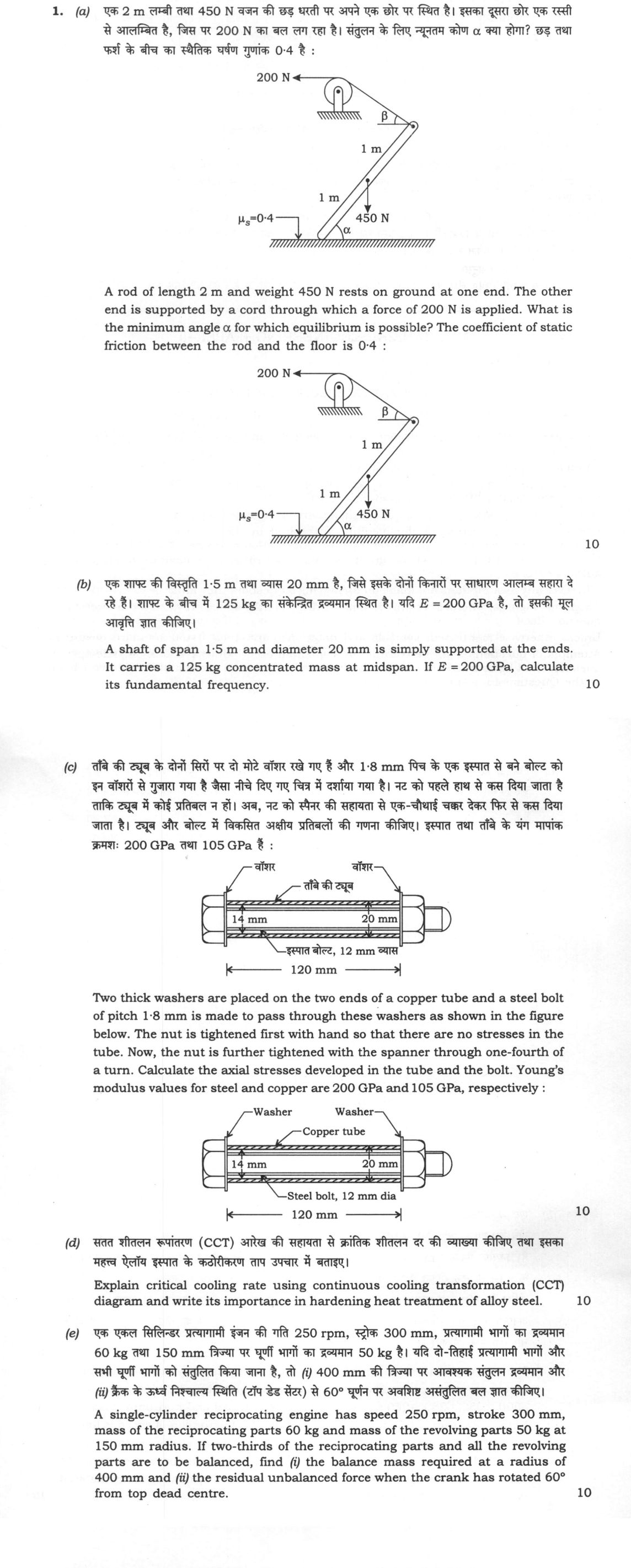
The figure this question refers to, in words
The question paper is a scan and the diagram did not survive as text. This is the figure as read from the original page — every component, value and label — so the question can be worked from the text below.
(a) A rod of total length 2 m rests with its lower end on a horizontal ground. The rod is inclined at an angle alpha to the horizontal. The rod is uniform, with its weight of 450 N acting vertically downwards at its midpoint, which is 1 m from the lower end. The upper end of the rod is attached to a cord. The cord passes over a fixed pulley and is pulled horizontally to the left with a force of 200 N. The cord segment between the rod's upper end and the pulley makes an angle beta with the horizontal. The coefficient of static friction between the rod's lower end and the ground is mu_s = 0.4. The angle alpha is the unknown to be determined.
(c) An assembly drawing of a bolted joint with a copper tube and a steel bolt. A copper tube of length 120 mm is shown horizontally. The tube has an inner diameter of 14 mm and an outer diameter of 20 mm. A steel bolt of 12 mm diameter passes concentrically through the tube. Two thick washers are placed at the two ends of the copper tube, one on the left and one on the right. The bolt head is on the left side, and a nut is threaded on the right side. The labels indicate 'Washer' on both ends, 'Copper tube' for the central sleeve, and 'Steel bolt, 12 mm dia' for the central rod. The dimension 120 mm is marked below the tube, indicating the length between the washers. The dimension 14 mm indicates the inner diameter of the copper tube, and 20 mm indicates the outer diameter of the copper tube.
Model answer
Written by UPSC Answer Check against this question's marking rubric, to the expected length. UPSC does not publish answers for Mains — this is one way to score well, not an official key.
(a) Let T = 200 N, W = 450 N and L = 2 m. Take moments about the lower end A. If the cord makes an angle β with the horizontal, the moment of T about A is T L sin(α + β), and the moment of the weight is W (L/2) cos α. For equilibrium:
T L sin(α + β) = W (L/2) cos α.
For the minimum possible α, sin(α + β) must be maximum, i.e. 1, which means the cord is perpendicular to the rod. Hence:
T L ≥ W (L/2) cos α
cos α ≤ 2T/W = 2(200)/450 = 8/9.
Therefore:
α_min = arccos(8/9) ≈ 27.27°.
Check friction at this angle. sin α = √(1 − (8/9)²) = √17/9. Vertical component of cord force = T cos α = 200(8/9) = 177.78 N upward. Normal reaction:
N = 450 − 177.78 = 272.22 N.
Required friction = T sin α = 200(√17/9) = 91.63 N.
Maximum static friction = μN = 0.4(272.22) = 108.89 N.
Since 91.63 N < 108.89 N, slip does not occur. Hence equilibrium is possible.
(b) Given L = 1.5 m, d = 20 mm = 0.02 m, m = 125 kg, E = 200 GPa = 200 × 10⁹ N/m². Neglect shaft mass. For a simply supported beam with central mass, stiffness is:
k = 48EI/L³.
Moment of inertia:
I = πd⁴/64 = π(0.02)⁴/64 = 7.854 × 10⁻⁹ m⁴.
EI = (200 × 10⁹)(7.854 × 10⁻⁹) = 1570.8 N m².
k = 48(1570.8)/(1.5³) = 75398.4/3.375 = 22340.2 N/m.
Natural frequency:
ω_n = √(k/m) = √(22340.2/125) = 13.369 rad/s.
Fundamental frequency:
f_n = ω_n/(2π) = 13.369/(2π) = 2.128 Hz.
f_n ≈ 2.13 Hz.
(c) Nut movement per one-fourth turn:
δ = pitch/4 = 1.8/4 = 0.45 mm.
Bolt area:
A_b = π(12)²/4 = 36π = 113.10 mm².
Copper tube area:
A_c = π(20² − 14²)/4 = 51π = 160.22 mm².
Let F be the tensile force in the bolt and compressive force in the tube. Compatibility gives:
δ = F L/(A_b E_s) + F L/(A_c E_c).
Substitute L = 120 mm, E_s = 200000 N/mm², E_c = 105000 N/mm².
1/(A_b E_s) = 1/(113.10 × 200000) = 4.421 × 10⁻⁸ N⁻¹.
1/(A_c E_c) = 1/(160.22 × 105000) = 5.944 × 10⁻⁸ N⁻¹.
Sum = 1.0365 × 10⁻⁷ N⁻¹.
δ = F(120)(1.0365 × 10⁻⁷) = F(1.2438 × 10⁻⁵ mm/N).
F = 0.45/(1.2438 × 10⁻⁵) = 36179 N.
Bolt stress:
σ_b = F/A_b = 36179/113.10 = 319.9 N/mm² = 320 MPa tension.
Copper stress:
σ_c = F/A_c = 36179/160.22 = 225.8 N/mm² = 226 MPa compression.
σ_b ≈ 320 MPa (tension), σ_c ≈ 226 MPa (compression).
(d) A continuous cooling transformation (CCT) diagram plots temperature against time on a logarithmic scale for austenite cooled continuously. Unlike an isothermal TTT diagram, CCT curves are shifted to lower temperatures and longer times because transformation occurs during continuous cooling. The critical cooling rate is the minimum cooling rate from the austenitizing temperature that suppresses diffusion-controlled transformations such as ferrite, pearlite and bainite, and ensures that austenite transforms largely to martensite. On the CCT diagram, it is the cooling curve just tangent to the start of the pearlite/ferrite transformation region. If cooling is slower, some soft pearlite or bainite forms; if faster, the curve misses the transformation nose and martensite forms at M_s.
Importance in hardening of alloy steel: It is a measure of hardenability. Alloying elements such as Cr, Ni, Mo and Mn shift the CCT curves to the right, lowering the critical cooling rate. This allows through-hardening of thicker sections with milder quenching media like oil or air, reducing quench cracking and distortion. It also guides selection of quenching medium and cooling rate to obtain the desired martensitic structure, hardness and toughness, and helps design heat-treatment cycles that avoid undesirable phases and control residual stresses.
(e) Given N = 250 rpm, stroke = 300 mm, so crank radius r = 150 mm = 0.15 m. m_rec = 60 kg, m_rev = 50 kg at r = 0.15 m. Balanced fraction of reciprocating parts = 2/3.
(i) Total mass to be balanced at crank radius:
m_rev + (2/3)m_rec = 50 + (2/3)(60) = 50 + 40 = 90 kg.
Balance mass B at radius R = 400 mm = 0.4 m:
B R = 90 r
B = 90(0.15)/0.4 = 33.75 kg.
B = 33.75 kg at radius 400 mm.
(ii) Angular speed:
ω = 2πN/60 = 2π(250)/60 = 25π/3 = 26.18 rad/s.
m_rec ω² r = 60(25π/3)²(0.15) = 625π² = 6168.5 N.
For balanced fraction c = 2/3, residual primary force components at crank angle θ = 60° from TDC are:
Along line of stroke:
F_x = (1 − c)m_rec ω² r cos θ = (1/3)(6168.5) cos 60° = 1028.1 N.
Perpendicular to line of stroke:
F_y = c m_rec ω² r sin θ = (2/3)(6168.5) sin 60° = 3561.4 N.
Resultant residual unbalanced force:
F = √(F_x² + F_y²) = 6168.5 √((1/3)²cos²60° + (2/3)²sin²60°)
F = 6168.5 √(13/36) = 6168.5(√13/6) = 3706.8 N.
F ≈ 3.707 kN, acting at tan⁻¹(3561.4/1028.1) ≈ 73.9° to the line of stroke.
What "Solve" is asking you to do
Choose the method, then carry it through to a final answer. Identifying what kind of problem this is and why that method applies is the first thing marked; a correct figure arrived at invisibly earns almost nothing.
Structure that answers it
Given data and what is required → method chosen, with the reason it applies → set-up (equation, circuit, free body, trial balance) → working, step by step → answer with units and any condition of validity
Where marks are lost
Doing the middle steps mentally and writing only the result. In mathematics papers, a further loss comes from giving a decimal where the exact value in surds or fractions was wanted, or from skipping the justification a part explicitly asks for.
How this answer will be evaluated
Approach
(a) calculate: given > formula > substitution > result with units > interpretation | (b) calculate: given > formula > substitution > result with units > interpretation | (c) calculate: given > formula > substitution > result with units > interpretation | (d) explain: definition/context > points in order > small example > short close | (e) calculate: given > formula > substitution > result with units > interpretation Full marks: All parts solved with correct method, clear diagrams, and physical interpretation.
Key points expected
- Free body diagram with all forces and angles
- Equilibrium equations for forces and moments
- Friction force expressed as μN
- Solve for minimum angle α
- Formula for natural frequency of a beam
- Correct calculation of moment of inertia I
- Substitution of given values with units
- Final frequency in Hz
Evaluation rubric
Each sub-part is marked on its own, against the marks and word limit printed on the paper.
- (a) Determine the minimum angle α for equilibrium of the rod. 10 marks
calculate— given → formula → substitution → result with units → interpretation
Must cover
- Free body diagram with all forces and angles
- Equilibrium equations for forces and moments
- Friction force expressed as μN
- Solve for minimum angle α
Loses marks
- Missing friction force in FBD
- Incorrect moment arm for weight
Earns more
- Correct identification of tension direction
- Moment taken about the pivot point
Extra mark
- Check for limiting equilibrium condition
- (b) Calculate the fundamental frequency of the shaft. 10 marks
calculate— given → formula → substitution → result with units → interpretation
Must cover
- Formula for natural frequency of a beam
- Correct calculation of moment of inertia I
- Substitution of given values with units
- Final frequency in Hz
Loses marks
- Incorrect formula for frequency
- Unit conversion errors in diameter or length
Earns more
- Explicit statement of boundary conditions
- Correct use of E and L in the formula
Extra mark
- Mention of mode shape for fundamental frequency
- (c) Calculate axial stresses in the tube and bolt. 10 marks
calculate— given → formula → substitution → result with units → interpretation
Must cover
- Compatibility equation for deformation
- Equilibrium equation for forces
- Correct calculation of cross-sectional areas
- Stress calculation for both materials
Loses marks
- Ignoring compatibility condition
- Incorrect area calculation for tube
Earns more
- Clear definition of elongation/contraction
- Correct use of Young's modulus values
Extra mark
- Discussion of stress distribution
- (d) Explain critical cooling rate using CCT diagram. 10 marks
explain— definition/context → points in order → small example → short close
Must cover
- Definition of critical cooling rate
- Description of CCT diagram features
- Link to hardening heat treatment
- Importance in alloy steel processing
Loses marks
- Confusing CCT with TTT diagram
- No mention of hardening context
Earns more
- Mention of nose of the curve
- Reference to specific alloy steel
Extra mark
- Example of a specific steel grade
- (e) Find balance mass and residual unbalanced force. 10 marks
calculate— given → formula → substitution → result with units → interpretation
Must cover
- Calculation of equivalent revolving mass
- Balance mass calculation at given radius
- Residual force calculation at 60°
- Correct use of angular velocity
Loses marks
- Incorrect conversion of rpm to rad/s
- Missing factor for two-thirds balancing
Earns more
- Clear separation of reciprocating and revolving parts
- Correct trigonometric application for 60°
Extra mark
- Diagram showing force vectors
Practice this exact question
Write your answer and it is marked point by point against the model answer above — what you covered, what you missed, what you got wrong.
Evaluate my answer →More from Mechanical Engineering 2024 Paper I
- Q1 (a) A rod of length 2 m and weight 450 N rests on ground at one end. The other end is sup…
- Q2 (a) Bodies A, B and C of weights 100 N, 200 N and 150 N, respectively are connected as sh…
- Q3 (a) Show the loading on the beams corresponding to the bending moment diagrams shown belo…
- Q4 (a) A governor of Hartnell type has each ball of weight 20 N and the lengths of vertical…