Paper I — Q7
(a) An orthogonal cutting of metal is performed using cutting speed of 120 m/min, tool rake angle 5° and width of cut 5 mm…
An orthogonal cutting of metal is performed using cutting speed of 120 m/min, tool rake angle 5° and width of cut 5 mm. Cutting produces chip thickness 0·4 mm and generates main cutting and thrust forces of 600 N and 300 N, respectively. Considering uncut chip thickness as 0·2 mm, calculate the chip thickness ratio, friction force and percentage of total cutting energy used to overcome friction at chip-tool interface. 20 marks
A company produces both interior and exterior paints from raw materials M1 and M2. The following table provides the basic data of the problem:
| Raw Material per ton of Paints (tons) | Maximum Daily | ||
|---|---|---|---|
| Exterior Paint | Interior Paint | Availability (tons) | |
| Raw Material M1 | 6 | 4 | 24 |
| Raw Material M2 | 1 | 2 | 6 |
| Profit per ton (₹) | 4,00,000 | 3,20,000 |
A market survey indicates that the daily demand for interior paint cannot exceed that for exterior paint by more than 1 ton. Also the maximum daily demand for interior paint is 2 tons. This company wants to determine the optimum product mix of interior and exterior paints that maximizes the total daily profit. Comment on the optimal solution if the objective function is maximization of Z = 480000x₁ + 320000x₂. 20 marks
What are the elements of a quality costing system? How does an organization benefit from a quality costing system? 10 marks
हिंदी में प्रश्न पढ़ें
धातु की एक लंबिक कतन क्रिया की जाती है, जिसमें कतन गति 120 m/min, औजार नति कोण 5° तथा कतन की चौड़ाई 5 mm है। कतन 0·4 mm मोटा छीलन (चिप) पैदा करता है तथा मुख्य कतन बल और प्रणोद बल क्रमशः 600 N तथा 300 N उत्पन्न करता है। बिना कटे चिप की मोटाई 0·2 mm मानते हुए चिप मोटाई अनुपात, घर्षण बल तथा चिप-औजार के बीच घर्षण को दूर करने में लगी हुई ऊर्जा, जो कुल कतन वाली ऊर्जा के प्रतिशत में हो, ज्ञात कीजिए। (20 अंक)
एक कंपनी कच्चे माल M1 तथा M2 से आंतरिक और बाहरी दोनों पेंट का उत्पादन करती है। निम्न तालिका समस्या का मूल आंकड़ा प्रदान करती है :
| प्रति टन पेंट में कच्चा माल (टन) | प्रतिदिन अधिकतम उपलब्धता (टन) | ||
|---|---|---|---|
| बाहरी पेंट | आंतरिक पेंट | ||
| कच्चा माल M1 | 6 | 4 | 24 |
| कच्चा माल M2 | 1 | 2 | 6 |
| प्रति टन लाभ (₹) | 4,00,000 | 3,20,000 |
एक बाजार सर्वेक्षण से पता चलता है कि आंतरिक पेंट की दैनिक मांग, बाहरी पेंट की दैनिक मांग से 1 टन से अधिक नहीं हो सकती है। साथ ही आंतरिक पेंट की अधिकतम दैनिक मांग 2 टन है। कंपनी आंतरिक और बाहरी पेंट का अनुकूलतम उत्पाद मिश्रण निर्धारित करना चाहती है, जो कुल दैनिक लाभ को अधिकतम करे। अनुकूलतम समाधान पर टिप्पणी कीजिए, यदि उद्देश्य फलन, z = 480000x₁ + 320000x₂ का अधिकतमीकरण है। (20 अंक)
गुणवत्ता लागत प्रणाली के कौन-कौन से तत्व हैं? गुणवत्ता लागत प्रणाली से एक संस्था किस प्रकार लाभान्वित होती है? (10 अंक)
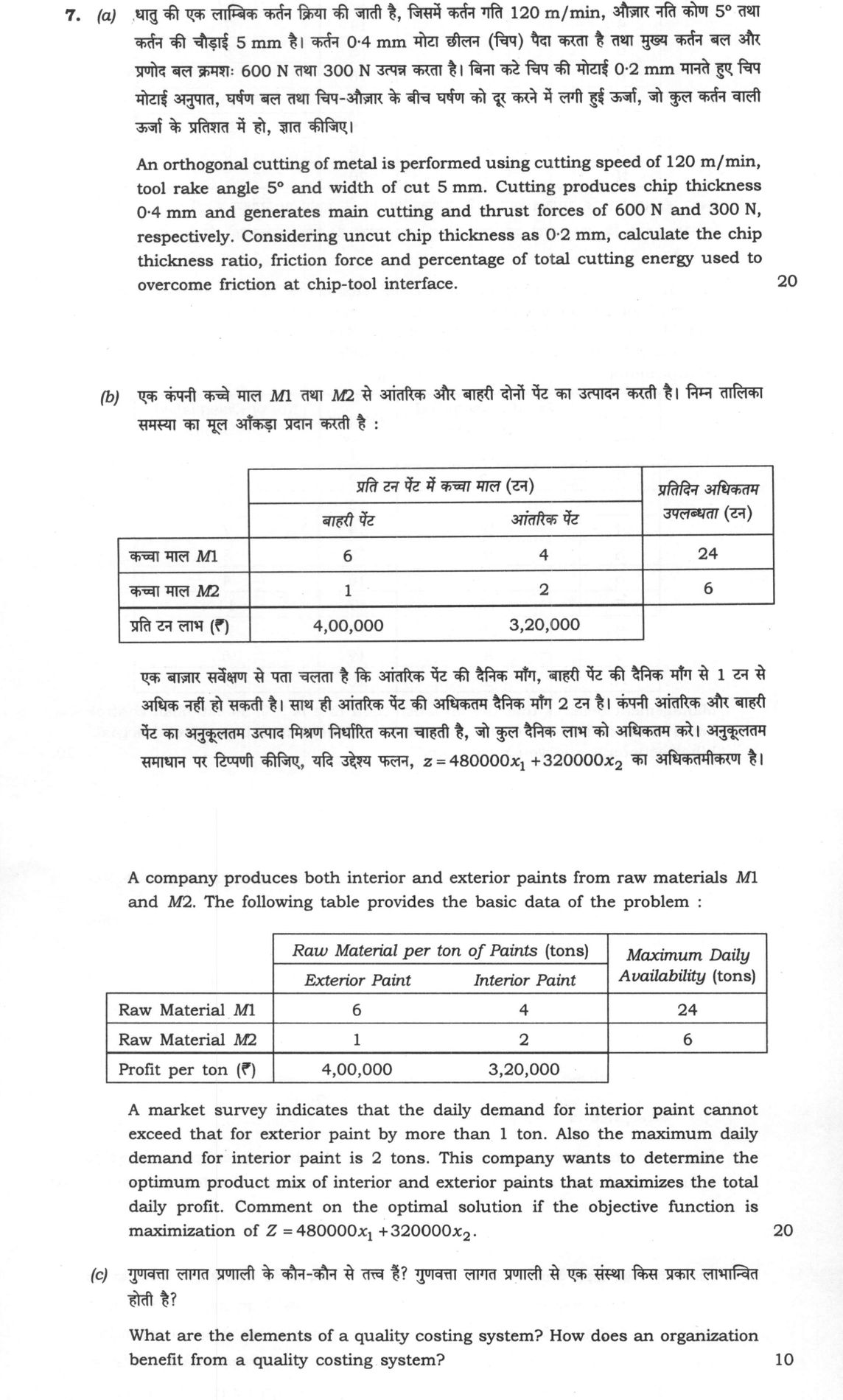
The figure this question refers to, in words
The question paper is a scan and the diagram did not survive as text. This is the figure as read from the original page — every component, value and label — so the question can be worked from the text below.
(b) Table with columns:
- Raw Material / Characteristic
- Exterior Paint (Raw Material per ton of Paints in tons)
- Interior Paint (Raw Material per ton of Paints in tons)
- Maximum Daily Availability (tons)
Data:
- Raw Material M1: Exterior Paint = 6, Interior Paint = 4, Maximum Daily Availability = 24
- Raw Material M2: Exterior Paint = 1, Interior Paint = 2, Maximum Daily Availability = 6
- Profit per ton (₹): Exterior Paint = 4,00,000, Interior Paint = 3,20,000, Maximum Daily Availability = [blank]
Model answer
Written by UPSC Answer Check against this question's marking rubric, to the expected length. UPSC does not publish answers for Mains — this is one way to score well, not an official key.
(a) Given: cutting speed v = 120 m/min, tool rake angle α = 5°, width of cut w = 5 mm, chip thickness t₂ = 0.4 mm, uncut chip thickness t₁ = 0.2 mm, main cutting force F_c = 600 N and thrust force F_t = 300 N.
By definition of chip thickness ratio in orthogonal cutting, r = t₁/t₂ = 0.2/0.4 = 0.5.
Using Merchant’s force-circle resolution at the chip-tool interface: F = F_c sin α + F_t cos α F = 600 sin 5° + 300 cos 5° F = 600(0.08716) + 300(0.99619) F = 52.30 + 298.86 = 351.16 N.
Also, normal force N = F_c cos α − F_t sin α = 600(0.99619) − 300(0.08716) = 597.72 − 26.15 = 571.57 N, so friction coefficient μ = F/N = 351.16/571.57 = 0.614.
For percentage of total cutting energy used to overcome chip-tool friction, chip velocity is V_c = r v = 0.5 × 120 = 60 m/min. Total cutting power = F_c v = 600 × 120 = 72000 N·m/min = 1200 W. Friction power at chip-tool interface = F V_c = 351.16 × 60 = 21069.6 N·m/min = 351.16 W. Percentage = (F V_c)/(F_c v) × 100 = (351.16 × 0.5/600) × 100 = 29.26%.
This assumes orthogonal cutting, continuous chip, steady cutting forces and no built-up-edge effect.
(b) Let x₁ = tons/day of exterior paint and x₂ = tons/day of interior paint. Using the stated objective Z = 480000x₁ + 320000x₂, the linear programming problem is:
Maximize Z = 480000x₁ + 320000x₂ subject to 6x₁ + 4x₂ ≤ 24 … raw material M1 x₁ + 2x₂ ≤ 6 … raw material M2 x₂ − x₁ ≤ 1 … interior demand constraint x₂ ≤ 2 … maximum daily interior demand x₁, x₂ ≥ 0.
Using the graphical method, convert M1 to 3x₁ + 2x₂ ≤ 12. The feasible region vertices are: (0,0), (0,1), (1,2), (2,2), (3,3/2), (4,0).
Evaluate Z: Z(0,0) = 0 Z(0,1) = 320000 Z(1,2) = 480000 + 640000 = 1120000 Z(2,2) = 960000 + 640000 = 1600000 Z(3,3/2) = 480000×3 + 320000×3/2 = 1440000 + 480000 = 1920000 Z(4,0) = 480000×4 = 1920000.
Thus the objective has multiple optimal solutions. The objective vector (480000, 320000) is proportional to the M1 constraint normal (6,4), since 480000/6 = 80000 and 320000/4 = 80000. Hence the objective line is parallel to the M1 constraint. Every point on the M1 edge between (3,3/2) and (4,0) is optimal.
So the optimal product mix is x₂ = 6 − 3x₁/2, with 3 ≤ x₁ ≤ 4, and the maximum daily profit is ₹19,20,000.
If the table profit ₹4,00,000 for exterior paint is used instead, the unique optimum occurs at x₁ = 3 tons/day, x₂ = 1.5 tons/day, giving Z = ₹16,80,000/day.
(c) A quality costing system classifies all costs incurred to ensure good quality and all costs caused by poor quality. Its main elements are:
- Prevention costs: quality planning, training, supplier evaluation, process design, preventive maintenance.
- Appraisal costs: inspection, testing, measurement, audits and quality checks.
- Internal failure costs: scrap, rework, re-inspection, downtime and corrective action before delivery.
- External failure costs: warranty claims, returns, complaints, recalls, field service and liability.
- Supporting elements: cost data collection, classification, reporting, trend analysis and corrective-action feedback.
Organizations benefit because the system quantifies quality problems in money terms, identifies the most costly failure areas, and justifies investment in prevention and appraisal. It reduces rework, scrap, warranty costs and customer dissatisfaction, improves product reliability and delivery performance, supports continuous improvement and helps prioritise quality projects. Ultimately, it lowers total cost of quality, improves profitability and strengthens competitive advantage.
What "Calculate" is asking you to do
Apply the standard formula or schedule to data the question has already supplied — a table of readings, cost records, a balance sheet — and produce the number. The method is rarely in doubt; the marks sit in the named intermediate quantities, each of which has to appear as a labelled line.
Structure that answers it
Data as given → formula or standard treatment, named → substitution → each intermediate, labelled → result with units
Where marks are lost
Omitting an intermediate the marking scheme pays for separately, or rounding at an intermediate line so the final figure drifts. In commerce and accountancy, any figure in a statement that no numbered working note supports is treated as unearned.
How this answer will be evaluated
Approach
(a) calculate: given > formula > substitution > result with units > interpretation | (b) comment: context > arguments both sides > judgment > close | (c) explain: definition/context > points in order > small example > short close Full marks: Accurate calculations with clear diagrams; precise LPP solution with insightful comment; comprehensive quality costing explanation.
Key points expected
- Calculate chip thickness ratio (r = t1/t2)
- Apply Merchant's circle or force transformation
- Calculate friction force (F) from Fc and Ft
- Compute energy percentage (F*Vc / Total Power)
- Formulates objective function and constraints
- Identifies feasible region via graphical method
- Calculates optimal mix for original profit
- Evaluates impact of new objective function
Evaluation rubric
Each sub-part is marked on its own, against the marks and word limit printed on the paper.
- (a) Determine chip thickness ratio, friction force, and percentage of energy used for friction. 20 marks
calculate— given → formula → substitution → result with units → interpretation
Must cover
- Calculate chip thickness ratio (r = t1/t2)
- Apply Merchant's circle or force transformation
- Calculate friction force (F) from Fc and Ft
- Compute energy percentage (F*Vc / Total Power)
Loses marks
- Confuses chip thickness with uncut thickness
- Omits rake angle in force transformation
- Calculates power without cutting speed
Earns more
- Draws orthogonal cutting force diagram
- States rake angle and friction angle explicitly
- Shows dimensional consistency in force units
Extra mark
- Calculates coefficient of friction (μ)
- (b) Solve LPP for optimal paint mix and comment on the new objective function. 20 marks
comment— context → arguments both sides → judgment → close
Must cover
- Formulates objective function and constraints
- Identifies feasible region via graphical method
- Calculates optimal mix for original profit
- Evaluates impact of new objective function
Loses marks
- Incorrectly sets up demand constraints
- Ignores the 'comment' on the new function
- Fails to identify the optimal corner point
Earns more
- Plots all constraint lines accurately
- Identifies corner points of feasible region
- Compares slopes of objective and constraints
Extra mark
- Notes if solution is unbounded or multiple
- (c) Define quality costing elements and explain organizational benefits. 10 marks
explain— definition/context → points in order → small example → short close
Must cover
- Lists elements: Prevention, Appraisal, Internal/External Failure
- Explains the cost of quality concept
- Links elements to organizational benefits
- Mentions cost reduction or quality improvement
Loses marks
- Confuses quality control with quality costing
- Fails to distinguish failure cost types
- Vague benefits without specific examples
Earns more
- Uses the 'Cost of Quality' (CoQ) model
- Distinguishes between cost of good and poor quality
- Provides a specific example of a benefit
Extra mark
- References Juran or Crosby quality models
Practice this exact question
Write your answer and it is marked point by point against the model answer above — what you covered, what you missed, what you got wrong.
Evaluate my answer →More from Mechanical Engineering 2024 Paper I
- Q4 (a) A governor of Hartnell type has each ball of weight 20 N and the lengths of vertical…
- Q5 (a) A cutting tool is used to machine alloy steel at cutting speed of 40 m/min. Consideri…
- Q6 (a) A perfectly plastic material having yield strength of 300 MPa is subjected to extrusi…
- Q7 (a) An orthogonal cutting of metal is performed using cutting speed of 120 m/min, tool ra…
- Q8 (a) Explain the principle of electric discharge machining (EDM) using suitable diagram. D…