Paper I — Q4
(a) A governor of Hartnell type has each ball of weight 20 N and the lengths of vertical and horizontal arms of the bell crank…
A governor of Hartnell type has each ball of weight 20 N and the lengths of vertical and horizontal arms of the bell crank lever are 125 mm and 65 mm, respectively. The fulcrum of the bell crank lever is at a distance of 100 mm from the axis of rotation. The maximum and minimum radii of rotation of the balls are 125 mm and 80 mm, and the corresponding equilibrium speeds are 325 rpm and 300 rpm, respectively. Find the stiffness of the spring and the equilibrium speed when the radius of rotation is 100 mm. 20 marks
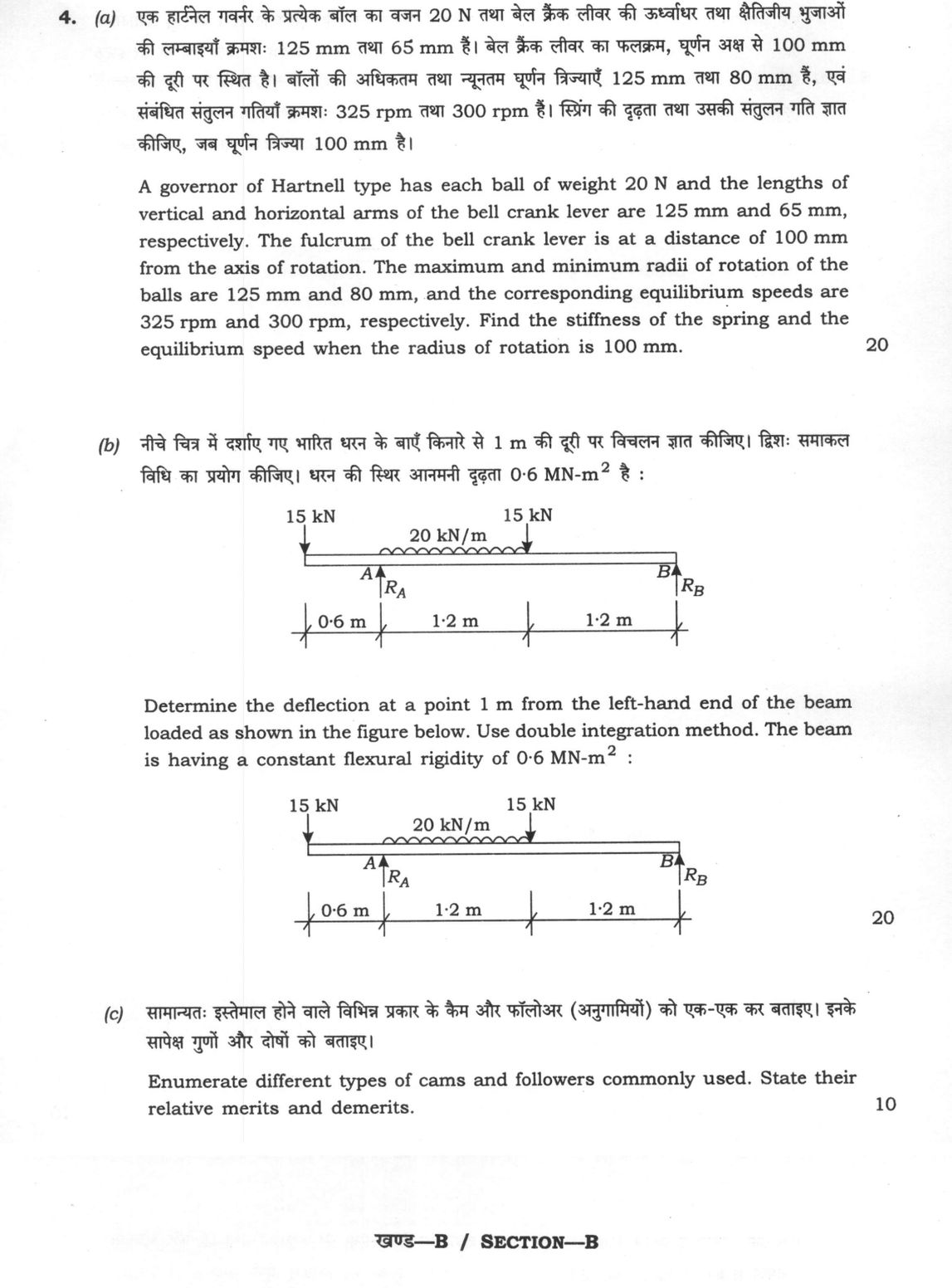
Determine the deflection at a point 1 m from the left-hand end of the beam loaded as shown in the figure below. Use double integration method. The beam is having a constant flexural rigidity of 0·6 MN-m² : 20 marks
Enumerate different types of cams and followers commonly used. State their relative merits and demerits. 10 marks
हिंदी में प्रश्न पढ़ें
एक हार्टनेल गवर्नर के प्रत्येक बॉल का वजन 20 N तथा बेल क्रैंक लीवर की उद्धवर्ध तथा क्षैतिजीय भुजाओं की लम्बाइयाँ क्रमशः 125 mm तथा 65 mm हैं। बेल क्रैंक लीवर का फलक्रम, घूर्णन अक्ष से 100 mm की दूरी पर स्थित है। बॉलों की अधिकतम तथा न्यूनतम घूर्णन त्रिज्याएँ 125 mm तथा 80 mm हैं, एवं संबंधित संतुलन गतियाँ क्रमशः 325 rpm तथा 300 rpm हैं। स्प्रिंग की दृढ़ता तथा उसकी संतुलन गति ज्ञात कीजिए, जब घूर्णन त्रिज्या 100 mm है। (20 अंक)
नीचे चित्र में दर्शाए गए भारित धरन के बाएँ किनारे से 1 m की दूरी पर विचलन ज्ञात कीजिए। दिशा: समाकल विधि का प्रयोग कीजिए। धरन की स्थिर आनमनी दृढ़ता 0·6 MN-m² है : (20 अंक)
सामान्यतः इस्तेमाल होने वाले विभिन्न प्रकार के कैम और फॉलोअर (अनुगामियों) को एक-एक कर बताइए। इनके सापेक्ष गुणों और दोषों को बताइए। (10 अंक)
The figure this question refers to, in words
The question paper is a scan and the diagram did not survive as text. This is the figure as read from the original page — every component, value and label — so the question can be worked from the text below.
(b) A horizontal beam with supports at points A and B. Point A is a pin support located 0.6 m from the left end. Point B is a roller support at the right end. The total length of the beam is 3.0 m. The beam is subjected to the following loads: 1. A downward point load of 15 kN at the left end (0.6 m to the left of A). 2. A uniformly distributed load (UDL) of 20 kN/m acting downwards over the central span between A and the point where the UDL ends. The UDL starts at A and extends 1.2 m to the right. 3. A downward point load of 15 kN located at the end of the UDL (1.2 m to the right of A). The distance from the end of the UDL to support B is 1.2 m. The reaction at A is labeled RA and the reaction at B is labeled RB. The flexural rigidity is given as 0.6 MN-m^2.
What "Solve" is asking you to do
Choose the method, then carry it through to a final answer. Identifying what kind of problem this is and why that method applies is the first thing marked; a correct figure arrived at invisibly earns almost nothing.
Structure that answers it
Given data and what is required → method chosen, with the reason it applies → set-up (equation, circuit, free body, trial balance) → working, step by step → answer with units and any condition of validity
Where marks are lost
Doing the middle steps mentally and writing only the result. In mathematics papers, a further loss comes from giving a decimal where the exact value in surds or fractions was wanted, or from skipping the justification a part explicitly asks for.
How this answer will be evaluated
Approach
(a) calculate: given > formula > substitution > result with units > interpretation | (b) calculate: given > formula > substitution > result with units > interpretation | (c) enumerate: list the items in order > one line each > no commentary Full marks: Rigorous derivations, correct units, clear diagrams, and physical interpretation of results.
Key points expected
- Free body diagram of bell crank lever
- Moment equilibrium equation including centrifugal force
- Two simultaneous equations for spring force
- Interpolation for speed at intermediate radius
- Calculation of support reactions RA and RB
- Bending moment equation M(x) with singularity functions
- Double integration to find slope and deflection
- Application of boundary conditions for constants
Evaluation rubric
Each sub-part is marked on its own, against the marks and word limit printed on the paper.
- (a) Spring stiffness and equilibrium speed at 100 mm radius. 20 marks
calculate— given → formula → substitution → result with units → interpretation
Must cover
- Free body diagram of bell crank lever
- Moment equilibrium equation including centrifugal force
- Two simultaneous equations for spring force
- Interpolation for speed at intermediate radius
Loses marks
- Omitting spring force in moment balance
- Incorrect lever arm ratios
Earns more
- Explicit calculation of centrifugal force
- Unit conversion for angular velocity
Extra mark
- Verification of spring compression
- (b) Deflection at 1 m from left end using double integration. 20 marks
calculate— given → formula → substitution → result with units → interpretation
Must cover
- Calculation of support reactions RA and RB
- Bending moment equation M(x) with singularity functions
- Double integration to find slope and deflection
- Application of boundary conditions for constants
Loses marks
- Incorrect moment equation for overhang
- Failure to apply boundary conditions
Earns more
- Correct handling of distributed load limits
- Clear definition of coordinate system
Extra mark
- Sketch of deflected shape
- (c) List cam and follower types with merits and demerits. 10 marks
enumerate— list the items in order → one line each → no commentary
Must cover
- List of common cam types (e.g., disk, cylindrical)
- List of common follower types (e.g., knife-edge, roller)
- Merits and demerits for each type
Loses marks
- Listing types without merits/demerits
- Confusing cam and follower types
Earns more
- Mention of specific applications
- Comparison of wear characteristics
Extra mark
- Sketch of a specific cam profile
Model answer coming soon
Every evaluation on this site is marked against a verified model answer. This question's answer is still being written; evaluation opens the moment it lands.
More from Mechanical Engineering 2024 Paper I
- Q1 (a) A rod of length 2 m and weight 450 N rests on ground at one end. The other end is sup…
- Q2 (a) Bodies A, B and C of weights 100 N, 200 N and 150 N, respectively are connected as sh…
- Q3 (a) Show the loading on the beams corresponding to the bending moment diagrams shown belo…
- Q4 (a) A governor of Hartnell type has each ball of weight 20 N and the lengths of vertical…
- Q5 (a) A cutting tool is used to machine alloy steel at cutting speed of 40 m/min. Consideri…
- Q6 (a) A perfectly plastic material having yield strength of 300 MPa is subjected to extrusi…
- Q7 (a) An orthogonal cutting of metal is performed using cutting speed of 120 m/min, tool ra…