Paper I — Q8
(a) Explain the principle of electric discharge machining (EDM) using suitable diagram. Describe the effect of process parameters…
Explain the principle of electric discharge machining (EDM) using suitable diagram. Describe the effect of process parameters of electric discharge machining on process performance characteristics such as material removal rate, tolerance and surface characteristics. 20 marks
XYZ corporation has given the following information on its capacity, sales and cost:
Current capacity = 100000 units
At current level of operation, its margin of safety is 50% of its break-even point
Contribution margin P/V ratio = 25%
The unutilized capacity at present is 10000 units
Sales price is ₹ 40 per unit
Based on the above information, determine the break-even point in sales volume, fixed costs, variable costs per unit and margin of safety in units. 20 marks
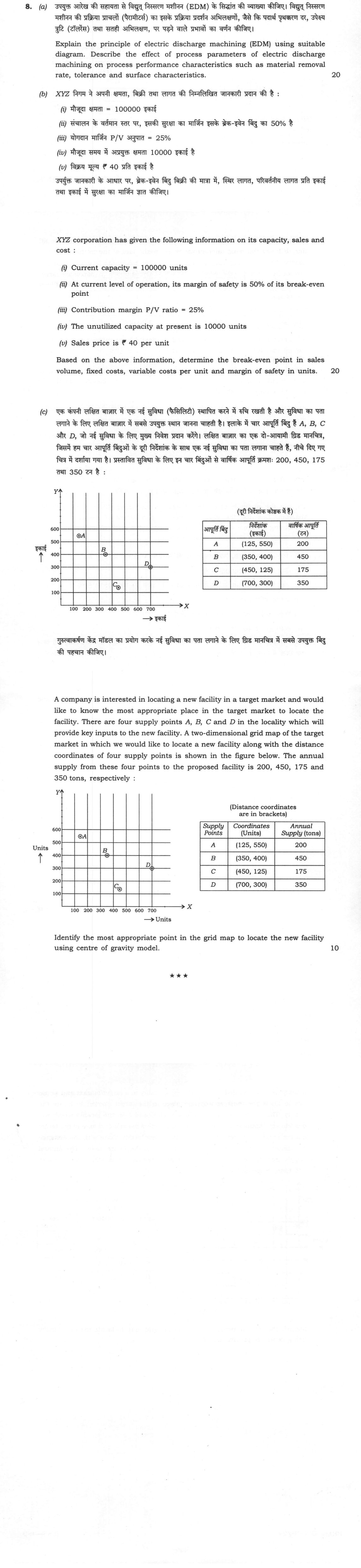
A company is interested in locating a new facility in a target market and would like to know the most appropriate place in the target market to locate the facility. There are four supply points A, B, C and D in the locality which will provide key inputs to the new facility. A two-dimensional grid map of the target market in which we would like to locate a new facility along with the distance coordinates of four supply points is shown in the figure below. The annual supply from these four points to the proposed facility is 200, 450, 175 and 350 tons, respectively:
(Distance coordinates are in brackets)
| Supply Points | Coordinates (Units) | Annual Supply (tons) |
|---|---|---|
| A | (125, 550) | 200 |
| B | (350, 400) | 450 |
| C | (450, 125) | 175 |
| D | (700, 300) | 350 |
Identify the most appropriate point in the grid map to locate the new facility using centre of gravity model. 10 marks
हिंदी में प्रश्न पढ़ें
उपयुक्त आरेख की सहायता से विद्युत निस्सरण मशीन (EDM) के सिद्धांत की व्याख्या कीजिए। विद्युत निस्सरण मशीन की प्रक्रिया प्राचलों (पैरामीटर्स) का इसके प्रक्रिया प्रदर्शन अभिलक्षणों, जैसे कि पदार्थ पृथक्करण दर, उपेक्ष्य त्रुटि (टॉलरेंस) तथा सतही अभिलक्षण, पर पड़ने वाले प्रभावों का वर्णन कीजिए। (20 अंक)
XYZ निगम ने अपनी क्षमता, बिक्री तथा लागत की निम्नलिखित जानकारी प्रदान की है :
मौजूदा क्षमता = 100000 इकाई
संचालन के वर्तमान स्तर पर, इसकी सुरक्षा का मार्जिन इसके ब्रेक-ईवेन बिंदु का 50% है
योगदान मार्जिन P/V अनुपात = 25%
मौजूदा समय में अप्रयुक्त क्षमता 10000 इकाई है
विक्रय मूल्य ₹ 40 प्रति इकाई है
उपर्युक्त जानकारी के आधार पर, ब्रेक-ईवेन बिंदु बिक्री की मात्रा में, स्थिर लागत, परिवर्तनीय लागत प्रति इकाई तथा इकाई में सुरक्षा का मार्जिन ज्ञात कीजिए। (20 अंक)
एक कंपनी लक्षित बाजार में एक नई सुविधा (फैसिलिटी) स्थापित करने में रुचि रखती है और सुविधा का पता लगाने के लिए लक्षित बाजार में सबसे उपयुक्त स्थान जानना चाहती है। इलाके में चार आपूर्ति बिंदु हैं A, B, C और D, जो नई सुविधा के लिए मुख्य निवेश प्रदान करेंगे। लक्षित बाजार का एक दो-आयामी ग्रिड मानचित्र, जिसमें हम चार आपूर्ति बिंदुओं के दूरी निर्देशांक के साथ एक नई सुविधा का पता लगाना चाहते हैं, नीचे दिए गए चित्र में दर्शाया गया है। प्रस्तावित सुविधा के लिए इन चार बिंदुओं से वार्षिक आपूर्ति क्रमशः: 200, 450, 175 तथा 350 टन है :
(दूरी निर्देशांक कोष्ठक में हैं)
| आपूर्ति बिंदु | निर्देशांक (इकाई) | वार्षिक आपूर्ति (टन) |
|---|---|---|
| A | (125, 550) | 200 |
| B | (350, 400) | 450 |
| C | (450, 125) | 175 |
| D | (700, 300) | 350 |
गुरुत्वाकर्षण केंद्र मॉडल का प्रयोग करके नई सुविधा का पता लगाने के लिए ग्रिड मानचित्र में सबसे उपयुक्त बिंदु की पहचान कीजिए। (10 अंक)
The figure this question refers to, in words
The question paper is a scan and the diagram did not survive as text. This is the figure as read from the original page — every component, value and label — so the question can be worked from the text below.
(b) Table with 4 columns and 11 rows. Header row: Sample, No. of Dissatisfied Customers, Sample, No. of Dissatisfied Customers. Row 1: 1, 10, 11, 6. Row 2: 2, 12, 12, 19. Row 3: 3, 8, 13, 10. Row 4: 4, 9, 14, 7. Row 5: 5, 6, 15, 8. Row 6: 6, 11, 16, 4. Row 7: 7, 13, 17, 11. Row 8: 8, 10, 18, 10. Row 9: 9, 8, 19, 6. Row 10: 10, 9, 20, 7.
(c) A two-dimensional Cartesian grid map with an X-axis and a Y-axis, both labeled 'Units'. The X-axis has tick marks at 100, 200, 300, 400, 500, 600, and 700. The Y-axis has tick marks at 100, 200, 300, 400, 500, and 600. Four points are plotted on the grid: Point A is located at coordinates (125, 550); Point B is located at coordinates (350, 400); Point C is located at coordinates (450, 125); and Point D is located at coordinates (700, 300). Each point is marked with a small circle and labeled with its corresponding letter.
Model answer
Written by UPSC Answer Check against this question's marking rubric, to the expected length. UPSC does not publish answers for Mains — this is one way to score well, not an official key.
Part (a) Electric discharge machining removes material by controlled thermal erosion, not by mechanical cutting. A conductive tool electrode and workpiece are held apart by a small dielectric-filled gap; a pulse generator applies short high-voltage pulses across the gap. When the dielectric breaks down, a spark discharge occurs, locally heating the workpiece to melting/vapourisation temperature. A tiny volume of metal is ejected, and the dielectric flushes debris, cools the zone and re-insulates the gap. A servo system maintains the gap by feeding the tool according to discharge conditions. In a suitable diagram, the tank contains dielectric, a pump circulates it, the pulse-generator circuit connects the tool and workpiece, and the tool-workpiece gap is shown. The tool is generally made cathode and workpiece anode for many materials, though polarity can be changed to control wear.
Process parameters control energy per spark and gap stability. Increasing pulse on-time or peak current raises energy per discharge, so material removal rate increases, but larger craters, deeper recast layer, higher surface roughness, more electrode wear and poorer tolerance follow. Higher gap voltage also increases spark energy and MRR, but excessive voltage causes arcing, irregular craters and worse finish. Longer pulse off-time improves flushing and dielectric recovery, reducing arcing and improving surface finish and dimensional tolerance, but it lowers MRR. Adequate flushing pressure and dielectric properties remove eroded particles, maintain a stable gap, and improve surface characteristics; poor flushing causes short circuits and rough surface. Thus EDM involves a trade-off: high MRR is obtained with high current and long on-time, while fine finish, tight tolerance and low wear require low current, short on-time, longer off-time and good flushing.
Part (b) Current capacity is 100,000 units and unutilised capacity is 10,000 units, so current sales volume is 90,000 units. Margin of safety (MOS) is given as 50% of break-even point (BEP). Since MOS = Sales − BEP, let BEP = x. Then 0.5x = 90,000 − x, giving 1.5x = 90,000 and x = 60,000 units. Hence BEP in sales volume is 60,000 units and MOS is 90,000 − 60,000 = 30,000 units. The P/V ratio is 25%, so contribution per unit is 25% of selling price ₹40, i.e. ₹10 per unit. Variable cost per unit is therefore ₹40 − ₹10 = ₹30. At break-even, total contribution equals fixed cost; fixed cost = 60,000 × ₹10 = ₹6,00,000. Thus fixed costs are ₹6,00,000, variable cost is ₹30 per unit, BEP is 60,000 units and MOS is 30,000 units.
Part (c) The centre of gravity model chooses the facility location that minimises weighted transportation distance by using supply quantities as weights. The coordinates and weights are: A (125,550) with 200 t; B (350,400) with 450 t; C (450,125) with 175 t; D (700,300) with 350 t. Total supply W = 200 + 450 + 175 + 350 = 1,175 tons. The weighted x-coordinate is X̄ = (200×125 + 450×350 + 175×450 + 350×700)/1,175 = (25,000 + 1,57,500 + 78,750 + 2,45,000)/1,175 = 5,06,250/1,175 = 430.85 units. The weighted y-coordinate is Ȳ = (200×550 + 450×400 + 175×125 + 350×300)/1,175 = (1,10,000 + 1,80,000 + 21,875 + 1,05,000)/1,175 = 4,16,875/1,175 = 354.79 units. Therefore the most appropriate point on the grid is approximately (431, 355). This point lies nearer to the high-supply points B and D, showing that the solution is sensitive to the weight distribution; if supplies change, the centre of gravity should be recalculated.
What "Explain" is asking you to do
Make the working of something clear — what sets it off, what follows from what, and what it produces. Explain is the Commission's mechanism word: it dominates the technical papers and the “explain why” stems, where the marks sit in the causal chain and not in the label.
Structure that answers it
State what it is → the initiating condition → the chain of cause, step by step → an instance where it plays out → what the chain produces
Where marks are lost
Describing what something looks like instead of why it works that way. Naming the stages without linking them reads as description too.
How this answer will be evaluated
Approach
(a) explain: definition/context > points in order > small example > short close | (b) calculate: given > formula > substitution > result with units > interpretation | (c) map: locate accurately > label > one line on why it matters Full marks: Accurate calculations, clear diagrams, and correct application of models.
Key points expected
- Principle: thermal removal via spark discharge
- Suitable diagram of EDM setup
- Effect of parameters on MRR
- Effect on tolerance and surface finish
- Current sales volume calculation (90,000 units)
- Break-even point in sales volume
- Fixed costs calculation
- Variable cost per unit calculation
Evaluation rubric
Each sub-part is marked on its own, against the marks and word limit printed on the paper.
- (a) Principle of EDM and effect of parameters on performance. 20 marks
explain— definition/context → points in order → small example → short close
Must cover
- Principle: thermal removal via spark discharge
- Suitable diagram of EDM setup
- Effect of parameters on MRR
- Effect on tolerance and surface finish
Loses marks
- No diagram provided
- Confusing EDM with electrochemical machining
Earns more
- Mention of dielectric fluid role
- Link between pulse energy and MRR
Extra mark
- Mention of recast layer or white layer
- (b) Determine BEP, fixed costs, variable costs, and margin of safety. 20 marks
calculate— given → formula → substitution → result with units → interpretation
Must cover
- Current sales volume calculation (90,000 units)
- Break-even point in sales volume
- Fixed costs calculation
- Variable cost per unit calculation
Loses marks
- Incorrect interpretation of margin of safety
- Arithmetic errors in cost calculations
Earns more
- Margin of safety in units calculation
- Use of P/V ratio formula
Extra mark
- Break-even point in sales value
- (c) Locate facility using centre of gravity model. 10 marks
map— locate accurately → label → one line on why it matters
Must cover
- Centre of gravity formula application
- Calculation of X coordinate
- Calculation of Y coordinate
- Identification of point on grid
Loses marks
- Ignoring weights (annual supply)
- Incorrect coordinate calculation
Earns more
- Tabulation of weighted coordinates
Extra mark
- Discussion of transportation cost minimization
Practice this exact question
Write your answer and it is marked point by point against the model answer above — what you covered, what you missed, what you got wrong.
Evaluate my answer →More from Mechanical Engineering 2024 Paper I
- Q5 (a) A cutting tool is used to machine alloy steel at cutting speed of 40 m/min. Consideri…
- Q6 (a) A perfectly plastic material having yield strength of 300 MPa is subjected to extrusi…
- Q7 (a) An orthogonal cutting of metal is performed using cutting speed of 120 m/min, tool ra…
- Q8 (a) Explain the principle of electric discharge machining (EDM) using suitable diagram. D…