Paper I — Q2
(a) Bodies A, B and C of weights 100 N, 200 N and 150 N, respectively are connected as shown. If released from rest, what would…
Bodies A, B and C of weights 100 N, 200 N and 150 N, respectively are connected as shown. If released from rest, what would be their respective velocities after 1 s? The pulleys are massless : 20 marks
The turning moment curve for one revolution of a multicylinder engine above and below the line of mean resisting torque are given by –30, +360, –250, +300, –300, +250, –380, +260 and –210 mm². The vertical and horizontal scales are 1 mm = 600 N-m and 1 mm = 5°, respectively. The fluctuation of speed is limited to ±1·5% of mean speed which is 250 rpm. The hoop stress in rim material is limited to 10 N/mm². Neglecting the effect of boss and arms, determine the suitable diameter and cross-section of flywheel rim. The density of rim material is 7200 kg/m³. Assume width of rim equal to four times its thickness. 20 marks
Calculate the packing efficiency and packing density of carbon if mass of carbon atom is 1·992×10⁻²⁶ kg and unit cell side (a) is 3·57×10⁻¹⁰ m. Assume crystal structure of carbon as diamond cubic. 10 marks
हिंदी में प्रश्न पढ़ें
पिंड A, B तथा C, जिनके वजन क्रमशः 100 N, 200 N तथा 150 N हैं, नीचे दर्शाए अनुसार जुड़े हैं। यदि इन्हें विराम की स्थिति से छोड़ दिया जाए, तो इनका वेग 1 s के बाद क्या होगा? घिरनियाँ द्रव्यमान रहित हैं : (20 अंक)
एक बहु-सिलिंडर इंजन के एक चक्र के लिए वर्तन-आघूर्ण आरेख माध्य प्रतिरोधी बल-आघूर्ण रेखा के ऊपर और नीचे दिए गए हैं, जो –30, +360, –250, +300, –300, +250, –380, +260 तथा –210 mm² हैं। उद्वधर पैमाना 1 mm = 600 N-m तथा क्षैतिज पैमाना 1 mm = 5° है। चाल का उच्चावचन माध्य गति के ±1·5% तक सीमित है जो कि 250 rpm है। रिम के पदार्थ में परिधीय प्रतिबल 10 N/mm² तक सीमित है। बाँस तथा भुजाओं के प्रभाव को नगण्य मानते हुए गतिपालक चक्र के रिम का उपयुक्त व्यास तथा अनुप्रस्थ काट ज्ञात कीजिए। रिम के पदार्थ का घनत्व 7200 kg/m³ है। रिम की चौड़ाई को उसकी मोटाई का चार गुना मान लीजिए। (20 अंक)
यदि कार्बन परमाणु का द्रव्यमान 1·992×10⁻²⁶ kg तथा इकाई कोशिका (सेल) पार्श्व (a) 3·57×10⁻¹⁰ m है, तो कार्बन की पैकिंग दक्षता तथा पैकिंग घनत्व ज्ञात कीजिए। कार्बन की क्रिस्टल संरचना को घनीय हीरक (डायमंड क्यूबिक) मान लीजिए। (10 अंक)
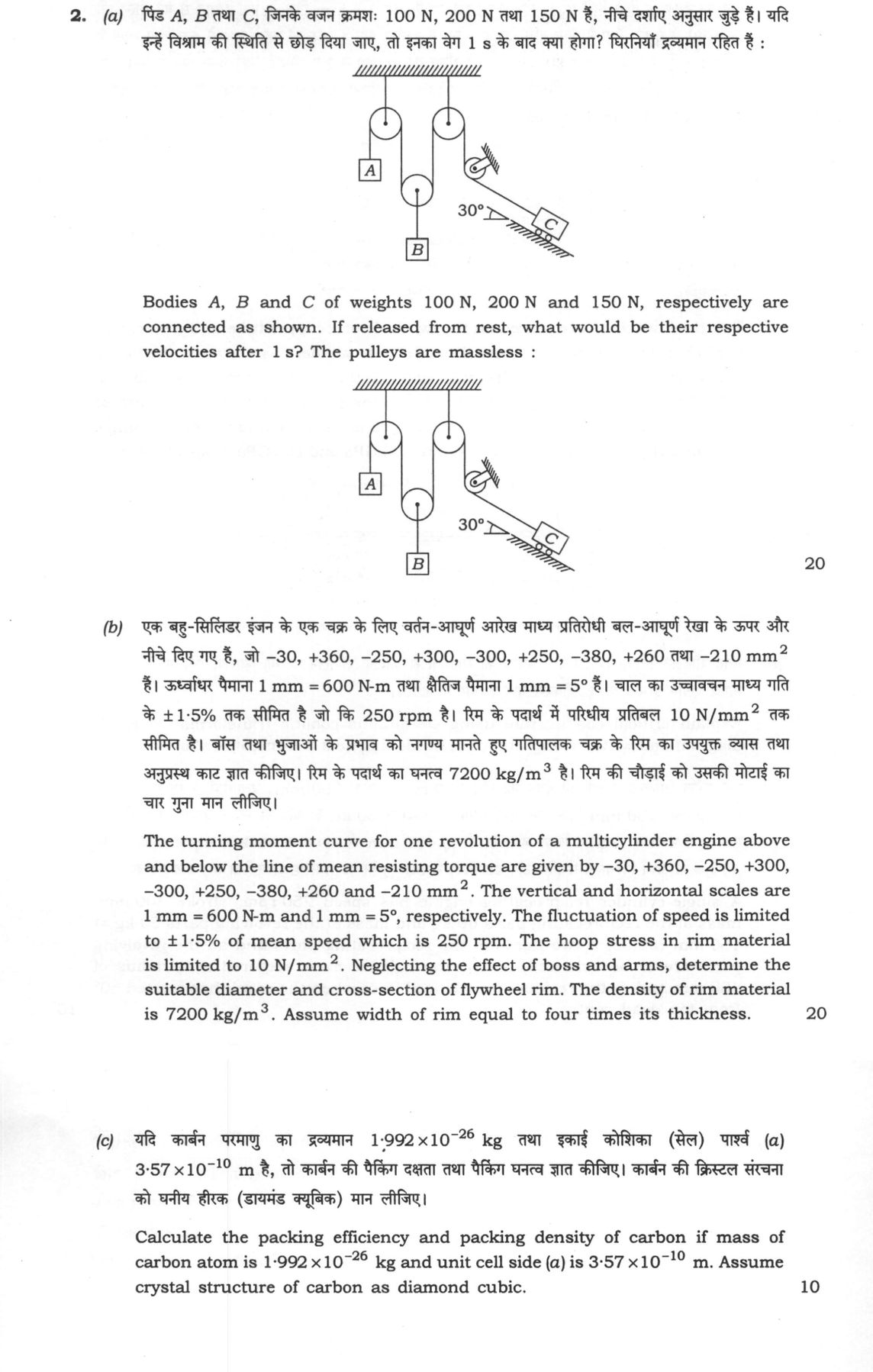
The figure this question refers to, in words
The question paper is a scan and the diagram did not survive as text. This is the figure as read from the original page — every component, value and label — so the question can be worked from the text below.
(a) A pulley and cable system connecting three bodies: A, B, and C.
- A horizontal rigid ceiling at the top supports two fixed pulleys via vertical brackets: a left fixed pulley and a right fixed pulley.
- A movable pulley is suspended between the two fixed pulleys, and body B is suspended vertically from the axle of this movable pulley.
- Body A hangs vertically from the cable end descending from the left side of the left fixed pulley.
- A continuous cable runs from body A, vertically up over the left fixed pulley, down and around the movable pulley carrying body B, vertically up and over the right fixed pulley, and then downwards towards an inclined plane.
- An inclined plane is inclined at an angle of 30 degrees to the horizontal.
- A third fixed pulley is mounted on a bracket at the top of this 30-degree inclined plane.
- The cable wraps around this third pulley and runs parallel to the inclined surface, connecting to body C, which is a block mounted on wheels resting on the 30-degree incline.
(b) A rectangular plate subjected to a biaxial state of plane stress with a central circular hole. The central circular hole is drawn with a dashed circular line having dashed horizontal and vertical centerlines, with a diameter dimension line labelled '250 mm'. The rectangular plate is subjected to the following stresses on its boundaries:
- Tensile direct stress along the x-direction: normal arrows directed outward from the left and right vertical edges, each labelled '20 MN/m^2'.
- Tensile direct stress along the y-direction: normal arrows directed outward from the top and bottom horizontal edges, each labelled '10 MN/m^2'.
- Shear stress of magnitude '7.5 MN/m^2' acting on all four edges: an arrow pointing to the left along the top edge, an arrow pointing upwards along the left edge, an arrow pointing to the right along the bottom edge, and an arrow pointing downwards along the right edge.
Model answer
Written by UPSC Answer Check against this question's marking rubric, to the expected length. UPSC does not publish answers for Mains — this is one way to score well, not an official key.
(a) Let T be the common cable tension. Take downward motion of A and B as positive, and motion of C up the 30° incline as positive. Since the cable is inextensible, displacement of C up incline = displacement of A down + 2 × displacement of B down. Hence aC = aA + 2aB.
Newton’s equations: For A: 100 − T = (100/g) aA. For B: 200 − 2T = (200/g) aB. For C: T − 150 sin30° = (150/g) aC, so T − 75 = (150/g) aC.
From the first two equations, aA = g(100 − T)/100, aB = g(200 − 2T)/200 = g(100 − T)/100. Thus aA = aB, and using the constraint, aC = 3aA = 3g(100 − T)/100.
Substitute in C’s equation: T − 75 = (150/g) × 3g(100 − T)/100 T − 75 = 450 − 4.5T 5.5T = 525 T = 1050/11 N = 95.45 N.
Then aA = aB = g(100 − 1050/11)/100 = g/22, aC = 3g/22.
After 1 s from rest, vA = vB = g/22 = 9.81/22 = 0.446 m/s, vC = 3g/22 = 1.338 m/s.
Final (a): vA = 0.446 m/s downward, vB = 0.446 m/s downward, vC = 1.338 m/s up the 30° incline. Assumptions: massless pulleys, inextensible cable, no friction.
(b) The given areas in mm² are: −30, +360, −250, +300, −300, +250, −380, +260, −210. Cumulative energy values, starting from zero: 0, −30, 330, 80, 380, 80, 330, −50, 210, 0. Maximum cumulative energy = 380 mm², minimum = −50 mm². Fluctuation area = 380 − (−50) = 430 mm².
Area scale: 1 mm² = (600 N-m) × (5° in rad) = 600 × (5π/180) = 600π/36 = 50π/3 N-m.
Therefore ΔE = 430 × 50π/3 = 21500π/3 J = 2.251 × 10⁴ J.
Speed fluctuation is ±1.5%, so Cs = 1.015 − 0.985 = 0.03.
Mean angular speed: ω = 2πN/60 = 2π × 250/60 = 25π/3 rad/s.
Flywheel moment of inertia: I = ΔE/(Cs ω²) = (21500π/3) / [ (3/100)(25π/3)² ] = 3440/π kg m² = 1095 kg m².
Hoop stress limiting speed: σ = ρ v². σ = 10 N/mm² = 10 × 10⁶ N/m². v = √(σ/ρ) = √(10 × 10⁶/7200) = 50√5/3 = 37.27 m/s.
Mean diameter: D = 60v/(πN) = 60 × (50√5/3)/(250π) = 4√5/π = 2.847 m.
Mean radius: R = D/2 = 2√5/π = 1.424 m.
Rim mass: m = I/R² = (3440/π)/(20/π²) = 172π kg = 540 kg.
Circumference at mean radius: 2πR = 4√5 m.
Cross-sectional area: A = m/(ρ × 2πR) = 172π/(7200 × 4√5) = 43π/(7200√5) m² = 8.391 × 10⁻³ m² = 8391 mm².
Given width b = 4t and A = bt = 4t², t = √(A/4) = 0.0458 m = 45.8 mm, b = 4t = 0.1832 m = 183.2 mm.
Final (b): Suitable mean diameter = 2.85 m; rim cross-section = 45.8 mm × 183.2 mm (thickness × width). Outer diameter ≈ 2.893 m, inner diameter ≈ 2.801 m. Assumptions: thin rim, boss and arms neglected.
(c) For diamond cubic structure, number of atoms per unit cell = 8. Nearest-neighbour distance = √3 a/4, so atomic radius r = √3 a/8.
Unit cell volume: V = a³ = (3.57 × 10⁻¹⁰)³ = 4.5499293 × 10⁻²⁹ m³.
Volume of atoms per cell: = 8 × (4/3)πr³ = 8 × (4/3)π(√3 a/8)³ = (√3π/16) a³.
Packing efficiency: = (√3π/16) a³ / a³ = √3π/16 = 0.3401 = 34.01%.
Mass per unit cell: = 8 × 1.992 × 10⁻²⁶ kg = 1.5936 × 10⁻²⁵ kg.
Packing density or mass density: ρ = mass per cell / V = 1.5936 × 10⁻²⁵ / 4.5499293 × 10⁻²⁹ = 3502.5 kg/m³ = 3.50 × 10³ kg/m³.
Final (c): Packing efficiency = 34.01%; packing density = 3.50 × 10³ kg/m³. Assumption: atoms are hard spheres touching along the body diagonal of the diamond cubic unit cell.
What "Solve" is asking you to do
Choose the method, then carry it through to a final answer. Identifying what kind of problem this is and why that method applies is the first thing marked; a correct figure arrived at invisibly earns almost nothing.
Structure that answers it
Given data and what is required → method chosen, with the reason it applies → set-up (equation, circuit, free body, trial balance) → working, step by step → answer with units and any condition of validity
Where marks are lost
Doing the middle steps mentally and writing only the result. In mathematics papers, a further loss comes from giving a decimal where the exact value in surds or fractions was wanted, or from skipping the justification a part explicitly asks for.
How this answer will be evaluated
Approach
(a) calculate: given > formula > substitution > result with units > interpretation | (b) calculate: given > formula > substitution > result with units > interpretation | (c) calculate: given > formula > substitution > result with units > interpretation Full marks: All parts solved with clear diagrams, correct equations, and physical interpretation.
Key points expected
- Draw free-body diagrams for A, B, and C
- Establish kinematic constraints between the bodies
- Apply Newton's second law to each mass
- Solve the system of equations for acceleration
- Calculate the maximum fluctuation of energy
- Determine the mass of the flywheel rim
- Apply the hoop stress formula for the rim
- Use the density and width-thickness ratio to find dimensions
Evaluation rubric
Each sub-part is marked on its own, against the marks and word limit printed on the paper.
- (a) Determine the velocities of bodies A, B, and C after 1 second. 20 marks
calculate— given → formula → substitution → result with units → interpretation
Must cover
- Draw free-body diagrams for A, B, and C
- Establish kinematic constraints between the bodies
- Apply Newton's second law to each mass
- Solve the system of equations for acceleration
Loses marks
- Plugging numbers without governing equations
- Ignoring the kinematic constraints of the pulley
- Unmarked states or forces in the diagram
Earns more
- Correctly identify the direction of motion
- State assumptions (massless pulleys, frictionless)
- Check dimensional consistency of forces
- Interpret the physical meaning of the result
Extra mark
- Labelled schematic of the pulley system
- Explicit statement of the tension in each rope
- (b) Determine the suitable diameter and cross-section of the flywheel rim. 20 marks
calculate— given → formula → substitution → result with units → interpretation
Must cover
- Calculate the maximum fluctuation of energy
- Determine the mass of the flywheel rim
- Apply the hoop stress formula for the rim
- Use the density and width-thickness ratio to find dimensions
Loses marks
- Ignoring the effect of the coefficient of fluctuation
- Incorrect conversion of units for torque or energy
- Plugging numbers without the hoop stress formula
Earns more
- Correctly interpret the turning moment curve
- State the formula for coefficient of fluctuation of speed
- Check units for torque and energy
- Interpret the physical significance of the rim size
Extra mark
- Labelled diagram of the flywheel rim
- Explicit calculation of the mean resisting torque
- (c) Calculate the packing efficiency and packing density of carbon. 10 marks
calculate— given → formula → substitution → result with units → interpretation
Must cover
- Identify the number of atoms in a diamond cubic unit cell
- Calculate the volume of the unit cell
- Determine the volume of the atoms in the cell
- Calculate the packing efficiency and density
Loses marks
- Incorrect number of atoms in the unit cell
- Ignoring the relationship between atomic radius and unit cell side
- Plugging numbers without the packing efficiency formula
Earns more
- Correctly identify the diamond cubic structure
- State the formula for packing efficiency
- Check units for mass and volume
- Interpret the physical meaning of packing efficiency
Extra mark
- Labelled diagram of the diamond cubic unit cell
- Explicit calculation of the atomic radius
Practice this exact question
Write your answer and it is marked point by point against the model answer above — what you covered, what you missed, what you got wrong.
Evaluate my answer →More from Mechanical Engineering 2024 Paper I
- Q1 (a) A rod of length 2 m and weight 450 N rests on ground at one end. The other end is sup…
- Q2 (a) Bodies A, B and C of weights 100 N, 200 N and 150 N, respectively are connected as sh…
- Q3 (a) Show the loading on the beams corresponding to the bending moment diagrams shown belo…
- Q4 (a) A governor of Hartnell type has each ball of weight 20 N and the lengths of vertical…
- Q5 (a) A cutting tool is used to machine alloy steel at cutting speed of 40 m/min. Consideri…