Paper I — Q5
(a) A cutting tool is used to machine alloy steel at cutting speed of 40 m/min. Considering the values of constants c and n for…
A cutting tool is used to machine alloy steel at cutting speed of 40 m/min. Considering the values of constants c and n for cutting tool material as 300 and 0·5, respectively as per tool-life equation, calculate the tool life in minutes. If the cutting speed is increased by 80%, then calculate the percentage change in tool life. 10 marks
The stepper motor of a point-to-point controlled NC machine has specification sensitivity of 3°/pulse. The pitch of the lead screw is 2·4 mm. Determine the expected positioning accuracy. 10 marks
A factory working in two shifts, each of 8 hours, produces 28000 tube lights using a set of workstations. Using this information, compute the actual cycle time of the plant operation. There are 6 tasks required to manufacture the tube light. The sum of all task times is equal to 10 seconds. How many workstations are required to maintain this level of production assuming that combining of tasks into those workstations is a feasible alternative? 10 marks
A car manufacturing unit uses large quantities of a component made of steel. The demand is continuous and inventory planning could be done independent of the production plan. The annual demand for the component is 2500 boxes. The company procures the item from a supplier at the rate of ₹ 1,250 per box. The company estimates the cost of carrying inventory to be 20 percent/unit/annum and the cost of ordering as ₹ 1,200 per order. The company works for 250 days in a year. How should the company design an inventory control system for this item? What is the total cost of the plan? 10 marks
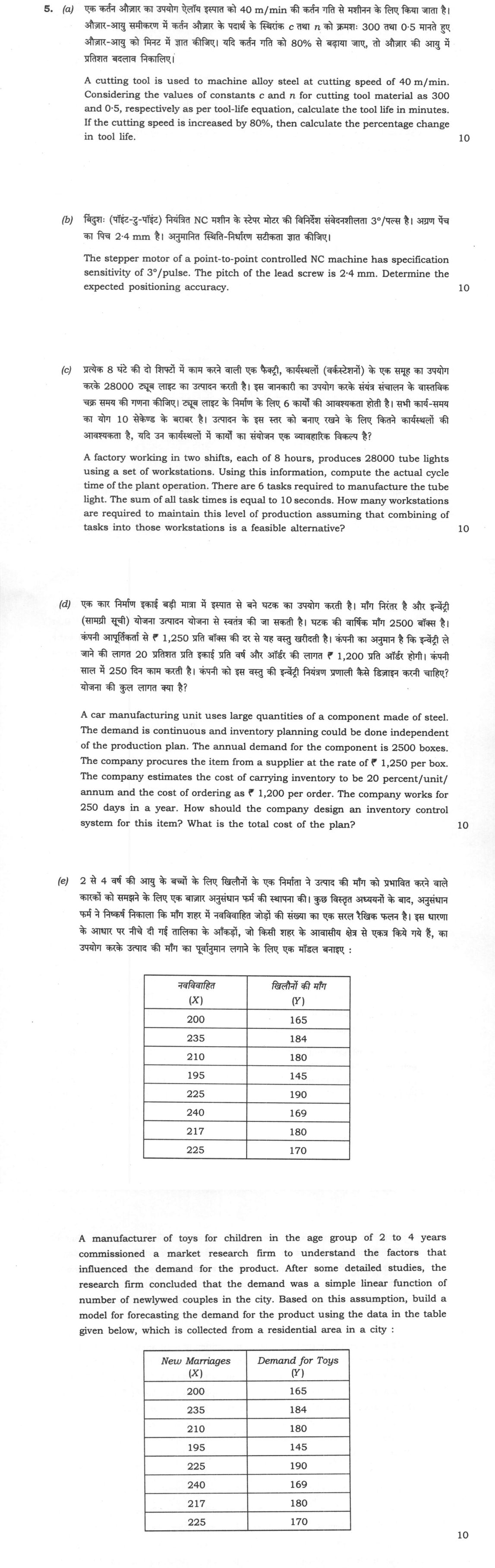
A manufacturer of toys for children in the age group of 2 to 4 years commissioned a market research firm to understand the factors that influenced the demand for the product. After some detailed studies, the research firm concluded that the demand was a simple linear function of number of newlywed couples in the city. Based on this assumption, build a model for forecasting the demand for the product using the data in the table given below, which is collected from a residential area in a city:
| New Marriages (X) | Demand for Toys (Y) |
|---|---|
| 200 | 165 |
| 235 | 184 |
| 210 | 180 |
| 195 | 145 |
| 225 | 190 |
| 240 | 169 |
| 217 | 180 |
| 225 | 170 |
10 marks
हिंदी में प्रश्न पढ़ें
एक कतन औजार का उपयोग ऐलॉय इस्पात को 40 m/min की कतन गति से मशीन के लिए किया जाता है। औजार-आयु समीकरण में कतन औजार के पदार्थ के स्थिरांक c तथा n को क्रमशः 300 तथा 0·5 मानते हुए औजार-आयु को मिनट में ज्ञात कीजिए। यदि कतन गति को 80% से बढ़ाया जाए, तो औजार की आयु में प्रतिशत बदलाव निकालिए। (10 अंक)
बिंदुशः (पॉइंट-टु-पॉइंट) नियंत्रित NC मशीन के स्टेपर मोटर की विभेदक संवेदनशीलता 3°/पल्स है। अग्रण पेंच का पिच 2·4 mm है। अनुमानित स्थिति-निर्धारण सटीकता ज्ञात कीजिए। (10 अंक)
प्रत्येक 8 घंटे की दो शिफ्टों में काम करने वाली एक फैक्ट्री, कार्यस्थलों (वर्कस्टेशनों) के एक समूह का उपयोग करके 28000 ट्यूब लाइट का उत्पादन करती है। इस जानकारी का उपयोग करके संयंत्र संचालन के वास्तविक चक्र समय की गणना कीजिए। ट्यूब लाइट के निर्माण के लिए 6 कार्यों की आवश्यकता होती है। सभी कार्य-समय का योग 10 सेकेंड के बराबर है। उत्पादन के इस स्तर को बनाए रखने के लिए कितने कार्यस्थलों की आवश्यकता है, यदि उन कार्यस्थलों में कार्यों का संयोजन एक व्यावहारिक विकल्प है? (10 अंक)
एक कार निर्माण इकाई बड़ी मात्रा में इस्पात से बने घटक का उपयोग करती है। माँग निरंतर है और इन्वेंट्री (सामग्री सूची) योजना उत्पादन योजना से स्वतंत्र की जा सकती है। घटक की वार्षिक माँग 2500 बॉक्स है। कंपनी आपूर्तिकर्ता से ₹ 1,250 प्रति बॉक्स की दर से यह वस्तु खरीदती है। कंपनी का अनुमान है कि इन्वेंट्री ले जाने की लागत 20 प्रतिशत प्रति इकाई प्रति वर्ष और ऑर्डर की लागत ₹ 1,200 प्रति ऑर्डर होगी। कंपनी साल में 250 दिन काम करती है। कंपनी को इस वस्तु की इन्वेंट्री नियंत्रण प्रणाली कैसे डिजाइन करनी चाहिए? योजना की कुल लागत क्या है? (10 अंक)
2 से 4 वर्ष की आयु के बच्चों के लिए खिलौनों के एक निर्माता ने उत्पाद की माँग को प्रभावित करने वाले कारकों को समझने के लिए एक बाजार अनुसंधान फर्म की स्थापना की। कुछ विस्तृत अध्ययनों के बाद, अनुसंधान फर्म ने निष्कर्ष निकाला कि माँग शहर में नवविवाहित जोड़ों की संख्या का एक सरल रैखिक फलन है। इस धारणा के आधार पर नीचे दी गई तालिका के आँकड़ों, जो किसी शहर के आवासीय क्षेत्र से एकत्र किये गये हैं, का उपयोग करके उत्पाद की माँग का पूर्वानुमान लगाने के लिए एक मॉडल बनाइए:
| नवविवाहित (X) | खिलौनों की माँग (Y) |
|---|---|
| 200 | 165 |
| 235 | 184 |
| 210 | 180 |
| 195 | 145 |
| 225 | 190 |
| 240 | 169 |
| 217 | 180 |
| 225 | 170 |
(10 अंक)
The figure this question refers to, in words
The question paper is a scan and the diagram did not survive as text. This is the figure as read from the original page — every component, value and label — so the question can be worked from the text below.
(e) Table with two columns: New Marriages (X) | Demand for Toys (Y) 200 | 165 235 | 184 210 | 180 195 | 145 225 | 190 240 | 169 217 | 180 225 | 170
Model answer
Written by UPSC Answer Check against this question's marking rubric, to the expected length. UPSC does not publish answers for Mains — this is one way to score well, not an official key.
(a) Use Taylor’s tool-life equation, V Tⁿ = C , where V is cutting speed in m/min, T is tool life in min, C = 300 and n = 0·5 for the given tool material.
At initial cutting speed V₁ = 40 m/min:
40 × T₁⁰·⁵ = 300
T₁⁰·⁵ = 300 / 40 = 7·5
T₁ = 7·5² = 56·25 min
So the initial tool life is 56·25 min.
If cutting speed is increased by 80%, the new speed is:
V₂ = 40 + 0·80 × 40 = 40 × 1·80 = 72 m/min
Again using Taylor’s equation:
72 × T₂⁰·⁵ = 300
T₂⁰·⁵ = 300 / 72 = 25 / 6 = 4·1667
T₂ = (25 / 6)² = 625 / 36 = 17·3611 min
Percentage change in tool life:
= [(T₂ − T₁) / T₁] × 100
= [(17·3611 − 56·25) / 56·25] × 100
= [−38·8889 / 56·25] × 100
= −69·1358%
Therefore, tool life decreases by 69·14%. Final answers: T₁ = 56·25 min, T₂ = 17·36 min, percentage change = −69·14%.
(b) The stepper motor has sensitivity 3°/pulse. Therefore, the number of pulses required for one complete revolution of the motor shaft is:
Pulses per revolution = 360° / 3° per pulse = 120 pulses/rev
The lead screw pitch is 2·4 mm/rev. Assuming the motor is directly coupled to the lead screw and there is no backlash or gear reduction, the linear movement per pulse is:
Linear resolution = pitch / pulses per revolution
= 2·4 mm/rev / 120 pulses/rev
= 0·02 mm/pulse
Thus, one pulse moves the slide by 0·02 mm. Hence the expected positioning accuracy, in the ideal direct-coupled case, is:
Positioning accuracy = 0·02 mm per pulse If expressed as a tolerance about the nearest achievable step, this corresponds to ±0·01 mm under ideal no-backlash conditions.
(c) Available time per day:
Total shifts = 2 shifts/day Each shift = 8 hours
Available time = 2 × 8 × 60 × 60 = 57,600 seconds/day
Assuming 28,000 tube lights are produced per day, the actual cycle time of the plant operation is:
Cycle time = available time / production quantity
= 57,600 s/day / 28,000 units/day
= 2·057142857 s/unit
≈ 2·057 s/unit
The total work content is the sum of all task times:
Σ task times = 10 seconds
The theoretical minimum number of workstations required to maintain this production level is:
N_min = ceil(Σ task times / cycle time)
= ceil(10 / 2·057142857)
= ceil(4·861111)
= 5 workstations
Therefore, the actual cycle time is approximately 2·057 s/unit and the minimum number of workstations required is 5, assuming tasks can be combined feasibly and no single task time exceeds the cycle time.
(d) This is a continuous-review deterministic inventory problem. Use the Economic Order Quantity, EOQ, model.
Given:
Annual demand, D = 2500 boxes/year Unit cost, C = ₹1250/box Ordering cost, S = ₹1200/order Carrying cost rate = 20% per unit per annum Working days = 250 days/year
Carrying cost per box per year:
H = 0·20 × 1250 = ₹250/box/year
EOQ formula:
Q* = √(2DS / H)
Q* = √(2 × 2500 × 1200 / 250)
Q* = √(6,000,000 / 250)
Q* = √24,000
Q* = 20√60 ≈ 154·92 boxes
Rounding to a practical order size:
EOQ ≈ 155 boxes per order
Number of orders per year:
N = D / Q* = 2500 / 154·92 ≈ 16·14 orders/year
Time between orders in working days:
T = (Q* / D) × working days
= (154·92 / 2500) × 250
= 15·49 working days
≈ 15·5 working days
Average inventory:
Q* / 2 = 154·92 / 2 = 77·46 boxes
Daily demand:
d = D / 250 = 2500 / 250 = 10 boxes/day
Annual ordering cost and carrying cost at EOQ:
Total variable inventory cost = √(2DSH)
= √(2 × 2500 × 1200 × 250)
= √1,500,000,000
≈ ₹38,729·83/year
Purchase cost:
= D × C = 2500 × 1250 = ₹31,25,000/year
Total annual cost including purchase:
= ₹31,25,000 + ₹38,729·83
= ₹31,63,729·83/year
Thus, the company should follow a continuous-review EOQ policy: order about 155 boxes every 15·5 working days. The relevant inventory cost is ₹38,729·83/year, and the total annual cost including purchase is ₹31,63,729·83/year. Since lead time is not given, the reorder point cannot be fixed; if lead time is L days and no safety stock is kept, reorder point = 10L boxes.
(e) Let X = number of new marriages in the area and Y = demand for toys. The market research concludes that demand is a simple linear function of X. Therefore, fit a least-squares linear regression model:
Y = a + bX
Using the given data:
n = 8
ΣX = 200 + 235 + 210 + 195 + 225 + 240 + 217 + 225 = 1747
ΣY = 165 + 184 + 180 + 145 + 190 + 169 + 180 + 170 = 1383
ΣX² = 200² + 235² + 210² + 195² + 225² + 240² + 217² + 225²
= 40,000 + 55,225 + 44,100 + 38,025 + 50,625 + 57,600 + 47,089 + 50,625
= 383,289
ΣXY = 200×165 + 235×184 + 210×180 + 195×145 + 225×190 + 240×169 + 217×180 + 225×170
= 33,000 + 43,240 + 37,800 + 28,275 + 42,750 + 40,560 + 39,060 + 38,250
= 302,935
Mean values:
X̄ = ΣX / n = 1747 / 8 = 218·375
Ȳ = ΣY / n = 1383 / 8 = 172·875
The slope b is:
b = [nΣXY − ΣXΣY] / [nΣX² − (ΣX)²]
= [8×302,935 − 1747×1383] / [8×383,289 − 1747²]
= [2,423,480 − 2,416,101] / [3,066,312 − 3,052,009]
= 7,379 / 14,303
= 0·515906
The intercept a is:
a = Ȳ − bX̄
= 172·875 − 0·515906 × 218·375
= 172·875 − 112·6609
= 60·2141
Hence the forecasting model is:
Y = 60·2141 + 0·515906X
where X is the number of new marriages and Y is the predicted demand for toys.
Interpretation: each additional newlywed couple increases toy demand by about 0·516 toys, and the model has a mathematical base demand of about 60·214 toys at X = 0, though this value should not be interpreted outside the observed range. The model is valid approximately for X between 195 and 240 new marriages. For example, if X = 220, predicted demand is:
Y = 60·2141 + 0·515906 × 220
= 60·2141 + 113·4993
= 173·71 toys
What "Calculate" is asking you to do
Apply the standard formula or schedule to data the question has already supplied — a table of readings, cost records, a balance sheet — and produce the number. The method is rarely in doubt; the marks sit in the named intermediate quantities, each of which has to appear as a labelled line.
Structure that answers it
Data as given → formula or standard treatment, named → substitution → each intermediate, labelled → result with units
Where marks are lost
Omitting an intermediate the marking scheme pays for separately, or rounding at an intermediate line so the final figure drifts. In commerce and accountancy, any figure in a statement that no numbered working note supports is treated as unearned.
How this answer will be evaluated
Approach
(a) calculate: given > formula > substitution > result with units > interpretation | (b) calculate: given > formula > substitution > result with units > interpretation | (c) calculate: given > formula > substitution > result with units > interpretation | (d) calculate: given > formula > substitution > result with units > interpretation | (e) calculate: given > formula > substitution > result with units > interpretation Full marks: All parts show complete method with correct formulas, substitutions, and final answers with units; no arithmetic errors.
Key points expected
- State Taylor's tool life equation V^n T = C
- Substitute V=40, C=300, n=0.5 to find T1
- Calculate new speed V2 = 40 + 80% of 40
- Compute T2 and percentage change in tool life
- State relationship between pulse angle and linear movement
- Convert 3°/pulse to fraction of full rotation (3/360)
- Multiply by lead screw pitch (2.4 mm)
- State final accuracy in mm
Evaluation rubric
Each sub-part is marked on its own, against the marks and word limit printed on the paper.
- (a) Tool life at initial speed and percentage change at increased speed. 10 marks
calculate— given → formula → substitution → result with units → interpretation
Must cover
- State Taylor's tool life equation V^n T = C
- Substitute V=40, C=300, n=0.5 to find T1
- Calculate new speed V2 = 40 + 80% of 40
- Compute T2 and percentage change in tool life
Loses marks
- Using wrong exponent for speed ratio
- Forgetting to convert percentage increase to absolute speed
Earns more
- Explicitly show the ratio T2/T1 = (V1/V2)^n
- State units for tool life (minutes)
Extra mark
- Mention physical interpretation of n value
- (b) Expected positioning accuracy of the NC machine. 10 marks
calculate— given → formula → substitution → result with units → interpretation
Must cover
- State relationship between pulse angle and linear movement
- Convert 3°/pulse to fraction of full rotation (3/360)
- Multiply by lead screw pitch (2.4 mm)
- State final accuracy in mm
Loses marks
- Confusing pitch with diameter
- Incorrect conversion of degrees to linear distance
Earns more
- Define positioning accuracy as resolution per pulse
- Show dimensional consistency in calculation
Extra mark
- Mention factors affecting actual accuracy (backlash, friction)
- (c) Actual cycle time and number of workstations required. 10 marks
calculate— given → formula → substitution → result with units → interpretation
Must cover
- Calculate total available time (2 shifts × 8 hours)
- Compute cycle time = Total time / Total output
- Use formula N = Sum of task times / Cycle time
- Round up to nearest integer for workstations
Loses marks
- Rounding down the number of workstations
- Using only one shift's time for calculation
Earns more
- Show conversion of hours to seconds
- State assumption about feasible task combination
Extra mark
- Mention line balancing efficiency calculation
- (d) Inventory control system design and total cost of the plan. 10 marks
calculate— given → formula → substitution → result with units → interpretation
Must cover
- Identify EOQ model as appropriate for continuous demand
- Calculate EOQ = sqrt(2DS/H) with given values
- Compute total annual cost (ordering + carrying)
- Determine reorder point or order frequency
Loses marks
- Using wrong formula for EOQ
- Forgetting to include both ordering and carrying costs in total
Earns more
- State assumptions of EOQ model
- Show calculation of carrying cost per unit (20% of 1250)
Extra mark
- Mention safety stock considerations
- Calculate number of orders per year
- (e) Linear regression model for forecasting toy demand. 10 marks
calculate— given → formula → substitution → result with units → interpretation
Must cover
- Calculate means of X and Y from given data
- Compute slope b = Σ(X-X̄)(Y-Ȳ) / Σ(X-X̄)²
- Compute intercept a = Ȳ - bX̄
- Write final regression equation Y = a + bX
Loses marks
- Using wrong formula for slope or intercept
- Arithmetic errors in summation calculations
Earns more
- Show calculation of ΣX, ΣY, ΣXY, ΣX²
- State the model as simple linear regression
Extra mark
- Calculate correlation coefficient r
- Provide one forecast example using the model
Practice this exact question
Write your answer and it is marked point by point against the model answer above — what you covered, what you missed, what you got wrong.
Evaluate my answer →More from Mechanical Engineering 2024 Paper I
- Q2 (a) Bodies A, B and C of weights 100 N, 200 N and 150 N, respectively are connected as sh…
- Q3 (a) Show the loading on the beams corresponding to the bending moment diagrams shown belo…
- Q4 (a) A governor of Hartnell type has each ball of weight 20 N and the lengths of vertical…
- Q5 (a) A cutting tool is used to machine alloy steel at cutting speed of 40 m/min. Consideri…
- Q6 (a) A perfectly plastic material having yield strength of 300 MPa is subjected to extrusi…
- Q7 (a) An orthogonal cutting of metal is performed using cutting speed of 120 m/min, tool ra…
- Q8 (a) Explain the principle of electric discharge machining (EDM) using suitable diagram. D…