Paper I — Q1
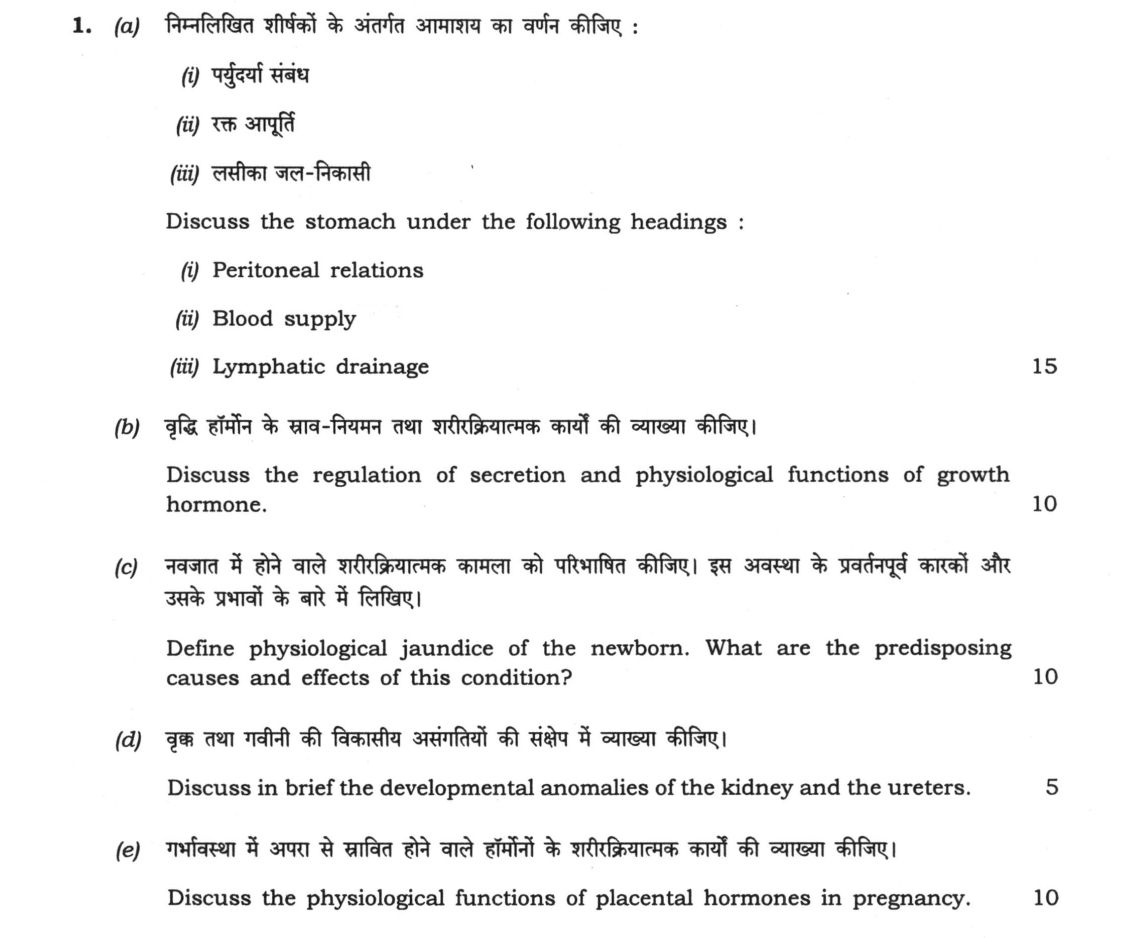
(a) Discuss the stomach under the following headings: (i) Peritoneal relations (ii) Blood supply (iii) Lymphatic drainage (15…
Discuss the stomach under the following headings: (i) Peritoneal relations (ii) Blood supply (iii) Lymphatic drainage 15 marks
Discuss the regulation of secretion and physiological functions of growth hormone. 10 marks
Define physiological jaundice of the newborn. What are the predisposing causes and effects of this condition? 10 marks
Discuss in brief the developmental anomalies of the kidney and the ureters. 5 marks
Discuss the physiological functions of placental hormones in pregnancy. 10 marks
हिंदी में प्रश्न पढ़ें
निम्नलिखित शीर्षकों के अंतर्गत आमाशय का वर्णन कीजिए : (i) पर्दुयाँ संबंध (ii) रक्त आपूर्ति (iii) लसीका जल-निकासी 15 marks
वृद्धि हार्मोन के स्राव-नियमन तथा शारीरक्रियात्मक कार्यों की व्याख्या कीजिए। 10 marks
नवजात में होने वाले शारीरक्रियात्मक कामला को परिभाषित कीजिए। इस अवस्था के प्रवर्तनपूर्व कारकों और उसके प्रभावों के बारे में लिखिए। 10 marks
वृक्क तथा गवीनी की विकासीय असंगतियों की संक्षेप में व्याख्या कीजिए। 5 marks
गर्भावस्था में अपरा से स्रावित होने वाले हार्मोनों के शारीरक्रियात्मक कार्यों की व्याख्या कीजिए। 10 marks
Model answer
Written by UPSC Answer Check against this question's marking rubric, to the expected length. UPSC does not publish answers for Mains — this is one way to score well, not an official key.
The stomach is an intraperitoneal organ whose relations, vascular and lymphatic anatomy determine its surgical approach. Peritoneal relations: Its anterior surface is related to the diaphragm, liver and anterior abdominal wall, while the posterior wall lies against the lesser sac and the pancreas, spleen, left kidney, left adrenal and transverse mesocolon. The fundus lies beneath the left dome of the diaphragm and may contact the spleen and left colic flexure. The stomach is mobile because of its omental attachments, but the cardia and pylorus are relatively fixed by the gastroesophageal and duodenal junctions. The lesser curvature is attached to the lesser omentum, which continues as the hepatogastric ligament to the liver, and the greater curvature is suspended by the greater omentum. These peritoneal folds enclose the stomach within the peritoneal cavity and provide routes for vessels and lymphatics. Blood supply: The stomach receives arterial blood from the coeliac trunk. The left gastric artery supplies the lesser curvature; the splenic artery gives short gastric arteries to the fundus and the left gastroepiploic artery to the greater curvature; the common hepatic artery gives the right gastric artery and, through the gastroduodenal artery, the right gastroepiploic artery. These arteries form a rich submucosal plexus, which explains the stomach’s tolerance to partial devascularisation. Venous drainage follows the left gastric, gastroepiploic and short gastric veins into the portal system. Lymphatic drainage: Lymph from the lesser curvature drains to the left gastric nodes, from the greater curvature to the right and left gastroepiploic nodes, from the fundus to the splenic nodes, and from the cardia to the paraesophageal nodes. These channels converge on the coeliac nodes, which are clinically important in gastric carcinoma staging and guide lymphadenectomy in surgery.
Growth hormone regulation and functions: Growth hormone is secreted by anterior pituitary somatotrophs in a pulsatile manner, especially during slow-wave sleep, exercise, stress and hypoglycaemia, and is modified by nutritional state. The hypothalamus controls it through growth hormone-releasing hormone, which stimulates secretion, and somatostatin, which inhibits it. Liver-derived insulin-like growth factor-1 provides negative feedback on both the pituitary and hypothalamus. GH acts directly on tissues and indirectly through IGF-1, which mediates much of its growth-promoting action. Physiologically, GH promotes linear growth by stimulating chondrocyte proliferation at the epiphyseal plates, increases protein synthesis and amino acid uptake, promotes lipolysis and free fatty acid availability, and has diabetogenic effects by reducing peripheral glucose utilisation and increasing insulin resistance. GH also promotes sodium and water retention and supports bone and cartilage growth. These actions support postnatal growth, muscle mass and metabolic adaptation to fasting; deficiency causes growth failure, while excess produces gigantism or acromegaly.
Physiological jaundice of the newborn: Physiological jaundice is a transient unconjugated hyperbilirubinaemia that appears in the first week of life, usually becoming visible after 48 hours, peaking on days 3–5 and resolving by one to two weeks. In term infants the serum bilirubin commonly rises to about 5–12 mg/dL and rarely exceeds 12–15 mg/dL; visible jaundice generally appears when levels exceed 5 mg/dL. It results from the normal increase in red cell mass, relatively short neonatal red cell survival, immature hepatic UDP-glucuronyl transferase activity and increased enterohepatic circulation of bilirubin. Predisposing causes include prematurity, breastfeeding, birth trauma, polycythaemia, infection and haemolytic conditions, especially ABO or Rh incompatibility and glucose-6-phosphate dehydrogenase deficiency, the latter being common in many Indian populations. In India, G6PD deficiency is particularly relevant in tribal and endemic populations, and newborn jaundice is a common presentation in primary health centres. Breastfeeding may prolong jaundice through increased enterohepatic circulation and caloric intake. The main effect is a temporary yellow discoloration, but if bilirubin rises excessively it may cross the blood–brain barrier and cause kernicterus, with risk of auditory and motor neurological impairment. Hence physiological jaundice is usually benign, yet it must be monitored, with feeding and phototherapy when indicated, to distinguish it from pathological causes. Severe pathological cases may require exchange transfusion and close follow-up in India.
Developmental anomalies of the kidney and ureters: The kidney develops from the metanephric mesenchyme and ureteric bud, and errors in ascent, fusion, branching or canalisation produce congenital anomalies. A horseshoe kidney results from fusion of the lower poles, often trapping the isthmus behind the inferior vena cava and aorta. A pelvic kidney is an ectopic kidney that fails to ascend and may be associated with malrotation and obstruction. Polycystic kidney disease, particularly autosomal dominant and recessive forms, represents a developmental and genetic disorder of nephron formation, producing enlarged cystic kidneys. Ureteric anomalies include a double ureter from incomplete ureteric bud bifurcation, ureteropelvic junction obstruction from abnormal muscle or fibrosis, and vesicoureteral reflux due to a short intramural ureteric tunnel. These anomalies may be unilateral or bilateral. Clinically, these anomalies are important in paediatric urology because early detection can preserve renal function. These lesions may present with hydronephrosis, recurrent urinary infection, hypertension or renal impairment, and are increasingly detected by antenatal ultrasound and paediatric imaging.
Placental hormones in pregnancy: The placenta acts as a temporary endocrine organ. Human chorionic gonadotropin, secreted by the syncytiotrophoblast, rescues the corpus luteum and maintains progesterone production during the first trimester until the placenta takes over. Human placental lactogen induces maternal insulin resistance, increases lipolysis and mobilises free fatty acids, thereby adapting maternal metabolism to favour glucose availability for the fetus. Placental progesterone maintains uterine quiescence, suppresses ovulation and supports the endometrium, while placental oestrogens promote uterine growth, breast development and vascular changes. Relaxin contributes to pelvic ligamentous laxity, cervical softening and preparation for labour. Their actions are complementary and time-dependent. Together these hormones sustain pregnancy, regulate maternal metabolism and prepare the mother for parturition and lactation.
In sum, the stomach’s anatomy, growth hormone physiology, neonatal jaundice, renal developmental anomalies and placental endocrine function are interlinked in clinical practice. A clear understanding of normal relations and regulation helps identify pathological deviation, guide investigation and management, and reduce complications in surgical, endocrine, neonatal and obstetric care. Such integrated knowledge is essential for safe clinical decision-making in Indian hospitals and primary care follow-up.
What "Discuss" is asking you to do
Lay the issue out from more than one side — how it arose, what is claimed for it, what is held against it, and where it now stands. UPSC attaches discuss to broad topics with several live dimensions, so coverage of the dimensions earns more than the strength of your opinion.
Structure that answers it
Set the issue up → the case as it is made → the case against → the dimension both sides leave out → where the balance now lies
Where marks are lost
Listing facts with no thread between them, or arguing one side throughout and calling it a discussion.
How this answer will be evaluated
Approach
Framework: Medical Science, Paper 1. (a) discuss: intro > 3-4 dimensions > example > balanced close | (b) discuss: intro > 3-4 dimensions > example > balanced close | (c) define: precise definition > the distinguishing feature > one example | (d) discuss: intro > 3-4 dimensions > example > balanced close | (e) discuss: intro > 3-4 dimensions > example > balanced close Full marks: Comprehensive, accurate, and well-structured answers with clear mechanisms and clinical relevance.
Key points expected
- Peritoneal relations: lesser omentum, greater omentum, bare area
- Blood supply: celiac trunk branches (left/right gastric, splenic, hepatic)
- Lymphatic drainage: celiac, splenic, and hepatic nodes
- Venous drainage: portal system (left/right gastric veins)
- Regulation: GHRH (stimulation) and Somatostatin (inhibition)
- Hypothalamic-pituitary axis control
- Physiological functions: growth, protein synthesis, lipolysis
- Role of IGF-1 (Somatomedin) in mediating effects
Evaluation rubric
Each sub-part is marked on its own, against the marks and word limit printed on the paper.
- (a) Anatomical description of the stomach covering peritoneal relations, blood supply, and lymphatic drainage. 15 marks
discuss— intro → 3-4 dimensions → example → balanced close
Must cover
- Peritoneal relations: lesser omentum, greater omentum, bare area
- Blood supply: celiac trunk branches (left/right gastric, splenic, hepatic)
- Lymphatic drainage: celiac, splenic, and hepatic nodes
- Venous drainage: portal system (left/right gastric veins)
Loses marks
- Confusing arterial supply with venous drainage
- Omitting the bare area of the liver/stomach
- Listing vessels without describing their course
Earns more
- Mention of specific nerve supply (vagus, celiac plexus)
- Clear distinction between anterior and posterior relations
- Reference to clinical significance (e.g., gastric cancer spread)
Extra mark
- Labelled diagram of stomach relations
- Mention of specific lymph node groups (e.g., perigastric nodes)
- (b) Regulation of GH secretion and its physiological functions. 10 marks
discuss— intro → 3-4 dimensions → example → balanced close
Must cover
- Regulation: GHRH (stimulation) and Somatostatin (inhibition)
- Hypothalamic-pituitary axis control
- Physiological functions: growth, protein synthesis, lipolysis
- Role of IGF-1 (Somatomedin) in mediating effects
Loses marks
- Confusing GH with TSH or ACTH regulation
- Omitting the role of IGF-1
- Listing functions without explaining the mechanism
Earns more
- Mention of feedback loops (negative feedback by IGF-1)
- Distinction between direct and indirect (IGF-1 mediated) effects
- Reference to clinical conditions (Gigantism, Acromegaly)
Extra mark
- Mention of specific receptors (GHRH receptor, SSTR2)
- Reference to specific growth plate mechanisms
- (c) Definition of physiological jaundice, its predisposing causes, and effects. 10 marks
define— precise definition → the distinguishing feature → one example
Must cover
- Definition: transient hyperbilirubinemia in healthy newborns
- Causes: increased RBC mass, immature hepatic conjugation
- Effects: risk of kernicterus if severe, usually self-limiting
- Distinction from pathological jaundice
Loses marks
- Confusing physiological with pathological jaundice
- Omitting the mechanism of increased bilirubin production
- Failing to mention the self-limiting nature
Earns more
- Mention of specific bilirubin levels (e.g., <15 mg/dL)
- Reference to the role of enterohepatic circulation
- Mention of phototherapy as a management option
Extra mark
- Mention of specific risk factors (e.g., prematurity, ABO incompatibility)
- Reference to specific bilirubin binding proteins (albumin)
- (d) Brief discussion of developmental anomalies of the kidney and ureters. 5 marks
discuss— intro → 3-4 dimensions → example → balanced close
Must cover
- Kidney anomalies: horseshoe kidney, ectopic kidney
- Ureter anomalies: ureteropelvic junction obstruction, vesicoureteral reflux
- Mention of specific embryological origins (metanephros, ureteric bud)
- Brief description of clinical significance
Loses marks
- Confusing kidney with ureter anomalies
- Omitting the embryological basis
- Listing anomalies without explaining their clinical significance
Earns more
- Mention of specific malformations (e.g., duplex kidney)
- Reference to specific clinical presentations (e.g., hydronephrosis)
- Mention of specific diagnostic methods (e.g., ultrasound, IVP)
Extra mark
- Mention of specific genetic syndromes (e.g., VACTERL)
- Reference to specific surgical interventions
- (e) Physiological functions of placental hormones in pregnancy. 10 marks
discuss— intro → 3-4 dimensions → example → balanced close
Must cover
- hCG: maintenance of corpus luteum, early pregnancy
- hPL: insulin resistance, lipolysis, nutrient supply
- Estrogen/Progesterone: uterine maintenance, breast development
- Relaxin: cervical softening, pelvic relaxation
Loses marks
- Confusing placental hormones with maternal hormones
- Omitting the role of hCG in early pregnancy
- Listing hormones without explaining their physiological functions
Earns more
- Mention of specific hormone levels (e.g., hCG peak at 10 weeks)
- Reference to specific physiological changes (e.g., increased GFR)
- Mention of specific clinical applications (e.g., pregnancy tests)
Extra mark
- Mention of specific hormone receptors (e.g., hCG receptor)
- Reference to specific hormonal interactions (e.g., hPL and insulin)
Practice this exact question
Write your answer and it is marked point by point against the model answer above — what you covered, what you missed, what you got wrong.
Evaluate my answer →More from Medical Science 2022 Paper I
- Q1 (a) Discuss the stomach under the following headings: (i) Peritoneal relations (ii) Blood…
- Q2 (a) Describe the anatomy of uterus under the following headings: (i) Gross features (ii)…
- Q3 (a) (i) Discuss the functions of basal ganglia. Add a note on Parkinson's disease. (5+5=1…
- Q4 (a) (i) Explain the mechanism of iron absorption in the intestine. What are the factors r…