Paper I — Q5
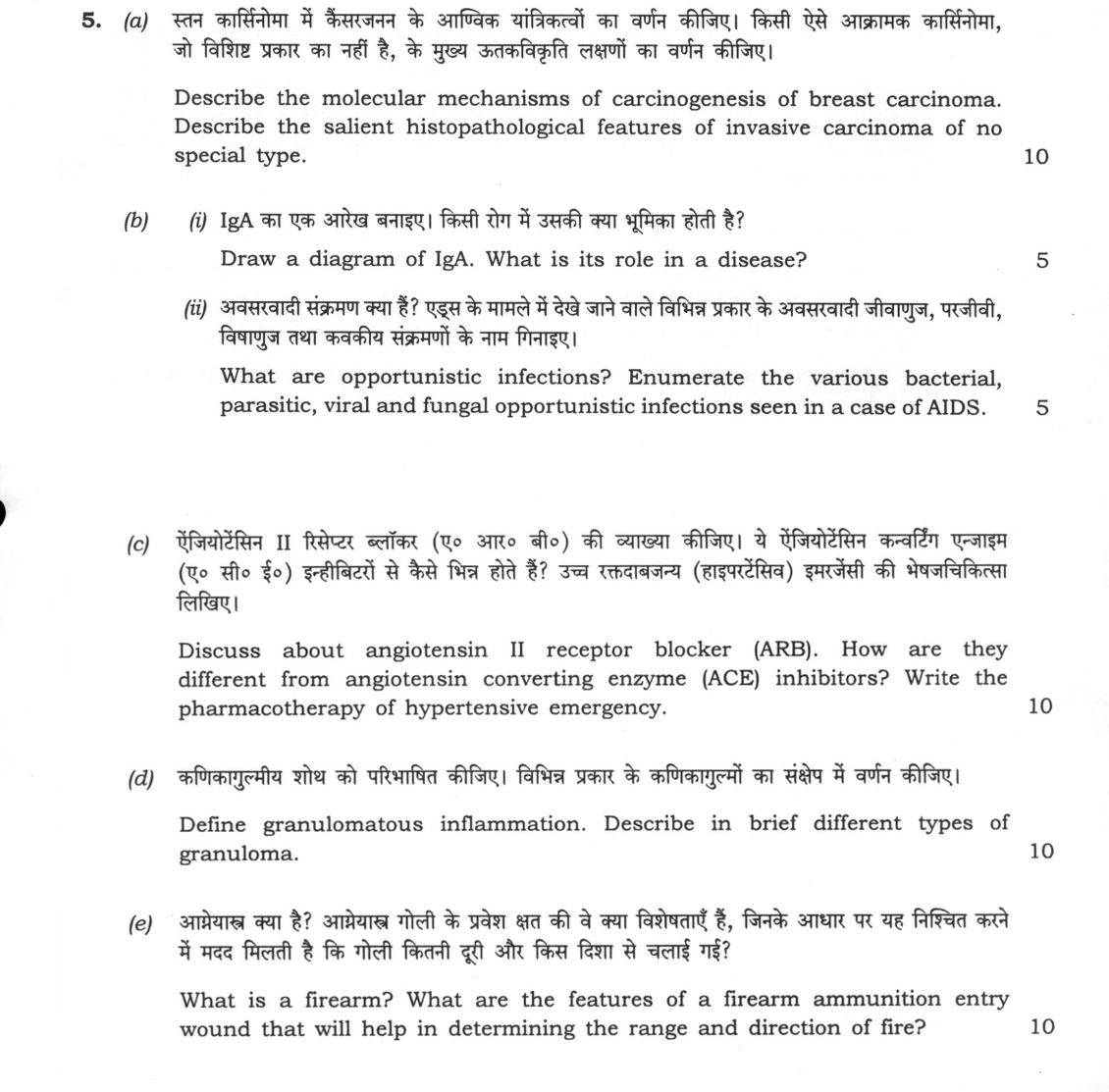
(a) Describe the molecular mechanisms of carcinogenesis of breast carcinoma. Describe the salient histopathological features of…
Describe the molecular mechanisms of carcinogenesis of breast carcinoma. Describe the salient histopathological features of invasive carcinoma of no special type. 10 marks
Draw a diagram of IgA. What is its role in a disease? 5 marks
What are opportunistic infections? Enumerate the various bacterial, parasitic, viral and fungal opportunistic infections seen in a case of AIDS. 5 marks
Discuss about angiotensin II receptor blocker (ARB). How are they different from angiotensin converting enzyme (ACE) inhibitors? Write the pharmacotherapy of hypertensive emergency. 10 marks
Define granulomatous inflammation. Describe in brief different types of granuloma. 10 marks
What is a firearm? What are the features of a firearm ammunition entry wound that will help in determining the range and direction of fire? 10 marks
हिंदी में प्रश्न पढ़ें
स्तन कार्सिनोमा में कैंसरजनन के आण्विक यांत्रिकताओं का वर्णन कीजिए। किसी ऐसे आक्रामक कार्सिनोमा, जो विशिष्ट प्रकार का नहीं है, के मुख्य उतकविकृति लक्षणों का वर्णन कीजिए। 10 marks
IgA का एक आरेख बनाइए। किसी रोग में उसकी क्या भूमिका होती है? 5 marks
अवसरवादी संक्रमण क्या हैं? एड्स के मामले में देखे जाने वाले विभिन्न प्रकार के अवसरवादी जीवाणुज, परजीवी, विषाणुज तथा कवकीय संक्रमणों के नाम गिनाइए। 5 marks
ऐंजियोटेंसिन II रिसेप्टर ब्लॉकर (ए० आर० बी०) की व्याख्या कीजिए। ये ऐंजियोटेंसिन कनवर्टिंग एंजाइम (ए० सी० ई०) इन्हीबिटरों से कैसे भिन्न होते हैं? उच्च रक्तदाबजन्य (हाइपरटेंसिव) इमरजेंसी की भेषजचिकित्सा लिखिए। 10 marks
कणिकागुल्मीय शोथ को परिभाषित कीजिए। विभिन्न प्रकार के कणिकागुल्मों का संक्षेप में वर्णन कीजिए। 10 marks
आर्म्स क्या है? आर्म्स गोली के प्रवेश घात की वे क्या विशेषताएं हैं, जिनके आधार पर यह निश्चित करने में मदद मिलती है कि गोली कितनी दूरी और किस दिशा से चलाई गई? 10 marks
Model answer
Written by UPSC Answer Check against this question's marking rubric, to the expected length. UPSC does not publish answers for Mains — this is one way to score well, not an official key.
Molecular mechanisms and histopathology of breast carcinoma. Breast carcinoma arises through a multistep sequence in which normal mammary epithelium acquires genetic and epigenetic alterations that allow clonal expansion, invasion and metastasis. In hereditary and high-risk forms, biallelic inactivation of BRCA1 or BRCA2 impairs homologous recombination repair of DNA double-strand breaks, producing genomic instability and increasing susceptibility to further mutations. TP53 mutations remove the principal cell-cycle checkpoint and apoptosis safeguard, allowing survival of damaged cells. Growth signalling is amplified by HER2/neu overexpression or amplification, which drives proliferation, survival and angiogenesis, while oestrogen receptor and progesterone receptor signalling in hormone-sensitive tumours promotes clonal expansion and is the basis of endocrine therapy. The molecular events explain why tumours are classified by ER, PR and HER2 status. Invasive carcinoma of no special type, formerly invasive ductal carcinoma, is the commonest type. It shows irregular nests, cords, angulated glands and single cells infiltrating a dense desmoplastic stroma with fibroblasts and inflammatory cells. The Nottingham grade is based on tubule formation, nuclear pleomorphism and mitotic count: well-formed tubules, uniform nuclei and low mitoses indicate grade I, whereas poor tubule formation, marked pleomorphism and high mitoses indicate grade III. Tubule formation is assessed as the proportion of tumour forming gland-like structures, and mitoses are counted in high-power fields. Lymphovascular invasion, central necrosis and a brisk stromal reaction are adverse features.
IgA structure and disease role. The diagram would show a secretory IgA dimer: two IgA monomers, each with two α heavy chains and two light chains linked by disulfide bonds, joined by a J chain; the dimer is bound to secretory component derived from polymeric immunoglobulin receptor, which protects it from proteolysis. The J chain is essential for dimer formation and transport. Serum IgA is mainly monomeric, while secretory IgA is dimeric and is the principal immunoglobulin of mucosal secretions. It neutralises pathogens, prevents adherence to epithelium and limits mucosal invasion. Clinically, selective IgA deficiency predisposes to recurrent sinopulmonary and gastrointestinal infections and is associated with celiac disease and autoimmune disease; IgA nephropathy, or Berger disease, is caused by deposition of IgA-containing immune complexes in the mesangium and may present with haematuria.
Opportunistic infections in AIDS. Opportunistic infections are caused by organisms that are usually harmless but produce disease when host immunity, especially cell-mediated immunity, is impaired. In AIDS, defined by marked CD4 T-cell depletion or AIDS-defining illness, bacterial infections include Mycobacterium tuberculosis and Mycobacterium avium complex; parasitic infections include Toxoplasma gondii and Cryptosporidium species; viral infections include cytomegalovirus, herpes simplex virus, varicella-zoster virus and JC virus; fungal infections include Candida species, Cryptococcus neoformans, Histoplasma capsulatum and Pneumocystis jirovecii. Pneumocystis jirovecii pneumonia is a classic AIDS-defining fungal infection. The spectrum reflects loss of CD4 T-cell help, impaired mucosal immunity and defective macrophage activation. These infections are more frequent at low CD4 counts and are reduced by antiretroviral therapy.
ARBs, ACE inhibitors and hypertensive emergency. ARBs are selective AT1 receptor blockers such as losartan, valsartan and telmisartan; they prevent angiotensin II from binding AT1 receptors, reducing vasoconstriction, aldosterone secretion, sodium retention and cardiac remodelling. ARBs and ACE inhibitors both lower blood pressure by reducing angiotensin II effects, but ARBs act downstream of the enzyme. Unlike ACE inhibitors, which block conversion of angiotensin I to angiotensin II and also reduce bradykinin degradation, ARBs do not cause bradykinin accumulation and therefore have less cough and angioedema; they also do not affect bradykinin B2 receptor-mediated effects. In hypertensive emergency, severe hypertension with acute end-organ damage requires ICU monitoring and titratable IV therapy. Labetalol, esmolol, nitroprusside or nicardipine are used; sublingual nifedipine is avoided because of unpredictable precipitous falls. The general target is to reduce mean arterial pressure by no more than 25% in the first hour, then gradually to about 160/100 mmHg over 2–6 hours, with special targets for aortic dissection, acute stroke or eclampsia.
Granulomatous inflammation. Granulomatous inflammation is a form of chronic inflammation in which activated macrophages transform into epithelioid histiocytes and may fuse into multinucleated giant cells, forming a granuloma. It is usually a Th1-mediated response: antigen-presenting cells release IL-12, T cells produce IFN-γ, and TNF-α sustains macrophage activation. The granuloma is often walled off by lymphocytes, limiting spread of the offending agent. Caseating granulomas have central necrosis, whereas non-caseating granulomas lack it. Types include infectious granulomas, such as caseating tuberculous granulomas, leprosy, syphilis and fungal infections; foreign-body granulomas, formed around suture, silica, talc or other indigestible material; sarcoidosis, with non-caseating granulomas in lungs and lymph nodes; Crohn's disease, with transmural non-caseating granulomas; and granulomatosis with polyangiitis (Wegener's), with necrotising granulomatous vasculitis of the upper and lower respiratory tract and kidneys. In India, tuberculosis is an important cause of caseating granulomas.
Firearm and entry-wound features. A firearm is a weapon that uses the explosive force of a propellant charge to propel a projectile through a barrel. Entry-wound features help determine range and direction. In contact wounds, the muzzle is pressed to the skin, producing a stellate laceration, muzzle imprint, soot or gunpowder in the wound and sometimes no abrasion collar. In close-range wounds, generally within about 1 metre, there is an abrasion collar or grease collar, soot impregnation and tattooing from unburnt powder particles, but no stellate laceration. In distant wounds, the entry is a clean, round or oval wound with an abrasion collar and no soot or tattooing. Soot and tattooing fade as range increases, while the abrasion collar persists at all ranges. Direction of fire is inferred from the inverted/converted wound shape, the abrasion collar, the trajectory of the projectile and, in bone, beveling: the entry bevel is inward, concave toward the direction of travel, while the exit bevel is outward. In soft tissue, entry wounds are usually smaller and may show inwardly turned edges, whereas exit wounds are larger and everted. Together these features distinguish entry from exit and estimate the distance from muzzle to target. Overall, these mechanisms, structures, infections, pharmacological actions, lesions and wound features form a coherent descriptive account.
What "Describe" is asking you to do
Give a full, ordered account of the thing named — its parts, stages or mechanism — in the sequence in which it actually exists or occurs. Most describe questions come from the science optionals, where the marks sit in correct technical detail and, where the stem says so, a labelled diagram.
Structure that answers it
One-line identification of the subject → the parts or stages in their real order, each with its defining detail → labelled diagram where the subject is structural → closing line on function or significance
Where marks are lost
Loose general prose where the examiner is ticking named parts, correct terminology and their sequence; and in the General Studies papers, turning to evaluation before the description is finished.
How this answer will be evaluated
Approach
Framework: Medical Science, Paper 1. (a) describe: define > structure or process in order > labelled diagram > significance | (b(i)) describe: define > structure or process in order > labelled diagram > significance | (b(ii)) enumerate: list the items in order > one line each > no commentary | (c) discuss: intro > 3-4 dimensions > example > balanced close | (d) describe: define > structure or process in order > labelled diagram > significance | (e) explain: definition/context > points in order > small example > short close Full marks: Comprehensive, accurate, and well-structured answers with specific examples and mechanisms.
Key points expected
- Molecular mechanisms of breast carcinogenesis
- Salient histopathological features of invasive carcinoma of no special type
- Diagram of IgA
- Role of IgA in a disease
- Definition of opportunistic infections
- List of bacterial opportunistic infections in AIDS
- List of parasitic opportunistic infections in AIDS
- List of viral and fungal opportunistic infections in AIDS
Evaluation rubric
Each sub-part is marked on its own, against the marks and word limit printed on the paper.
- (a) Molecular mechanisms of breast carcinogenesis and histopathology of invasive carcinoma of no special type. 10 marks
describe— define → structure or process in order → labelled diagram → significance
Must cover
- Molecular mechanisms of breast carcinogenesis
- Salient histopathological features of invasive carcinoma of no special type
Loses marks
- Listing symptoms without mechanism
- Confusing special types with no special type
Earns more
- Mentions specific oncogenes (e.g., HER2, BRCA)
- Mentions specific histological patterns (e.g., tubular, solid)
Extra mark
- Mentions specific molecular pathways (e.g., PI3K/AKT)
- (b(i)) Diagram of IgA and its role in a disease. 5 marks
describe— define → structure or process in order → labelled diagram → significance
Must cover
- Diagram of IgA
- Role of IgA in a disease
Loses marks
- Diagram without labels
- Role not linked to a specific disease
Earns more
- Mentions specific disease (e.g., mucosal infections)
Extra mark
- Mentions specific mechanism of IgA action
- (b(ii)) Definition of opportunistic infections and list of bacterial, parasitic, viral, fungal infections in AIDS. 5 marks
enumerate— list the items in order → one line each → no commentary
Must cover
- Definition of opportunistic infections
- List of bacterial opportunistic infections in AIDS
- List of parasitic opportunistic infections in AIDS
- List of viral and fungal opportunistic infections in AIDS
Loses marks
- Listing infections without categorization
- Omitting any of the four categories
Earns more
- Mentions specific examples for each category
Extra mark
- Mentions specific CD4 count thresholds for each infection
- (c) Discussion of ARBs, their difference from ACE inhibitors, and pharmacotherapy of hypertensive emergency. 10 marks
discuss— intro → 3-4 dimensions → example → balanced close
Must cover
- Discussion of angiotensin II receptor blockers (ARBs)
- Difference between ARBs and ACE inhibitors
- Pharmacotherapy of hypertensive emergency
Loses marks
- Confusing ARBs with ACE inhibitors
- Management without priority
Earns more
- Mentions specific ARB drugs
- Mentions specific ACE inhibitor drugs
- Mentions specific drugs for hypertensive emergency
Extra mark
- Mentions specific guidelines for hypertensive emergency management
- (d) Definition of granulomatous inflammation and description of different types of granuloma. 10 marks
describe— define → structure or process in order → labelled diagram → significance
Must cover
- Definition of granulomatous inflammation
- Description of different types of granuloma
Loses marks
- Definition without distinguishing features
- Listing types without description
Earns more
- Mentions specific types (e.g., caseating, non-caseating)
- Mentions specific diseases associated with each type
Extra mark
- Mentions specific histological features of each type
- (e) Definition of a firearm and features of entry wound for determining range and direction of fire. 10 marks
explain— definition/context → points in order → small example → short close
Must cover
- Definition of a firearm
- Features of firearm ammunition entry wound for determining range
- Features of firearm ammunition entry wound for determining direction of fire
Loses marks
- Definition without distinguishing features
- Features not linked to range or direction
Earns more
- Mentions specific features (e.g., soot, powder tattooing)
- Mentions specific distances for range determination
Extra mark
- Mentions specific forensic techniques for direction determination
Practice this exact question
Write your answer and it is marked point by point against the model answer above — what you covered, what you missed, what you got wrong.
Evaluate my answer →More from Medical Science 2022 Paper I
- Q2 (a) Describe the anatomy of uterus under the following headings: (i) Gross features (ii)…
- Q3 (a) (i) Discuss the functions of basal ganglia. Add a note on Parkinson's disease. (5+5=1…
- Q4 (a) (i) Explain the mechanism of iron absorption in the intestine. What are the factors r…
- Q5 (a) Describe the molecular mechanisms of carcinogenesis of breast carcinoma. Describe the…
- Q6 (a) (i) Describe in brief the pathogenesis and histopathological features of rheumatic he…
- Q7 (a) What are organophosphate compounds? Discuss briefly the clinical features, treatment…
- Q8 (a) (i) Enumerate different species of Aspergillus and the infections caused by them. Giv…