Paper I — Q8
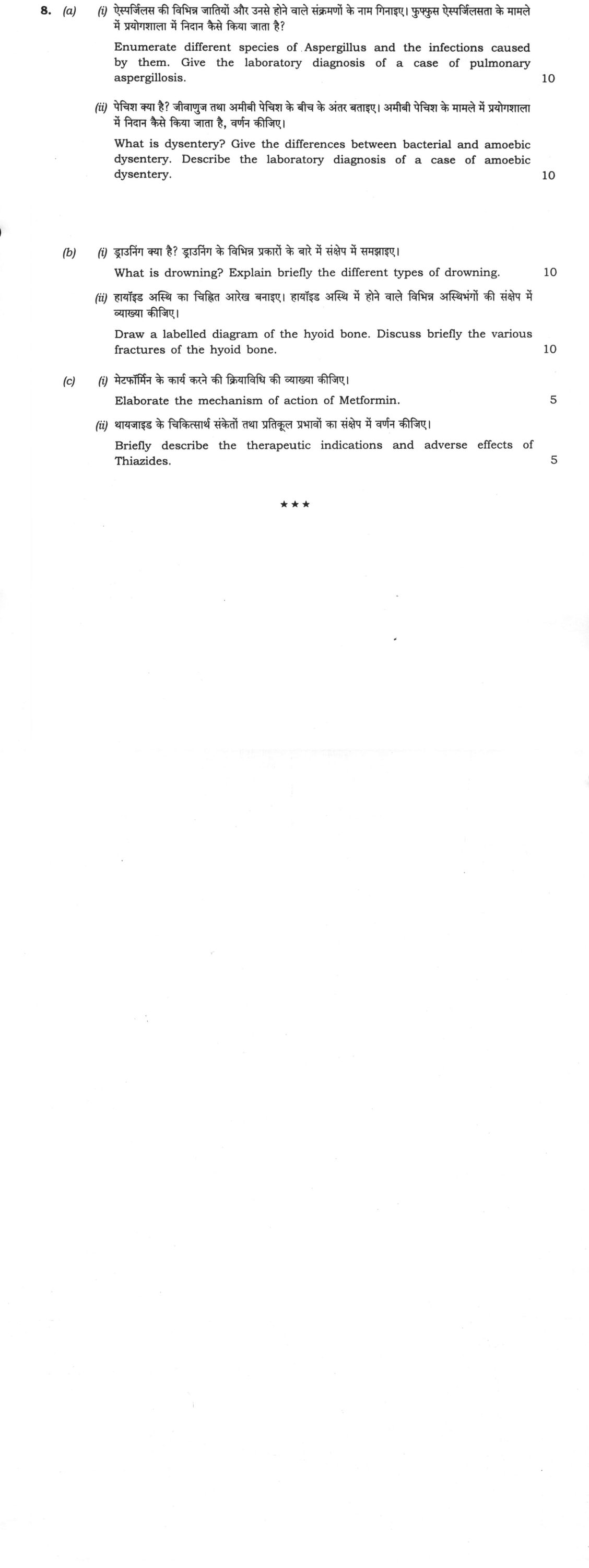
(a) (i) Enumerate different species of Aspergillus and the infections caused by them. Give the laboratory diagnosis of a case of…
Enumerate different species of Aspergillus and the infections caused by them. Give the laboratory diagnosis of a case of pulmonary aspergillosis. 10 marks
What is dysentery? Give the differences between bacterial and amoebic dysentery. Describe the laboratory diagnosis of a case of amoebic dysentery. 10 marks
What is drowning? Explain briefly the different types of drowning. 10 marks
Draw a labelled diagram of the hyoid bone. Discuss briefly the various fractures of the hyoid bone. 10 marks
Elaborate the mechanism of action of Metformin. 5 marks
Briefly describe the therapeutic indications and adverse effects of Thiazides. 5 marks
हिंदी में प्रश्न पढ़ें
ऐस्पर्जिलस की विभिन्न जातियों और उनसे होने वाले संक्रमणों के नाम गिनाइए। फुप्फुस ऐस्पर्जिलसता के मामले में प्रयोगशाला में निदान कैसे किया जाता है? 10 marks
पेचिश क्या है? जीवाणुज तथा अमीबी पेचिश के बीच के अंतर बताइए। अमीबी पेचिश के मामले में प्रयोगशाला में निदान कैसे किया जाता है, वर्णन कीजिए। 10 marks
ड्राउनिंग क्या है? ड्राउनिंग के विभिन्न प्रकारों के बारे में संक्षेप में समझाइए। 10 marks
हायॉइड अस्थि का चिह्नित आरेख बनाइए। हायॉइड अस्थि में होने वाले विभिन्न अस्थिभंगों की संक्षेप में व्याख्या कीजिए। 10 marks
मेटफॉर्मिन के कार्य करने की क्रियाविधि की व्याख्या कीजिए। 5 marks
थायजाइड के चिकित्सार्थ संकेतों तथा प्रतिकूल प्रभावों का संक्षेप में वर्णन कीजिए। 5 marks
Model answer
Written by UPSC Answer Check against this question's marking rubric, to the expected length. UPSC does not publish answers for Mains — this is one way to score well, not an official key.
Aspergillus is a septate mould whose clinical importance depends on species. The species to enumerate are A. fumigatus, the most common cause of invasive aspergillosis and aspergilloma; A. flavus, associated with aflatoxin production, keratitis and sinus disease; A. niger, causing otomycosis and black fungal balls; A. terreus, notable for relative resistance to amphotericin B; and A. clavatus, a less common species in pulmonary disease. In pulmonary aspergillosis, lower respiratory specimens are preferred. Laboratory diagnosis of pulmonary aspergillosis begins with microscopy of sputum, bronchoalveolar lavage or tissue in KOH mount, showing septate hyphae with acute-angle branching. Culture on Sabouraud dextrose agar confirms the species. Serological and molecular markers include serum or BAL galactomannan and β-D-glucan. High-resolution CT may show a halo sign in invasive disease, and biopsy with PAS/GMS staining gives histopathological proof. Galactomannan is particularly useful in invasive disease, while β-D-glucan is a broader fungal marker.
Dysentery is inflammation of the colon producing stools containing blood and mucus, often with tenesmus. Bacterial dysentery, classically due to Shigella, has abrupt onset, fever, frequent small-volume stools, intense cramps and neutrophilic exudate in stool. Amoebic dysentery, due to Entamoeba histolytica, is usually gradual, with larger-volume stools, less frequent passage, right iliac fossa pain and flask-shaped colonic ulcers. Laboratory diagnosis of amoebic dysentery relies on stool microscopy for trophozoites with ingested red blood cells and cysts, concentration techniques, ELISA for E. histolytica antigen, serology, and colonoscopy with biopsy when the diagnosis is uncertain. In India, both Shigella and Entamoeba histolytica are common, so microscopy and antigen testing are essential.
Drowning is death caused by submersion in liquid, with airway obstruction and asphyxia. The main types are wet drowning, about 80 per cent, where fluid is aspirated into the lungs; dry drowning, about 20 per cent, where laryngospasm prevents aspiration; fresh-water and salt-water drowning, which differ in electrolyte effects; fresh water may cause haemolysis and hyperkalaemia, while salt water causes hemoconcentration; secondary or delayed drowning, where pulmonary oedema and ARDS develop after initial recovery; and near-drowning, where the victim survives but may have hypoxic injury. Autopsy may show fine froth in the airways, diatoms in the lungs, and emphysema aquosum.
The hyoid bone is a U-shaped unpaired bone in the anterior neck. A labelled diagram should show the body, the two greater cornua projecting posteriorly, the two lesser cornua projecting anteriorly, and the muscular attachments: stylohyoid, mylohyoid, geniohyoid and digastric. The digastric tendon is attached to the lesser cornu, and the thyrohyoid membrane relates to the body. Fractures of the hyoid are important in medicolegal cases. In manual strangulation or throttling, the bone may fracture or the thyrohyoid ligament may be avulsed, especially in older persons with a calcified hyoid. In hanging, fracture of the greater horn may occur, though it is less common than in manual strangulation. The presence, site and pattern of fracture help distinguish suicide, homicide and accidental death, and therefore require careful autopsy correlation.
Metformin acts mainly by activating AMP-activated protein kinase, which lowers hepatic glucose output by inhibiting gluconeogenesis and decreasing glycogenolysis. It also increases peripheral insulin sensitivity and reduces intestinal glucose absorption. Because it does not stimulate insulin secretion, it carries little risk of hypoglycaemia, but lactic acidosis is a serious contraindication in renal impairment, hypoxia or severe liver disease.
Thiazides are indicated in hypertension, mild oedema in congestive heart failure and nephrotic syndrome, nephrogenic diabetes insipidus and hypercalciuria. Their adverse effects include hypokalaemia, hyponatraemia, hyperglycaemia, hyperuricaemia, hyperlipidaemia, photosensitivity and sulfa allergy. Thus, species-specific microbiology, stool and serological diagnosis, forensic classification and anatomy, and the pharmacological basis of therapy together determine correct diagnosis and management.
What "Enumerate" is asking you to do
Produce the complete set of items asked for, countable and correctly named. The examiner marks against a checklist, so a missing item costs and an elaborated one gains nothing — where discussion is wanted the stem asks for it as a separate sub-part.
Structure that answers it
One line naming the basis on which the set is drawn → items numbered, each in a phrase or a single line → the discussion sub-part taken up separately, after the list is complete
Where marks are lost
Treating it as an essay. Six items named in six lines score better than three items explained at length.
How this answer will be evaluated
Approach
Framework: Medical Science, Paper 1. (a(i)) enumerate: list the items in order > one line each > no commentary | (a(ii)) compare: paired headings or table > key differences > significance > conclusion | (b(i)) explain: definition/context > points in order > small example > short close | (b(ii)) describe: define > structure or process in order > labelled diagram > significance | (c(i)) explain: definition/context > points in order > small example > short close | (c(ii)) describe: define > structure or process in order > labelled diagram > significance Full marks: Comprehensive, accurate, and well-structured answers with all key points and diagrams.
Key points expected
- List A. fumigatus, A. flavus, A. niger, A. terreus
- Link species to specific infections (e.g., A. fumigatus to aspergilloma)
- Mention KOH mount and culture on Sabouraud's dextrose agar
- Include serology (galactomannan) or histopathology (septate hyphae)
- Define dysentery (bloody/mucoid diarrhea)
- Compare onset, stool character, and causative agents
- Describe stool microscopy for Entamoeba histolytica trophozoites
- Mention cysts in chronic cases and antigen detection
Evaluation rubric
Each sub-part is marked on its own, against the marks and word limit printed on the paper.
- (a(i)) List Aspergillus species, their infections, and lab diagnosis of pulmonary aspergillosis. 10 marks
enumerate— list the items in order → one line each → no commentary
Must cover
- List A. fumigatus, A. flavus, A. niger, A. terreus
- Link species to specific infections (e.g., A. fumigatus to aspergilloma)
- Mention KOH mount and culture on Sabouraud's dextrose agar
- Include serology (galactomannan) or histopathology (septate hyphae)
Loses marks
- Listing species without associated clinical syndromes
- Omitting histopathological features of hyphae
Earns more
- Mention 45-degree dichotomous branching
- Differentiate invasive vs. allergic aspergillosis
Extra mark
- Mention PCR for rapid diagnosis
- (a(ii)) Define dysentery, compare bacterial vs. amoebic types, and detail lab diagnosis of amoebic dysentery. 10 marks
compare— paired headings or table → key differences → significance → conclusion
Must cover
- Define dysentery (bloody/mucoid diarrhea)
- Compare onset, stool character, and causative agents
- Describe stool microscopy for Entamoeba histolytica trophozoites
- Mention cysts in chronic cases and antigen detection
Loses marks
- Confusing E. histolytica with E. dispar
- Failing to distinguish acute vs. chronic stool findings
Earns more
- Mention 'flask-shaped ulcers' for amoebic
- Mention 'rice-water' vs 'blood and mucus' distinction
Extra mark
- Mention PCR for E. histolytica
- (b(i)) Define drowning and explain its different types. 10 marks
explain— definition/context → points in order → small example → short close
Must cover
- Define drowning as respiratory impairment from submersion
- Explain 'wet drowning' (aspiration of fluid)
- Explain 'dry drowning' (laryngospasm)
- Mention 'secondary drowning' (delayed pulmonary edema)
Loses marks
- Defining drowning as just 'drowning in water'
- Omitting the mechanism of laryngospasm
Earns more
- Mention 'silent drowning' as a term
- Briefly explain pathophysiology of hypoxia
Extra mark
- Mention 'near-drowning' terminology
- (b(ii)) Draw a labelled hyoid bone and discuss its various fractures. 10 marks
describe— define → structure or process in order → labelled diagram → significance
Must cover
- Draw hyoid bone with corpus, greater, and lesser horns
- Label all parts accurately
- Discuss fracture of greater horn (ligamentous injury)
- Discuss fracture of lesser horn (carotid artery injury)
Loses marks
- Missing labels on the diagram
- Failing to link fracture site to specific injury
Earns more
- Mention 'butterfly fracture' of the corpus
- Link fractures to strangulation/neck trauma
Extra mark
- Mention 'V-shaped' fracture pattern
- (c(i)) Elaborate the mechanism of action of Metformin. 5 marks
explain— definition/context → points in order → small example → short close
Must cover
- Mention inhibition of hepatic gluconeogenesis
- Mention increased peripheral insulin sensitivity
- Mention activation of AMPK pathway
- Mention decreased intestinal absorption of glucose
Loses marks
- Suggesting it stimulates insulin secretion
- Omitting the primary site of action (liver)
Earns more
- Mention 'biguanide' class
- Mention no risk of hypoglycemia
Extra mark
- Mention effect on gut microbiome
- (c(ii)) Describe therapeutic indications and adverse effects of Thiazides. 5 marks
describe— define → structure or process in order → labelled diagram → significance
Must cover
- List hypertension as primary indication
- List edema (cardiac, renal) as indication
- Mention hypercalcemia as an adverse effect
- Mention hypokalemia as an adverse effect
Loses marks
- Confusing thiazides with loop diuretics
- Omitting electrolyte disturbances
Earns more
- Mention 'thiazide-sensitive Na-K-2Cl cotransporter' inhibition
- Mention use in nephrogenic diabetes insipidus
Extra mark
- Mention 'thiazide diuretics' as a class
Practice this exact question
Write your answer and it is marked point by point against the model answer above — what you covered, what you missed, what you got wrong.
Evaluate my answer →More from Medical Science 2022 Paper I
- Q5 (a) Describe the molecular mechanisms of carcinogenesis of breast carcinoma. Describe the…
- Q6 (a) (i) Describe in brief the pathogenesis and histopathological features of rheumatic he…
- Q7 (a) What are organophosphate compounds? Discuss briefly the clinical features, treatment…
- Q8 (a) (i) Enumerate different species of Aspergillus and the infections caused by them. Giv…