Paper I — Q4
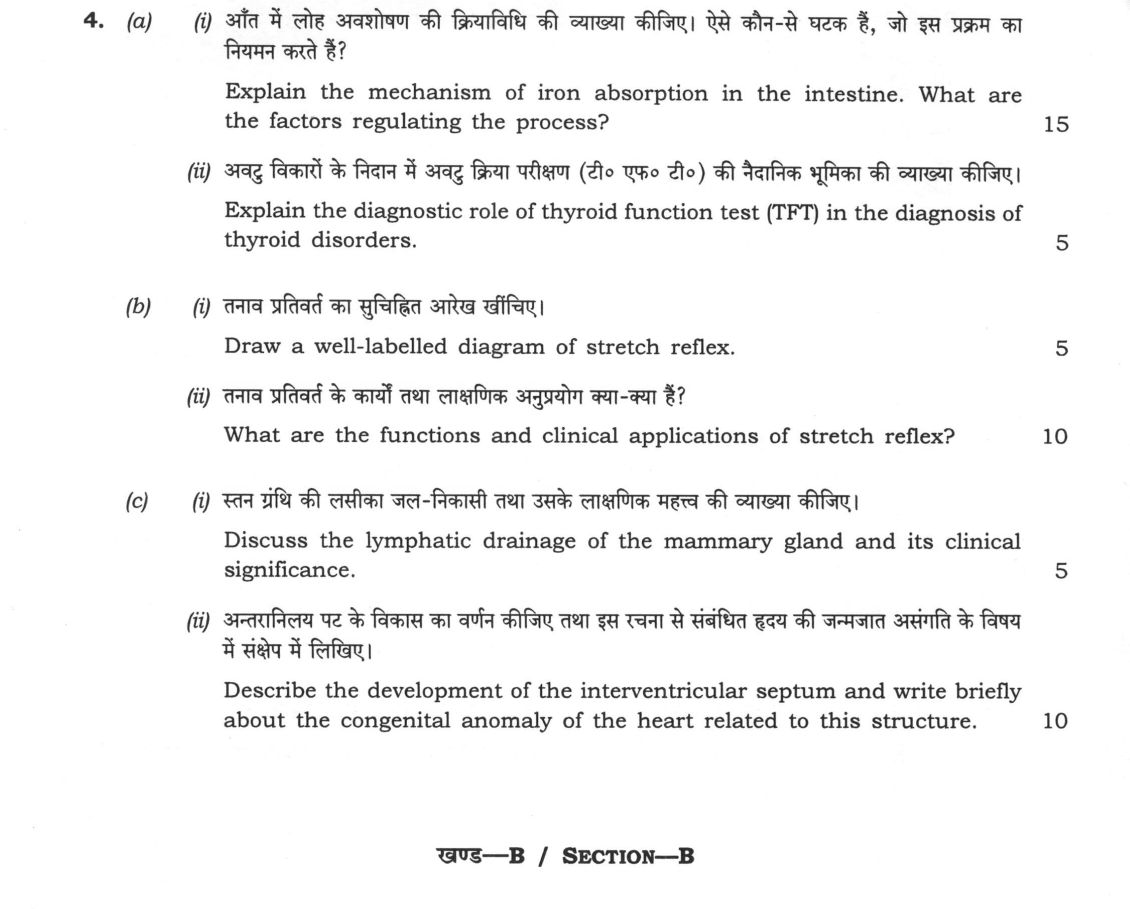
(a) (i) Explain the mechanism of iron absorption in the intestine. What are the factors regulating the process? (15 marks) (ii)…
Explain the mechanism of iron absorption in the intestine. What are the factors regulating the process? 15 marks
Explain the diagnostic role of thyroid function test (TFT) in the diagnosis of thyroid disorders. 5 marks
Draw a well-labelled diagram of stretch reflex. 5 marks
What are the functions and clinical applications of stretch reflex? 10 marks
Discuss the lymphatic drainage of the mammary gland and its clinical significance. 5 marks
Describe the development of the interventricular septum and write briefly about the congenital anomaly of the heart related to this structure. 10 marks
हिंदी में प्रश्न पढ़ें
आंत में लोह अवशोषण की क्रियाविधि की व्याख्या कीजिए। ऐसे कौन-से घटक हैं, जो इस प्रक्रम का नियमन करते हैं? 15 marks
अवटु विकारों के निदान में अवटु क्रिया परीक्षण (टी० एफ० टी०) की नैदानिक भूमिका की व्याख्या कीजिए। 5 marks
तनाव प्रतिवर्त का सुचिहित आरेख खींचिए। 5 marks
तनाव प्रतिवर्त के कार्यों तथा लाक्षणिक अनुप्रयोग क्या-क्या हैं? 10 marks
स्तन ग्रंथि की लसीका जल-निकासी तथा उसके लाक्षणिक महत्व की व्याख्या कीजिए। 5 marks
अन्तरालिलय पट के विकास का वर्णन कीजिए तथा इस रचना से संबंधित हृदय की जन्मजात असंगति के विषय में संक्षेप में लिखिए। 10 marks
Model answer
Written by UPSC Answer Check against this question's marking rubric, to the expected length. UPSC does not publish answers for Mains — this is one way to score well, not an official key.
(a)(i) Iron absorption. Dietary iron is absorbed mainly in the duodenum as heme and non-heme iron. Non-heme ferric iron in the lumen is reduced to ferrous iron by duodenal cytochrome b, then enters enterocytes through apical DMT1. Heme iron is taken up by heme carrier protein 1, dissociated in the enterocyte, and its iron enters the labile pool. Inside the cell, iron may be stored as ferritin or exported basolaterally by ferroportin (FPN1); ceruloplasmin oxidises it to ferric iron for transferrin binding. Hepcidin is the key regulator: it binds ferroportin, causing internalisation and degradation, and blocks iron export. Hepcidin rises with high iron stores or inflammation, and falls with iron deficiency, high erythropoietic demand, or hypoxia via HIF-1α. Body iron stores, erythropoietic demand and hypoxia are sensed by the liver and erythroid marrow, which adjust hepcidin secretion. Thus, low hepcidin keeps ferroportin on the basolateral membrane and increases iron release, while high hepcidin retains iron in enterocytes. Vitamin C enhances non-heme iron reduction and absorption; phytates, polyphenols and calcium inhibit it.
(a)(ii) Thyroid function tests. TSH is the screening test because it amplifies small thyroid hormone changes. TSH is therefore measured first, with FT4/FT3 used to confirm and localise the defect. FT4 is preferred over total T4 because binding proteins vary, and FT3 may be normal in early hypothyroidism. Primary hypothyroidism shows low FT4 with high TSH; primary hyperthyroidism shows high FT4/FT3 with suppressed TSH. Secondary/tertiary central hypothyroidism shows low or inappropriately normal TSH with low FT4, and FT3 may be normal or low. Subclinical disease has abnormal TSH with normal FT4. In pregnancy, hCG lowers TSH and may raise FT4, so trimester-specific TSH ranges are needed.
(b)(i) Stretch reflex diagram. A labelled diagram shows a muscle spindle parallel to extrafusal fibres. The spindle contains intrafusal nuclear bag and chain fibres, with annulospiral primary endings on nuclear bag and chain fibres and flower-spray secondary endings on nuclear chain fibres. The Ia afferent enters the spinal cord and makes a monosynaptic excitatory synapse on the alpha motor neuron to the same muscle. The efferent alpha axon leaves the cord and stimulates extrafusal fibres, causing contraction. It also excites an Ia inhibitory interneuron, which inhibits the antagonist alpha motor neuron, giving reciprocal inhibition.
(b)(ii) Functions and clinical applications. The stretch reflex maintains muscle tone, resists overstretch, and helps posture against gravity. Clinically, deep tendon reflexes—knee jerk (L3-L4), ankle jerk (S1-S2), biceps (C5-C6), triceps (C7-C8)—test the reflex arc. The same arc is used in neurological examination to localise lesions. Clonus testing detects hyperexcitability. Hyperreflexia, clonus and spasticity suggest upper motor neuron lesions; hyporeflexia or areflexia suggests lower motor neuron lesions.
(c)(i) Mammary lymphatic drainage. Most breast lymph drains to axillary nodes: pectoral/anterior, subscapular/posterior, lateral, central and apical groups; apical nodes drain into the subclavian trunk. Medial breast lymph drains to parasternal/internal mammary nodes. Clinically, axillary nodal status determines breast cancer staging and prognosis; sentinel lymph node biopsy guides axillary surgery, and apical/parasternal involvement can cause lymphedema.
(c)(ii) Interventricular septum development. The interventricular septum has muscular and membranous parts. The muscular septum grows upward from the apex from trabeculated ventricular myocardium. The membranous septum forms by fusion of endocardial cushions, conus septum/aortopulmonary septum, and the upper muscular septum. Failure of closure causes ventricular septal defect: muscular VSD from incomplete muscular septum, and membranous/perimembranous VSD from defective cushion/conus fusion. Anterior malalignment of the conus septum with aortic override and right ventricular outflow obstruction produces Tetralogy of Fallot.
Thus, iron, thyroid, reflex, lymphatic and cardiac development depend on precise regulatory checkpoints; failure at any level produces characteristic clinical disease.
What "Explain" is asking you to do
Make the working of something clear — what sets it off, what follows from what, and what it produces. Explain is the Commission's mechanism word: it dominates the technical papers and the “explain why” stems, where the marks sit in the causal chain and not in the label.
Structure that answers it
State what it is → the initiating condition → the chain of cause, step by step → an instance where it plays out → what the chain produces
Where marks are lost
Describing what something looks like instead of why it works that way. Naming the stages without linking them reads as description too.
How this answer will be evaluated
Approach
Framework: Clinical Sequence (Definition > Aetiology/Pathophysiology > Features > Investigation/Management). (a(i)) explain: definition/context > points in order > small example > short close | (a(ii)) explain: definition/context > points in order > small example > short close | (b(i)) describe: define > structure or process in order > labelled diagram > significance | (b(ii)) explain: definition/context > points in order > small example > short close | (c(i)) discuss: intro > 3-4 dimensions > example > balanced close | (c(ii)) describe: define > structure or process in order > labelled diagram > significance Full marks: Comprehensive, clinically relevant, and mechanistically accurate with clear diagrams.
Key points expected
- Distinguish between heme and non-heme iron absorption
- Detail duodenal uptake via DMT1 and ferroportin
- Explain the role of hepcidin in regulating ferroportin
- Identify factors like iron stores, erythropoiesis, and pH
- Interpretation of TSH levels (primary screening)
- Interpretation of Free T3 and Free T4 levels
- Differentiation between primary and secondary hypothyroidism
- Identification of hyperthyroidism vs. hypothyroidism
Evaluation rubric
Each sub-part is marked on its own, against the marks and word limit printed on the paper.
- (a(i)) Mechanism of intestinal iron absorption and its regulatory factors. 15 marks
explain— definition/context → points in order → small example → short close
Must cover
- Distinguish between heme and non-heme iron absorption
- Detail duodenal uptake via DMT1 and ferroportin
- Explain the role of hepcidin in regulating ferroportin
- Identify factors like iron stores, erythropoiesis, and pH
Loses marks
- Confusing heme and non-heme pathways
- Omitting the role of hepcidin
- Listing symptoms without explaining the mechanism
Earns more
- Mention of Dcytb (duodenal cytochrome b) reduction
- Reference to transferrin transport in plasma
- Mention of ferritin storage in enterocytes
Extra mark
- Mention of specific genetic disorders (e.g., Hereditary Hemochromatosis)
- (a(ii)) Diagnostic role of thyroid function tests (TFT) in thyroid disorders. 5 marks
explain— definition/context → points in order → small example → short close
Must cover
- Interpretation of TSH levels (primary screening)
- Interpretation of Free T3 and Free T4 levels
- Differentiation between primary and secondary hypothyroidism
- Identification of hyperthyroidism vs. hypothyroidism
Loses marks
- Listing tests without explaining diagnostic significance
- Failing to distinguish primary from secondary causes
Earns more
- Mention of TSH receptor antibodies (TRAb) for Graves'
- Mention of anti-TPO antibodies for Hashimoto's
Extra mark
- Mention of thyroid ultrasound as a complementary investigation
- (b(i)) A well-labelled diagram of the stretch reflex. 5 marks
describe— define → structure or process in order → labelled diagram → significance
Must cover
- Labeling of muscle spindle (receptor)
- Labeling of Ia afferent nerve fiber
- Labeling of alpha motor neuron (efferent)
- Labeling of the effector muscle
Loses marks
- Missing key components of the reflex arc
- Illegible or unlabelled diagram
Earns more
- Inclusion of the inhibitory interneuron (for reciprocal inhibition)
- Labeling of the gamma motor neuron (if present)
Extra mark
- Clear indication of the direction of impulse flow
- (b(ii)) Functions and clinical applications of the stretch reflex. 10 marks
explain— definition/context → points in order → small example → short close
Must cover
- Role in maintaining muscle tone and posture
- Role in protective reflexes (e.g., knee jerk)
- Clinical use in neurological examination (DTRs)
- Differentiation of UMN vs LMN lesions based on reflexes
Loses marks
- Listing functions without clinical context
- Failing to link reflexes to neurological diagnosis
Earns more
- Mention of the role in proprioception
- Specific examples like the biceps or patellar reflex
Extra mark
- Mention of the role in rehabilitation or physiotherapy
- (c(i)) Lymphatic drainage of the mammary gland and its clinical significance. 5 marks
discuss— intro → 3-4 dimensions → example → balanced close
Must cover
- Identification of axillary lymph nodes as primary drainage
- Mention of parasternal (internal thoracic) nodes
- Clinical significance in breast cancer metastasis
- Role in sentinel lymph node biopsy
Loses marks
- Omitting the parasternal drainage pathway
- Failing to link drainage to cancer staging
Earns more
- Mention of contralateral axillary drainage
- Mention of subclavian nodes
Extra mark
- Mention of the role in lymphedema management
- (c(ii)) Development of the interventricular septum and related congenital anomalies. 10 marks
describe— define → structure or process in order → labelled diagram → significance
Must cover
- Formation of the muscular septum (from ventricular walls)
- Formation of the membranous septum (from endocardial cushions)
- Description of Ventricular Septal Defect (VSD)
- Mention of the foramen of Membranous Septum
Loses marks
- Confusing the atrial and ventricular septum development
- Failing to mention the membranous component
Earns more
- Mention of the role of the aorticopulmonary septum
- Description of the closure mechanism
Extra mark
- Mention of specific types of VSD (e.g., perimembranous, muscular)
Practice this exact question
Write your answer and it is marked point by point against the model answer above — what you covered, what you missed, what you got wrong.
Evaluate my answer →More from Medical Science 2022 Paper I
- Q1 (a) Discuss the stomach under the following headings: (i) Peritoneal relations (ii) Blood…
- Q2 (a) Describe the anatomy of uterus under the following headings: (i) Gross features (ii)…
- Q3 (a) (i) Discuss the functions of basal ganglia. Add a note on Parkinson's disease. (5+5=1…
- Q4 (a) (i) Explain the mechanism of iron absorption in the intestine. What are the factors r…
- Q5 (a) Describe the molecular mechanisms of carcinogenesis of breast carcinoma. Describe the…
- Q6 (a) (i) Describe in brief the pathogenesis and histopathological features of rheumatic he…
- Q7 (a) What are organophosphate compounds? Discuss briefly the clinical features, treatment…