Paper I — Q7
(a) What are organophosphate compounds? Discuss briefly the clinical features, treatment and postmortem findings of a case of…
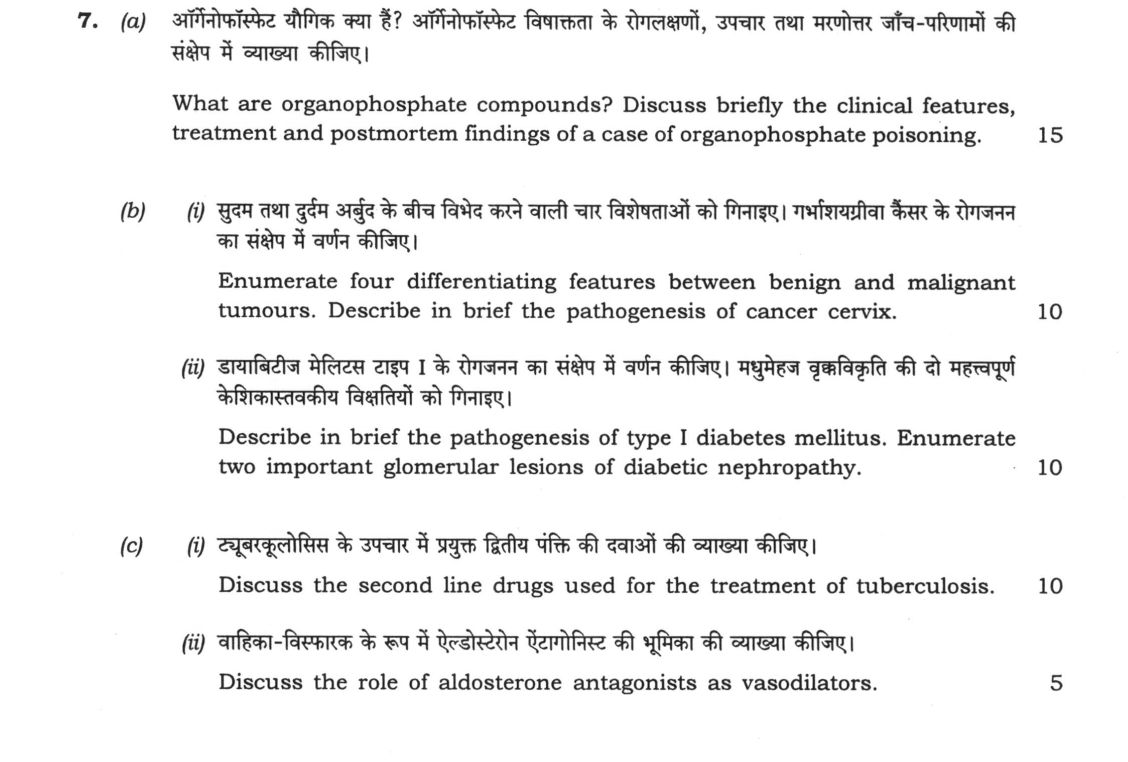
What are organophosphate compounds? Discuss briefly the clinical features, treatment and postmortem findings of a case of organophosphate poisoning. 15 marks
Enumerate four differentiating features between benign and malignant tumours. Describe in brief the pathogenesis of cancer cervix. 10 marks
Describe in brief the pathogenesis of type I diabetes mellitus. Enumerate two important glomerular lesions of diabetic nephropathy. 10 marks
Discuss the second line drugs used for the treatment of tuberculosis. 10 marks
Discuss the role of aldosterone antagonists as vasodilators. 5 marks
हिंदी में प्रश्न पढ़ें
ऑर्गेनोफॉस्फेट यौगिक क्या हैं? ऑर्गेनोफॉस्फेट विषाक्तता के रोगलक्षणों, उपचार तथा मरणोत्तर जाँच-परिणामों की संक्षेप में व्याख्या कीजिए। 15 marks
सुदम तथा दुर्दम अर्बुद के बीच विभेद करने वाली चार विशेषताओं को गिनाइए। गर्भाशयग्रीवा कैंसर के रोगजनन का संक्षेप में वर्णन कीजिए। 10 marks
डायाबिटीज मेलिटस टाइप I के रोगजनन का संक्षेप में वर्णन कीजिए। मधुमेहज वृक्कविकृति की दो महत्वपूर्ण केशिकास्तवकीय विक्षतियों को गिनाइए। 10 marks
ट्यूबरकुलोसिस के उपचार में प्रयुक्त द्वितीय पंक्ति की दवाओं की व्याख्या कीजिए। 10 marks
वाहिका-विस्फारक के रूप में एल्डोस्टेरोन एंटागोनिस्ट की भूमिका की व्याख्या कीजिए। 5 marks
Model answer
Written by UPSC Answer Check against this question's marking rubric, to the expected length. UPSC does not publish answers for Mains — this is one way to score well, not an official key.
Organophosphate Poisoning
Organophosphate compounds are synthetic esters of phosphoric or phosphonic acid that function as potent, irreversible inhibitors of the enzyme acetylcholinesterase (AChE). By phosphorylating the serine hydroxyl group at the active esteratic site of AChE, they prevent acetylcholine degradation, resulting in massive accumulation of acetylcholine across peripheral and central nervous system cholinergic synapses.
Clinically, acute toxicity manifests through a triad of cholinergic excess:
- Muscarinic manifestations: Increased secretions and smooth muscle contraction, presenting as salivation, lacrimation, urination, defecation, gastrointestinal cramping, emesis, bronchorrhea, bronchospasm, bradycardia, and miosis.
- Nicotinic manifestations: Muscle fasciculations, cramps, weakness, flaccid paralysis of respiratory muscles, initial hypertension, and tachycardia.
- Central nervous system manifestations: Restlessness, confusion, ataxia, generalized convulsions, and central respiratory depression.
Treatment requires rapid gastrointestinal and cutaneous decontamination alongside secure airway management with adequate pre-oxygenation. Pharmacotherapy comprises Atropine sulphate (a competitive muscarinic antagonist given intravenously in escalating doses until pulmonary secretions dry and bronchospasm resolves) and Oximes, specifically Pralidoxime (2-PAM), which reactivate phosphorylated AChE by hydrolysing the inhibitor-enzyme complex before irreversible biochemical "aging" occurs.
Postmortem examination characteristically demonstrates an intense, pungent kerosene- or garlic-like odour upon opening body cavities, persistent pinpoint pupils, abundant fine white or blood-tinged froth at the mouth and nostrils, profound pulmonary congestion with edema, and marked mucosal petechiae in the stomach and small intestine.
Tumour Pathology and Cervical Carcinogenesis
Four cardinal features distinguish benign from malignant tumours:
- Differentiation and Anaplasia: Benign tumours are uniformly well-differentiated, closely resembling parent tissue; malignant tumours exhibit variable loss of differentiation, pleomorphism, hyperchromasia, and anaplasia.
- Mitotic Activity: Benign neoplasms display rare, typical mitoses; malignant neoplasms show frequent, atypical, and multipolar mitotic figures.
- Local Invasion: Benign lesions grow as cohesive, well-demarcated, encapsulated masses without invading adjacent structures; malignant lesions lack capsules and actively infiltrate, destroy, and breach native tissue planes and basement membranes.
- Metastasis: Benign tumours do not metastasize; metastasis is the unequivocal hallmark of malignancy.
The pathogenesis of cervical cancer centers on persistent high-risk Human Papillomavirus (HPV types 16 and 18) infection at the squamocolumnar transformation zone. Viral DNA integrates into the host genome, driving overproduction of viral oncoproteins E6 and E7. Oncoprotein E6 binds and accelerates ubiquitin-mediated degradation of the p53 tumour suppressor protein, preventing apoptosis. Concurrently, E7 binds and inactivates the retinoblastoma protein (pRb), releasing E2F transcription factors to drive unregulated cell cycle entry into the S-phase. This genomic instability induces dysplastic progression from Cervical Intraepithelial Neoplasia (CIN 1 to CIN 3/carcinoma in situ) before breaching the basement membrane to establish invasive squamous cell carcinoma.
Pathogenesis of Type 1 Diabetes Mellitus and Glomerular Lesions
Type 1 diabetes mellitus arises from chronic, cell-mediated autoimmune destruction of pancreatic beta cells in genetically predisposed individuals, strongly linked to HLA-DR3 and HLA-DR4 alleles within the major histocompatibility complex. Environmental triggers provoke a breakdown in self-tolerance, recruiting CD4+ T-helper 1 cells and cytotoxic CD8+ T lymphocytes to induce islet inflammation (insulitis). Circulating autoantibodies against glutamic acid decarboxylase (GAD65), insulinoma-associated protein-2 (IA-2), and zinc transporter-8 (ZnT8) serve as key biomarkers of this progressive beta-cell destruction, culminating in absolute insulin deficiency when over 80–90% of beta-cell mass is lost.
Diabetic nephropathy produces two characteristic glomerular lesions:
- Diffuse glomerulosclerosis: Universal widening of the mesangium due to extracellular matrix deposition, accompanied by uniform thickening of the glomerular basement membrane.
- Nodular glomerulosclerosis (Kimmelstiel-Wilson lesion): Pathognomonic ovoid, laminated, acellular, eosinophilic, PAS-positive mesangial nodules situated in the glomerular periphery, compressing adjacent capillary lumens.
Second-Line Antitubercular Drugs
Second-line anti-tuberculosis drugs form the cornerstone for managing drug-resistant tuberculosis (MDR-TB and XDR-TB) within programmatic frameworks such as India's National Tuberculosis Elimination Program (NTEP). They are categorized into:
- Fluoroquinolones (Group A): High-dose Levofloxacin and Moxifloxacin, which inhibit bacterial DNA gyrase (topoisomerase II), serving as core bactericidal components.
- Second-line Injectables: Aminoglycosides (Amikacin, Kanamycin) and cyclic peptides (Capreomycin), which disrupt the 30S ribosomal subunit to inhibit protein synthesis.
- Oral Bacteriostatic Agents: Ethionamide/Prothionamide (inhibiting mycolic acid synthesis), Cycloserine/Terizidone (inhibiting cell wall synthesis), and Para-aminosalicylic acid (PAS, disrupting folate synthesis).
- Core Repurposed/Novel Agents: Bedaquiline (ATP synthase inhibitor), Linezolid (oxazolidinone protein synthesis inhibitor), and Clofazimine.
Aldosterone Antagonists as Vasodilators
Spironolactone and Eplerenone act as competitive antagonists at intracellular mineralocorticoid receptors in the distal renal tubules and the cardiovascular system. Beyond promoting natriuresis and potassium retention, they exert systemic vasodilatory actions by counteracting the non-epithelial, direct pathobiological effects of aldosterone. Aldosterone normally stimulates vascular smooth muscle mineralocorticoid receptors, upregulating endothelin-1, inducing protein kinase C activation, and promoting reactive oxygen species production, all of which cause vasoconstriction. By blocking these pathways, aldosterone antagonists reduce vascular tone, diminish oxidative degradation of nitric oxide (NO), improve endothelial-dependent vasodilation, and attenuate long-term perivascular and medial vascular fibrosis, thereby lowering systemic vascular resistance in congestive heart failure and resistant hypertension.
Comprehensive management across these toxicological, oncological, and metabolic disorders relies on combining early biomarker detection with targeted pharmacological and public health interventions.
What "Discuss" is asking you to do
Lay the issue out from more than one side — how it arose, what is claimed for it, what is held against it, and where it now stands. UPSC attaches discuss to broad topics with several live dimensions, so coverage of the dimensions earns more than the strength of your opinion.
Structure that answers it
Set the issue up → the case as it is made → the case against → the dimension both sides leave out → where the balance now lies
Where marks are lost
Listing facts with no thread between them, or arguing one side throughout and calling it a discussion.
How this answer will be evaluated
Approach
Framework: Medical Science, Paper 1. (a) discuss: intro > 3-4 dimensions > example > balanced close | (b(i)) enumerate: list the items in order > one line each > no commentary | (b(ii)) describe: define > structure or process in order > labelled diagram > significance | (c(i)) discuss: intro > 3-4 dimensions > example > balanced close | (c(ii)) discuss: intro > 3-4 dimensions > example > balanced close Full marks: Comprehensive, accurate, and well-structured answers with all required points and bonus elements.
Key points expected
- Definition: Inhibitors of acetylcholinesterase (AChE)
- Mechanism: Irreversible binding to AChE causing cholinergic crisis
- Treatment: Atropine (antagonist) and Pralidoxime (reactivator)
- Postmortem: High cholinesterase inhibition, pulmonary edema
- Four distinct features (e.g., Capsule, Metastasis, Growth rate, Anaplasia)
- Pathogenesis: HPV (16/18) infection
- Pathogenesis: Progression from CIN to invasive carcinoma
- Pathogenesis: Role of E6/E7 oncoproteins
Evaluation rubric
Each sub-part is marked on its own, against the marks and word limit printed on the paper.
- (a) Definition of organophosphates, clinical features, treatment, and postmortem findings. 15 marks
discuss— intro → 3-4 dimensions → example → balanced close
Must cover
- Definition: Inhibitors of acetylcholinesterase (AChE)
- Mechanism: Irreversible binding to AChE causing cholinergic crisis
- Treatment: Atropine (antagonist) and Pralidoxime (reactivator)
- Postmortem: High cholinesterase inhibition, pulmonary edema
Loses marks
- Omitting Pralidoxime from treatment
- Confusing organophosphates with carbamates
- Listing symptoms without linking to AChE inhibition
Earns more
- Mention of 'intermediate syndrome' or 'delayed neuropathy'
- Differentiation of muscarinic vs nicotinic signs
- Mention of 'cholinergic storm' in acute phase
Extra mark
- Reference to specific organophosphate (e.g., Parathion, Malathion)
- Mention of 'atropine titration' endpoint (drying of secretions)
- (b(i)) Four differentiating features of benign vs malignant tumours and pathogenesis of cancer cervix. 10 marks
enumerate— list the items in order → one line each → no commentary
Must cover
- Four distinct features (e.g., Capsule, Metastasis, Growth rate, Anaplasia)
- Pathogenesis: HPV (16/18) infection
- Pathogenesis: Progression from CIN to invasive carcinoma
- Pathogenesis: Role of E6/E7 oncoproteins
Loses marks
- Listing fewer than four differentiating features
- Omitting HPV from pathogenesis
- Confusing benign and malignant features
Earns more
- Mention of 'loss of contact inhibition' in malignant features
- Mention of 'desmoplastic reaction' in invasive stage
- Reference to 'Papanicolaou smear' for screening
Extra mark
- Mention of 'squamous cell carcinoma' as most common type
- Reference to 'Cervical Intraepithelial Neoplasia (CIN)' grading
- (b(ii)) Pathogenesis of Type I diabetes mellitus and two glomerular lesions of diabetic nephropathy. 10 marks
describe— define → structure or process in order → labelled diagram → significance
Must cover
- Pathogenesis: Autoimmune destruction of beta cells
- Pathogenesis: Genetic susceptibility (HLA-DR3/DR4)
- Lesion 1: Kimmelstiel-Wilson nodules (nodular glomerulosclerosis)
- Lesion 2: Diffuse glomerulosclerosis (GBM thickening)
Loses marks
- Confusing Type I with Type II pathogenesis
- Omitting Kimmelstiel-Wilson nodules
- Listing non-glomerular lesions (e.g., arteriosclerosis)
Earns more
- Mention of 'insulin deficiency' as primary defect
- Mention of 'polyuria/polydipsia' as early clinical signs
- Reference to 'C-peptide' levels in diagnosis
Extra mark
- Mention of 'microalbuminuria' as early marker of nephropathy
- Reference to 'basement membrane thickening' in early stages
- (c(i)) Second line drugs used for the treatment of tuberculosis. 10 marks
discuss— intro → 3-4 dimensions → example → balanced close
Must cover
- Fluoroquinolones (e.g., Levofloxacin, Moxifloxacin)
- Injectables (e.g., Streptomycin, Amikacin)
- Rifabutin (alternative to Rifampicin)
- Ethionamide (alternative to Isoniazid)
Loses marks
- Listing first-line drugs (e.g., Isoniazid, Rifampicin) as second-line
- Omitting fluoroquinolones
- Confusing second-line with adjunctive therapy
Earns more
- Mention of 'MDR-TB' (Multidrug-Resistant TB) context
- Reference to 'WHO guidelines' for MDR-TB treatment
- Mention of 'side effects' (e.g., ototoxicity for aminoglycosides)
Extra mark
- Mention of 'Linezolid' as newer second-line agent
- Reference to 'bedaquiline' for XDR-TB
- (c(ii)) Role of aldosterone antagonists as vasodilators. 5 marks
discuss— intro → 3-4 dimensions → example → balanced close
Must cover
- Mechanism: Blockade of aldosterone receptors
- Effect: Reduction of sodium and water retention
- Effect: Reduction of vascular smooth muscle hypertrophy
- Effect: Improvement of endothelial function
Loses marks
- Confusing aldosterone antagonists with ACE inhibitors
- Omitting mechanism of action
- Listing non-vasodilator effects only
Earns more
- Mention of 'Spironolactone' or 'Eplerenone' as examples
- Reference to 'heart failure' or 'hypertension' as indications
- Mention of 'anti-fibrotic' properties
Extra mark
- Reference to 'RAAS' (Renin-Angiotensin-Aldosterone System) pathway
- Mention of 'hyperkalemia' as a side effect
Practice this exact question
Write your answer and it is marked point by point against the model answer above — what you covered, what you missed, what you got wrong.
Evaluate my answer →More from Medical Science 2022 Paper I
- Q4 (a) (i) Explain the mechanism of iron absorption in the intestine. What are the factors r…
- Q5 (a) Describe the molecular mechanisms of carcinogenesis of breast carcinoma. Describe the…
- Q6 (a) (i) Describe in brief the pathogenesis and histopathological features of rheumatic he…
- Q7 (a) What are organophosphate compounds? Discuss briefly the clinical features, treatment…
- Q8 (a) (i) Enumerate different species of Aspergillus and the infections caused by them. Giv…