Paper I — Q2
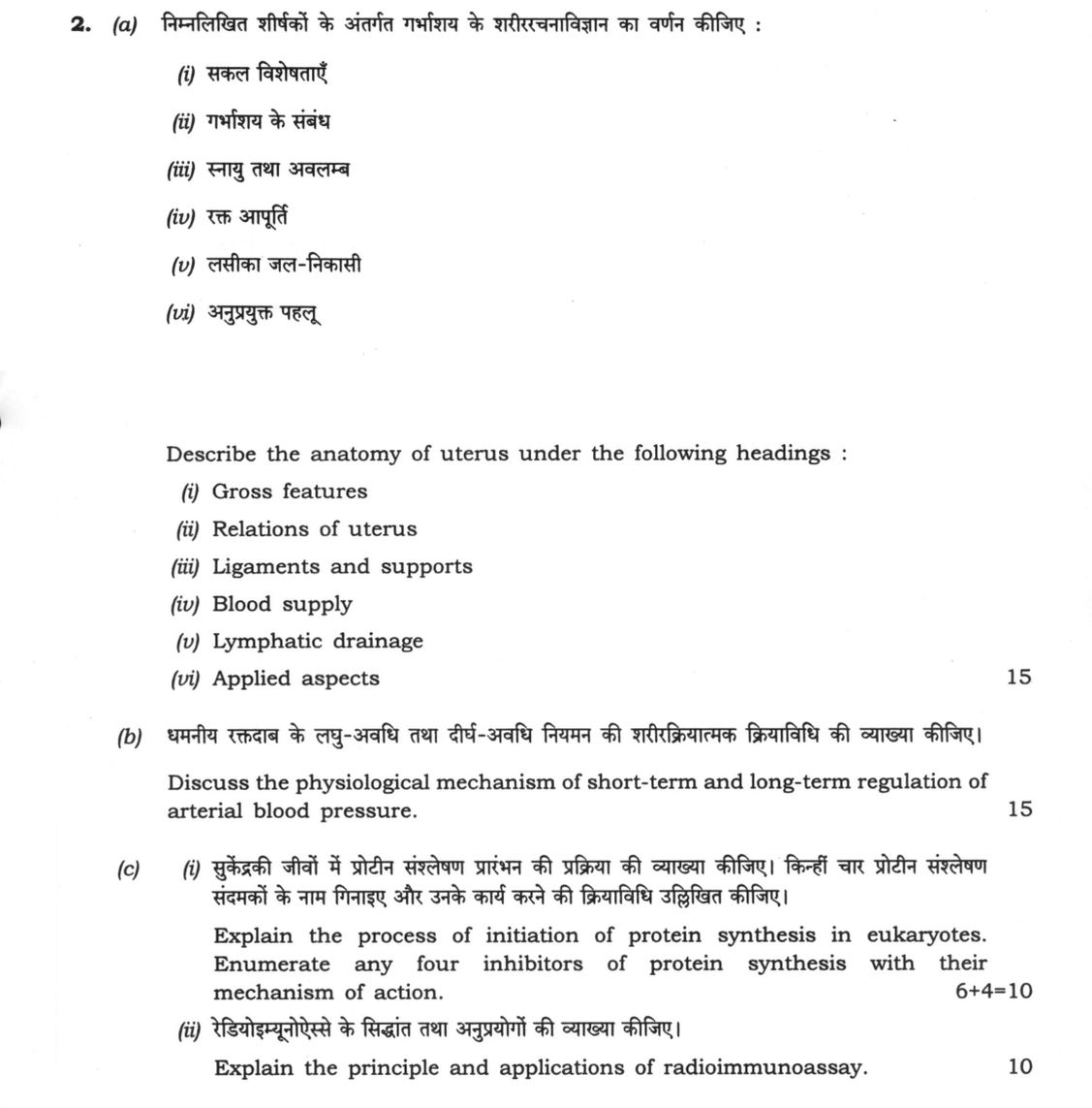
(a) Describe the anatomy of uterus under the following headings: (i) Gross features (ii) Relations of uterus (iii) Ligaments and…
Describe the anatomy of uterus under the following headings: (i) Gross features (ii) Relations of uterus (iii) Ligaments and supports (iv) Blood supply (v) Lymphatic drainage (vi) Applied aspects 15 marks
Discuss the physiological mechanism of short-term and long-term regulation of arterial blood pressure. 15 marks
Explain the process of initiation of protein synthesis in eukaryotes. Enumerate any four inhibitors of protein synthesis with their mechanism of action. (6+4=10 marks)
Explain the principle and applications of radioimmunoassay. 10 marks
हिंदी में प्रश्न पढ़ें
निम्नलिखित शीर्षकों के अंतर्गत गर्भाशय के शरीररचनाविज्ञान का वर्णन कीजिए : (i) सकल विशेषताएँ (ii) गर्भाशय के संबंध (iii) स्नायु तथा अवलंब (iv) रक्त आपूर्ति (v) लसीका जल-निकासी (vi) अनुप्रयुक्त पहलू 15 marks
धमनिय रक्तदाब के लघु-अवधि तथा दीर्घ-अवधि नियमन की शारीरिकीयत्मक क्रियाविधि की व्याख्या कीजिए। 15 marks
सुकेंद्रकी जीवों में प्रोटीन संश्लेषण प्रारंभ की प्रक्रिया की व्याख्या कीजिए। किन्हीं चार प्रोटीन संश्लेषण सदमकों के नाम गिनाइए और उनके कार्य करने की क्रियाविधि उल्लिखित कीजिए। (6+4=10)
रेडियोइम्यूनोएसे के सिद्धांत तथा अनुप्रयोगों की व्याख्या कीजिए। 10 marks
Model answer
Written by UPSC Answer Check against this question's marking rubric, to the expected length. UPSC does not publish answers for Mains — this is one way to score well, not an official key.
Uterus. The uterus is a thick-walled, pear-shaped muscular organ, about 7.5 cm long, 5 cm wide and 2.5 cm thick, with fundus, body and cervix. It lies in the pelvis between bladder and rectum, anteverted and anteflexed. Peritoneum covers fundus and anterior body, forming the vesicouterine pouch; posteriorly it forms the rectouterine pouch of Douglas. The cervix is partly extraperitoneal and enters the vagina. Its supports are the broad ligament, round ligament, cardinal ligament, uterosacral ligament and pubocervical ligament; the ovarian ligament attaches ovary to uterus but is not a principal support. The uterine artery, a branch of the internal iliac artery, runs in the cardinal ligament and anastomoses with the ovarian artery; venous drainage is through the uterine plexus to internal iliac veins. Lymphatics from the fundus and body drain mainly to external iliac and para-aortic nodes, while those from the cervix drain to internal iliac and sacral nodes. Applied anatomy includes pelvic organ prolapse when cardinal, uterosacral and pubocervical supports fail; hysterectomy requires knowledge of the uterine artery, cardinal ligament and ureter; the pouches collect ascites or haemoperitoneum, and cervical lymphatics guide cancer staging. Estrogen and progesterone regulate uterine growth and secretory changes.
Blood pressure. Short-term regulation is neural. Baroreceptors in the carotid sinus and aortic arch sense stretch; rising pressure increases afferent firing through the glossopharyngeal and vagus nerves to the nucleus tractus solitarius. This increases vagal outflow and reduces sympathetic outflow, lowering heart rate, contractility and total peripheral resistance. Chemoreceptors in the carotid and aortic bodies respond to hypoxia, hypercapnia and acidosis, raising sympathetic tone. In severe hypotension, the central ischemic response causes powerful medullary vasoconstriction. Long-term regulation is renal and humoral, especially the renal-body fluid mechanism. High pressure increases glomerular filtration and natriuresis, reducing extracellular volume; low pressure conserves sodium and water. The renin-angiotensin-aldosterone system is activated by low renal perfusion, sympathetic stimulation or low sodium: renin converts angiotensinogen to angiotensin I, ACE forms angiotensin II, which constricts vessels, stimulates aldosterone, thirst and ADH release. ADH increases water reabsorption. Atrial natriuretic peptide and brain natriuretic peptide oppose this by promoting natriuresis and vasodilation. Capillary fluid shifts also buffer volume changes, as excess interstitial fluid is returned to plasma over time.
Protein synthesis. Eukaryotic initiation begins when the 40S ribosomal subunit, with initiator methionyl-tRNA, eIF2-GTP, eIF1, eIF1A and eIF3, forms the 43S pre-initiation complex. eIF4F (eIF4E, eIF4G, eIF4A) binds the 5′ cap and recruits the 43S complex to mRNA. The complex scans to the first AUG, where start-codon recognition triggers GTP hydrolysis by eIF2, mediated by eIF5, and release of initiation factors. eIF5B then promotes joining of the 60S subunit to form the 80S initiation complex. Elongation then begins. Inhibitors include tetracycline, which blocks aminoacyl-tRNA binding at the 30S site; chloramphenicol, which inhibits 50S peptidyl transferase; erythromycin, which blocks translocation by binding the 50S exit tunnel; and puromycin, which mimics aminoacyl-tRNA and causes premature chain termination. Clinically, such inhibitors are used as antibiotics.
Radioimmunoassay. Radioimmunoassay is a competitive binding assay. A fixed amount of antibody is incubated with a known amount of radiolabeled antigen and a sample containing unlabeled antigen. The two antigens compete for the same antibody-binding sites; as the concentration of unlabeled antigen rises, the proportion of radiolabeled antigen bound falls. Bound radioactivity is measured and compared with a standard curve to quantify the sample. The method is highly sensitive, often detecting picogram per millilitre levels. It is used in Indian diagnostic laboratories for thyroid hormones T3 and T4, insulin, cortisol, hCG in pregnancy, therapeutic drug levels, and tumor markers such as PSA and AFP. Thus, anatomy, homeostasis, molecular biology and immunoassay diagnostics interconnect clinically.
What "Describe" is asking you to do
Give a full, ordered account of the thing named — its parts, stages or mechanism — in the sequence in which it actually exists or occurs. Most describe questions come from the science optionals, where the marks sit in correct technical detail and, where the stem says so, a labelled diagram.
Structure that answers it
One-line identification of the subject → the parts or stages in their real order, each with its defining detail → labelled diagram where the subject is structural → closing line on function or significance
Where marks are lost
Loose general prose where the examiner is ticking named parts, correct terminology and their sequence; and in the General Studies papers, turning to evaluation before the description is finished.
How this answer will be evaluated
Approach
Framework: Medical Science, Paper 1. (a) describe: define > structure or process in order > labelled diagram > significance | (b) discuss: intro > 3-4 dimensions > example > balanced close | (c(i)) explain: definition/context > points in order > small example > short close | (c(ii)) explain: definition/context > points in order > small example > short close Full marks: Comprehensive, accurate, and well-structured answers with diagrams and specific examples.
Key points expected
- Gross features: pear-shaped, fundus, body, cervix, isthmus
- Relations: anterior (urinary bladder), posterior (rectum), lateral (uterine arteries)
- Ligaments: broad, round, uterosacral, cardinal, ovarian
- Blood supply: uterine artery (internal iliac), ovarian artery (aorta)
- Short-term: Baroreceptor reflex (carotid sinus/aortic arch)
- Short-term: Chemoreceptor reflex (carotid/aortic bodies)
- Long-term: Renin-Angiotensin-Aldosterone System (RAAS)
- Long-term: Renal fluid volume control (pressure natriuresis)
Evaluation rubric
Each sub-part is marked on its own, against the marks and word limit printed on the paper.
- (a) Anatomical description of uterus covering six specific headings. 15 marks
describe— define → structure or process in order → labelled diagram → significance
Must cover
- Gross features: pear-shaped, fundus, body, cervix, isthmus
- Relations: anterior (urinary bladder), posterior (rectum), lateral (uterine arteries)
- Ligaments: broad, round, uterosacral, cardinal, ovarian
- Blood supply: uterine artery (internal iliac), ovarian artery (aorta)
Loses marks
- Omitting specific named ligaments
- Confusing uterine and ovarian artery origins
- Listing relations without specifying anterior/posterior
Earns more
- Lymphatic drainage: external/internal iliac, para-aortic nodes
- Applied aspects: C-section, hysterectomy, endometriosis
- Labelled diagram of uterus and ligaments
- Mention of peritoneal reflections (vesicouterine/rectouterine pouches)
Extra mark
- Mention of specific surgical landmarks (e.g., ureter crossing uterine artery)
- Reference to specific anatomical variations
- (b) Physiological mechanisms of short-term and long-term arterial BP regulation. 15 marks
discuss— intro → 3-4 dimensions → example → balanced close
Must cover
- Short-term: Baroreceptor reflex (carotid sinus/aortic arch)
- Short-term: Chemoreceptor reflex (carotid/aortic bodies)
- Long-term: Renin-Angiotensin-Aldosterone System (RAAS)
- Long-term: Renal fluid volume control (pressure natriuresis)
Loses marks
- Confusing short-term (neural) with long-term (humoral) mechanisms
- Omitting the role of the kidney in long-term regulation
- Listing symptoms without explaining the mechanism
Earns more
- Flow diagram of baroreceptor reflex arc
- Mention of central chemoreceptors (medulla)
- Role of vasopressin (ADH) in long-term regulation
- Mention of myogenic response
Extra mark
- Mention of specific receptor types (e.g., AT1 receptors)
- Reference to specific clinical conditions (e.g., Pheochromocytoma)
- (c(i)) Initiation of protein synthesis in eukaryotes and four inhibitors. 10 marks
explain— definition/context → points in order → small example → short close
Must cover
- Initiation: 43S pre-initiation complex formation
- Initiation: mRNA scanning and start codon recognition
- Inhibitor 1: Chloramphenicol (50S peptidyl transferase)
- Inhibitor 2: Tetracycline (30S tRNA binding)
Loses marks
- Describing prokaryotic initiation instead of eukaryotic
- Listing inhibitors without mechanism of action
- Omitting the role of the 43S complex
Earns more
- Inhibitor 3: Streptomycin (30S misreading)
- Inhibitor 4: Erythromycin (50S translocation)
- Mention of eIFs (eukaryotic initiation factors)
- Mention of GTP hydrolysis in initiation
Extra mark
- Mention of specific eIFs (e.g., eIF4E, eIF2)
- Reference to specific clinical applications of inhibitors
- (c(ii)) Principle and applications of radioimmunoassay (RIA). 10 marks
explain— definition/context → points in order → small example → short close
Must cover
- Principle: Competitive binding of labelled/unlabelled antigen
- Principle: Inverse relationship between bound and free antigen
- Application: Hormone measurement (e.g., TSH, insulin)
- Application: Drug monitoring (e.g., digoxin, theophylline)
Loses marks
- Confusing RIA with ELISA
- Omitting the competitive nature of the assay
- Listing applications without specifying the analyte
Earns more
- Mention of specific isotopes (e.g., I-125)
- Mention of sensitivity (pg/mL range)
- Mention of specific clinical conditions (e.g., thyroid disorders)
- Mention of limitations (radioactive waste)
Extra mark
- Mention of specific commercial kits
- Reference to specific regulatory guidelines for RIA
Practice this exact question
Write your answer and it is marked point by point against the model answer above — what you covered, what you missed, what you got wrong.
Evaluate my answer →More from Medical Science 2022 Paper I
- Q1 (a) Discuss the stomach under the following headings: (i) Peritoneal relations (ii) Blood…
- Q2 (a) Describe the anatomy of uterus under the following headings: (i) Gross features (ii)…
- Q3 (a) (i) Discuss the functions of basal ganglia. Add a note on Parkinson's disease. (5+5=1…
- Q4 (a) (i) Explain the mechanism of iron absorption in the intestine. What are the factors r…
- Q5 (a) Describe the molecular mechanisms of carcinogenesis of breast carcinoma. Describe the…