Paper I — Q6
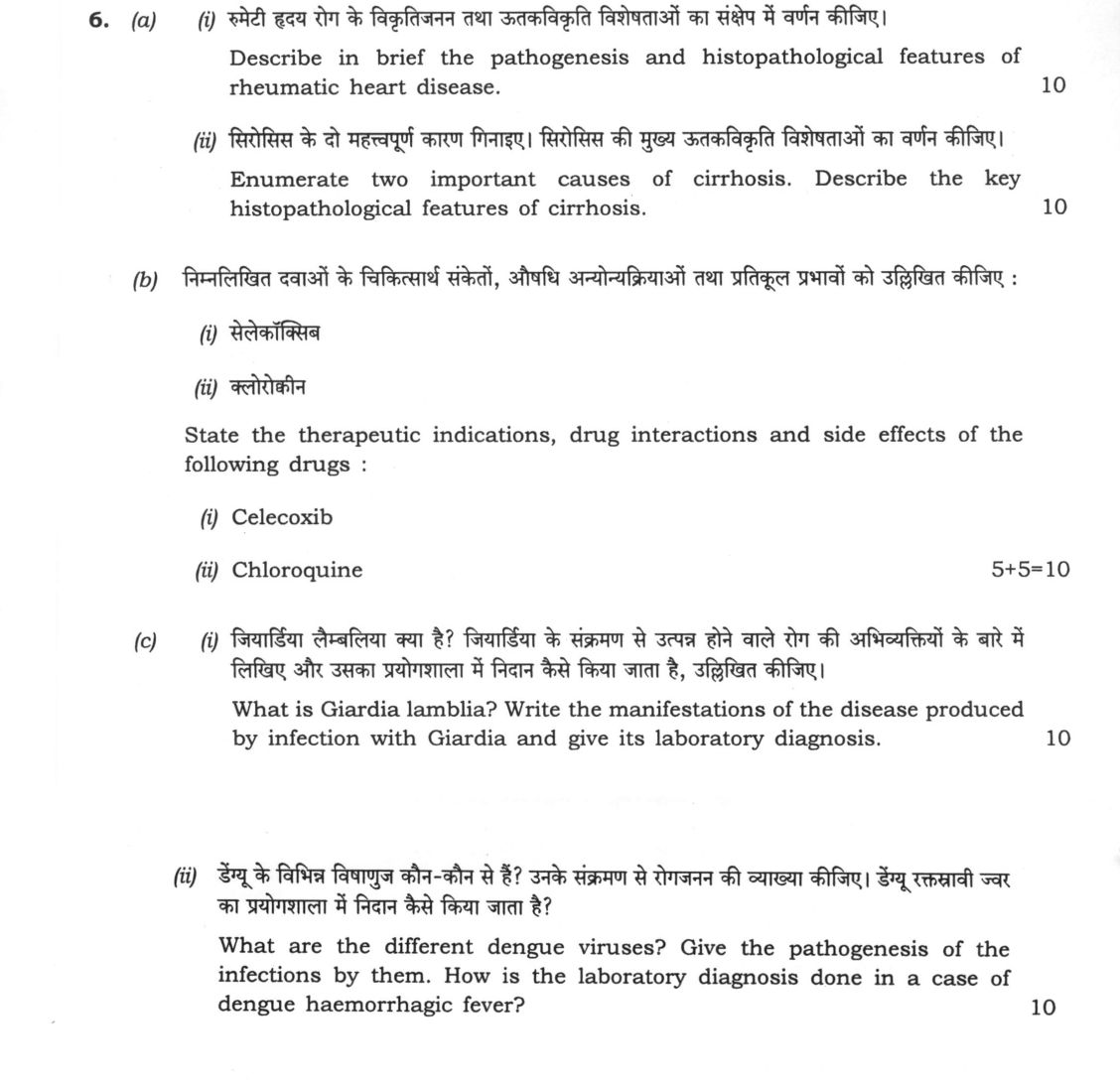
(a) (i) Describe in brief the pathogenesis and histopathological features of rheumatic heart disease. (10 marks) (ii) Enumerate…
Describe in brief the pathogenesis and histopathological features of rheumatic heart disease. 10 marks
Enumerate two important causes of cirrhosis. Describe the key histopathological features of cirrhosis. 10 marks
State the therapeutic indications, drug interactions and side effects of the following drugs: (i) Celecoxib (ii) Chloroquine (5+5=10 marks)
What is Giardia lamblia? Write the manifestations of the disease produced by infection with Giardia and give its laboratory diagnosis. 10 marks
What are the different dengue viruses? Give the pathogenesis of the infections by them. How is the laboratory diagnosis done in a case of dengue haemorrhagic fever? 10 marks
हिंदी में प्रश्न पढ़ें
रूमेटी हृदय रोग के विकृतिजनन तथा उतकविकृति विशेषताओं का संक्षेप में वर्णन कीजिए। 10 marks
सिरोसिस के दो महत्वपूर्ण कारण गिनाइए। सिरोसिस की मुख्य उतकविकृति विशेषताओं का वर्णन कीजिए। 10 marks
निम्नलिखित दवाओं के चिकित्सार्थ संकेतों, औषधि अन्योन्यक्रियाओं तथा प्रतिकूल प्रभावों को उल्लिखित कीजिए : (i) सेलेकोक्सिब (ii) क्लोरोक्वीन (5+5=10)
जियार्डिया लैम्बलिया क्या है? जियार्डिया के संक्रमण से उत्पन्न होने वाले रोग की अभिव्यक्तियों के बारे में लिखिए और उसका प्रयोगशाला में निदान कैसे किया जाता है, उल्लिखित कीजिए। 10 marks
डेंगू के विभिन्न विषाणुज कौन-कौन से हैं? उनके संक्रमण से रोगजनन की व्याख्या कीजिए। डेंगू रक्तस्रावी ज्वर का प्रयोगशाला में निदान कैसे किया जाता है? 10 marks
Model answer
Written by UPSC Answer Check against this question's marking rubric, to the expected length. UPSC does not publish answers for Mains — this is one way to score well, not an official key.
Rheumatic heart disease. RHD is a late sequela of acute rheumatic fever following untreated group A beta-haemolytic Streptococcus pyogenes pharyngitis, usually after a latent period of 2–4 weeks. Pathogenesis is immune-mediated: streptococcal M protein shares epitopes with cardiac myosin, and streptococcal carbohydrate antigens cross-react with valvular laminin, producing molecular mimicry. T cells and antibodies cause granulomatous inflammation in the myocardium, endocardium and valves, often as pancarditis. Histologically, early lesions show Aschoff bodies—foci of fibrinoid necrosis surrounded by macrophages, including Anitschkow cells, Aschoff giant cells, lymphocytes and plasma cells. In chronic RHD, valvular fibrosis, thickening, calcification and commissural fusion occur, with mitral valve most commonly affected, followed by aortic valve, leading to stenosis and/or regurgitation.
Cirrhosis. Two important causes are alcoholic liver disease and chronic viral hepatitis, especially hepatitis B and C, which are common in India. Cirrhosis is a chronic diffuse liver disease in which normal lobular architecture is replaced by fibrous septa and regenerative nodules. Key histopathological features include bridging fibrosis, distorted hepatic plates, regenerative hepatocyte nodules, loss of normal lobules, and portal tract inflammation. The fibrous septa contain inflammatory cells, bile ducts and vessels, and the regenerative nodules may be compressed. In alcoholic cirrhosis, Mallory bodies, steatosis and neutrophilic infiltration may be seen; in viral cirrhosis, interface hepatitis and lymphoplasmacytic infiltrates may predominate.
Celecoxib. Celecoxib is a selective COX-2 inhibitor used for rheumatoid arthritis, osteoarthritis, acute pain and familial adenomatous polyposis. Its main interactions are with warfarin and other anticoagulants, increasing bleeding risk; with ACE inhibitors, ARBs and diuretics, increasing renal impairment and hyperkalaemia; and with other NSAIDs or corticosteroids, increasing gastrointestinal and cardiovascular risk. Because COX-2 selectivity reduces but does not eliminate prostaglandin-mediated gastric protection, GI risk remains. Side effects include gastrointestinal bleeding, dyspepsia, fluid retention, hypertension, oedema, renal dysfunction, and increased cardiovascular thrombotic events such as myocardial infarction and stroke.
Chloroquine. Chloroquine is an antimalarial used for clinical cure of erythrocytic stages of Plasmodium vivax and P. ovale, and for P. falciparum where sensitivity persists; radical cure of hypnozoites in vivax/ovale requires primaquine. It is also used as an amebicidal, especially for amoebic liver abscess, and immunomodulatory drug in conditions such as lupus. Important interactions include lowering the seizure threshold and antagonising anticonvulsants, and caution with digoxin due to arrhythmia risk. Side effects include retinopathy with chronic use, cardiomyopathy and conduction disturbances, nausea, pruritus, and depigmentation.
Giardia lamblia. Giardia lamblia is a flagellated intestinal protozoan with pear-shaped trophozoites and oval cysts. Trophozoites attach to the duodenal and jejunal mucosa, while cysts are the infective stage passed in faeces. It causes giardiasis, a malabsorptive diarrhoeal illness with chronic watery or foul-smelling stools, steatorrhoea, abdominal cramps, bloating, flatulence, weight loss and failure to thrive in children. Laboratory diagnosis is by detecting trophozoites in duodenal aspirate or by string test, cysts in stool, antigen detection by ELISA or rapid tests, and sometimes PCR.
Dengue. Dengue is caused by four serotypes, DEN-1 to DEN-4, transmitted by Aedes mosquitoes. Infection causes viraemia and immune activation. In primary infection, disease is usually mild; in secondary infection with a different serotype, pre-existing non-neutralising antibodies can bind virus and enhance entry into monocytes and macrophages through Fc receptors, causing antibody-dependent enhancement, increased viral replication, cytokine release, vascular leakage and plasma leakage. Laboratory diagnosis of dengue haemorrhagic fever includes detection of NS1 antigen or viral RNA by RT-PCR in early viraemic phase, IgM and IgG serology, and monitoring haematological markers such as thrombocytopenia and rising haematocrit indicating plasma leakage. NS1 is most useful in the first five days, while IgM appears after about five days; PCR is most sensitive early. Thus, accurate diagnosis and management depend on correlating pathogenesis, histopathology, drug profiles and laboratory findings.
What "Describe" is asking you to do
Give a full, ordered account of the thing named — its parts, stages or mechanism — in the sequence in which it actually exists or occurs. Most describe questions come from the science optionals, where the marks sit in correct technical detail and, where the stem says so, a labelled diagram.
Structure that answers it
One-line identification of the subject → the parts or stages in their real order, each with its defining detail → labelled diagram where the subject is structural → closing line on function or significance
Where marks are lost
Loose general prose where the examiner is ticking named parts, correct terminology and their sequence; and in the General Studies papers, turning to evaluation before the description is finished.
How this answer will be evaluated
Approach
Framework: Medical Science, Paper 1. (a(i)) describe: define > structure or process in order > labelled diagram > significance | (a(ii)) enumerate: list the items in order > one line each > no commentary | (b(i)) enumerate: list the items in order > one line each > no commentary | (b(ii)) enumerate: list the items in order > one line each > no commentary | (c(i)) explain: definition/context > points in order > small example > short close | (c(ii)) explain: definition/context > points in order > small example > short close Full marks: Accurate pathophysiology, specific histology, and precise drug/organism details.
Key points expected
- Molecular mimicry with Group A Streptococcus
- Aschoff bodies and Anitschkow cells
- Valvular vegetations (verrucous)
- Chronic valvular deformity (e.g., mitral stenosis)
- Alcoholic liver disease
- Chronic viral hepatitis (B or C)
- Regenerative nodules
- Fibrous septa / architectural distortion
Evaluation rubric
Each sub-part is marked on its own, against the marks and word limit printed on the paper.
- (a(i)) Pathogenesis and histopathological features of rheumatic heart disease. 10 marks
describe— define → structure or process in order → labelled diagram → significance
Must cover
- Molecular mimicry with Group A Streptococcus
- Aschoff bodies and Anitschkow cells
- Valvular vegetations (verrucous)
- Chronic valvular deformity (e.g., mitral stenosis)
Loses marks
- Confusing with infective endocarditis
- Omitting the role of streptococcal infection
- Listing symptoms without histological basis
Earns more
- Role of immune complex deposition
- Specific valve involvement (mitral > aortic)
- Mention of 'buttonhole' deformity
Extra mark
- Reference to Jones criteria
- Mention of 'fish mouth' appearance
- (a(ii)) Two causes of cirrhosis and its key histopathological features. 10 marks
enumerate— list the items in order → one line each → no commentary
Must cover
- Alcoholic liver disease
- Chronic viral hepatitis (B or C)
- Regenerative nodules
- Fibrous septa / architectural distortion
Loses marks
- Listing more than two causes without focus
- Confusing cirrhosis with simple fatty liver
- Omitting the fibrous septa component
Earns more
- Mention of portal hypertension mechanism
- Distinction between micronodular and macronodular
- Mention of Kupffer cell hyperplasia
Extra mark
- Reference to specific viral serotypes
- Mention of 'honeycomb' liver appearance
- (b(i)) Indications, interactions, and side effects of Celecoxib. 5 marks
enumerate— list the items in order → one line each → no commentary
Must cover
- COX-2 selective inhibitor mechanism
- Indications: Osteoarthritis, Rheumatoid Arthritis
- Cardiovascular risk (thrombosis)
- GI side effects (less than NSAIDs but present)
Loses marks
- Treating it as a non-selective NSAID
- Omitting cardiovascular risks
- Confusing with COX-1 inhibitors
Earns more
- Interaction with SSRIs (bleeding risk)
- Interaction with Warfarin
- Mention of 'Celebrex' brand name
Extra mark
- Reference to VIGOR trial
- Mention of specific contraindications (MI history)
- (b(ii)) Indications, interactions, and side effects of Chloroquine. 5 marks
enumerate— list the items in order → one line each → no commentary
Must cover
- Antimalarial (P. vivax, P. ovale, P. malariae)
- Autoimmune: SLE, Rheumatoid Arthritis
- Retinopathy (bull's eye maculopathy)
- QT prolongation / Cardiac toxicity
Loses marks
- Omitting retinal toxicity
- Confusing with Quinine
- Ignoring cardiac side effects
Earns more
- Interaction with antacids (absorption)
- Interaction with Warfarin
- Mention of 'Chloroquine-resistant' P. falciparum
Extra mark
- Reference to 'Chloroquine phosphate' salt
- Mention of specific dosing for malaria vs RA
- (c(i)) Giardia lamblia: definition, manifestations, and lab diagnosis. 10 marks
explain— definition/context → points in order → small example → short close
Must cover
- Flagellated protozoan (trophozoite/cyst)
- Giardiasis: Chronic diarrhea, malabsorption
- Stool microscopy (cysts/trophozoites)
- ELISA / Antigen detection
Loses marks
- Confusing with Entamoeba histolytica
- Omitting the cyst stage in diagnosis
- Listing symptoms without mechanism
Earns more
- Mention of 'pear-shaped' trophozoite
- Mention of 'falling leaf' motility
- Mention of 'steatorrhea'
Extra mark
- Reference to 'Beaver fever'
- Mention of specific staining (Trichrome)
- (c(ii)) Dengue viruses, pathogenesis, and lab diagnosis of DHF. 10 marks
explain— definition/context → points in order → small example → short close
Must cover
- Four serotypes (DENV 1-4)
- Aedes aegypti vector
- Pathogenesis: Viremia, immune complex, capillary leak
- Lab: NS1 antigen, IgM/IgG serology
Loses marks
- Confusing with Zika or Chikungunya
- Omitting the role of Aedes mosquito
- Listing symptoms without pathophysiology
Earns more
- Mention of 'cross-reactive' antibodies
- Mention of 'plasma leakage' in DHF
- Mention of 'thrombocytopenia'
Extra mark
- Reference to 'Dengue Shock Syndrome'
- Mention of specific RT-PCR for early diagnosis
Practice this exact question
Write your answer and it is marked point by point against the model answer above — what you covered, what you missed, what you got wrong.
Evaluate my answer →More from Medical Science 2022 Paper I
- Q3 (a) (i) Discuss the functions of basal ganglia. Add a note on Parkinson's disease. (5+5=1…
- Q4 (a) (i) Explain the mechanism of iron absorption in the intestine. What are the factors r…
- Q5 (a) Describe the molecular mechanisms of carcinogenesis of breast carcinoma. Describe the…
- Q6 (a) (i) Describe in brief the pathogenesis and histopathological features of rheumatic he…
- Q7 (a) What are organophosphate compounds? Discuss briefly the clinical features, treatment…
- Q8 (a) (i) Enumerate different species of Aspergillus and the infections caused by them. Giv…