Paper II — Q1
(a) Enumerate the imaging modalities used in the diagnosis of cardiac diseases. List their specific indications in diagnosing…
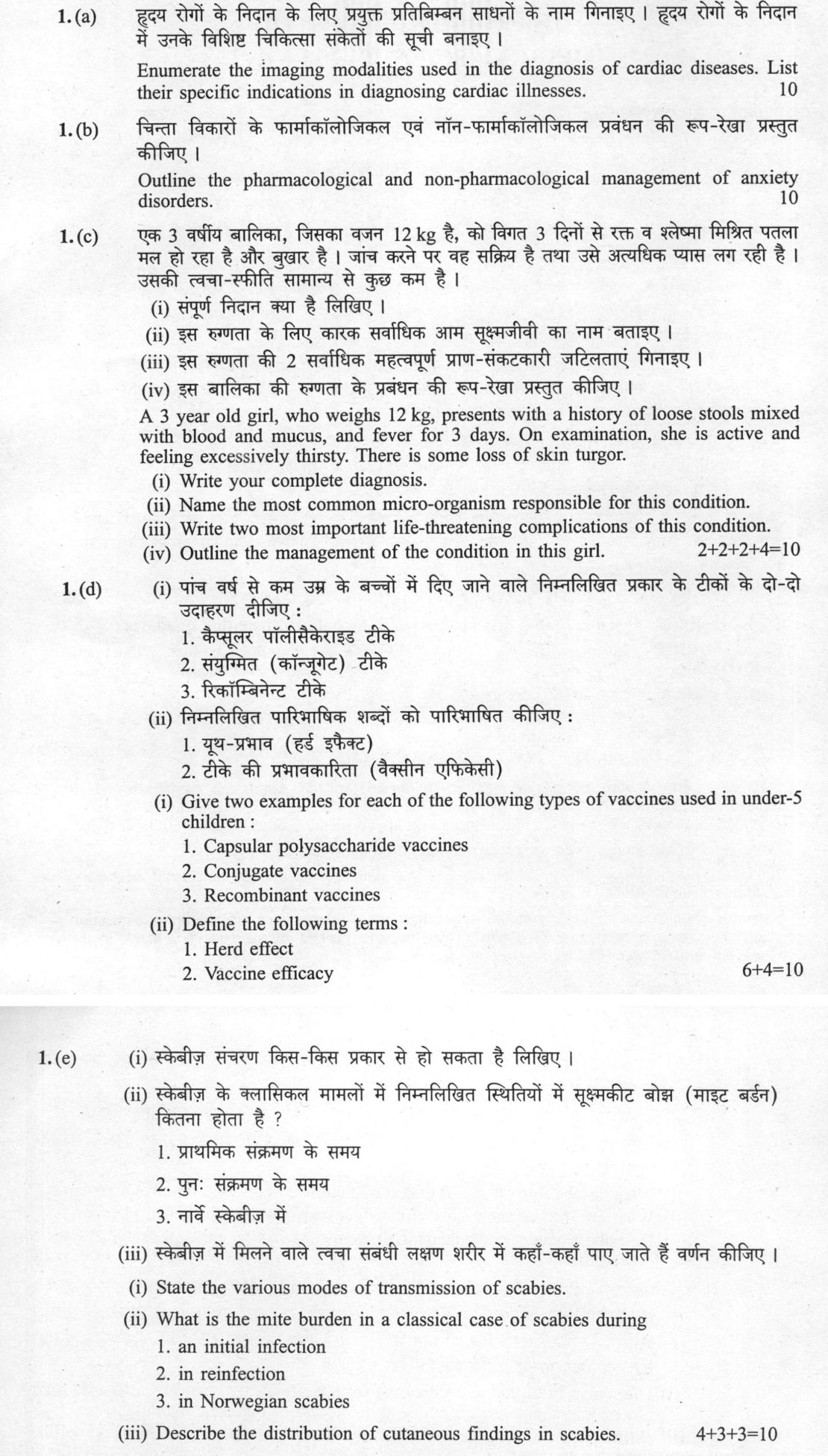
Enumerate the imaging modalities used in the diagnosis of cardiac diseases. List their specific indications in diagnosing cardiac illnesses. 10 marks
Outline the pharmacological and non-pharmacological management of anxiety disorders. 10 marks
A 3 year old girl, who weighs 12 kg, presents with a history of loose stools mixed with blood and mucus, and fever for 3 days. On examination, she is active and feeling excessively thirsty. There is some loss of skin turgor. Write your complete diagnosis.
Name the most common micro-organism responsible for this condition.
Write two most important life-threatening complications of this condition.
Outline the management of the condition in this girl. (2+2+2+4=10 marks)
Give two examples for each of the following types of vaccines used in under-5 children: 1. Capsular polysaccharide vaccines 2. Conjugate vaccines 3. Recombinant vaccines
Define the following terms: 1. Herd effect 2. Vaccine efficacy (6+4=10 marks)
State the various modes of transmission of scabies.
What is the mite burden in a classical case of scabies during 1. an initial infection 2. in reinfection 3. in Norwegian scabies
Describe the distribution of cutaneous findings in scabies. (4+3+3=10 marks)
हिंदी में प्रश्न पढ़ें
हृदय रोगों के निदान के लिए प्रयुक्त प्रतिबिम्बन साधनों के नाम गिनाइए । हृदय रोगों के निदान में उनके विशिष्ट चिकित्सा संकेतों की सूची बनाइए । (10 अंक)
चिंता विकारों के फार्माकोलॉजिकल एवं नॉन-फार्माकोलॉजिकल प्रबंधन की रूप-रेखा प्रस्तुत कीजिए । (10 अंक)
एक 3 वर्षीय बालिका, जिसका वजन 12 kg है, को विगत 3 दिनों से रक्त व श्लेष्मा मिश्रित पतला मल हो रहा है और बुखार है । जांच करने पर वह सक्रिय है तथा उसे अत्यधिक प्यास लग रही है । उसकी त्वचा-स्फीति सामान्य से कुछ कम है । संपूर्ण निदान क्या है लिखिए ।
इस रुग्णता के लिए कारक सर्वाधिक आम सूक्ष्मजीवी का नाम बताइए ।
इस रुग्णता की 2 सर्वाधिक महत्वपूर्ण प्राण-संकटकारी जटिलताएं गिनाइए ।
इस बालिका की रुग्णता के प्रबंधन की रूप-रेखा प्रस्तुत कीजिए । (2+2+2+4=10 अंक)
पांच वर्ष से कम उम्र के बच्चों में दिए जाने वाले निम्नलिखित प्रकार के टीकों के दो-दो उदाहरण दीजिए : 1. कैप्सुलर पॉलिसैकराइड टीके 2. संयुग्मित (कांजुगेट) टीके 3. रिकॉम्बिनेंट टीके
निम्नलिखित पारिभाषिक शब्दों को परिभाषित कीजिए : 1. यूथ-प्रभाव (हर्ड इफेक्ट) 2. टीके की प्रभावकारिता (वैक्सीन एफिकेसी) (6+4=10 अंक)
स्केबीज संचरण किस-किस प्रकार से हो सकता है लिखिए ।
स्केबीज के क्लासिकल मामलों में निम्नलिखित स्थितियों में सूक्ष्मकीट बोझ (माइट बर्डन) कितना होता है ? 1. प्राथमिक संक्रमण के समय 2. पुनः संक्रमण के समय 3. नार्वे स्केबीज में
स्केबीज में मिलने वाले त्वचा संबंधी लक्षण शरीर में कहाँ-कहाँ पाए जाते हैं वर्णन कीजिए । (4+3+3=10 अंक)
Model answer
Written by UPSC Answer Check against this question's marking rubric, to the expected length. UPSC does not publish answers for Mains — this is one way to score well, not an official key.
(a) Cardiac imaging modalities and indications. The imaging modalities used in the diagnosis of cardiac diseases are chest radiography, echocardiography, cardiac CT, cardiac MRI, nuclear imaging and invasive angiography. Chest radiography is quick, inexpensive and useful to detect cardiomegaly, pulmonary congestion, pleural effusion, aortic calcification, mediastinal widening and characteristic congenital heart disease patterns. Transthoracic echocardiography is the initial non-invasive test for valve assessment, chamber size, systolic and diastolic function, wall motion, pericardial effusion, cardiomyopathy, congenital heart disease and endocarditis; two-dimensional, Doppler, colour-flow and tissue-Doppler studies quantify valve gradients, regurgitant jets and pulmonary pressures. Transoesophageal echocardiography is used when transthoracic views are inadequate, for atrial thrombus before cardioversion, prosthetic valve dysfunction, small vegetations and aortic pathology; stress echocardiography, with treadmill or dobutamine, is indicated for inducible ischaemia, functional capacity and risk stratification. Cardiac CT is used for coronary CTA in stable chest pain of low or intermediate risk, coronary calcium scoring, aortic dissection or aneurysm, congenital anomalies and pericardial disease. Cardiac MRI is indicated for myocarditis, infiltrative cardiomyopathy, myocardial viability, congenital heart disease, aortic disease and cardiac masses; late gadolinium enhancement identifies fibrosis or inflammation. Nuclear imaging includes MUGA for ejection fraction, especially chemotherapy-related cardiotoxicity, and SPECT or PET for myocardial perfusion, viability, ischaemia, myocarditis, sarcoidosis and prosthetic valve endocarditis. Invasive coronary angiography remains the reference test for coronary artery disease, acute coronary syndromes, pre-revascularisation assessment and complex valvular or congenital evaluation; right-heart catheterisation may be added for pulmonary hypertension or congenital shunts.
(b) Management of anxiety disorders. Pharmacological management is based on SSRIs as first-line therapy, such as fluoxetine, sertraline or escitalopram, usually continued for several months after remission; benefit may take 2-4 weeks. SNRIs such as venlafaxine or duloxetine are useful alternatives. Benzodiazepines such as alprazolam, lorazepam or clonazepam are reserved for short-term relief, usually 2-4 weeks, because of sedation, tolerance and dependence; they should be tapered and avoided in substance-use disorders. Buspirone is useful in generalised anxiety; beta-blockers such as propranolol control performance-related tremor, palpitations and somatic symptoms. Non-pharmacological management includes psychoeducation, cognitive behavioural therapy, graded exposure therapy for phobic or panic symptoms, relaxation and breathing techniques, progressive muscle relaxation, mindfulness, regular sleep, exercise, reduction of caffeine and alcohol, and family or peer support. CBT is particularly important in specific phobia, panic disorder and social anxiety.
(c) Case of 3-year-old with dysentery. (i) The complete diagnosis is a 3-year-old girl with acute bacillary dysentery and some dehydration, corresponding to WHO Plan B. (ii) The most common micro-organism in India is Shigella flexneri; in developed settings Shigella sonnei is common. (iii) The two most important life-threatening complications are haemolytic uraemic syndrome and toxic megacolon, with septic shock as a related serious complication. (iv) Management is supportive and antimicrobial. The child is active and thirsty with reduced skin turgor, so give ORS 75 ml/kg over 4 hours, i.e. about 900 ml for 12 kg, then re-assess dehydration. Continue feeding and give ORS after each loose stool. Give zinc 20 mg once daily for 10-14 days. Start antibiotics for dysentery, e.g. cefixime 8 mg/kg/day in two divided doses for 5 days, or azithromycin 10 mg/kg on day 1 followed by 5 mg/kg on days 2-5. Avoid anti-motility drugs. Stool microscopy or culture, blood counts and renal function may be done if available or if HUS is suspected. Monitor urine output, mental status, stool frequency and blood, fever, abdominal distension, pallor and oliguria for HUS, and refer if severe dehydration, persistent vomiting, lethargy, shock, persistent bloody stools or abdominal distension. If the child cannot drink or becomes severely dehydrated, Plan C intravenous fluids and urgent referral are needed. Safe water, handwashing and continued age-appropriate food are also important.
(d) Vaccines and terms. (i) Capsular polysaccharide vaccines used in under-5 children include Vi capsular polysaccharide typhoid vaccine, given from 2 years, and 23-valent pneumococcal polysaccharide vaccine when indicated from 2 years in high-risk children. Conjugate vaccines include Hib vaccine and 13-valent pneumococcal conjugate vaccine; meningococcal ACWY conjugate is another example. Conjugation links the polysaccharide to a protein carrier and improves T-cell-dependent immunity in infants. Recombinant vaccines used in under-5 children include recombinant hepatitis B vaccine and the recombinant pertussis component of acellular pertussis vaccines (DTaP), which contains pertussis toxin, filamentous haemagglutinin and fimbrial proteins. (ii) Herd effect, or herd immunity, is indirect protection of unvaccinated or vulnerable individuals when a high proportion of the community is immunised, reducing transmission. Vaccine efficacy is the proportionate reduction in disease among vaccinated persons compared with unvaccinated controls in a controlled trial, calculated as (attack rate unvaccinated minus attack rate vaccinated) divided by attack rate unvaccinated, multiplied by 100.
(e) Scabies. (i) Modes of transmission are direct prolonged skin-to-skin contact, sexual contact, and contact with contaminated fomites such as bedding and clothing, especially in crusted scabies. (ii) In a classical case, the mite burden is about 10-15 mites in initial infection; in reinfection the burden rises rapidly, often to hundreds or thousands; in Norwegian/crusted scabies it may reach millions. (iii) Cutaneous findings are distributed on flexor surfaces and intertriginous areas: finger webs, wrists, elbows, axillae, periumbilical region, waist, groin, buttocks and genitalia. Burrows may be seen in finger webs, and pruritus is often worse at night. In immunocompetent adults the head, face, palms and soles are usually spared; in infants and in crusted scabies the face, scalp, palms and soles may be involved. Household contacts should be treated simultaneously. Accurate selection of cardiac imaging, timely anxiety treatment, correct dysentery management, precise vaccine classification, and recognition of scabies distribution are therefore essential in clinical practice.
What "Enumerate" is asking you to do
Produce the complete set of items asked for, countable and correctly named. The examiner marks against a checklist, so a missing item costs and an elaborated one gains nothing — where discussion is wanted the stem asks for it as a separate sub-part.
Structure that answers it
One line naming the basis on which the set is drawn → items numbered, each in a phrase or a single line → the discussion sub-part taken up separately, after the list is complete
Where marks are lost
Treating it as an essay. Six items named in six lines score better than three items explained at length.
How this answer will be evaluated
Approach
Framework: Clinical Sequence (Definition > Aetiology > Features > Investigation > Management). (a) enumerate: list the items in order > one line each > no commentary | (b) explain: definition/context > points in order > small example > short close | (c(i)) explain: definition/context > points in order > small example > short close | (c(ii)) explain: definition/context > points in order > small example > short close | (c(iii)) explain: definition/context > points in order > small example > short close | (c(iv)) explain: definition/context > points in order > small example > short close | (d(i)) enumerate: list the items in order > one line each > no commentary | (d(ii)) define: precise definition > the distinguishing feature > one example | (e(i)) explain: definition/context > points in order > small example > short close | (e(ii)) explain: definition/context > points in order > small example > short close | (e(iii)) describe: define > structure or process in order > labelled diagram > significance Full marks: Precise clinical reasoning, correct drug/vaccine names, clear distinction between concepts.
Key points expected
- List at least 4 distinct imaging modalities
- Pair each modality with specific clinical indications
- Include standard modalities (e.g., ECG, Echo, CT, MRI)
- Detail pharmacological options (e.g., SSRIs, Benzodiazepines)
- Detail non-pharmacological options (e.g., CBT, lifestyle)
- Distinguish between acute and long-term management
- Diagnose Dysentery (bloody/mucoid stools)
- Diagnose Dehydration (specify degree: mild/moderate)
Evaluation rubric
Each sub-part is marked on its own, against the marks and word limit printed on the paper.
- (a) List imaging modalities and their specific diagnostic indications for cardiac diseases. 10 marks
enumerate— list the items in order → one line each → no commentary
Must cover
- List at least 4 distinct imaging modalities
- Pair each modality with specific clinical indications
- Include standard modalities (e.g., ECG, Echo, CT, MRI)
Loses marks
- Listing modalities without specific indications
- Vague descriptions (e.g., 'used for heart problems')
Earns more
- Mention advanced techniques (e.g., PET, SPECT)
- Distinguish between structural and functional imaging
Extra mark
- Reference specific guidelines (e.g., AHA/ACC) for modality selection
- (b) Outline pharmacological and non-pharmacological management strategies for anxiety disorders. 10 marks
explain— definition/context → points in order → small example → short close
Must cover
- Detail pharmacological options (e.g., SSRIs, Benzodiazepines)
- Detail non-pharmacological options (e.g., CBT, lifestyle)
- Distinguish between acute and long-term management
Loses marks
- Listing drugs without indication or context
- Ignoring non-pharmacological management
Earns more
- Mention specific drug classes and side effects
- Discuss the role of psychotherapy (CBT/DBT)
Extra mark
- Reference current clinical practice guidelines (e.g., NICE)
- (c(i)) Provide the complete clinical diagnosis for the 3-year-old girl. 2 marks
explain— definition/context → points in order → small example → short close
Must cover
- Diagnose Dysentery (bloody/mucoid stools)
- Diagnose Dehydration (specify degree: mild/moderate)
Loses marks
- Diagnosing only 'Diarrhea' without specifying dysentery
- Failing to assess or state dehydration status
Earns more
- Specify 'Acute' dysentery
- Note 'Active' status in diagnosis
Extra mark
- Mention specific WHO dehydration classification criteria
- (c(ii)) Name the most common micro-organism responsible for this condition. 2 marks
explain— definition/context → points in order → small example → short close
Must cover
- Identify Shigella species (e.g., S. dysenteriae)
Loses marks
- Naming non-invasive organisms (e.g., ETEC, Rotavirus)
- Vague answers like 'bacteria' or 'virus'
Earns more
- Mention other common causes (e.g., EIEC, Entamoeba)
Extra mark
- Mention specific serotype if relevant to region
- (c(iii)) List two most important life-threatening complications of this condition. 2 marks
explain— definition/context → points in order → small example → short close
Must cover
- List severe dehydration / Hypovolemic shock
- List electrolyte imbalance (e.g., Hypokalemia, Hyponatremia)
Loses marks
- Listing non-life-threatening complications (e.g., malnutrition)
- Listing only one complication
Earns more
- Mention Toxic megacolon
- Mention HUS (Hemolytic Uremic Syndrome)
Extra mark
- Mention specific metabolic derangements (e.g., Metabolic acidosis)
- (c(iv)) Outline the management of the condition in this specific girl. 4 marks
explain— definition/context → points in order → small example → short close
Must cover
- Prescribe ORS (Plan A/B) for rehydration
- Prescribe Zinc supplementation
- Prescribe appropriate antibiotics (e.g., Ciprofloxacin/Azithromycin)
- Advise on diet and follow-up
Loses marks
- Omitting Zinc supplementation
- Prescribing anti-motility agents (contraindicated)
Earns more
- Specify antibiotic choice based on age/weight
- Mention monitoring for dehydration signs
Extra mark
- Reference National Diarrhea Control Programme guidelines
- (d(i)) Give two examples for each of the three vaccine types. 6 marks
enumerate— list the items in order → one line each → no commentary
Must cover
- List 2 Capsular polysaccharide vaccines (e.g., Pneumococcal, Meningococcal)
- List 2 Conjugate vaccines (e.g., Hib, Pneumococcal)
- List 2 Recombinant vaccines (e.g., Hep B, HPV)
Loses marks
- Listing fewer than two examples per type
- Misclassifying vaccine types
Earns more
- Correctly categorizing vaccines into the right type
Extra mark
- Mentioning specific strains or valency
- (d(ii)) Define Herd effect and Vaccine efficacy. 4 marks
define— precise definition → the distinguishing feature → one example
Must cover
- Define Herd effect (community immunity)
- Define Vaccine efficacy (protection in trials)
Loses marks
- Confusing efficacy with effectiveness
- Vague definitions lacking key components
Earns more
- Distinguishing efficacy from effectiveness
Extra mark
- Mentioning threshold for herd immunity
- (e(i)) State the various modes of transmission of scabies. 4 marks
explain— definition/context → points in order → small example → short close
Must cover
- Direct skin-to-skin contact (prolonged)
- Indirect contact (fomites/bedding)
- Sexual contact
Loses marks
- Listing only one mode of transmission
- Vague descriptions of contact
Earns more
- Mentioning Norwegian scabies transmission (more infectious)
Extra mark
- Mentioning incubation period
- (e(ii)) State the mite burden in initial, reinfection, and Norwegian scabies. 3 marks
explain— definition/context → points in order → small example → short close
Must cover
- Initial infection: Low (1-10 mites)
- Reinfection: Low (1-10 mites)
- Norwegian scabies: Very High (thousands)
Loses marks
- Confusing mite burden with symptom severity
- Failing to distinguish Norwegian scabies burden
Earns more
- Explaining why burden differs (immune response)
Extra mark
- Mentioning specific mite counts per cm2
- (e(iii)) Describe the distribution of cutaneous findings in scabies. 3 marks
describe— define → structure or process in order → labelled diagram → significance
Must cover
- Interdigital spaces
- Flexor surfaces (wrists, elbows)
- Genitalia (penis/scrotum in males)
Loses marks
- Listing random skin areas
- Failing to mention characteristic sites
Earns more
- Mentioning sparing of face/scalp in adults
- Describing burrows
Extra mark
- Mentioning distribution in infants (face/palms)
Practice this exact question
Write your answer and it is marked point by point against the model answer above — what you covered, what you missed, what you got wrong.
Evaluate my answer →More from Medical Science 2022 Paper II
- Q1 (a) Enumerate the imaging modalities used in the diagnosis of cardiac diseases. List thei…
- Q2 (a) Discuss in brief the etiology, clinical features, diagnosis and treatment of nephroti…
- Q3 (a) (i) Discuss in brief about the diet and exercise related advice given to a 35 year ol…
- Q4 (a) A 25 year old female has presented to the medicine OPD with complaints of excessive t…