Paper II — Q6
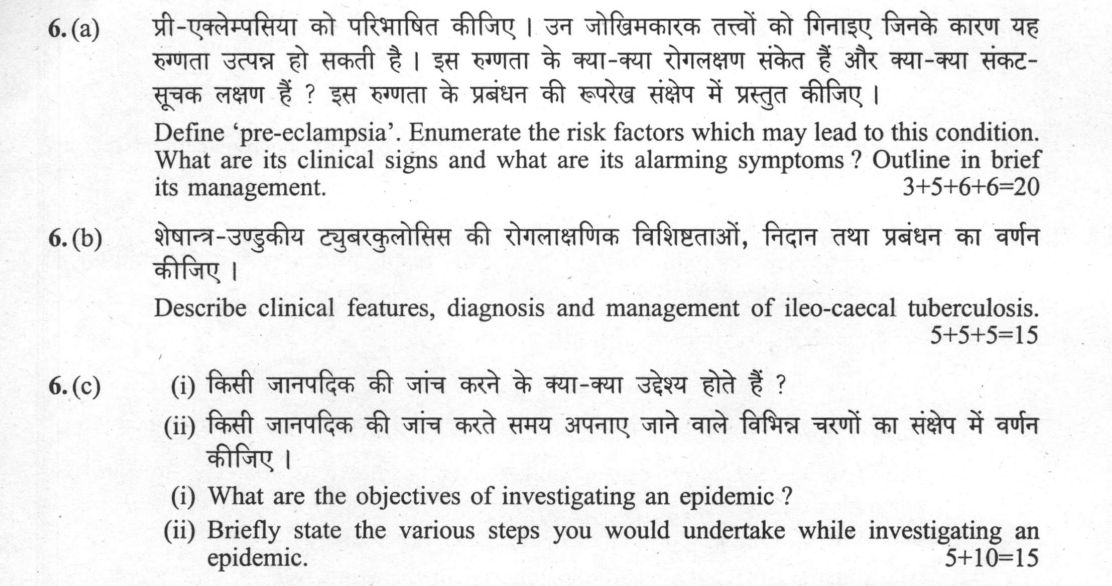
(a) Define 'pre-eclampsia'. Enumerate the risk factors which may lead to this condition. What are its clinical signs and what are…
Define 'pre-eclampsia'. Enumerate the risk factors which may lead to this condition. What are its clinical signs and what are its alarming symptoms ? Outline in brief its management. 3+5+6+6=20
Describe clinical features, diagnosis and management of ileo-caecal tuberculosis. 5+5+5=15
What are the objectives of investigating an epidemic ?
Briefly state the various steps you would undertake while investigating an epidemic. 5+10=15
हिंदी में प्रश्न पढ़ें
प्री-एक्लेम्पसिया को परिभाषित कीजिए। उन जोखिमकारक तत्वों को गिनाइए जिनके कारण यह रुग्णता उत्पन्न हो सकती है। इस रुग्णता के क्या-क्या रोगलक्षण संकेत हैं और क्या-क्या संकट-सूचक लक्षण हैं ? इस रुग्णता के प्रबंधन की रूपरेखा संक्षेप में प्रस्तुत कीजिए। 3+5+6+6=20
शेषान्त्र-उपदुकीय ट्यूबरकुलोसिस की रोगलाक्षणिक विशिष्टताओं, निदान तथा प्रबंधन का वर्णन कीजिए। 5+5+5=15
किसी जानपदिक की जांच करने के क्या-क्या उद्देश्य होते हैं ?
किसी जानपदिक की जांच करते समय अपनाए जाने वाले विभिन्न चरणों का संक्षेप में वर्णन कीजिए। 5+10=15
Model answer
Written by UPSC Answer Check against this question's marking rubric, to the expected length. UPSC does not publish answers for Mains — this is one way to score well, not an official key.
Pre-eclampsia. Pre-eclampsia is new-onset hypertension with proteinuria after 20 weeks of gestation in a previously normotensive woman, reflecting placental endothelial dysfunction. High-risk factors include nulliparity, chronic hypertension, renal disease, multiple gestation, personal history of pre-eclampsia, diabetes, autoimmune disease, obesity, family history, and age extremes. NFHS-5’s maternal mortality ratio of 97 per lakh live births and rising maternal complications make early ANC and risk stratification essential. Clinical signs are BP ≥140/90 mmHg on two readings, proteinuria of 300 mg/24h or a positive dipstick, and oedema, often with rapid weight gain. Alarming symptoms suggesting severe disease are severe headache, visual disturbances, epigastric or right upper quadrant pain, hyperreflexia, oliguria, and pulmonary oedema. Management follows WHO/FIGO principles: confirm diagnosis, admit for monitoring, give antihypertensives such as labetalol, nifedipine or hydralazine, and magnesium sulphate for seizure prophylaxis in severe cases. Acute severe hypertension is treated to a target below 150/100 mmHg. Monitor urine output, reflexes and respiratory rate; stop magnesium if respiratory rate falls below 12/min, reflexes are absent, or urine output is inadequate. Definitive treatment is delivery at the appropriate gestational age, with antenatal corticosteroids if preterm and safe; magnesium is continued for 24 hours after delivery, and low-dose aspirin is used earlier in high-risk women for prevention from 12 to 16 weeks where feasible. Severe pre-eclampsia may progress to eclampsia, HELLP or placental abruption, so delivery planning must be individualized.
Ileo-caecal tuberculosis. Ileo-caecal TB usually presents with chronic right iliac fossa pain, a palpable mass, fever, anorexia, weight loss, and alternating constipation and diarrhoea; complications include intestinal obstruction, fistula, abscess and ascites. Diagnosis combines clinical suspicion with colonoscopy and biopsy showing caseating granulomas; colonoscopy may reveal ulcers, strictures or mucosal nodularity, and tissue GeneXpert MTB/RIF gives rapid rifampicin resistance detection. CT/MRI showing thickened ileocaecal wall, mesenteric lymph nodes and “comb sign”, and ascitic fluid ADA when ascites is present support the diagnosis. Mantoux/IGRA may support diagnosis but are not confirmatory. Management is anti-tubercular therapy under NTEP, formerly RNTCP, typically 2HRZE/4HR for new extrapulmonary abdominal TB, with nutritional support, directly observed therapy, and monitoring for hepatotoxicity. In malnourished patients, nutritional rehabilitation is important. Surgery is indicated not only for acute mechanical obstruction or perforation but also for diagnostic uncertainty, non-response to ATT, fistula, abscess, and chronic obstruction; it may involve ileocaecal resection or strictureplasty. Early surgical consultation is needed if obstruction is high-grade, and follow-up should monitor for relapse and drug resistance, especially in diabetic patients. The rising TB–diabetes comorbidity makes glycaemic control and adherence essential.
Epidemic investigation. The objectives are to verify the existence of an epidemic, confirm the diagnosis, determine its extent, identify the source and mode of transmission, implement control measures, formulate and test hypotheses, train field personnel, and communicate findings. Investigation begins with preparation of the field team and notification under IDSP. The first step is to establish that an epidemic exists by comparing observed cases with expected baseline. The diagnosis is verified clinically and laboratory-wise, and a working case definition is fixed. Cases are counted and oriented by person, place and time to describe the outbreak. A line list, attack rates and maps are prepared. Hypotheses about source, vehicle, reservoir and transmission are formulated from the data and tested by analytic studies such as case-control or cohort analysis. Control measures are implemented early and revised as evidence emerges, for example isolation, safe water, vector control, vaccination or food safety action. Finally, findings are reported using the IDSP outbreak response protocol, follow-up is done, surveillance is strengthened, and lessons are documented. This ordered approach converts an outbreak into a controlled public-health response.
What "Describe" is asking you to do
Give a full, ordered account of the thing named — its parts, stages or mechanism — in the sequence in which it actually exists or occurs. Most describe questions come from the science optionals, where the marks sit in correct technical detail and, where the stem says so, a labelled diagram.
Structure that answers it
One-line identification of the subject → the parts or stages in their real order, each with its defining detail → labelled diagram where the subject is structural → closing line on function or significance
Where marks are lost
Loose general prose where the examiner is ticking named parts, correct terminology and their sequence; and in the General Studies papers, turning to evaluation before the description is finished.
How this answer will be evaluated
Approach
Framework: Clinical Sequence (Definition > Aetiology > Features > Management). (a) describe: definition > risk factors > clinical signs > management | (b) describe: clinical features > diagnosis > management | (c) explain: objectives > steps in order Full marks: Precise clinical definitions, logical flow, specific management protocols.
Key points expected
- Pre-eclampsia: MgSO4, delivery
- Ileo-caecal TB: ATT, biopsy
- Epidemic: Verify, define, control
Evaluation rubric
Each sub-part is marked on its own, against the marks and word limit printed on the paper.
- (a) Define pre-eclampsia, list risk factors, signs, and management. 20 marks
describe— definition → risk factors → clinical signs → management
Must cover
- Definition: HTN + proteinuria after 20 weeks
- Risk factors: primigravida, multiple pregnancy, diabetes
- Signs: edema, headache, visual disturbances
- Management: MgSO4, delivery, antihypertensives
Loses marks
- No mention of delivery as definitive treatment
- Confusing pre-eclampsia with chronic HTN
Earns more
- Mention HELLP syndrome
- Differentiate from chronic hypertension
- Mention NICE guidelines
- Mention eclampsia as complication
Extra mark
- Mention specific MgSO4 dosage
- Mention specific antihypertensive drugs
- (b) Describe features, diagnosis, and management of ileo-caecal TB. 15 marks
describe— clinical features → diagnosis → management
Must cover
- Features: right iliac fossa pain, mass, fever
- Diagnosis: X-ray, CT, biopsy, AFB culture
- Management: ATT (Anti-Tubercular Therapy)
- Surgery for complications (obstruction, fistula)
Loses marks
- Confusing with Crohn's disease
- Omitting biopsy/culture in diagnosis
Earns more
- Mention 'Paul Buetter sign'
- Mention differential diagnosis (Crohn's, carcinoma)
- Mention specific ATT regimen (2HRZE/4HR)
- Mention laparoscopic diagnosis
Extra mark
- Mention specific CT findings
- Mention specific surgical indications
- (c) State objectives and steps of investigating an epidemic. 15 marks
explain— objectives → steps in order
Must cover
- Objectives: verify, define, control, prevent
- Step 1: Verify diagnosis and existence
- Step 2: Define population and time
- Step 3: Generate hypotheses (person, place, time)
Loses marks
- Skipping verification step
- No mention of control measures
Earns more
- Mention 'epidemic curve'
- Mention 'attack rate'
- Mention 'case definition'
- Mention 'control measures'
Extra mark
- Mention specific statistical tests
- Mention specific control measures
Practice this exact question
Write your answer and it is marked point by point against the model answer above — what you covered, what you missed, what you got wrong.
Evaluate my answer →More from Medical Science 2022 Paper II
- Q3 (a) (i) Discuss in brief about the diet and exercise related advice given to a 35 year ol…
- Q4 (a) A 25 year old female has presented to the medicine OPD with complaints of excessive t…
- Q5 (a) (i) Name the clinical tests for checking sapheno-femoral junction competence and deep…
- Q6 (a) Define 'pre-eclampsia'. Enumerate the risk factors which may lead to this condition.…
- Q7 7.(a) A 40 year old lady came to casualty with pain in the right upper abdomen associated…
- Q8 8.(a) The 'End TB Strategy' is an evolution over the previous strategies to win over tube…