Paper II — Q4
(a) A 25 year old female has presented to the medicine OPD with complaints of excessive tiredness, cold intolerance and menstrual…
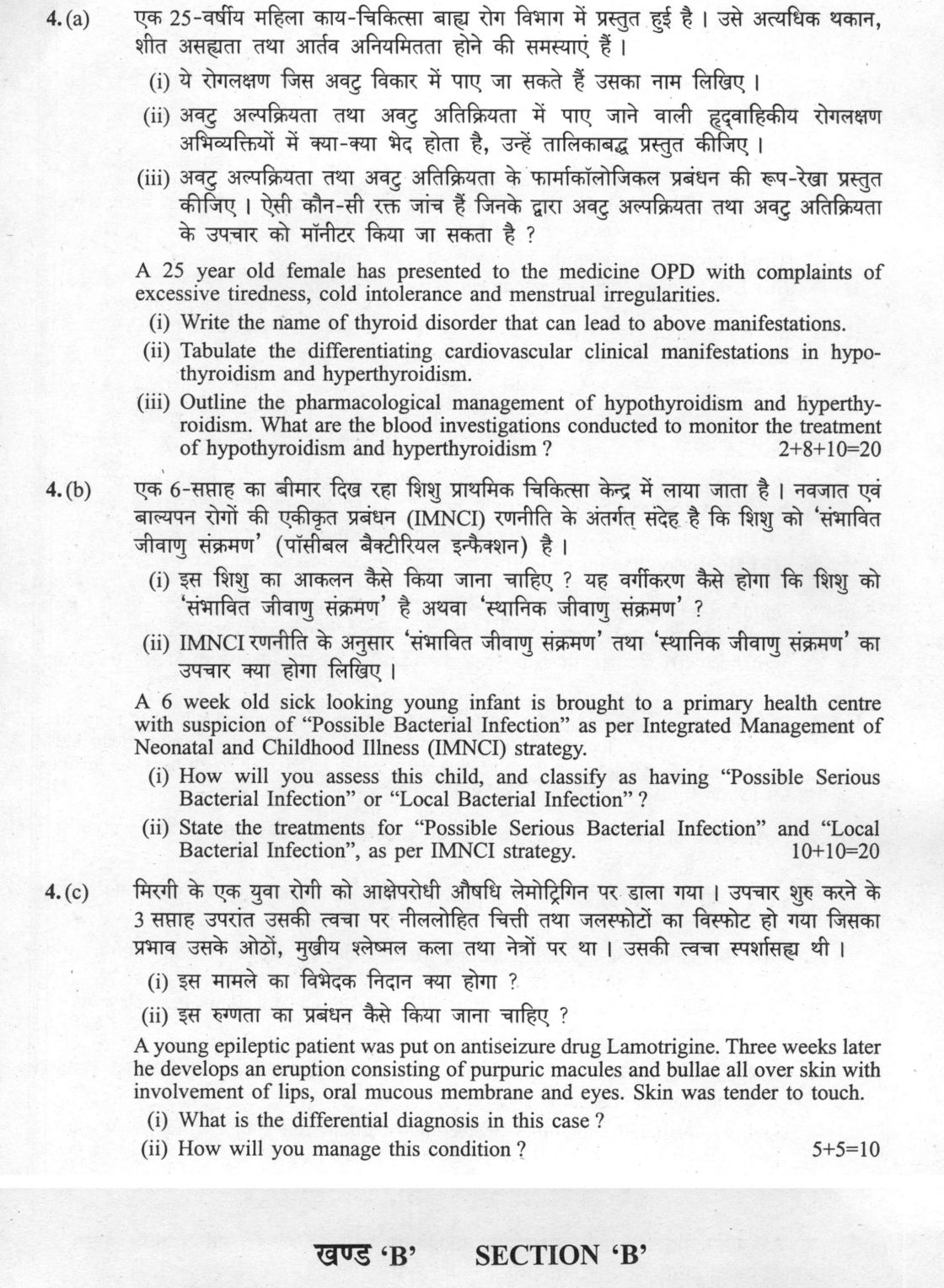
A 25 year old female has presented to the medicine OPD with complaints of excessive tiredness, cold intolerance and menstrual irregularities.
Write the name of thyroid disorder that can lead to above manifestations.
Tabulate the differentiating cardiovascular clinical manifestations in hypothyroidism and hyperthyroidism.
Outline the pharmacological management of hypothyroidism and hyperthyroidism. What are the blood investigations conducted to monitor the treatment of hypothyroidism and hyperthyroidism ? 2+8+10=20
A 6 week old sick looking young infant is brought to a primary health centre with suspicion of "Possible Bacterial Infection" as per Integrated Management of Neonatal and Childhood Illness (IMNCI) strategy.
How will you assess this child, and classify as having "Possible Serious Bacterial Infection" or "Local Bacterial Infection" ?
State the treatments for "Possible Serious Bacterial Infection" and "Local Bacterial Infection", as per IMNCI strategy. 10+10=20
A young epileptic patient was put on antiseizure drug Lamotrigine. Three weeks later he develops an eruption consisting of purpuric macules and bullae all over skin with involvement of lips, oral mucous membrane and eyes. Skin was tender to touch.
What is the differential diagnosis in this case ?
How will you manage this condition ? 5+5=10
हिंदी में प्रश्न पढ़ें
(क) एक 25-वर्षीय महिला काय-चिकित्सा बाह्य रोग विभाग में प्रस्तुत हुई है । उसे अत्यधिक थकान, शीत असहनता तथा आर्तव अनियमितता होने की समस्याएं हैं ।
ये रोगलक्षण जिस अवटु विकार में पाए जा सकते हैं उसका नाम लिखिए ।
अवटु अल्पक्रियता तथा अवटु अतिक्रियता में पाए जाने वाली हृद्वाहिकीय रोगलक्षण अभिव्यक्तियों में क्या-क्या भेद होता है, उन्हें तालिकाबद्ध प्रस्तुत कीजिए ।
अवटु अल्पक्रियता तथा अवटु अतिक्रियता के फार्माकोलॉजिकल प्रबंधन की रूप-रेखा प्रस्तुत कीजिए । ऐसी कौन-सी रक्त जांच है जिनके द्वारा अवटु अल्पक्रियता तथा अवटु अतिक्रियता के उपचार को मॉनिटर किया जा सकता है ? 2+8+10=20
(ख) एक 6-सप्ताह का बीमार दिख रहा शिशु प्राथमिक चिकित्सा केंद्र में लाया जाता है । नवजात एवं बाल्यपन रोगों की एकीकृत प्रबंधन (IMNCI) रणनीति के अंतर्गत संदेह है कि शिशु को 'संभावित जीवाणु संक्रमण' (पॉसिबल बैक्टीरियल इंफेक्शन) है ।
इस शिशु का आकलन कैसे किया जाना चाहिए ? यह वर्गीकरण कैसे होगा कि शिशु को 'संभावित जीवाणु संक्रमण' है अथवा 'स्थानिक जीवाणु संक्रमण' ?
IMNCI रणनीति के अनुसार 'संभावित जीवाणु संक्रमण' तथा 'स्थानिक जीवाणु संक्रमण' का उपचार क्या होगा लिखिए । 10+10=20
(ग) मिर्गी के एक युवा रोगी को आक्षेपरोधी औषधि लेमोट्रिगिन पर डाला गया । उपचार शुरू करने के 3 सप्ताह उपरांत उसकी त्वचा पर नीललोहित चित्ती तथा जलस्फोटों का विस्फोट हो गया जिसका प्रभाव उसके ओंठों, मुखीय श्लेष्मल कला तथा नेत्रों पर था । उसकी त्वचा स्पर्शसंवेदनशील थी ।
इस मामले का विभेदक निदान क्या होगा ?
इस वृणता का प्रबंधन कैसे किया जाना चाहिए ? 5+5=10
Model answer
Written by UPSC Answer Check against this question's marking rubric, to the expected length. UPSC does not publish answers for Mains — this is one way to score well, not an official key.
Part (a)
(i) Thyroid Disorder The clinical presentation of excessive tiredness, cold intolerance, and menstrual irregularities (typically menorrhagia or oligomenorrhea) in a 25-year-old female is characteristic of Primary Hypothyroidism, most commonly caused by autoimmune thyroiditis (Hashimoto's Thyroiditis).
(ii) Cardiovascular Manifestations
| Parameter | Hypothyroidism | Hyperthyroidism | | :--- | :--- | :--- | | Heart Rate & Rhythm | Sinus bradycardia | Sinus tachycardia, Atrial fibrillation | | Blood Pressure | Diastolic hypertension (increased SVR) | Systolic hypertension, wide pulse pressure | | Cardiac Output | Decreased (reduced inotropy/chronotropy) | Increased (hyperdynamic circulation) | | Myocardial & Pericardial| Weak heart sounds, Pericardial effusion | Loud S1, flow murmurs, high-output failure | | Lipid Profile | Hypercholesterolemia, accelerated CAD | Decreased total and LDL cholesterol |
(iii) Pharmacological Management and Monitoring
- Hypothyroidism: Tablet Levothyroxine (T4) is the drug of choice, initiated at 1.6 µg/kg/day orally on an empty stomach 30–60 minutes before breakfast. Titrate dose by 12.5–25 µg every 6–8 weeks.
- Hyperthyroidism:
- Antithyroid Drugs (ATDs): Carbimazole/Methimazole (10–30 mg/day); Propylthiouracil (PTU, 100–300 mg/day, preferred in the first trimester of pregnancy and thyroid storm).
- Symptomatic control: Beta-blockers (e.g., Propranolol 20–40 mg thrice daily).
- Definitive therapy: Radioactive Iodine (¹³¹I) or total/subtotal thyroidectomy for refractory cases or toxic multinodular goitre.
- Monitoring Investigations:
- Hypothyroidism: Serum TSH (target: 0.5–2.5 mIU/L) measured every 6–8 weeks post-dose adjustment, then annually once euthyroid. Free T4 is measured in secondary/central hypothyroidism.
- Hyperthyroidism: Serum Free T4 and Free T3 measured every 4–6 weeks during ATD titration, as TSH may remain suppressed for months. Complete Blood Count (to detect agranulocytosis) and Liver Function Tests prior to and during ATD therapy.
---
Part (b)
(i) Assessment and Classification (IMNCI for Young Infants aged 0–2 months) Assessment involves checking for the following danger signs: history of convulsions, fast breathing (≥ 60 breaths/min), severe chest indrawing, nasal flaring, grunting, hypothermia (<35.5^circC) or fever (≥ 37.5^circC), bulging fontanelle, umbilical redness extending to the skin or draining pus, extensive skin pustules (>10 or bullae), lethargy or unconsciousness, and inability to feed.
- Possible Serious Bacterial Infection (PSBI): Classified if any one of the following is present: convulsions, fast breathing, severe chest indrawing, grunting, fever/hypothermia, bulging fontanelle, >10 skin pustules or large bullae, umbilical redness extending to periumbilical skin, lethargy/unconsciousness, or not feeding well/unable to feed.
- Local Bacterial Infection: Classified if there is umbilicus red or draining pus (not extending to skin), or fewer than 10 skin pustules, without any PSBI danger signs.
(ii) Treatment Protocols as per IMNCI
- Possible Serious Bacterial Infection (PSBI):
- Give first dose of intramuscular antibiotics: Inj. Ampicillin (50 mg/kg IM) plus Inj. Gentamicin (5 mg/kg IM).
- Prevent hypoglycemia: provide expressed breast milk or 10% dextrose orally/nasogastrically.
- Keep the infant warm during transport (Kangaroo Mother Care/wrapping).
- Urgent referral to a First Referral Unit (FRU) or tertiary hospital.
- If referral is not feasible: Outpatient management with Inj. Gentamicin (5 mg/kg IM once daily for 7 days) plus oral Amoxicillin (50 mg/kg/day in 2 divided doses for 7 days).
- Local Bacterial Infection:
- Prescribe oral Amoxicillin (50 mg/kg/day divided into 2 doses) for 5 days.
- Apply topical 0.5% Gentian Violet to umbilical discharge or skin pustules twice daily.
- Advise the mother on home care, exclusive breastfeeding, and keeping the infant warm.
- Schedule a mandatory follow-up visit in 2 days.
---
Part (c)
(i) Differential Diagnosis
- Stevens-Johnson Syndrome (SJS) / Toxic Epidermal Necrolysis (TEN) Spectrum (Lamotrigine-induced; primary diagnosis given mucosal involvement, purpuric macules, bullae, and skin tenderness).
- Drug Reaction with Eosinophilia and Systemic Symptoms (DRESS) Syndrome.
- Erythema Multiforme Major (often secondary to infections like HSV/Mycoplasma, with limited body surface involvement).
- Autoimmune Bullous Dermatoses (e.g., Bullous Pemphigoid, Pemphigus Vulgaris).
- Staphylococcal Scalded Skin Syndrome (SSSS) (less likely in adults; spares mucous membranes).
(ii) Management
- Immediate Drug Withdrawal: Promptly and permanently discontinue Lamotrigine; document adverse drug reaction.
- Supportive & Intensive Care:
- Admit to an ICU or specialised Burn Unit with sterile barrier nursing and strict thermoregulation (ambient temperature 30–32°C).
- Fluid and Electrolyte Management: Administer IV crystalloids (e.g., Ringer's Lactate) titrated to maintain a urine output of 0.5–1 mL/kg/hour.
- Nutritional Support: High-calorie, high-protein enteral feeding via nasogastric tube.
- Wound Care: Non-adherent dressings (e.g., petroleum gauze); avoid aggressive debridement.
- Organ-Specific Measures:
- Ophthalmology consult: Frequent preservative-free lubricant eye drops, topical antibiotics, and sweeping of fornices to prevent symblepharon and corneal scarring.
- Oral/Mucosal care: Antiseptic mouth rinses (chlorhexidine) and topical analgesics.
- Targeted/Immunomodulatory Therapy:
- Consider early administration of IV Immunoglobulin (IVIG) (2–3 g/kg over 3–5 days) or Cyclosporine (3–5 mg/kg/day) to arrest epidermal detachment.
- Systemic antibiotics only if clinical signs of secondary sepsis arise, guided by wound cultures. Avoid prophylactic antibiotics.
What "Outline" is asking you to do
Set out a whole scheme from end to end in its main steps without going into any of them. It is the directive used for protocols and frameworks — a management plan, a reaction mechanism, a statutory scheme — where the mark lies in having the full sequence with nothing missing.
Structure that answers it
What the scheme is for → step one → step two → the remaining steps through to the end point → the condition on which the sequence turns
Where marks are lost
Depth in the wrong place: elaborating the first two steps and never reaching the end of the scheme, which is where completeness is checked.
How this answer will be evaluated
Approach
Framework: Clinical Sequence (Definition > Aetiology > Features > Investigation > Management). (a(i)) explain: definition/context > points in order > small example > short close | (a(ii)) compare: paired headings or table > key differences > significance > conclusion | (a(iii)) enumerate: list the items in order > one line each > no commentary | (b(i)) explain: definition/context > points in order > small example > short close | (b(ii)) enumerate: list the items in order > one line each > no commentary | (c(i)) explain: definition/context > points in order > small example > short close | (c(ii)) suggest: the problem in one line > implementable measures > who acts > conclusion Full marks: Precise clinical terminology, correct IMNCI protocols, clear differentiation of SJS/TEN, structured management.
Key points expected
- Identify Hypothyroidism
- Link to cold intolerance/tiredness
- Table format used
- Hypo: Bradycardia/Pericardial effusion
- Hyper: Tachycardia/Atrial fibrillation
- Hyper: High output failure
- Hypo: Levothyroxine replacement
- Hyper: Antithyroid drugs (Carbimazole/Methimazole)
Evaluation rubric
Each sub-part is marked on its own, against the marks and word limit printed on the paper.
- (a(i)) Name the specific thyroid disorder matching the clinical triad. 2 marks
explain— definition/context → points in order → small example → short close
Must cover
- Identify Hypothyroidism
- Link to cold intolerance/tiredness
Loses marks
- Naming Hyperthyroidism
- Vague answer like 'thyroid problem'
Earns more
- Mention Hashimoto's thyroiditis as likely cause
- (a(ii)) Tabulate differentiating cardiovascular manifestations of hypo- vs hyperthyroidism. 8 marks
compare— paired headings or table → key differences → significance → conclusion
Must cover
- Table format used
- Hypo: Bradycardia/Pericardial effusion
- Hyper: Tachycardia/Atrial fibrillation
- Hyper: High output failure
Loses marks
- Listing symptoms without comparison
- Missing key differentiator (e.g., AF)
Earns more
- Mention Hypertension in Hyperthyroidism
- Mention Diastolic murmur in Hyperthyroidism
Extra mark
- Mention specific ECG changes (e.g., low voltage in hypo)
- (a(iii)) Pharmacological management and monitoring investigations for both conditions. 10 marks
enumerate— list the items in order → one line each → no commentary
Must cover
- Hypo: Levothyroxine replacement
- Hyper: Antithyroid drugs (Carbimazole/Methimazole)
- Monitoring: TSH levels
- Monitoring: Free T3/T4 levels
Loses marks
- Omitting monitoring investigations
- Confusing drug classes
Earns more
- Mention Beta-blockers for symptomatic relief in Hyper
- Mention Radioiodine as definitive option
Extra mark
- Mention specific target TSH ranges
- (b(i)) Assessment and classification of 'Possible Serious' vs 'Local' bacterial infection. 10 marks
explain— definition/context → points in order → small example → short close
Must cover
- Check for danger signs (not feeding, convulsions)
- Check for local signs (pus in ear, skin abscess)
- Define 'Possible Serious' (danger signs + no local focus)
- Define 'Local' (local signs + no danger signs)
Loses marks
- Failing to distinguish danger signs from local signs
- Vague assessment without IMNCI criteria
Earns more
- Mention specific IMNCI danger signs (fast breathing, chest indrawing)
- Mention specific local signs (impetigo, otitis media)
Extra mark
- Mention specific age criteria (e.g., <2 months)
- (b(ii)) Treatment protocols for 'Possible Serious' and 'Local' bacterial infection. 10 marks
enumerate— list the items in order → one line each → no commentary
Must cover
- Serious: Inpatient referral
- Serious: IV/IM antibiotics (Ampicillin + Gentamicin)
- Local: Oral antibiotics (Amoxicillin)
- Local: Local wound care
Loses marks
- Treating serious infection with oral meds
- Omitting referral for serious cases
Earns more
- Mention specific drug names (e.g., Amoxicillin)
- Mention referral criteria for serious cases
Extra mark
- Mention specific dosage if known
- (c(i)) Differential diagnosis for the drug-induced eruption. 5 marks
explain— definition/context → points in order → small example → short close
Must cover
- Diagnose Stevens-Johnson Syndrome (SJS)
- Mention Toxic Epidermal Necrolysis (TEN)
- Link to Lamotrigine
Loses marks
- Diagnosing simple drug rash
- Missing SJS/TEN
Earns more
- Mention DRESS syndrome as differential
- Mention Erythema Multiforme
Extra mark
- Mention specific drug class (aromatic anticonvulsants)
- (c(ii)) Management plan for the condition. 5 marks
suggest— the problem in one line → implementable measures → who acts → conclusion
Must cover
- Stop Lamotrigine immediately
- Supportive care (fluids/electrolytes)
- Referral to burn unit/dermatology
- Alternative antiepileptic (non-cross reactive)
Loses marks
- Continuing the drug
- Ignoring supportive care
Earns more
- Mention wound care for skin
- Mention eye care (ophthalmology)
Extra mark
- Mention IVIG or Cyclosporine for severe cases
Practice this exact question
Write your answer and it is marked point by point against the model answer above — what you covered, what you missed, what you got wrong.
Evaluate my answer →More from Medical Science 2022 Paper II
- Q1 (a) Enumerate the imaging modalities used in the diagnosis of cardiac diseases. List thei…
- Q2 (a) Discuss in brief the etiology, clinical features, diagnosis and treatment of nephroti…
- Q3 (a) (i) Discuss in brief about the diet and exercise related advice given to a 35 year ol…
- Q4 (a) A 25 year old female has presented to the medicine OPD with complaints of excessive t…
- Q5 (a) (i) Name the clinical tests for checking sapheno-femoral junction competence and deep…
- Q6 (a) Define 'pre-eclampsia'. Enumerate the risk factors which may lead to this condition.…
- Q7 7.(a) A 40 year old lady came to casualty with pain in the right upper abdomen associated…