Paper II — Q7
7.(a) A 40 year old lady came to casualty with pain in the right upper abdomen associated with vomitings for 5 days. On…
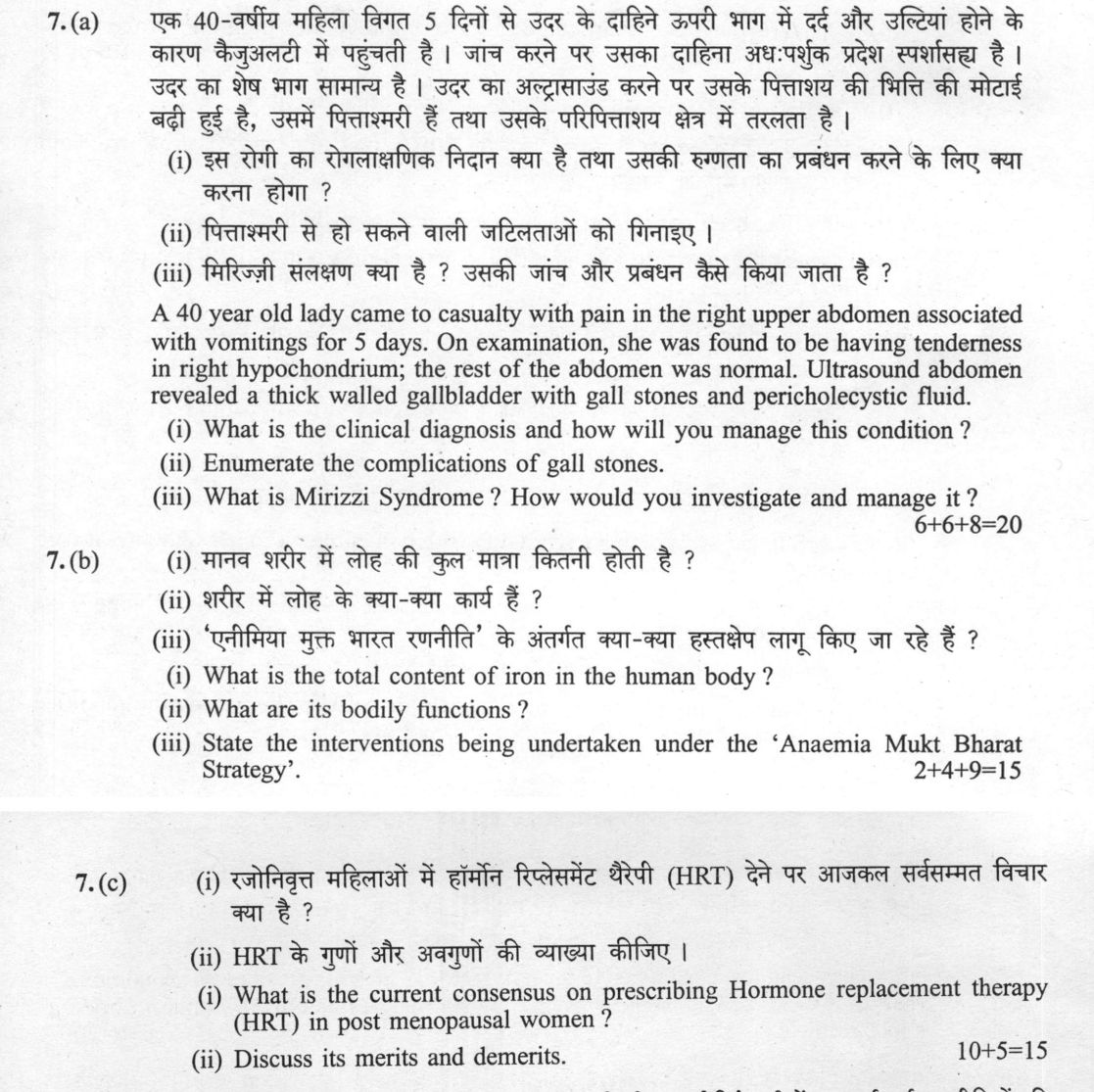
7.(a) A 40 year old lady came to casualty with pain in the right upper abdomen associated with vomitings for 5 days. On examination, she was found to be having tenderness in right hypochondrium; the rest of the abdomen was normal. Ultrasound abdomen revealed a thick walled gallbladder with gall stones and pericholecystic fluid.
What is the clinical diagnosis and how will you manage this condition ? 6 marks
Enumerate the complications of gall stones. 6 marks
What is Mirizzi Syndrome ? How would you investigate and manage it ? 8 marks
7.(b) (i) What is the total content of iron in the human body ? 2 marks
What are its bodily functions ? 4 marks
State the interventions being undertaken under the 'Anaemia Mukt Bharat Strategy'. 9 marks
7.(c) (i) What is the current consensus on prescribing Hormone replacement therapy (HRT) in post menopausal women ? 10 marks
Discuss its merits and demerits. 5 marks
हिंदी में प्रश्न पढ़ें
७.(क) एक 40-वर्षीय महिला विगत 5 दिनों से उदर के दाहिने ऊपरी भाग में दर्द और उल्टियां होने के कारण कैजुअल्टी में पहुंचती है। जांच करने पर उसका दाहिना अधःपृष्ठिक प्रदेश स्पर्शसंवेदी है। उदर का शेष भाग सामान्य है। उदर का अल्ट्रासाउंड करने पर उसके पित्ताशय की भित्ति की मोटाई बढ़ी हुई है, उसमें पित्ताश्मरी है तथा उसके परिपित्ताशय क्षेत्र में तरलता है।
इस रोगी का रोगलाक्षणिक निदान क्या है तथा उसकी रुग्णता का प्रबंधन करने के लिए क्या करना होगा ? (6 अंक)
पित्ताश्मरी से हो सकने वाली जटिलताओं को गिनाइए। (6 अंक)
मिरिज्जी संलक्षण क्या है ? उसकी जांच और प्रबंधन कैसे किया जाता है ? (8 अंक)
७.(ख) (i) मानव शरीर में लोहे की कुल मात्रा कितनी होती है ? (2 अंक)
शरीर में लोहे के क्या-क्या कार्य हैं ? (4 अंक)
'एनीमिया मुक्त भारत रणनीति' के अंतर्गत क्या-क्या हस्तक्षेप लागू किए जा रहे हैं ? (9 अंक)
७.(ग) (i) रजोनिवृत्त महिलाओं में हार्मोन रिप्लेसमेंट थेरेपी (HRT) देने पर आजकल सर्वसम्मत विचार क्या है ? (10 अंक)
HRT के गुणों और अवगुणों की व्याख्या कीजिए । (5 अंक)
Model answer
Written by UPSC Answer Check against this question's marking rubric, to the expected length. UPSC does not publish answers for Mains — this is one way to score well, not an official key.
7(a)(i) The presentation is acute calculous cholecystitis satisfying Tokyo Guidelines 2018 (TG18): right upper abdominal pain, vomiting, right hypochondrial tenderness/Murphy’s sign, and ultrasound showing a thick-walled gallbladder, gallstones and pericholecystic fluid. Manage with NPO/IV fluids, analgesia, IV ceftriaxone plus metronidazole, and early laparoscopic cholecystectomy if fit; if severe inflammation, sepsis, or high surgical risk, choose delayed interval cholecystectomy, with cholecystostomy if unstable.
7(a)(ii) Complications: intra-luminal—mucocele, empyema; extra-luminal—perforation, peritonitis, abscess; fistulous—cholecystoenteric, gallstone ileus; malignant—gallbladder carcinoma.
7(a)(iii) Mirizzi syndrome is external compression of the common hepatic duct by a stone impacted in the cystic duct/infundibulum, causing obstructive jaundice. Csendes Type I is extrinsic compression; Types II–IV involve cholecystobiliary fistulae of increasing extent, Type IV being extensive. Investigate with MRCP (gold standard) and ERCP if intervention is needed. Manage by open surgery; subtotal cholecystectomy with drainage; Roux-en-Y hepaticojejunostomy for Type IV/large duct defects.
7(b) Total body iron is 3–4 g in men and 2–2.5 g in women. About 65% is in haemoglobin, 30% in stores as ferritin/hemosiderin, and 5% in myoglobin and enzymes. Functions include oxygen transport by haemoglobin/myoglobin, electron transport in cytochromes, DNA synthesis via ribonucleotide reductase, and immune function. Under Anaemia Mukt Bharat, the six interventions are prophylactic IFA supplementation, deworming, intensified BCC, testing and treatment of anaemia using digital methods and point-of-care treatment, mandatory food fortification, and addressing non-nutritional causes such as malaria, haemoglobinopathies and fluorosis. The 6×6×6 approach targets children, adolescents, women, pregnant/lactating women and other priority groups, with institutional mechanisms for convergence, coordination, communication, monitoring, data management and review.
7(c) Current NAMS/IMS consensus favours HRT only for symptomatic postmenopausal women within the window of opportunity—age <60 or <10 years from menopause—after individualized risk assessment. Use the lowest effective dose, preferably transdermal estradiol, with progestogen if uterus present. Absolute contraindications include VTE, active/recent arterial thromboembolic disease (MI/stroke), breast cancer, active liver disease, and unexplained vaginal bleeding; stable CAD is a relative caution, not an absolute contraindication, and HRT is not for cardiovascular prevention. Merits: relief of vasomotor symptoms, prevention of osteoporosis, improvement of urogenital atrophy, and possible cognitive benefit if started early. Demerits: increased VTE risk (RR 2–3), breast cancer risk (RR about 1.2 with >5 years), stroke and gallbladder disease. Thus, HRT is justified only for selected symptomatic women, not as routine prevention.
What "Enumerate" is asking you to do
Produce the complete set of items asked for, countable and correctly named. The examiner marks against a checklist, so a missing item costs and an elaborated one gains nothing — where discussion is wanted the stem asks for it as a separate sub-part.
Structure that answers it
One line naming the basis on which the set is drawn → items numbered, each in a phrase or a single line → the discussion sub-part taken up separately, after the list is complete
Where marks are lost
Treating it as an essay. Six items named in six lines score better than three items explained at length.
How this answer will be evaluated
Approach
Framework: Clinical Sequence (Definition > Aetiology > Features > Investigation > Management). (a(i)) explain: definition/context > points in order > small example > short close | (a(ii)) enumerate: list the items in order > one line each > no commentary | (a(iii)) explain: definition/context > points in order > small example > short close | (b(i)) explain: definition/context > points in order > small example > short close | (b(ii)) explain: definition/context > points in order > small example > short close | (b(iii)) explain: definition/context > points in order > small example > short close | (c(i)) explain: definition/context > points in order > small example > short close | (c(ii)) discuss: intro > 3-4 dimensions > example > balanced close Full marks: Precise clinical diagnosis, tiered management, specific strategy components, and balanced HRT discussion with guidelines.
Key points expected
- Diagnosis: Acute Cholecystitis
- Immediate: NPO, IV fluids, analgesics, antibiotics
- Definitive: Laparoscopic cholecystectomy
- Follow-up: Histopathology and diet advice
- Cholecystitis
- Cholangitis
- Pancreatitis
- Gallbladder perforation
Evaluation rubric
Each sub-part is marked on its own, against the marks and word limit printed on the paper.
- (a(i)) Diagnosis of Acute Cholecystitis and tiered management plan. 6 marks
explain— definition/context → points in order → small example → short close
Must cover
- Diagnosis: Acute Cholecystitis
- Immediate: NPO, IV fluids, analgesics, antibiotics
- Definitive: Laparoscopic cholecystectomy
- Follow-up: Histopathology and diet advice
Loses marks
- Management without priority (immediate vs definitive)
- Diagnosis of simple biliary colic only
Earns more
- Mention of Tokyo Guidelines
- Specific antibiotic choice (e.g., Ceftriaxone)
Extra mark
- Mention of ERCP if CBD stones suspected
- (a(ii)) List of gallstone complications. 6 marks
enumerate— list the items in order → one line each → no commentary
Must cover
- Cholecystitis
- Cholangitis
- Pancreatitis
- Gallbladder perforation
Loses marks
- Listing symptoms instead of complications
- Commentary on each item
Earns more
- Gallstone ileus
- Cholangiocarcinoma
Extra mark
- Mirizzi syndrome
- (a(iii)) Definition, investigation, and management of Mirizzi Syndrome. 8 marks
explain— definition/context → points in order → small example → short close
Must cover
- Definition: Extrinsic compression of CHD by stone
- Investigation: MRCP or ERCP
- Management: Cholecystectomy with cholecysto-enteric bypass
- Management: T-tube drainage if needed
Loses marks
- Confusing with simple CBD stone
- Omitting management plan
Earns more
- Mention of classification (Type I vs II)
- Specific surgical procedure (choledochoduodenostomy)
Extra mark
- Mention of fistula formation
- (b(i)) Total iron content in the human body. 2 marks
explain— definition/context → points in order → small example → short close
Must cover
- Total amount: 3-5 grams
- Major storage: Ferritin/Hemosiderin
Loses marks
- Vague answer without specific quantity
- Confusing with daily requirement
Earns more
- Mention of daily turnover (20-25 mg)
Extra mark
- Specific percentage in hemoglobin (65-70%)
- (b(ii)) Bodily functions of iron. 4 marks
explain— definition/context → points in order → small example → short close
Must cover
- Oxygen transport (Hemoglobin)
- Oxygen storage (Myoglobin)
- Electron transport (Cytochromes)
- Enzymatic function (Catalase/Peroxidase)
Loses marks
- Listing only oxygen transport
- Vague statements without specific proteins
Earns more
- Role in DNA synthesis
- Immune function
Extra mark
- Mention of specific enzymes (e.g., Ribonucleotide reductase)
- (b(iii)) Interventions under 'Anaemia Mukt Bharat Strategy'. 9 marks
explain— definition/context → points in order → small example → short close
Must cover
- Pre-conception and pregnancy care
- Infant and young child care
- Adolescent girl and women care
- Men and elderly care
Loses marks
- Generic advice not linked to the strategy
- Omitting specific target groups
Earns more
- Specific targets (e.g., 50% reduction)
- Mention of IEC (Information, Education, Communication)
Extra mark
- Mention of specific year of launch (2018)
- (c(i)) Current consensus on HRT in post-menopausal women. 10 marks
explain— definition/context → points in order → small example → short close
Must cover
- Indication: Vasomotor symptoms (hot flashes)
- Timing: Start within 10 years of menopause
- Contraindications: Breast cancer, VTE history
- Route: Transdermal preferred for VTE risk
Loses marks
- Recommending HRT for primary prevention
- Ignoring contraindications
Earns more
- Mention of 'Window of Opportunity' theory
- Specific guidelines (e.g., NAMS, ACOG)
Extra mark
- Mention of specific study (e.g., WHI)
- (c(ii)) Merits and demerits of HRT. 5 marks
discuss— intro → 3-4 dimensions → example → balanced close
Must cover
- Merit: Relief of vasomotor symptoms
- Merit: Prevention of bone loss (osteoporosis)
- Demerit: Increased risk of VTE/Stroke
- Demerit: Controversial link to breast cancer
Loses marks
- Listing only merits or only demerits
- Vague statements without specific risks
Earns more
- Mention of improved quality of life
- Mention of cardiovascular risk profile
Extra mark
- Mention of specific risk ratios
Practice this exact question
Write your answer and it is marked point by point against the model answer above — what you covered, what you missed, what you got wrong.
Evaluate my answer →More from Medical Science 2022 Paper II
- Q4 (a) A 25 year old female has presented to the medicine OPD with complaints of excessive t…
- Q5 (a) (i) Name the clinical tests for checking sapheno-femoral junction competence and deep…
- Q6 (a) Define 'pre-eclampsia'. Enumerate the risk factors which may lead to this condition.…
- Q7 7.(a) A 40 year old lady came to casualty with pain in the right upper abdomen associated…
- Q8 8.(a) The 'End TB Strategy' is an evolution over the previous strategies to win over tube…