Paper II — Q8
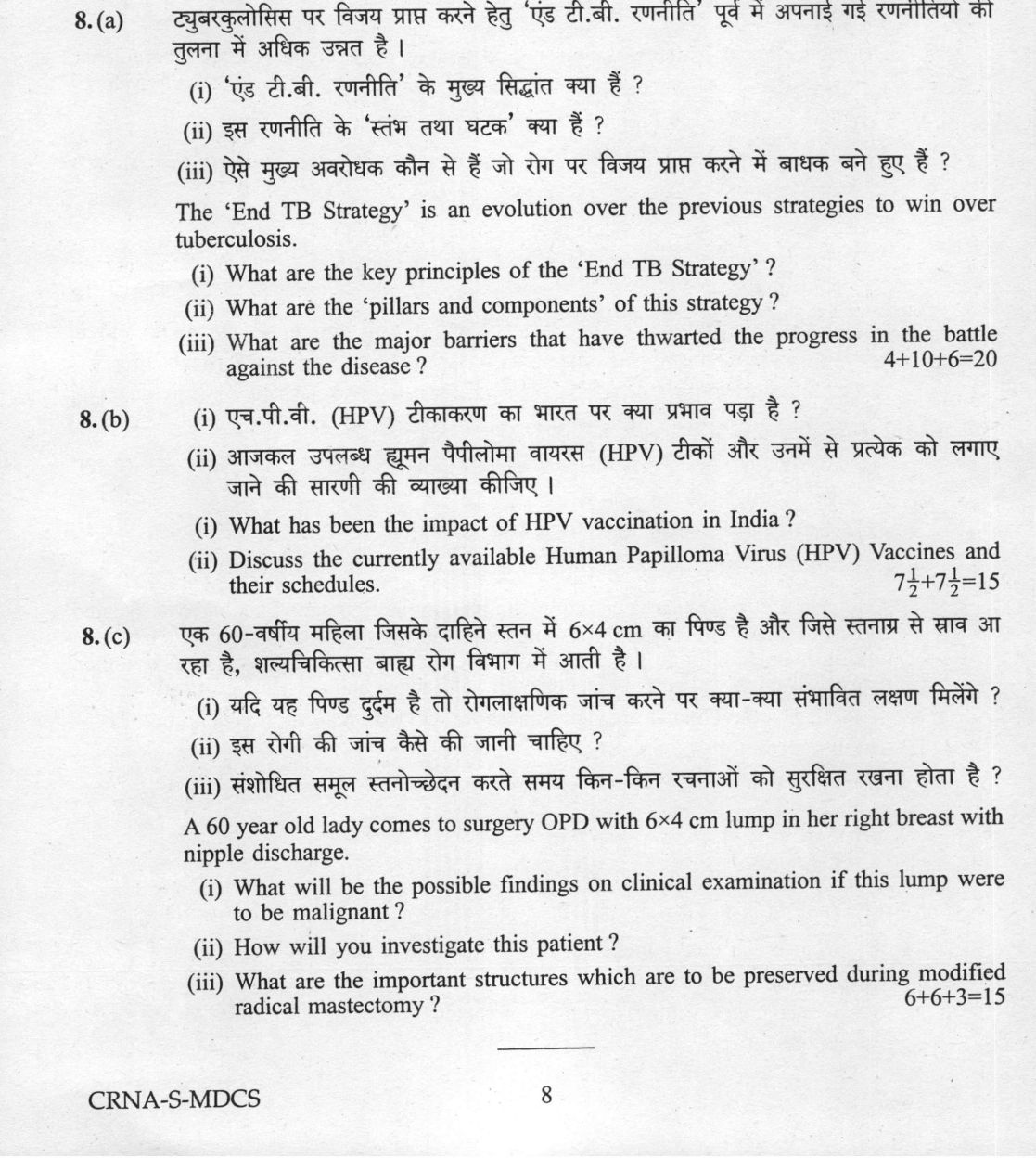
8.(a) The 'End TB Strategy' is an evolution over the previous strategies to win over tuberculosis. (i) What are the key…
8.(a) The 'End TB Strategy' is an evolution over the previous strategies to win over tuberculosis.
What are the key principles of the 'End TB Strategy' ? 4 marks
What are the 'pillars and components' of this strategy ? 10 marks
What are the major barriers that have thwarted the progress in the battle against the disease ? 6 marks
8.(b) (i) What has been the impact of HPV vaccination in India ? (7½ marks)
Discuss the currently available Human Papilloma Virus (HPV) Vaccines and their schedules. (7½ marks)
8.(c) A 60 year old lady comes to surgery OPD with 6×4 cm lump in her right breast with nipple discharge.
What will be the possible findings on clinical examination if this lump were to be malignant ? 6 marks
How will you investigate this patient ? 6 marks
What are the important structures which are to be preserved during modified radical mastectomy ? 3 marks
हिंदी में प्रश्न पढ़ें
८.(क) ट्यूबरकुलोसिस पर विजय प्राप्त करने हेतु 'एंड टी.बी. रणनीति' पूर्व में अपनाई गई रणनीतियों की तुलना में अधिक उन्नत है ।
'एंड टी.बी. रणनीति' के मुख्य सिद्धांत क्या हैं ? (4 अंक)
इस रणनीति के 'स्तंभ तथा घटक' क्या हैं ? (10 अंक)
ऐसे मुख्य अवरोधक कौन से हैं जो रोग पर विजय प्राप्त करने में बाधक बने हुए हैं ? (6 अंक)
८.(ख) (i) एच.पी.वी. (HPV) टीकाकरण का भारत पर क्या प्रभाव पड़ा है ? (7½ अंक)
आजकल उपलब्ध ह्यूमन पैपिलोमा वायरस (HPV) टीकों और उनमें से प्रत्येक को लगाए जाने की सारणी की व्याख्या कीजिए । (7½ अंक)
८.(ग) एक 60-वर्षीय महिला जिसके दाहिने स्तन में 6×4 cm का पिंड है और जिसे स्तनाग्र से स्राव आ रहा है, शल्यचिकित्सा बाह्य रोग विभाग में आती है ।
यदि यह पिंड दुर्दम है तो रोगलाक्षणिक जांच करने पर क्या-क्या संभावित लक्षण मिलेंगे ? (6 अंक)
इस रोगी की जांच कैसे की जानी चाहिए ? (6 अंक)
संशोधित समूल स्तनोच्छेदन करते समय किन-किन रचनाओं को सुरक्षित रखना होता है ? (3 अंक)
Model answer
Written by UPSC Answer Check against this question's marking rubric, to the expected length. UPSC does not publish answers for Mains — this is one way to score well, not an official key.
End TB Strategy. The End TB Strategy moves TB control beyond vertical DOTS to an integrated, patient-centred, rights-based, evidence-based, multi-sectoral approach aligned with SDG 3.3. Its three pillars are: (1) integrated, patient-centred prevention, diagnosis, treatment and care; (2) intensified TB research and development; and (3) strong health systems with predictable financing. Its thirteen components are prevention (including BCG, preventive therapy, contact tracing and nutrition), diagnosis, treatment, care and support; research, diagnostics, vaccines and new treatments; and health systems, community/civil-society engagement, infection control and quality use of medicines, financing, and governance with data and surveillance. Major barriers are MDR/XDR-TB and drug resistance, diagnostic delays, stigma, poverty, weak primary care, funding gaps, and COVID-19 disruption.
HPV vaccination in India. India carries about 12% of global cervical cancer burden (≈77,000 new cases and 41,000 deaths annually). Impact so far is limited but measurable: Tamil Nadu’s demonstration project has vaccinated over a million girls, with reported coverage around 70% in pilot districts, and SIIP inclusion plus NTAGI recommendations have moved HPV vaccine for girls 9–14 toward national rollout. National coverage remains low, so population impact is still potential rather than realized; high coverage could prevent 70–80% of cervical cancer. Because most oncogenic HPV infections occur soon after sexual debut, pre-exposure vaccination of 9–14-year-olds is the most cost-effective route to a measurable fall in cervical cancer in India.
Available HPV vaccines and schedules. Available vaccines are bivalent Cervarix (HPV 16/18), quadrivalent Gardasil (6/11/16/18), and nonavalent Gardasil 9 (adds 31/33/45/52/58). For 9–14 years, a two-dose schedule is used, usually 0 and 6–12 months; for 15–26 years, three doses at 0, 1–2 and 6 months. Manufacturer schedules are Cervarix 0, 1–2, 6 months; Gardasil and Gardasil 9 0, 2, 6 months, with the same two-dose option for younger adolescents.
Breast lump. If malignant, examination may show a hard, irregular, fixed lump; skin dimpling, tethering, ulceration or peau d’orange; nipple retraction or bloody discharge; enlarged hard/matted axillary nodes, and possibly contralateral nodes. Investigation is by triple assessment: clinical examination, imaging (mammography and ultrasound; MRI when indicated), and cytology/histology (FNAC or, preferably, core biopsy), followed by ER/PR/HER2 receptor testing. In modified radical mastectomy, preserve pectoralis major; pectoralis minor may be preserved (Auchincloss) or divided (Patey), while the long thoracic nerve to serratus anterior, thoracodorsal nerve to latissimus dorsi, and intercostobrachial nerve must be protected.
The way forward is therefore to operationalize End TB components, scale HPV vaccination with coverage monitoring, and apply disciplined triple assessment and nerve-sparing MRM.
What "Discuss" is asking you to do
Lay the issue out from more than one side — how it arose, what is claimed for it, what is held against it, and where it now stands. UPSC attaches discuss to broad topics with several live dimensions, so coverage of the dimensions earns more than the strength of your opinion.
Structure that answers it
Set the issue up → the case as it is made → the case against → the dimension both sides leave out → where the balance now lies
Where marks are lost
Listing facts with no thread between them, or arguing one side throughout and calling it a discussion.
How this answer will be evaluated
Approach
Framework: Clinical Sequence & WHO End TB Strategy. (a) explain: Definition/Context > Key Principles > Pillars & Components > Barriers | (b) discuss: Impact Overview > Vaccine Types > Schedules > Balanced Close | (c) explain: Clinical Findings > Investigation Sequence > Surgical Anatomy Full marks: Precise clinical terminology, correct strategy pillars, and accurate surgical anatomy.
Key points expected
- End TB Strategy 3 Pillars
- HPV Vaccine Valency (2, 4, 9)
- Malignant breast lump signs (fixed, irregular)
- MRM preserves Pectoralis muscles
Evaluation rubric
Each sub-part is marked on its own, against the marks and word limit printed on the paper.
- (a) Outline the WHO End TB Strategy principles, its 3 pillars, and major barriers to TB control. 20 marks
explain— Definition/Context → Key Principles → Pillars & Components → Barriers
Must cover
- Principles: Universal access, differentiated care, strong systems
- Pillar 1: Integrated, patient-centered care and treatment
- Pillar 2: Intensive TB control activities
- Pillar 3: Research, innovation, and investment
Loses marks
- Confusing DOTS with End TB Strategy
- Listing barriers without linking to strategy failure
Earns more
- Mention of 90-90-90 targets
- Barriers: Drug resistance (MDR/XDR), poverty, stigma
- Barriers: Weak health systems, lack of funding
Extra mark
- Reference to National TB Elimination Programme (NTEP)
- (b) Assess HPV vaccination impact in India and detail available vaccines with their schedules. 15 marks
discuss— Impact Overview → Vaccine Types → Schedules → Balanced Close
Must cover
- Impact: Cervical cancer reduction, herd immunity
- Vaccines: Bivalent (Cervarix), Quadrivalent (Gardasil), 9-valent (Gardasil 9)
- Schedule: 2-dose (9-14 yrs) or 3-dose (15+ yrs)
- India context: State-wise rollout (e.g., Kerala, Karnataka)
Loses marks
- Confusing HPV with Hepatitis B vaccine
- Ignoring the specific Indian context in impact
Earns more
- Mention of specific strains covered (16, 18, 6, 11, etc.)
- Comparison of valency and protection scope
Extra mark
- Reference to WHO recommendation for 9-14 age group
- (c) List malignant clinical signs, investigation protocol, and structures preserved in MRM. 15 marks
explain— Clinical Findings → Investigation Sequence → Surgical Anatomy
Must cover
- Findings: Hard, fixed, irregular, skin dimpling, axillary nodes
- Investigation: FNAC, Mammography, Ultrasound, Biopsy
- Preserved: Pectoralis major, Pectoralis minor
- Preserved: Intercostal neurovascular bundles
Loses marks
- Listing benign findings (e.g., smooth, mobile)
- Omitting axillary node examination in findings
Earns more
- Mention of 'peau d'orange' or 'umbilication'
- Staging workup: CT chest/abdomen, Bone scan
Extra mark
- Mention of sentinel node biopsy as alternative
Practice this exact question
Write your answer and it is marked point by point against the model answer above — what you covered, what you missed, what you got wrong.
Evaluate my answer →More from Medical Science 2022 Paper II
- Q5 (a) (i) Name the clinical tests for checking sapheno-femoral junction competence and deep…
- Q6 (a) Define 'pre-eclampsia'. Enumerate the risk factors which may lead to this condition.…
- Q7 7.(a) A 40 year old lady came to casualty with pain in the right upper abdomen associated…
- Q8 8.(a) The 'End TB Strategy' is an evolution over the previous strategies to win over tube…