Paper II — Q5
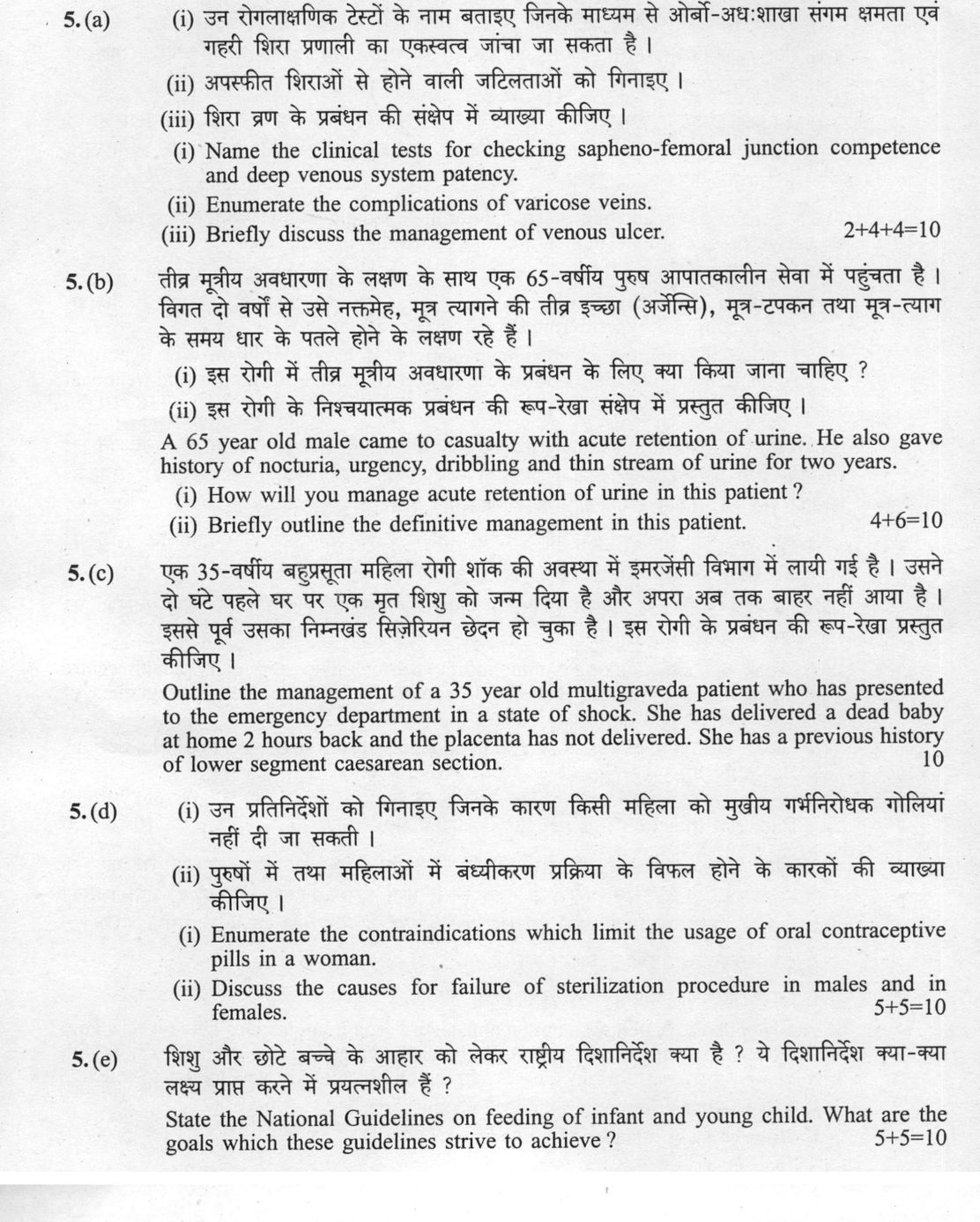
(a) (i) Name the clinical tests for checking sapheno-femoral junction competence and deep venous system patency. (ii) Enumerate…
Name the clinical tests for checking sapheno-femoral junction competence and deep venous system patency.
Enumerate the complications of varicose veins.
Briefly discuss the management of venous ulcer. 2+4+4=10
A 65 year old male came to casualty with acute retention of urine. He also gave history of nocturia, urgency, dribbling and thin stream of urine for two years. How will you manage acute retention of urine in this patient ?
Briefly outline the definitive management in this patient. 4+6=10
Outline the management of a 35 year old multigraveda patient who has presented to the emergency department in a state of shock. She has delivered a dead baby at home 2 hours back and the placenta has not delivered. She has a previous history of lower segment caesarean section. 10 marks
Enumerate the contraindications which limit the usage of oral contraceptive pills in a woman.
Discuss the causes for failure of sterilization procedure in males and in females. 5+5=10
State the National Guidelines on feeding of infant and young child. What are the goals which these guidelines strive to achieve ? 5+5=10
हिंदी में प्रश्न पढ़ें
उन रोगलाक्षणिक टेस्टों के नाम बताइए जिनके माध्यम से ओबी-अधःशाखा संगम क्षमता एवं गहरी शिरा प्रणाली का एकत्रत्व जाँचा जा सकता है।
अपस्फीति शिराओं से होने वाली जटिलताओं को गिनाइए।
शिरा व्रण के प्रबंधन की संक्षेप में व्याख्या कीजिए। 2+4+4=10
तीव्र मूत्रीय अवधारणा के लक्षण के साथ एक 65-वर्षीय पुरुष आपातकालीन सेवा में पहुँचता है। विगत दो वर्षों से उसे नक्तमेह, मूत्र त्यागने की तीव्र इच्छा (अर्जेंसी), मूत्र-टपकन तथा मूत्र-त्याग के समय धार के पतले होने के लक्षण रहे हैं। इस रोगी में तीव्र मूत्रीय अवधारणा के प्रबंधन के लिए क्या किया जाना चाहिए ?
इस रोगी के निश्चयात्मक प्रबंधन की रूप-रेखा संक्षेप में प्रस्तुत कीजिए। 4+6=10
एक 35-वर्षीय बहुप्रसूता महिला रोगी शॉक की अवस्था में इमरजेंसी विभाग में लायी गई है। उसने दो घंटे पहले घर पर एक मृत शिशु को जन्म दिया है और अपरा अब तक बाहर नहीं आया है। इससे पूर्व उसका निम्नबंध सिजेरियन छेदन हो चुका है। इस रोगी के प्रबंधन की रूप-रेखा प्रस्तुत कीजिए। 10
उन प्रतिनिदेशों को गिनाइए जिनके कारण किसी महिला को मुख्य गर्भनिरोधक गोलियाँ नहीं दी जा सकती।
पुरुषों में तथा महिलाओं में बंध्यीकरण प्रक्रिया के विफल होने के कारकों की व्याख्या कीजिए। 5+5=10
शिशु और छोटे बच्चे के आहार को लेकर राष्ट्रीय दिशानिर्देश क्या हैं ? ये दिशानिर्देश क्या-क्या लक्ष्य प्राप्त करने में प्रयत्नशील हैं ? 5+5=10
Model answer
Written by UPSC Answer Check against this question's marking rubric, to the expected length. UPSC does not publish answers for Mains — this is one way to score well, not an official key.
Varicose Veins and Venous Ulcer Management
Clinical Tests: Sapheno-femoral junction (SFJ) competence is evaluated using the Brodie-Trendelenburg test (Part I), where a tourniquet is applied to the upper thigh with the leg elevated and emptied; rapid filling from above upon release indicates SFJ incompetence. Other tests include the Morrissey cough impulse test and Schwartz test. Deep venous system patency is evaluated using Perthes test and the Modified Perthes test (applying a tourniquet below the knee and asking the patient to walk; decompression of superficial veins confirms a patent deep venous system and competent perforators).
Complications of Varicose Veins: Chronic venous hypertension leads to cutaneous and vascular complications:
- Venous stasis dermatitis (stasis eczema) and pruritus.
- Hemosiderin pigmentation and lipodermatosclerosis (inverted champagne-bottle leg appearance).
- Atrophie blanche and venous ulceration, classically situated in the gaiter zone (medial malleolus).
- Superficial thrombophlebitis.
- Hemorrhage (external rupture of thin-walled varices, which can be profuse).
- Periostitis of the underlying tibia and secondary Marjolin's ulcer (malignant degeneration in long-standing non-healing ulcers).
Management of Venous Ulcer: Assessment requires Duplex ultrasonography to map venous reflux and deep patency, along with Ankle-Brachial Index (ABI) to rule out concurrent arterial insufficiency (ABI must be >0.8 for high-compression therapy).
- Compression Therapy: This is the cornerstone of conservative management. Four-layer bandaging or short-stretch multicomponent compression bandages provide a pressure of 30–40 mmHg at the ankle, counteracting venous hypertension.
- Limb Elevation and Mobility: Elevating the legs above the level of the heart during rest and structured calf-muscle exercises to enhance the calf muscle pump.
- Local Wound Care: Sharp or autolytic debridement of necrotic tissue, infection control, and non-adherent moist dressings.
- Pharmacotherapy: Oral Pentoxifylline (400 mg thrice daily) or micronized purified flavonoid fractions (MPFF) to improve microvascular perfusion.
- Surgical/Endovenous Correction: Superficial venous ablation (Endovenous Laser Ablation, Radiofrequency Ablation, or SFJ flush ligation with stripping) to eliminate reflux. Large refractory ulcers may require split-thickness skin grafting (SSG).
---
Acute Retention of Urine and Benign Prostatic Hyperplasia
Management of Acute Retention: The immediate objective is rapid and safe decompression of the urinary bladder:
- Urethral Catheterization: Perform immediate urethral catheterization under strict aseptic conditions using a 14–16 Fr Foley catheter with abundant lubricating lidocaine gel. Decompress the bladder completely.
- Failed Catheterization: If resistance is encountered (due to an enlarged median lobe, false passage, or stricture), force must not be applied. An emergency percutaneous suprapubic cystostomy (SPC) should be performed under ultrasound guidance or local anesthesia.
- Assessment: Rule out acute prostatitis, evaluate for urethral stricture, and monitor the patient for post-obstructive diuresis and electrolyte derangements if the drained residual volume exceeds 1000 mL.
Definitive Management: Initial diagnostic evaluation includes digital rectal examination (DRE), serum prostate-specific antigen (PSA), renal function tests, urine culture, and ultrasound of the KUB region (evaluating prostate volume, upper tract changes, and post-void residual volume).
- Surgical Intervention (Gold Standard):
- Transurethral Resection of the Prostate (TURP): The standard operative intervention for symptomatic BPH with prostate volume <80 grams.
- Holmium Laser Enucleation of the Prostate (HoLEP) or Open Simple Prostatectomy (Freyer's transvesical or Millin's retropubic approach) for large glands (>80–100 grams).
- Medical Therapy: Indicated for patients who are poor surgical candidates or during a trial without catheter (TWOC). It comprises a combination of a selective alpha-1 adrenergic blocker (Tamsulosin 0.4 mg or Silodosin 8 mg daily) for immediate symptom relief and a 5-alpha reductase inhibitor (Finasteride 5 mg or Dutasteride 0.5 mg daily) to reduce prostate volume over 6 months.
---
Emergency Management of Shock with Retained Placenta and Previous Scar
A 35-year-old multigravida presenting in shock post-home delivery with a retained placenta and a previous LSCS scar must be managed as an obstetric catastrophe—primary suspects being severe postpartum hemorrhage (PPH), morbidly adherent placenta (Placenta Accreta spectrum), or uterine rupture along the scar.
Resuscitation (Immediate ABC Approach):
- Airway and Breathing: Administer high-flow supplemental oxygen (10–15 L/min via non-rebreather mask).
- Circulation: Establish two wide-bore (14G or 16G) peripheral intravenous lines. Rapidly infuse warm crystalloids (Ringer's Lactate).
- Blood Transfusion: Send blood immediately for grouping, cross-matching (at least 4 units of packed red blood cells, fresh frozen plasma, and platelets), complete blood count, and coagulation profile. Activate the hospital's Massive Transfusion Protocol (MTP).
- Catheterization: Insert an indwelling Foley catheter to monitor hourly urine output (targeting >30 mL/hr) and decompress the bladder.
Targeted Operative and Medical Management:
- Uterotonic Therapy: Administer intravenous oxytocin infusion (20–40 IU in 500 mL normal saline) and intramuscular Carboprost/Misoprostol sublingually, monitoring hemodynamics.
- Examination Under Anesthesia (EUA): Transfer immediately to the operating theatre. Under general anesthesia, perform gentle manual removal of the placenta (MROP).
- Evaluation for Scar Rupture and Placenta Accreta: Following placental removal, explore the uterine cavity digitally to assess the integrity of the previous LSCS scar. Transabdominal/transvaginal ultrasound can confirm complete evacuation and exclude intra-abdominal fluid.
- Laparotomy: If the placenta fails to separate (Placenta Accreta/Increta) or if a uterine rupture is palpated with ongoing internal hemorrhage, perform an immediate emergency exploratory laparotomy. Repair the uterine rupture if viable, or proceed to an emergency obstetric hysterectomy if bleeding is uncontrollable or extensive placental invasion is present.
- Postoperative Care: Administer broad-spectrum intravenous antibiotics (e.g., Ceftriaxone, Metronidazole), correct coagulopathy, and transfer to the Intensive Care Unit.
---
Contraindications to OCPs and Failure of Sterilization
Contraindications to Combined Oral Contraceptive Pills (WHO MEC Category 4):
- Age ≥35 years who smoke ≥15 cigarettes per day.
- Current or past history of deep vein thrombosis, pulmonary embolism, or known thrombogenic mutations (e.g., Factor V Leiden).
- Ischemic heart disease, stroke, or complicated valvular heart disease (e.g., pulmonary hypertension).
- Migraine with aura at any age.
- Severe hypertension (systolic ≥160 mmHg or diastolic ≥100 mmHg) or vascular disease.
- Current or past history of breast cancer.
- Active liver disease: acute viral hepatitis, decompensated cirrhosis, or benign/malignant liver tumors.
- Lactation within the first 6 weeks postpartum (estrogen impairs lactation and increases thromboembolic risk).
Causes for Failure of Sterilization:
Female Sterilization (Tubal Ligation):
- Spontaneous recanalization of the fallopian tubes via epithelialized fistulous tracts.
- Uteroperitoneal or tuboperitoneal fistula formation.
- Surgical technical error: Misidentification and ligation of adjacent structures (round ligament, ovarian ligament, or epiploic appendices) instead of the fallopian tube.
- Incomplete tubal occlusion or slippage/misplacement of Hulka clips or Falope rings.
- Luteal phase pregnancy (fertilization having occurred immediately prior to the procedure).
Male Sterilization (Vasectomy):
- Spontaneous recanalization/reanastomosis of the transected ends of the vas deferens.
- Technical surgical error: Incomplete transection, failure to excise a segment, or ligation of adjacent fascial/vascular structures instead of the vas deferens.
- Unprotected intercourse before achieving complete azoospermia (failure to comply with barrier contraception for 3 months or 20 ejaculations post-procedure).
- Congenital duplication of the vas deferens (rare anatomical variant missed during surgery).
---
National Guidelines on Infant and Young Child Feeding (IYCF)
The Ministry of Health and Family Welfare (MoHFW), in collaboration with the Indian Academy of Pediatrics (IAP) and National Neonatal Forum (NNF), outlines standard IYCF guidelines:
- Early Initiation: Initiation of breastfeeding within the first hour of life ("the golden hour"), ensuring skin-to-skin contact and administration of colostrum, avoiding all pre-lacteal feeds (such as honey, animal milk, or ghutti).
- Exclusive Breastfeeding: Exclusive breastfeeding for the first six completed months (180 days) of life. No water, fluids, or other foods should be administered except oral rehydration solution, drops/syrups of vitamins, minerals, and medicines.
- Timely Complementary Feeding: Introduction of nutritionally adequate, safe, hygienically prepared, and age-appropriate complementary foods starting at 6 months of age.
- Continued Breastfeeding: Continued frequent, on-demand breastfeeding up to 2 years of age or beyond alongside complementary feeding.
- Active and Responsive Feeding: Feeding young infants directly and assisting older children, adhering to food hygiene and responsive feeding principles during illness and convalescence.
Goals of the Guidelines:
- Reduction of Neonatal, Infant, and Under-5 Mortality Rates (IMR and U5MR) by protecting against severe infections (diarrhea and pneumonia).
- Prevention of Childhood Undernutrition: Directly tackling and reducing the prevalence of stunting, wasting, and underweight in children under 5 years, aligning with POSHAN Abhiyaan and Sustainable Development Goal 2 (Zero Hunger).
- Optimal Neurodevelopment: Fostering early brain architecture and cognitive development through essential fatty acids and maternal-infant bonding.
- Institutional Targets: Achieving >90% institutional adherence to early initiation of breastfeeding and raising exclusive breastfeeding rates across all demographics.
What "Outline" is asking you to do
Set out a whole scheme from end to end in its main steps without going into any of them. It is the directive used for protocols and frameworks — a management plan, a reaction mechanism, a statutory scheme — where the mark lies in having the full sequence with nothing missing.
Structure that answers it
What the scheme is for → step one → step two → the remaining steps through to the end point → the condition on which the sequence turns
Where marks are lost
Depth in the wrong place: elaborating the first two steps and never reaching the end of the scheme, which is where completeness is checked.
How this answer will be evaluated
Approach
Framework: Clinical sequence: Definition > Aetiology/Pathophysiology > Features > Investigation > Management (Immediate/Definitive/Follow-up). (a(i)) enumerate: list the items in order > one line each > no commentary | (a(ii)) enumerate: list the items in order > one line each > no commentary | (a(iii)) discuss: intro > 3-4 dimensions > example > balanced close | (b(i)) suggest: the problem in one line > implementable measures > who acts > conclusion | (b(ii)) discuss: intro > 3-4 dimensions > example > balanced close | (c) discuss: intro > 3-4 dimensions > example > balanced close | (d(i)) enumerate: list the items in order > one line each > no commentary | (d(ii)) discuss: intro > 3-4 dimensions > example > balanced close | (e) discuss: intro > 3-4 dimensions > example > balanced close Full marks: Precise clinical terminology, correct sequence of management, clear distinction between immediate and definitive care.
Key points expected
- Trendelenburg test for sapheno-femoral junction
- Perthes test for deep venous patency
- Varicose ulceration
- Superficial thrombophlebitis
- Haemorrhage (Cockett's syndrome)
- Lipodermatosclerosis / Stasis dermatitis
- Compression therapy (bandaging/stockings)
- Wound care (debridement/antiseptics)
Evaluation rubric
Each sub-part is marked on its own, against the marks and word limit printed on the paper.
- (a(i)) List specific clinical tests for sapheno-femoral junction and deep venous patency. 2 marks
enumerate— list the items in order → one line each → no commentary
Must cover
- Trendelenburg test for sapheno-femoral junction
- Perthes test for deep venous patency
Loses marks
- Listing imaging tests (Doppler) instead of clinical tests
- Confusing tests for junction vs patency
Earns more
- Short saphenous test (Brodie-Turnbull)
- (a(ii)) List complications of varicose veins. 4 marks
enumerate— list the items in order → one line each → no commentary
Must cover
- Varicose ulceration
- Superficial thrombophlebitis
- Haemorrhage (Cockett's syndrome)
- Lipodermatosclerosis / Stasis dermatitis
Loses marks
- Listing causes of varicose veins
- Listing management options
Earns more
- Malignant transformation (Marjolin's ulcer)
- (a(iii)) Outline management of venous ulcer. 4 marks
discuss— intro → 3-4 dimensions → example → balanced close
Must cover
- Compression therapy (bandaging/stockings)
- Wound care (debridement/antiseptics)
- Definitive treatment (sclerotherapy/surgery)
- Elevation and exercise
Loses marks
- Management without priority (e.g., surgery before compression)
- Ignoring the underlying venous hypertension
Earns more
- Specific mention of Unna's boot
- (b(i)) Immediate management of acute retention of urine. 4 marks
suggest— the problem in one line → implementable measures → who acts → conclusion
Must cover
- Catheterization (Foley's catheter)
- Assessment of bladder volume
- Relief of obstruction (if mechanical)
- Monitoring of urine output
Loses marks
- Suggesting definitive surgery (TURP) as immediate step
- Ignoring the acute nature of the retention
Earns more
- Mention of suprapubic catheter if urethral fails
- (b(ii)) Definitive management of the underlying condition (BPH). 6 marks
discuss— intro → 3-4 dimensions → example → balanced close
Must cover
- Medical management (Alpha-blockers/5-ARI)
- Surgical options (TURP)
- Indications for surgery
- Follow-up (IPSS score/PSA)
Loses marks
- Listing symptoms without management plan
- Ignoring the 2-year history of LUTS
Earns more
- Mention of minimally invasive options (TUMT/TUAB)
- (c) Management of postpartum hemorrhage with retained placenta and shock. 10 marks
discuss— intro → 3-4 dimensions → example → balanced close
Must cover
- Resuscitation (IV fluids/blood transfusion)
- Manual removal of placenta (MROP)
- Uterotonics (Oxytocin/Carboprost)
- Surgical intervention (Hysterectomy if needed)
Loses marks
- Ignoring the shock state (focusing only on placenta)
- Delaying resuscitation for surgery
Earns more
- Specific mention of previous LSCC as risk factor
- Mention of uterine artery ligation
- (d(i)) List contraindications for oral contraceptive pills. 5 marks
enumerate— list the items in order → one line each → no commentary
Must cover
- Thromboembolic disease (DVT/PE)
- Migraine with aura
- Smoking (age >35)
- Breast cancer / Liver disease
Loses marks
- Listing side effects instead of contraindications
- Listing relative contraindications as absolute without distinction
Earns more
- Hypertension (severe)
- Diabetes with vascular disease
- (d(ii)) Causes of failure in male and female sterilization. 5 marks
discuss— intro → 3-4 dimensions → example → balanced close
Must cover
- Male: Recanalization / Technical error
- Female: Recanalization / Technical error
- Ectopic pregnancy (if failure occurs)
- Incomplete occlusion
Loses marks
- Confusing failure with regret
- Ignoring the mechanism of recanalization
Earns more
- Mention of specific techniques (vasectomy vs tubectomy)
- (e) National Guidelines on infant feeding and their goals. 10 marks
discuss— intro → 3-4 dimensions → example → balanced close
Must cover
- Exclusive breastfeeding (0-6 months)
- Complementary feeding (6-24 months)
- Continued breastfeeding (up to 2 years)
- Goals: Reduce infant mortality / Malnutrition
Loses marks
- Listing generic nutrition advice without national context
- Ignoring the specific age groups (0-6, 6-24)
Earns more
- Mention of IYCF (Infant and Young Child Feeding) guidelines
- Specific mention of WHO/UNICEF recommendations
Practice this exact question
Write your answer and it is marked point by point against the model answer above — what you covered, what you missed, what you got wrong.
Evaluate my answer →More from Medical Science 2022 Paper II
- Q2 (a) Discuss in brief the etiology, clinical features, diagnosis and treatment of nephroti…
- Q3 (a) (i) Discuss in brief about the diet and exercise related advice given to a 35 year ol…
- Q4 (a) A 25 year old female has presented to the medicine OPD with complaints of excessive t…
- Q5 (a) (i) Name the clinical tests for checking sapheno-femoral junction competence and deep…
- Q6 (a) Define 'pre-eclampsia'. Enumerate the risk factors which may lead to this condition.…
- Q7 7.(a) A 40 year old lady came to casualty with pain in the right upper abdomen associated…
- Q8 8.(a) The 'End TB Strategy' is an evolution over the previous strategies to win over tube…