Paper II — Q3
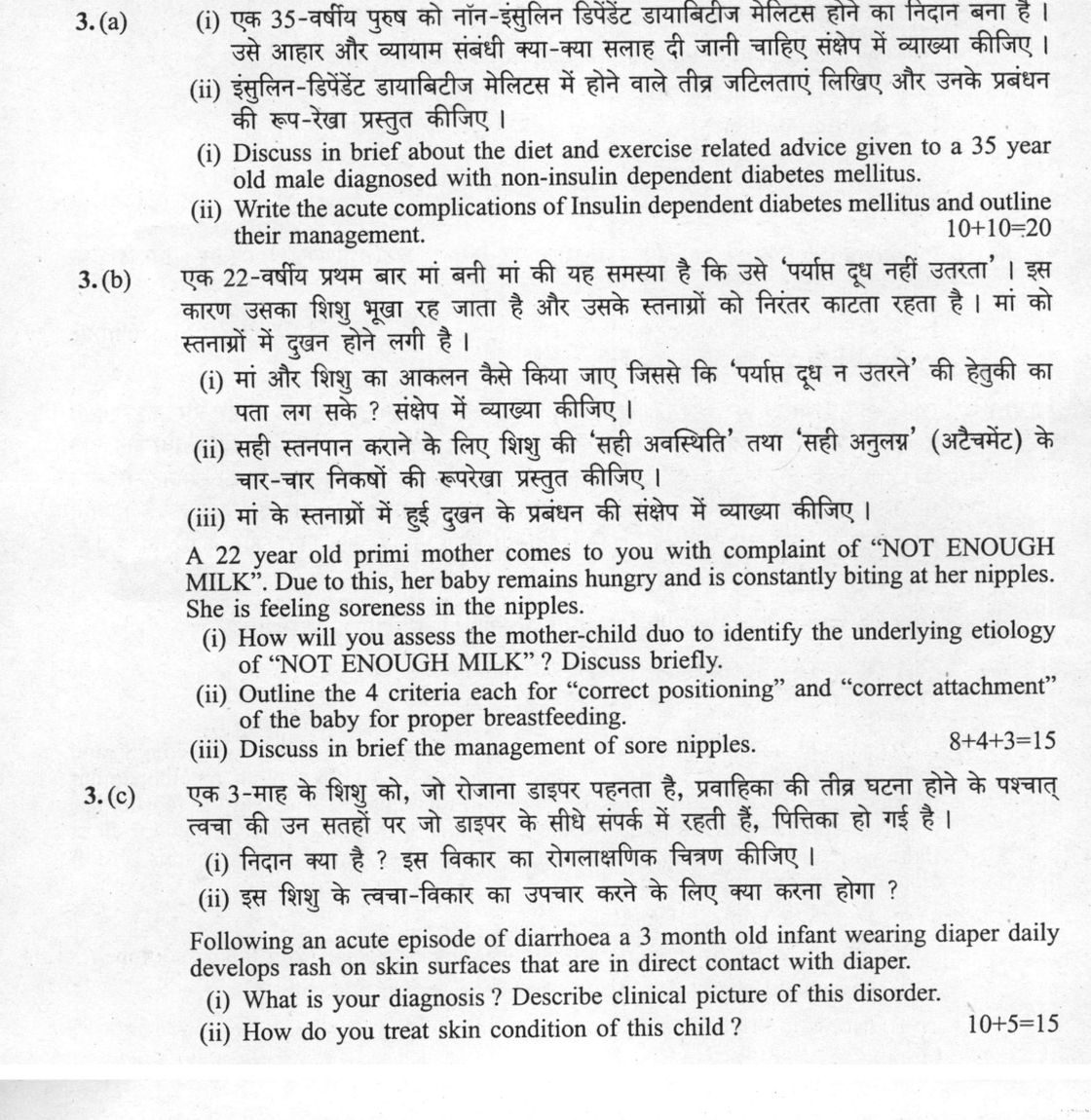
(a) (i) Discuss in brief about the diet and exercise related advice given to a 35 year old male diagnosed with non-insulin…
Discuss in brief about the diet and exercise related advice given to a 35 year old male diagnosed with non-insulin dependent diabetes mellitus.
Write the acute complications of Insulin dependent diabetes mellitus and outline their management. 10+10=20
A 22 year old primi mother comes to you with complaint of "NOT ENOUGH MILK". Due to this, her baby remains hungry and is constantly biting at her nipples. She is feeling soreness in the nipples.
How will you assess the mother-child duo to identify the underlying etiology of "NOT ENOUGH MILK" ? Discuss briefly.
Outline the 4 criteria each for "correct positioning" and "correct attachment" of the baby for proper breastfeeding.
Discuss in brief the management of sore nipples. 8+4+3=15
Following an acute episode of diarrhoea a 3 month old infant wearing diaper daily develops rash on skin surfaces that are in direct contact with diaper.
What is your diagnosis ? Describe clinical picture of this disorder.
How do you treat skin condition of this child ? 10+5=15
हिंदी में प्रश्न पढ़ें
(क) (i) एक 35-वर्षीय पुरुष को नॉन-इंसुलिन डिपेंडेंट डायबिटीज मेलिटस होने का निदान बना है। उसे आहार और व्यायाम संबंधी क्या-क्या सलाह दी जानी चाहिए संक्षेप में व्याख्या कीजिए।
इंसुलिन-डिपेंडेंट डायबिटीज मेलिटस में होने वाले तीव्र जटिलताएं लिखिए और उनके प्रबंधन की रूप-रेखा प्रस्तुत कीजिए। 10+10=20
(ख) एक 22-वर्षीय प्रथम बार माँ बनी माँ की यह समस्या है कि उसे 'पर्याप्त दूध नहीं उतरता'। इस कारण उसका शिशु भूखा रह जाता है और उसके स्तनाग्रों को निरंतर काटता रहता है। माँ को स्तनाग्रों में दुखन होने लगी है।
माँ और शिशु का आकलन कैसे किया जाए जिससे कि 'पर्याप्त दूध न उतरने' की हेतुकी का पता लग सके ? संक्षेप में व्याख्या कीजिए।
सही स्तनपान कराने के लिए शिशु की 'सही अवस्थिति' तथा 'सही अनुलग्न' (अटैचमेंट) के चार-चार निकषों की रूपरेखा प्रस्तुत कीजिए।
माँ के स्तनाग्रों में हुई दुखन के प्रबंधन की संक्षेप में व्याख्या कीजिए। 8+4+3=15
(ग) एक 3-माह के शिशु को, जो रोजाना डायपर पहनता है, प्रवाहिका की तीव्र घटना होने के पश्चात् त्वचा की उन सतहों पर जो डायपर के सीधे संपर्क में रहती हैं, पित्तिका हो गई है।
निदान क्या है ? इस विकार का रोगलक्षणिक चित्रण कीजिए।
इस शिशु के त्वचा-विकार का उपचार करने के लिए क्या करना होगा ? 10+5=15
Model answer
Written by UPSC Answer Check against this question's marking rubric, to the expected length. UPSC does not publish answers for Mains — this is one way to score well, not an official key.
Management of Non-Insulin Dependent Diabetes Mellitus
Dietary prescription for a 35-year-old male with type 2 diabetes mellitus centers on caloric restriction to attain a healthy body mass index, utilizing a Mediterranean or Dietary Approaches to Stop Hypertension (DASH) pattern. Carbohydrate intake should prioritize low glycemic index and load foods, complex carbohydrates with structured carbohydrate counting, and high dietary fiber intake (30–40 g/day). Saturated fats must be restricted to under 7% of total energy intake, trans-fats eliminated, and lean proteins encouraged alongside micronutrient-dense vegetables.
Exercise advice includes a minimum of 150 minutes per week of moderate-intensity aerobic physical activity (such as brisk walking, cycling, or swimming) spread over at least 3 days, with no more than two consecutive days without activity. This should be combined with resistance training 2 to 3 times weekly. Clinical precautions include pre-exercise blood glucose monitoring, maintaining adequate hydration, wearing protective footwear, and carrying rapid-acting carbohydrates to manage exercise-induced hypoglycemia.
Acute Complications of Insulin Dependent Diabetes Mellitus
Acute complications of type 1 diabetes mellitus primarily comprise Diabetic Ketoacidosis (DKA) and Hypoglycemia. DKA arises from absolute insulin deficiency, precipitating unchecked lipolysis that releases free fatty acids, which undergo hepatic beta-oxidation into ketone bodies (acetoacetate and beta-hydroxybutyrate). This leads to high anion-gap metabolic acidosis, profound osmotic diuresis, and dehydration.
DKA management requires aggressive fluid resuscitation beginning with 0.9% normal saline (10–20 mL/kg in the first hour), followed by low-dose continuous intravenous regular insulin infusion (0.1 U/kg/hour). Insulin must be withheld if serum potassium is below 3.3 mEq/L until hypokalemia is corrected. Potassium replacement (20–30 mEq/L of infusion fluid) is initiated once urine output is established and potassium drops below 5.2 mEq/L. Dextrose (5%) is added to intravenous fluids when blood glucose reaches 200–250 mg/dL to prevent rapid osmolar shifts and hypoglycemia, while neurologic monitoring is maintained to promptly detect and treat cerebral edema using intravenous mannitol (0.5–1 g/kg) or 3% hypertonic saline. Hypoglycemia is managed via the "rule of 15" with oral simple sugars or intravenous 25–50% dextrose if unconscious.
Assessment and Management of Lactation Failure and Sore Nipples
Lactation assessment of the mother-child duo involves evaluating maternal prolactin and oxytocin reflexes, examining breast anatomy for hypoplasia, inverted nipples, or engorgement, and screening for maternal dehydration, systemic illness, or postpartum anxiety. Infant assessment entails reviewing gestational age, birth weight, weight gain trajectory, daily urinary (>6 pale voids/day) and stool output, oral anatomy for ankyloglossia or clefts, and observing latch dynamics to differentiate nutritive sucking from ineffective fluttering.
The four standard criteria for correct infant positioning are: the infant’s head and body are kept in a straight line; the infant is held close to the mother's body facing the breast; the infant's whole body is well supported; and the infant approaches the breast with the nose opposite the nipple.
The four standard criteria for correct attachment are: the infant’s mouth is opened wide; the lower lip is everted outward; the chin firmly touches the maternal breast; and more of the areola is visible above the upper lip than below the lower lip.
Management of sore nipples focuses on immediate correction of positioning and latch technique. Application of expressed hindmilk or medical-grade purified lanolin promotes moist wound healing. Hydrogel pads or ventilated breast shells prevent friction between feeds. If secondary candidiasis (burning pain, flaking) or Staphylococcus aureus infection is identified, topical or oral antifungals (clotrimazole) or antibiotics are administered. Temporary manual expression may be utilized if direct nursing is acutely intolerable.
Diagnosis and Treatment of Infantile Diaper Dermatitis
The presentation following acute diarrhea represents Irritant Contact Diaper Dermatitis with potential Candida albicans superinfection. Irritant dermatitis manifests as bright erythema, edema, and scaling over the convex surfaces in direct contact with the diaper (buttocks, lower abdomen, pubic area), characteristically sparing the deep intertriginous skin folds. Secondary candidiasis is distinguished by a beefy-red, confluent rash that actively involves the inguinal and genitocrural folds, surrounded by discrete peripheral erythematous papulopustular "satellite lesions."
Treatment requires the ABCDE approach: Air exposure (leaving the diaper off whenever feasible); Barrier creams (thick applications of zinc oxide paste or white petrolatum at every diaper change); Cleansing gently with warm water and soft cloths while avoiding commercial alcohol-based wipes; Diaper modifications using superabsorbent disposable diapers with frequent changes; and Education. When candidal infection is present, topical antifungals such as clotrimazole or nystatin cream are applied directly to the skin 2–3 times daily beneath the protective barrier layer.
Primary health networks must combine lifestyle interventions under the National Programme for Prevention and Control of Non-Communicable Diseases (NP-NCD) with infant nutrition strategies under the MAA (Mothers’ Absolute Affection) programme to deliver continuous, evidence-based preventive care.
What "Discuss" is asking you to do
Lay the issue out from more than one side — how it arose, what is claimed for it, what is held against it, and where it now stands. UPSC attaches discuss to broad topics with several live dimensions, so coverage of the dimensions earns more than the strength of your opinion.
Structure that answers it
Set the issue up → the case as it is made → the case against → the dimension both sides leave out → where the balance now lies
Where marks are lost
Listing facts with no thread between them, or arguing one side throughout and calling it a discussion.
How this answer will be evaluated
Approach
Framework: Clinical Sequence (Definition > Aetiology > Features > Management). (a(i)) discuss: intro > 3-4 dimensions > example > balanced close | (a(ii)) explain: definition/context > points in order > small example > short close | (b(i)) discuss: intro > 3-4 dimensions > example > balanced close | (b(ii)) enumerate: list the items in order > one line each > no commentary | (b(iii)) discuss: intro > 3-4 dimensions > example > balanced close | (c(i)) describe: define > structure or process in order > labelled diagram > significance | (c(ii)) explain: definition/context > points in order > small example > short close Full marks: Accurate clinical sequence, specific management protocols, and clear differentiation of criteria.
Key points expected
- Caloric restriction and carbohydrate control
- Specific exercise prescription (aerobic/resistance)
- Weight management targets
- Lifestyle modification for insulin sensitivity
- Diabetic Ketoacidosis (DKA) management
- Hypoglycemia management
- Hyperosmolar Hyperglycemic State (HHS) if applicable
- Insulin therapy protocols
Evaluation rubric
Each sub-part is marked on its own, against the marks and word limit printed on the paper.
- (a(i)) Dietary and exercise advice for a 35-year-old male with NIDDM. 10 marks
discuss— intro → 3-4 dimensions → example → balanced close
Must cover
- Caloric restriction and carbohydrate control
- Specific exercise prescription (aerobic/resistance)
- Weight management targets
- Lifestyle modification for insulin sensitivity
Loses marks
- Generic advice not specific to NIDDM
- Ignoring the patient's age/gender context
Earns more
- Mention of specific food groups (low GI)
- Reference to ADA or ICMR guidelines
- Cardiovascular risk factor management
Extra mark
- Mention of specific national health programme targets
- (a(ii)) Acute complications of IDDM and their management. 10 marks
explain— definition/context → points in order → small example → short close
Must cover
- Diabetic Ketoacidosis (DKA) management
- Hypoglycemia management
- Hyperosmolar Hyperglycemic State (HHS) if applicable
- Insulin therapy protocols
Loses marks
- Confusing chronic with acute complications
- Management without priority (immediate vs definitive)
Earns more
- Fluid resuscitation specifics
- Electrolyte correction (potassium)
- Monitoring parameters (glucose, ketones)
Extra mark
- Mention of specific emergency protocols
- (b(i)) Assessment of mother-child duo for 'not enough milk'. 8 marks
discuss— intro → 3-4 dimensions → example → balanced close
Must cover
- Evaluation of infant intake (wet/dirty diapers)
- Assessment of infant weight gain
- Evaluation of maternal breast fullness/softness
- Observation of latch and suckling
Loses marks
- Focusing only on maternal supply without infant assessment
- Ignoring the 'biting' symptom in assessment
Earns more
- Mention of 'let-down' reflex assessment
- Exclusion of infant illness
- Maternal diet and hydration check
Extra mark
- Reference to WHO breastfeeding indicators
- (b(ii)) 4 criteria for correct positioning and 4 for correct attachment. 4 marks
enumerate— list the items in order → one line each → no commentary
Must cover
- 4 distinct criteria for positioning
- 4 distinct criteria for attachment
- Head and body alignment
- Nipple-areola in mouth
Loses marks
- Listing fewer than 4 criteria for each
- Vague descriptions without specific anatomical landmarks
Earns more
- Chin touching breast
- Nose clear
- Symmetrical cheek fullness
- Slow deep sucks
Extra mark
- Mention of 'Cradle' or 'Cross-cradle' hold specifics
- (b(iii)) Management of sore nipples. 3 marks
discuss— intro → 3-4 dimensions → example → balanced close
Must cover
- Correction of latch/position
- Air drying of nipples
- Use of lanolin or breast milk for healing
Loses marks
- Suggesting weaning as first-line management
- Ignoring the cause (poor latch)
Earns more
- Pain management (analgesics)
- Avoidance of harsh soaps
- Continuation of breastfeeding
Extra mark
- Mention of specific ointments (e.g., pure lanolin)
- (c(i)) Diagnosis and clinical picture of the infant's rash. 10 marks
describe— define → structure or process in order → labelled diagram → significance
Must cover
- Diagnosis: Diaper Dermatitis (or Diaper Rash)
- Erythema in convex areas (buttocks, genitals)
- Sparing of skin folds (intertriginous areas)
- History of diarrhea and diaper use
Loses marks
- Diagnosing without considering the diarrhea history
- Describing features of unrelated dermatoses
Earns more
- Mention of satellite lesions (if candidal)
- Description of 'beefy red' appearance
- Exclusion of other rashes (eczema, psoriasis)
Extra mark
- Mention of specific grading of severity
- (c(ii)) Treatment of the skin condition. 5 marks
explain— definition/context → points in order → small example → short close
Must cover
- Frequent diaper changes
- Air exposure/drying
- Barrier cream (zinc oxide) application
Loses marks
- Treating only the rash without addressing diarrhea
- Suggesting systemic steroids for simple diaper rash
Earns more
- Treatment of underlying diarrhea (ORS)
- Antifungal if candidal (clotrimazole)
- Avoidance of irritants (wipes with alcohol)
Extra mark
- Mention of specific barrier cream brands or types
Practice this exact question
Write your answer and it is marked point by point against the model answer above — what you covered, what you missed, what you got wrong.
Evaluate my answer →More from Medical Science 2022 Paper II
- Q1 (a) Enumerate the imaging modalities used in the diagnosis of cardiac diseases. List thei…
- Q2 (a) Discuss in brief the etiology, clinical features, diagnosis and treatment of nephroti…
- Q3 (a) (i) Discuss in brief about the diet and exercise related advice given to a 35 year ol…
- Q4 (a) A 25 year old female has presented to the medicine OPD with complaints of excessive t…
- Q5 (a) (i) Name the clinical tests for checking sapheno-femoral junction competence and deep…
- Q6 (a) Define 'pre-eclampsia'. Enumerate the risk factors which may lead to this condition.…