Paper II — Q2
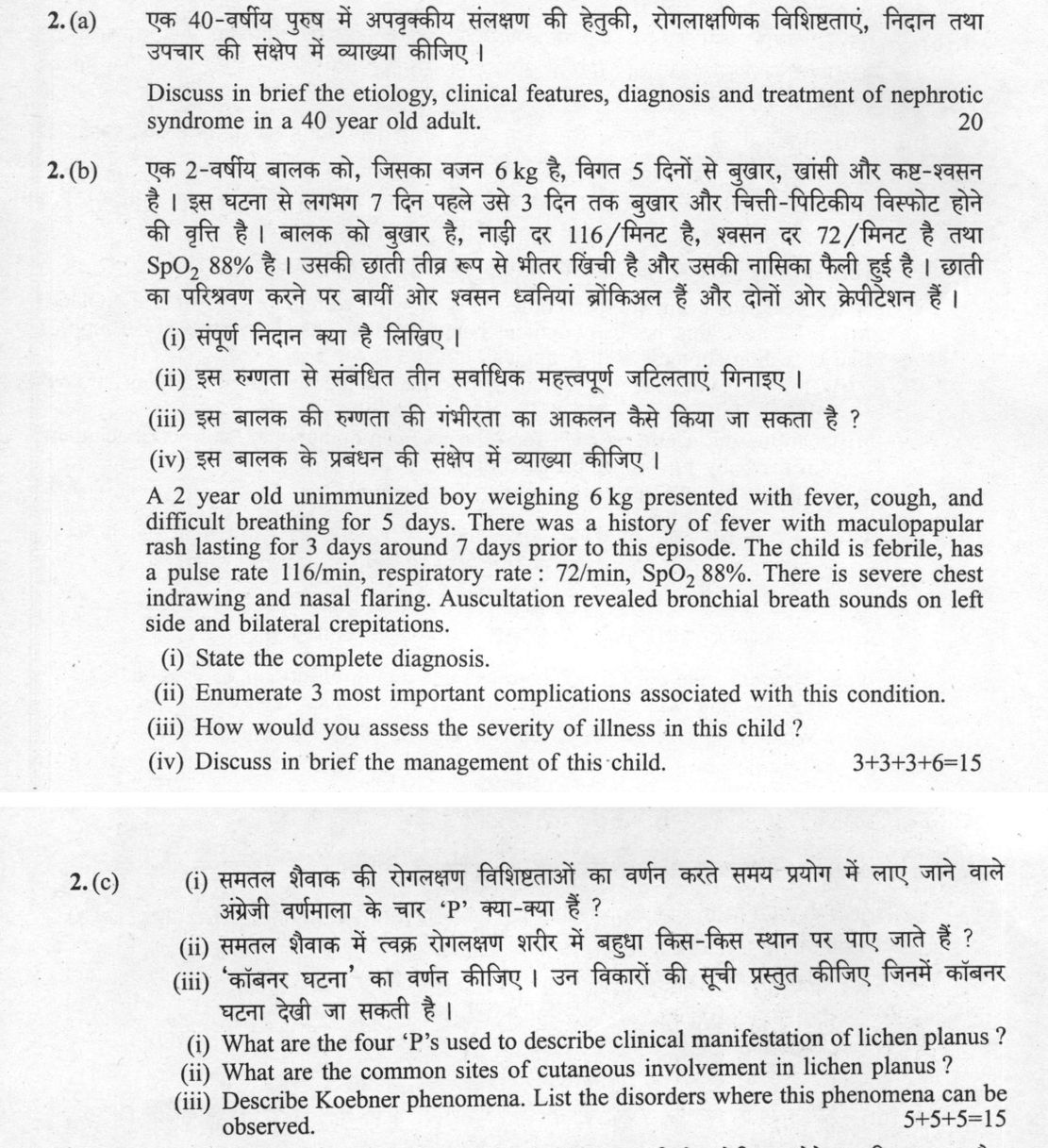
(a) Discuss in brief the etiology, clinical features, diagnosis and treatment of nephrotic syndrome in a 40 year old adult. (20…
Discuss in brief the etiology, clinical features, diagnosis and treatment of nephrotic syndrome in a 40 year old adult. 20 marks
A 2 year old unimmunized boy weighing 6 kg presented with fever, cough, and difficult breathing for 5 days. There was a history of fever with maculopapular rash lasting for 3 days around 7 days prior to this episode. The child is febrile, has a pulse rate 116/min, respiratory rate : 72/min, SpO₂ 88%. There is severe chest indrawing and nasal flaring. Auscultation revealed bronchial breath sounds on left side and bilateral crepitations. State the complete diagnosis.
Enumerate 3 most important complications associated with this condition.
How would you assess the severity of illness in this child ?
Discuss in brief the management of this child. (3+3+3+6=15 marks)
What are the four 'P's used to describe clinical manifestation of lichen planus ?
What are the common sites of cutaneous involvement in lichen planus ?
Describe Koebner phenomena. List the disorders where this phenomena can be observed. (5+5+5=15 marks)
हिंदी में प्रश्न पढ़ें
एक 40-वर्षीय पुरुष में अपवृक्कीय संलक्षण की हेतुकी, रोगलाक्षणिक विशिष्टताएं, निदान तथा उपचार की संक्षेप में व्याख्या कीजिए । (20 अंक)
एक 2-वर्षीय बालक को, जिसका वजन 6 kg है, विगत 5 दिनों से बुखार, खांसी और कष्ट-श्वसन है । इस घटना से लगभग 7 दिन पहले उसे 3 दिन तक बुखार और चित्ती-पिट्टीकीय विस्फोट होने की बूति है । बालक को बुखार है, नाड़ी दर 116/मिनट है, श्वसन दर 72/मिनट है तथा SpO₂ 88% है । उसकी छाती तीव्र रूप से भीतर खिंची है और उसकी नासिका फैली हुई है । छाती का परीक्षण करने पर बायीं ओर श्वसन ध्वनियां ब्रांकियल हैं और दोनों ओर क्रेपिटेशन हैं । संपूर्ण निदान क्या है लिखिए ।
इस रुग्णता से संबंधित तीन सर्वाधिक महत्वपूर्ण जटिलताएं गिनाइए ।
इस बालक की रुग्णता की गंभीरता का आकलन कैसे किया जा सकता है ?
इस बालक के प्रबंधन की संक्षेप में व्याख्या कीजिए । (3+3+3+6=15 अंक)
समतल शैवाक की रोगलक्षण विशिष्टताओं का वर्णन करते समय प्रयोग में लाए जाने वाले अंग्रेजी वर्णमाला के चार 'P' क्या-क्या हैं ?
समतल शैवाक में त्वक् रोगलक्षण शरीर में बहुधा किस-किस स्थान पर पाए जाते हैं ?
'कॉबनर घटना' का वर्णन कीजिए। उन विकारों की सूची प्रस्तुत कीजिए जिनमें कॉबनर घटना देखी जा सकती है। (5+5+5=15 अंक)
Model answer
Written by UPSC Answer Check against this question's marking rubric, to the expected length. UPSC does not publish answers for Mains — this is one way to score well, not an official key.
Nephrotic Syndrome in an Adult (40 Years Old)
Etiology: Nephrotic syndrome in adults arises from primary glomerular diseases or secondary systemic disorders. Primary causes include Membranous Nephropathy (most common in adults ~40 years, frequently associated with anti-PLA2R antibodies), Focal Segmental Glomerulosclerosis (FSGS), Minimal Change Disease, and Membranoproliferative Glomerulonephritis (MPGN). Secondary causes include diabetic nephropathy, systemic lupus erythematosus (lupus nephritis), systemic amyloidosis, infections (Hepatitis B, Hepatitis C, HIV), medications (NSAIDs, penicillamine), and paraneoplastic manifestations of solid tumors or hematologic malignancies.
Clinical Features: The hallmark presentation comprises the nephrotic tetrad: heavy proteinuria (>3.5 g/24 hours/1.73 m²), profound hypoalbuminemia (<3.0 g/dL), generalized pitting edema (starting periorbital, progressing to dependent pedal edema and anasarca with ascites/pleural effusion), and dyslipidemia (elevated LDL and triglycerides, with lipiduria presenting as oval fat bodies or "Maltese crosses"). Patients also exhibit increased susceptibility to encapsulated bacterial infections and a hypercoagulable state predisposing to deep vein thrombosis and renal vein thrombosis.
Diagnosis: Initial workup includes urinalysis showing marked proteinuria and fatty casts, 24-hour urinary protein quantification or spot urine protein-to-creatinine ratio (>3.5), serum albumin, renal function tests (serum creatinine, BUN), and lipid profile. Secondary screening includes ANA, anti-dsDNA, anti-PLA2R serology, serum/urine protein electrophoresis (SPEP/UPEP), and viral markers (HBsAg, Anti-HCV, HIV). A percutaneous renal biopsy under ultrasound guidance with light, immunofluorescence, and electron microscopy is mandatory in adult-onset nephrotic syndrome to establish definitive etiology and guide therapy.
Treatment:
- General & Supportive: Dietary sodium restriction (<2 g/day), loop diuretics (furosemide/torsemide) combined with thiazides for refractory edema, ACE inhibitors or ARBs to reduce intraglomerular pressure and proteinuria, statins for dyslipidemia, and prophylactic anticoagulation if serum albumin is <2.0–2.5 g/dL.
- Specific Immunosuppressive Therapy: Targeted by biopsy findings. High-dose oral corticosteroids (Prednisolone 1 mg/kg/day) represent initial therapy, combined with or switched to calcineurin inhibitors (Cyclosporine/Tacrolimus), Cyclophosphamide, Mycophenolate Mofetil, or Rituximab for steroid-resistant, relapsing, or membranous/FSGS pathologies.
---
Pediatric Respiratory Presentation
(i) Complete Diagnosis: Severe post-measles bronchopneumonia with left-sided lobar consolidation, in Type 1 (hypoxemic) respiratory failure, occurring in an unimmunized child with severe acute malnutrition (weight 6 kg at 2 years). The 7-day interval reflects measles-induced cell-mediated immunosuppression (anergy) predisposing to secondary bacterial invasion.
(ii) Three Important Complications:
- Acute Respiratory Distress Syndrome (ARDS) / respiratory failure.
- Secondary bacterial superinfections with necrotizing pneumonia, empyema, or lung abscess (most commonly Staphylococcus aureus, Streptococcus pneumoniae, or Haemophilus influenzae).
- Subglottic laryngotracheobronchitis (measles croup) causing acute upper airway obstruction, or systemic septic shock.
(iii) Severity Assessment: Based on WHO Integrated Management of Childhood Illness (IMCI) and pediatric triage guidelines, the child demonstrates critical danger signs: severe hypoxemia (SpO₂ 88%), extreme tachypnea (RR 72/min; normal <40/min for 2 years), severe lower chest indrawing, nasal flaring, bronchial breath sounds indicating dense consolidation, and severe underlying malnutrition.
(iv) Management:
- Airway & Oxygenation: Immediate humidified supplemental oxygen via nasal prongs or face mask targeting SpO₂ >92–94%; prepare for CPAP or mechanical ventilation if exhaustion ensues.
- Antibiotic Therapy: Prompt empiric intravenous antibiotics with Ceftriaxone (50–100 mg/kg/day) plus Ampicillin; add Vancomycin or Cloxacillin if staphylococcal pneumonia is suspected.
- Measles-Specific Therapy: High-dose oral Vitamin A (200,000 IU stat on Day 1, Day 2, and a third dose at 2–4 weeks due to severe malnutrition) to restore epithelial integrity and mucosal immunity.
- Supportive & Nutritional Care: Maintenance IV fluids restricted to 70–80% to prevent pulmonary edema; antipyretics; gentle airway suctioning; and phased nutritional rehabilitation using WHO F-75 therapeutic feeds following acute stabilization under Nutrition Rehabilitation Centre (NRC) protocols.
---
Lichen Planus
(i) Four 'P's of Lichen Planus: Pruritic, Purple (violaceous), Polygonal, and Papules/Plaques (flat-topped or Planar).
(ii) Common Sites of Cutaneous Involvement: Flexor aspects of the wrists, anterior surfaces of forearms, ankles, pretibial areas, lumbar spine/sacral region, oral mucosa (buccal mucosa and tongue demonstrating Wickham striae), genitalia (glans penis, vulva), scalp (lichen planopilaris causing cicatricial alopecia), and nails (longitudinal ridging, thinning, and pterygium unguis).
(iii) Koebner Phenomenon: Also termed the isomorphic response, it refers to the development of characteristic isomorphic lesions of a preexisting cutaneous disease along lines of trauma, mechanical friction, or injury to previously unaffected skin. It is classically observed in Psoriasis, Lichen Planus, Vitiligo, Darier disease, Flat Warts (Verruca plana), and Molluscum Contagiosum.
A structured syndromic and biopsy-guided approach in nephrotic syndrome, strict adherence to WHO critical-care pathways in post-measles complications, and recognition of hallmark dermatological signs are essential for achieving optimal clinical outcomes across general and pediatric practice.
What "Discuss" is asking you to do
Lay the issue out from more than one side — how it arose, what is claimed for it, what is held against it, and where it now stands. UPSC attaches discuss to broad topics with several live dimensions, so coverage of the dimensions earns more than the strength of your opinion.
Structure that answers it
Set the issue up → the case as it is made → the case against → the dimension both sides leave out → where the balance now lies
Where marks are lost
Listing facts with no thread between them, or arguing one side throughout and calling it a discussion.
How this answer will be evaluated
Approach
Framework: Clinical Sequence (Definition > Aetiology > Features > Investigation > Management). (a) discuss: intro > 3-4 dimensions > example > balanced close | (b(i)) enumerate: list the items in order > one line each > no commentary | (b(ii)) enumerate: list the items in order > one line each > no commentary | (b(iii)) explain: definition/context > points in order > small example > short close | (b(iv)) discuss: intro > 3-4 dimensions > example > balanced close | (c(i)) enumerate: list the items in order > one line each > no commentary | (c(ii)) enumerate: list the items in order > one line each > no commentary | (c(iii)) describe: define > structure or process in order > labelled diagram > significance Full marks: Accurate clinical reasoning, specific drug names, IMNCI criteria, and clear differentiation of adult vs pediatric nephrotic syndrome.
Key points expected
- Etiology specific to 40-year-old adult (e.g., FSGS, Membranous)
- Clinical features: edema, hypoalbuminemia, hyperlipidemia
- Diagnosis: Urine protein, serum albumin, renal biopsy
- Treatment: Steroids, immunosuppressants, supportive care
- Measles (based on rash history)
- Measles Pneumonia (based on respiratory signs)
- Severe Respiratory Distress / Hypoxia
- Otitis Media
Evaluation rubric
Each sub-part is marked on its own, against the marks and word limit printed on the paper.
- (a) Etiology, clinical features, diagnosis, and treatment of nephrotic syndrome in a 40-year-old adult. 20 marks
discuss— intro → 3-4 dimensions → example → balanced close
Must cover
- Etiology specific to 40-year-old adult (e.g., FSGS, Membranous)
- Clinical features: edema, hypoalbuminemia, hyperlipidemia
- Diagnosis: Urine protein, serum albumin, renal biopsy
- Treatment: Steroids, immunosuppressants, supportive care
Loses marks
- Describing pediatric causes (Minimal Change Disease) as primary
- Listing symptoms without pathophysiological mechanism
- Management without priority (e.g., no mention of diuretics first)
Earns more
- Differentiation from pediatric nephrotic syndrome
- Mention of secondary causes (Diabetes, Amyloidosis)
- Specific drug names (e.g., Cyclophosphamide, Mycophenolate)
Extra mark
- Reference to KDIGO guidelines
- Mention of specific biopsy findings (e.g., podocyte effacement)
- (b(i)) Complete diagnosis of the 2-year-old boy. 3 marks
enumerate— list the items in order → one line each → no commentary
Must cover
- Measles (based on rash history)
- Measles Pneumonia (based on respiratory signs)
- Severe Respiratory Distress / Hypoxia
Loses marks
- Diagnosing only 'Pneumonia' without 'Measles'
- Diagnosing 'Meningitis' without evidence
- Missing the 'Severe' classification
Earns more
- Mention of 'Unimmunized' status as risk factor
- Specific mention of 'Severe' classification per IMNCI
Extra mark
- Mention of 'Koplik's spots' if present (though not in text)
- (b(ii)) 3 most important complications of this condition. 3 marks
enumerate— list the items in order → one line each → no commentary
Must cover
- Otitis Media
- Encephalitis
- Diarrhea / Malnutrition
Loses marks
- Listing complications of pneumonia only (e.g., empyema)
- Listing unrelated complications (e.g., DVT)
Earns more
- Corneal ulceration / Blindness
- Pneumonia (if not in primary diagnosis)
Extra mark
- Mention of 'Subacute Sclerosing Panencephalitis' (SSPE)
- (b(iii)) Assessment of severity of illness in this child. 3 marks
explain— definition/context → points in order → small example → short close
Must cover
- IMNCI classification (Severe Pneumonia / Very Severe Disease)
- Respiratory rate > 70/min (72/min)
- SpO2 < 90% (88%)
- Severe chest indrawing / nasal flaring
Loses marks
- Classifying as 'Mild' or 'Moderate'
- Ignoring SpO2 value
- Vague description without specific criteria
Earns more
- Mention of 'General danger signs' (fever, lethargy)
- Reference to WHO/IMNCI chart
Extra mark
- Mention of 'Pulse oximetry' as a specific tool
- (b(iv)) Management of this child. 6 marks
discuss— intro → 3-4 dimensions → example → balanced close
Must cover
- Immediate: Oxygen therapy (SpO2 88%)
- Antibiotics: IV/IM (e.g., Ampicillin + Gentamicin)
- Supportive: Fluids, nutrition, fever control
- Vaccination: Measles vaccine (post-recovery)
Loses marks
- Oral antibiotics only (insufficient for severe case)
- No oxygen therapy mentioned
- Management without priority (e.g., no immediate stabilization)
Earns more
- Mention of 'Hospitalization' requirement
- Specific antibiotic regimen for measles pneumonia
- Monitoring for complications
Extra mark
- Reference to National Immunization Schedule (NIS)
- Mention of 'Vitamin A' supplementation
- (c(i)) Four 'P's of lichen planus. 5 marks
enumerate— list the items in order → one line each → no commentary
Must cover
- Pruritic
- Polygonal
- Planar (Flat-topped)
- Purple (Violaceous)
Loses marks
- Missing any of the 4 core P's
- Confusing with other conditions (e.g., Psoriasis)
Earns more
- Mention of 'Papules' (5th P)
- Wickham's striae
Extra mark
- Mention of 'Posterior forearm' as common site
- (c(ii)) Common sites of cutaneous involvement in lichen planus. 5 marks
enumerate— list the items in order → one line each → no commentary
Must cover
- Flexor surfaces of wrists
- Forearms
- Ankles
- Lumbar region
Loses marks
- Listing only one site
- Listing sites not typical for LP (e.g., scalp only)
Earns more
- Mucosal involvement (oral, genital)
- Nail involvement (pterygium)
Extra mark
- Mention of 'Koebner phenomenon' sites
- (c(iii)) Koebner phenomena and disorders where observed. 5 marks
describe— define → structure or process in order → labelled diagram → significance
Must cover
- Definition: Lesions at site of trauma
- Disorders: Psoriasis, Lichen Planus, Linear Lichen Nitidus
- Mechanism: Isomorphic response
Loses marks
- Defining as 'autoinoculation' (incorrect)
- Listing only one disorder
- Vague description without mechanism
Earns more
- Mention of 'Linear arrangement' of lesions
- Specific examples (e.g., scratch marks)
Extra mark
- Mention of 'Dermatosis herpetiformis'
Practice this exact question
Write your answer and it is marked point by point against the model answer above — what you covered, what you missed, what you got wrong.
Evaluate my answer →More from Medical Science 2022 Paper II
- Q1 (a) Enumerate the imaging modalities used in the diagnosis of cardiac diseases. List thei…
- Q2 (a) Discuss in brief the etiology, clinical features, diagnosis and treatment of nephroti…
- Q3 (a) (i) Discuss in brief about the diet and exercise related advice given to a 35 year ol…
- Q4 (a) A 25 year old female has presented to the medicine OPD with complaints of excessive t…
- Q5 (a) (i) Name the clinical tests for checking sapheno-femoral junction competence and deep…