Paper I — Q1
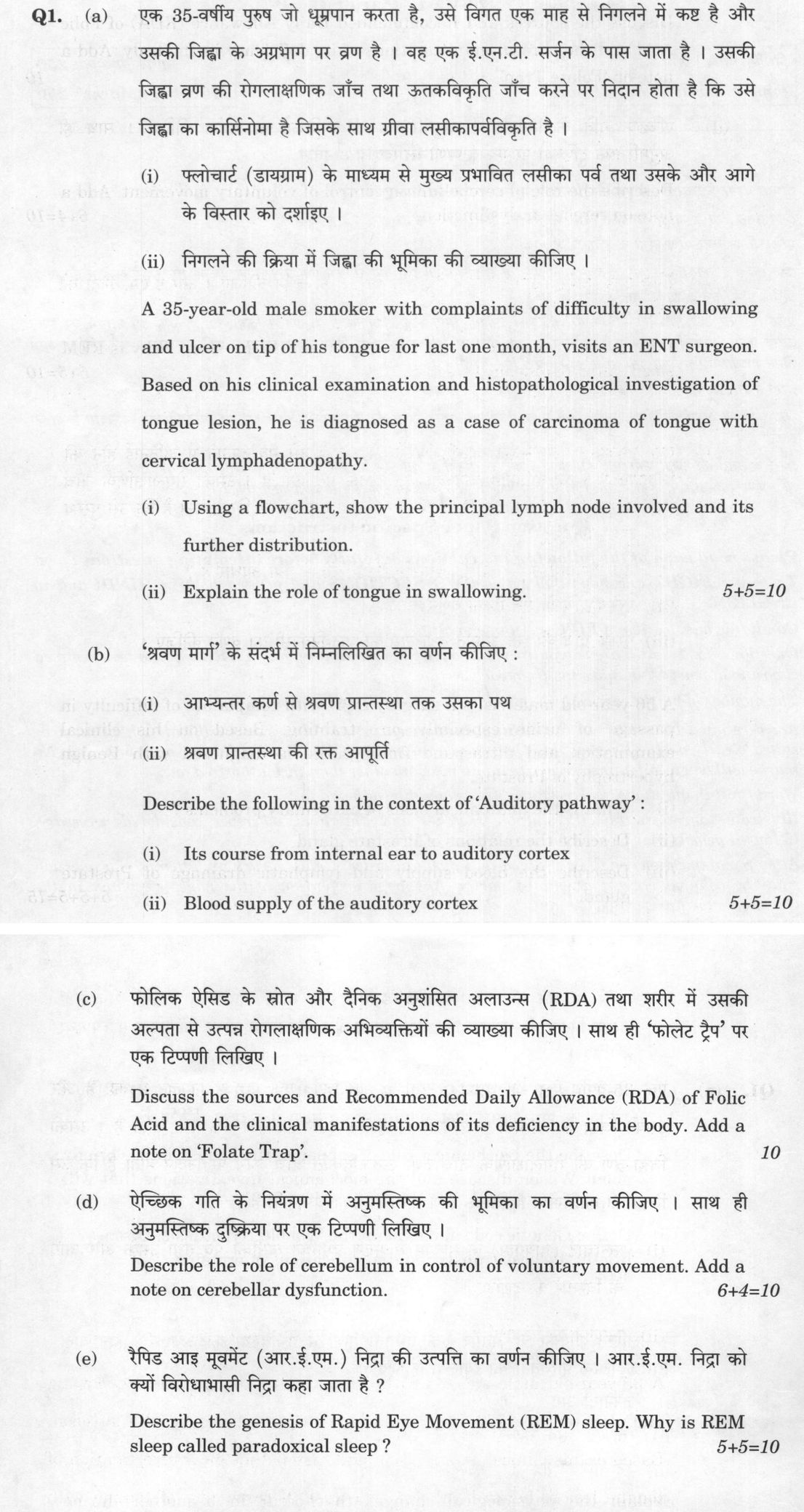
A 35-year-old male smoker with complaints of difficulty in swallowing and ulcer on tip of his tongue for last one month, visits…
A 35-year-old male smoker with complaints of difficulty in swallowing and ulcer on tip of his tongue for last one month, visits an ENT surgeon. Based on his clinical examination and histopathological investigation of tongue lesion, he is diagnosed as a case of carcinoma of tongue with cervical lymphadenopathy.
Using a flowchart, show the principal lymph node involved and its further distribution. 5 marks
Explain the role of tongue in swallowing. 5 marks
Describe the following in the context of 'Auditory pathway' : Its course from internal ear to auditory cortex 5 marks
Blood supply of the auditory cortex 5 marks
Discuss the sources and Recommended Daily Allowance (RDA) of Folic Acid and the clinical manifestations of its deficiency in the body. Add a note on 'Folate Trap'. 10 marks
Describe the role of cerebellum in control of voluntary movement. Add a note on cerebellar dysfunction. (6+4=10 marks)
Describe the genesis of Rapid Eye Movement (REM) sleep. Why is REM sleep called paradoxical sleep ? (5+5=10 marks)
हिंदी में प्रश्न पढ़ें
एक 35-वर्षीय पुरुष जो धूम्रपान करता है, उसे विगत एक माह से निगलने में कठिनाई है और उसकी जिभा के अग्रभाग पर व्रण है । वह एक ई.एन.टी. सर्जन के पास जाता है । उसकी जिभा व्रण की रोगलाक्षणिक जाँच तथा उतकविकृति जाँच करने पर निदान होता है कि उसे जिभा का कार्सिनोमा है जिसके साथ ग्रीवा लसिकापर्वविकृति है ।
फ्लोचार्ट (डायग्राम) के माध्यम से मुख्य प्रभावित लसिका पर्व तथा उसके और आगे के विस्तार को दर्शाइए । (5 अंक)
निगलने की क्रिया में जिभा की भूमिका की व्याख्या कीजिए । (5 अंक)
'श्रवण मार्ग' के संदर्भ में निम्नलिखित का वर्णन कीजिए : आभ्यंतर कर्ण से श्रवण प्रान्तस्था तक उसका पथ (5 अंक)
श्रवण प्रान्तस्था की रक्त आपूर्ति (5 अंक)
फोलिक एसिड के स्रोत और दैनिक अनुशंसित अलाउंस (RDA) तथा शरीर में उसकी अल्पता से उत्पन्न रोगलाक्षणिक अभिव्यक्तियों की व्याख्या कीजिए । साथ ही 'फोलेट ट्रैप' पर एक टिप्पणी लिखिए । (10 अंक)
ऐच्छिक गति के नियंत्रण में अनुमस्तिष्क की भूमिका का वर्णन कीजिए । साथ ही अनुमस्तिष्क दुर्दशा पर एक टिप्पणी लिखिए । (6+4=10 अंक)
रैपिड आई मूवमेंट (आर.ई.एम.) निद्रा की उत्पत्ति का वर्णन कीजिए । आर.ई.एम. निद्रा को क्यों विरोधाभासी निद्रा कहा जाता है ? (5+5=10 अंक)
Model answer
Written by UPSC Answer Check against this question's marking rubric, to the expected length. UPSC does not publish answers for Mains — this is one way to score well, not an official key.
(a) Lymphatic drainage and swallowing. In a carcinoma of the tongue tip, the principal first-echelon node is the submental group, with submandibular nodes commonly involved as the next station. The flowchart is: tip of tongue → submental nodes (Level IA) → submandibular nodes (Level IB) → deep cervical nodes: jugulodigastric (Level II) → jugulo-omohyoid (Level III) → inferior deep cervical nodes (Level IV) → supraclavicular nodes (Level VB). Lateral tongue lesions may bypass submental nodes and drain directly to submandibular and jugulodigastric nodes; posterior tongue drains mainly to jugulodigastric and deep cervical nodes. Levels I–V are used for oral cancer staging, neck dissection planning, and assessing cervical lymphadenopathy in a smoker. The submental nodes lie in the submental triangle, while the jugulodigastric node is a common clinical landmark for oral tongue metastasis.
Swallowing has four phases. In the oral preparatory phase, the tongue grinds food against the palate and teeth, forms a bolus, and tastes it. In the oral phase, the tongue elevates and propels the bolus posteriorly toward the oropharynx. In the pharyngeal phase, the tongue base retracts and elevates, the soft palate closes the nasopharynx, the larynx elevates and the epiglottis helps protect the airway, and the bolus is pushed past the upper oesophageal sphincter. In the oesophageal phase, peristalsis carries the bolus to the stomach. The tongue thus provides propulsion, sensory feedback, bolus control, and airway protection.
(b) Auditory pathway and cortical blood supply. Sound vibrates the tympanic membrane and ossicles, moves the oval window, stimulates hair cells in the organ of Corti, and activates the cochlear nerve. The pathway is: cochlear nerve → cochlear nuclei (dorsal and ventral) in the medulla → superior olivary complex → lateral lemniscus → inferior colliculus in the midbrain → medial geniculate body in the thalamus → auditory radiations → primary auditory cortex (Heschl’s gyrus) in the superior temporal gyrus. The pathway is partly bilateral, allowing sound localisation; the superior olivary complex compares inputs from both ears, while the inferior colliculus integrates auditory information before thalamic relay. Auditory radiations pass through the internal capsule to reach the cortex. The auditory cortex is supplied mainly by temporal branches of the middle cerebral artery, especially superior and anterior temporal branches, with posterior/inferior temporal regions supplied by the posterior cerebral artery. The MCA supplies the anterior and superior part of Heschl’s gyrus, while the PCA supplies the posterior and inferior part.
(c) Folic acid: sources, RDA, deficiency and folate trap. Folic acid is a B vitamin required for one-carbon transfer reactions in DNA synthesis. Dietary sources include green leafy vegetables such as spinach, amaranth, and methi; legumes and lentils such as moong and chana; liver; citrus fruits; and fortified cereals. ICMR-NIN Recommended Daily Allowance is about 300 µg/day for adult men and women, 500 µg/day in pregnancy, and 400 µg/day in lactation. Deficiency impairs DNA synthesis and causes megaloblastic anaemia with hypersegmented neutrophils, glossitis, diarrhoea, and mucosal atrophy. Because folate is needed for rapidly dividing cells, deficiency first affects the bone marrow, producing macro-ovalocytes and megaloblastic changes. In pregnancy it is associated with neural tube defects, and deficiency raises homocysteine, contributing to hyperhomocysteinemia and vascular risk. The folate trap occurs in vitamin B12 deficiency: N5-methyltetrahydrofolate cannot transfer its methyl group to homocysteine because methionine synthase requires B12. Folate becomes trapped as N5-methyl-THF, reducing the free THF pool. This impairs thymidylate synthesis from N5,N10-methylene-THF, causing megaloblastic anaemia; purine synthesis uses N10-formyl-THF and is also affected indirectly by folate depletion.
(d) Cerebellum in voluntary movement and dysfunction. The cerebellum does not initiate movement but refines it. It receives proprioceptive, vestibular, and cortical input, compares intended movement with actual output, and sends corrective signals through the thalamus to motor cortex. The neocerebellum plans and sequences voluntary movements; the spinocerebellum coordinates limb force, timing, and posture; the vestibulocerebellum maintains balance and eye movements. Through feedforward prediction and feedback error correction, it enables smooth, accurate, learned movement, adjusting muscle force and timing during reaching, walking, and speech. The cerebellar output is indirect; it reaches motor cortex through the thalamus, so lesions cause inaccuracy rather than paralysis. Cerebellar dysfunction produces ataxia, intention tremor, dysmetria, dysdiadochokinesia, decomposition of movement, hypotonia, nystagmus, and gait instability.
(e) Genesis and paradoxical nature of REM sleep. REM sleep is generated by a brainstem circuit involving the pons, reticular formation, and cholinergic nuclei such as the pedunculopontine and laterodorsal tegmental areas. These cholinergic neurons activate thalamic and cortical circuits, producing pons-geniculate-occipital waves and desynchronised EEG activity. At the same time, monoaminergic wake-promoting nuclei, the locus coeruleus and raphe nuclei, and histaminergic neurons are inhibited, while pontine reticular neurons excite spinal motor neurons that suppress voluntary muscle tone. The pons also generates the phasic bursts of rapid eye movements and the atonia that define the stage. The result is rapid eye movements, vivid dreaming, autonomic variability, and penile erection. REM sleep is called paradoxical sleep because the EEG is desynchronised and resembles wakefulness, yet the body is paralysed, with loss of skeletal muscle tone except for extraocular and respiratory muscles, and the mind is actively dreaming. Thus, the case integrates lymphatic anatomy, swallowing physiology, auditory and motor pathways, folate biochemistry, and sleep physiology.
What "Describe" is asking you to do
Give a full, ordered account of the thing named — its parts, stages or mechanism — in the sequence in which it actually exists or occurs. Most describe questions come from the science optionals, where the marks sit in correct technical detail and, where the stem says so, a labelled diagram.
Structure that answers it
One-line identification of the subject → the parts or stages in their real order, each with its defining detail → labelled diagram where the subject is structural → closing line on function or significance
Where marks are lost
Loose general prose where the examiner is ticking named parts, correct terminology and their sequence; and in the General Studies papers, turning to evaluation before the description is finished.
How this answer will be evaluated
Approach
Framework: Clinical Sequence & Anatomical Pathway. (a(i)) map: locate accurately > label > one line on why it matters | (a(ii)) explain: definition/context > points in order > small example > short close | (b(i)) trace: start point > the stages in sequence > end point > what changed | (b(ii)) describe: define > structure or process in order > labelled diagram > significance | (c) discuss: intro > 3-4 dimensions > example > balanced close | (d) describe: define > structure or process in order > labelled diagram > significance | (e) describe: define > structure or process in order > labelled diagram > significance Full marks: Accurate anatomical pathways, precise clinical signs, and clear mechanistic explanations (e.g., Folate Trap).
Key points expected
- Identify submental nodes as primary drainage
- Show flow to submandibular nodes
- Trace path to deep cervical nodes
- Mention jugular chain involvement
- Describe tongue as a muscular hydrostat
- Explain elevation against hard palate
- Detail posterior propulsion of bolus
- Mention closure of oropharynx
Evaluation rubric
Each sub-part is marked on its own, against the marks and word limit printed on the paper.
- (a(i)) Flowchart of lymphatic drainage from tongue tip to cervical nodes. 5 marks
map— locate accurately → label → one line on why it matters
Must cover
- Identify submental nodes as primary drainage
- Show flow to submandibular nodes
- Trace path to deep cervical nodes
- Mention jugular chain involvement
Loses marks
- Omitting submental nodes
- Confusing venous with lymphatic flow
Earns more
- Mention contralateral spread
- Label specific levels (I-III)
Extra mark
- Mention Virchow's node (left side)
- (a(ii)) Mechanism of tongue's role in the swallowing process. 5 marks
explain— definition/context → points in order → small example → short close
Must cover
- Describe tongue as a muscular hydrostat
- Explain elevation against hard palate
- Detail posterior propulsion of bolus
- Mention closure of oropharynx
Loses marks
- Describing only taste function
- Ignoring the propulsive mechanism
Earns more
- Mention specific muscles (genioglossus)
Extra mark
- Mention coordination with soft palate
- (b(i)) Neural pathway from cochlea to auditory cortex. 5 marks
trace— start point → the stages in sequence → end point → what changed
Must cover
- Name Cochlear (VIII) nerve
- Identify Cochlear nuclei in pons
- Trace to Superior Olivary Complex
- Mention Inferior Colliculus and MGB
Loses marks
- Skipping the thalamic relay (MGB)
- Confusing with vestibular pathway
Earns more
- Mention decussation of fibers
- Name Lateral Lemniscus
Extra mark
- Mention Heschl's gyrus specifically
- (b(ii)) Arterial supply to the auditory cortex. 5 marks
describe— define → structure or process in order → labelled diagram → significance
Must cover
- Identify Middle Cerebral Artery (MCA)
- Specify Superior Temporal Artery branch
- Mention supply to Heschl's gyrus
Loses marks
- Attributing supply to Anterior Cerebral Artery
- Vague 'cerebral arteries' without naming MCA
Earns more
- Mention anastomosis with Anterior Cerebral Artery
Extra mark
- Mention specific cortical branches
- (c) Sources, RDA, deficiency signs, and Folate Trap mechanism. 10 marks
discuss— intro → 3-4 dimensions → example → balanced close
Must cover
- List dietary sources (leafy greens, liver)
- State RDA (approx 400mcg/day)
- Describe megaloblastic anemia features
- Explain Folate Trap (methyl-THF accumulation)
Loses marks
- Confusing Folate with B12 deficiency signs
- Omitting the 'Trap' mechanism
Earns more
- Mention neural tube defects in pregnancy
- Mention glossitis
Extra mark
- Mention interaction with Vitamin B12
- (d) Cerebellar role in movement and signs of dysfunction. 10 marks
describe— define → structure or process in order → labelled diagram → significance
Must cover
- Explain coordination and timing of movement
- Mention role in muscle tone regulation
- List signs: Ataxia, Dysmetria, Nystagmus
- Mention Intention Tremor
Loses marks
- Confusing with basal ganglia signs (rigidity)
- Listing signs without mechanism
Earns more
- Distinguish cerebellar vs vestibular ataxia
- Mention dysdiadochokinesia
Extra mark
- Mention specific lobes (anterior/posterior)
- (e) Genesis of REM sleep and reason for 'paradoxical' label. 10 marks
describe— define → structure or process in order → labelled diagram → significance
Must cover
- Mention PGO waves (Pons-Geniculate-Occipital)
- Examine cholinergic activation in pons
- Define 'paradoxical' as high EEG activity
- Mention muscle atonia (flaccidity)
Loses marks
- Describing only NREM sleep
- Failing to explain the 'paradox' (awake brain, asleep body)
Earns more
- Mention role in memory consolidation
- Mention dream association
Extra mark
- Mention specific neurotransmitters (ACh vs Serotonin)
Practice this exact question
Write your answer and it is marked point by point against the model answer above — what you covered, what you missed, what you got wrong.
Evaluate my answer →More from Medical Science 2023 Paper I
- Q1 A 35-year-old male smoker with complaints of difficulty in swallowing and ulcer on tip of…
- Q2 A 56-year-old male visits a surgery OPD with complaints of difficulty in passage of urine…
- Q3 (a) (i) Describe the following regarding the knee joint : (I) All movements including loc…
- Q4 (a) (i) Describe the role of SRY (Sex-determining region on Y gene) transcription factors…