Paper I — Q3
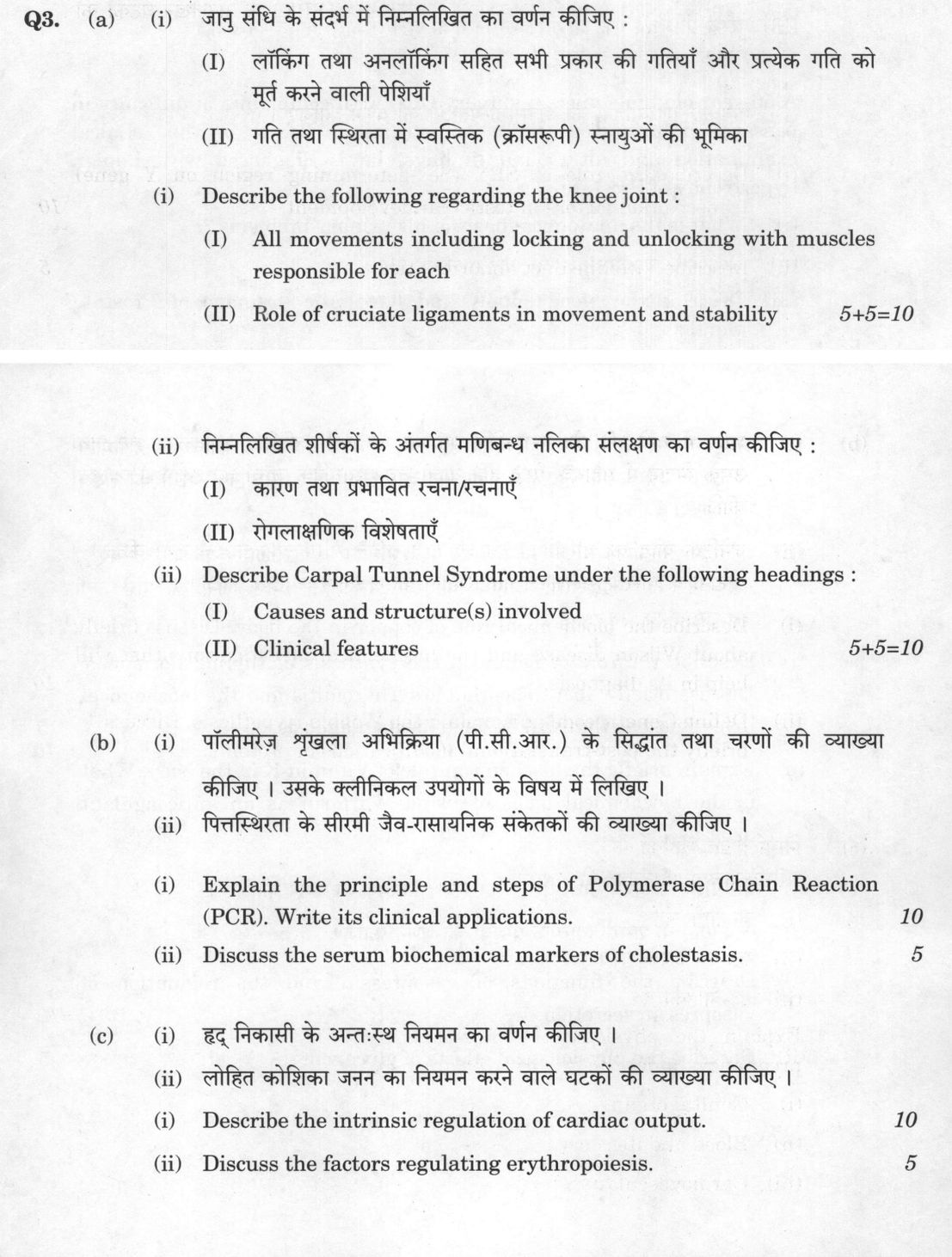
(a) (i) Describe the following regarding the knee joint : (I) All movements including locking and unlocking with muscles…
Describe the following regarding the knee joint : (I) All movements including locking and unlocking with muscles responsible for each (II) Role of cruciate ligaments in movement and stability 5+5=10
Describe Carpal Tunnel Syndrome under the following headings : (I) Causes and structure(s) involved (II) Clinical features 5+5=10
Explain the principle and steps of Polymerase Chain Reaction (PCR). Write its clinical applications. 10 marks
Discuss the serum biochemical markers of cholestasis. 5 marks
Describe the intrinsic regulation of cardiac output. 10 marks
Discuss the factors regulating erythropoiesis. 5 marks
हिंदी में प्रश्न पढ़ें
जानु संधि के संदर्भ में निम्नलिखित का वर्णन कीजिए : (I) लॉकिंग तथा अनलॉकिंग सहित सभी प्रकार की गतियाँ और प्रत्येक गति को मूर्त करने वाली पेशियाँ (II) गति तथा स्थिरता में स्वस्तिक (क्रॉसरूपी) स्नायुओं की भूमिका
निम्नलिखित शीर्षकों के अंतर्गत मणिबन्ध नलिका संलक्षण का वर्णन कीजिए : (I) कारण तथा प्रभावित रचना/रचनाएँ (II) रोगलाक्षणिक विशेषताएँ
पॉलिमरेज श्रृंखला अभिक्रिया (पी.सी.आर.) के सिद्धांत तथा चरणों की व्याख्या कीजिए । उसके क्लीनिकल उपयोगों के विषय में लिखिए ।
पित्तस्थिरता के सीरम जैव-रासायनिक संकेतकों की व्याख्या कीजिए ।
हृद् निकासी के अन्तःस्थ नियमन का वर्णन कीजिए ।
लोहित कोशिका जनन का नियमन करने वाले घटकों की व्याख्या कीजिए ।
Model answer
Written by UPSC Answer Check against this question's marking rubric, to the expected length. UPSC does not publish answers for Mains — this is one way to score well, not an official key.
Knee joint. The knee is a modified hinge with a small pivot component. Its movements are flexion, produced by hamstrings, gastrocnemius, sartorius and gracilis; extension, produced by quadriceps femoris, while tensor fasciae latae stabilizes the extended knee through the iliotibial tract but is not a primary extensor; in flexion, medial tibial rotation, by popliteus, semimembranosus and gracilis; lateral tibial rotation, by biceps femoris and sartorius; locking (screw-home mechanism), in terminal extension when the tibia externally rotates on the femur (or the femur internally rotates on a fixed tibia) as the ACL tightens and quadriceps, especially vastus medialis oblique, complete extension; and unlocking, initiated by popliteus, which internally rotates the tibia (or externally rotates the femur) to permit flexion. The cruciate ligaments maintain anteroposterior and rotational stability: the ACL prevents anterior tibial translation, resists hyperextension and controls the pivot, while the PCL prevents posterior tibial translation, limits posterior drawer and stabilizes the knee in flexion.
Carpal tunnel syndrome. Carpal tunnel syndrome is compression of the median nerve within the carpal tunnel, a fibro-osseous canal formed by carpal bones and covered by the flexor retinaculum (transverse carpal ligament), overlying flexor digitorum superficialis and profundus tendons and the flexor pollicis longus. Causes include repetitive strain, trauma or carpal fracture, rheumatoid arthritis, hypothyroidism, pregnancy. Clinical features are nocturnal paresthesia and numbness in the thumb, index, middle and radial half of the ring finger, thenar atrophy with weak opposition, and positive Tinel, Phalen and Durkan signs.
PCR. PCR amplifies a defined DNA segment using sequence-specific primers, dNTPs, buffer and thermostable Taq polymerase, with magnesium ions (Mg2+) supplied as MgCl2 as the essential cofactor. The cycle has three steps: denaturation at 94–98°C separates strands; annealing at 50–65°C allows primers to bind; and extension at about 72°C enables Taq polymerase to synthesize complementary strands. After 25–35 cycles, the target is amplified exponentially. Clinical applications include CBNAAT for tuberculosis in India, RT-PCR for SARS-CoV-2, detection of HIV, hepatitis, dengue and malaria, and genetic testing.
Cholestasis markers. Serum biochemical markers of cholestasis include elevated alkaline phosphatase, GGT and 5'-nucleotidase. ALP is nonspecific, so GGT and 5'-nucleotidase help confirm a hepatobiliary source; 5'-nucleotidase is not exclusive to biliary epithelium but is relatively more specific for hepatobiliary disease than ALP. Conjugated hyperbilirubinaemia and raised serum bile acids are characteristic, while AST and ALT are usually less prominent than in hepatocellular injury.
Cardiac output. Intrinsic regulation of cardiac output (CO = HR × SV) is dominated by the Frank-Starling mechanism: increased venous return raises end-diastolic volume, lengthens cardiac sarcomeres and increases stroke volume. The Anrep effect provides a slow, sustained increase in contractility after an acute rise in afterload, independent of end-diastolic volume. The Bowditch effect and treppe allow heart rate to modify intracellular calcium handling and contractility. Autonomic and hormonal influences, especially sympathetic β1 stimulation and catecholamines, modulate these intrinsic properties, but the heart’s intrinsic length-tension, afterload and rate responses match output to venous return.
Erythropoiesis. Erythropoiesis is regulated mainly by oxygen delivery. Tissue hypoxia stabilizes hypoxia-inducible factor in renal peritubular fibroblasts, inducing erythropoietin, which acts on BFU-E and CFU-E progenitors to drive maturation through proerythroblast, erythroblast and reticulocyte stages. Adequate iron, vitamin B12 and folate are required for haemoglobin synthesis and DNA replication. The feedback loop is completed by the resulting increase in red cell mass and oxygen-carrying capacity, which suppresses further EPO release.
Conclusion. Thus, the knee, carpal tunnel, PCR, cholestasis, cardiac and erythropoietic systems are each defined by precise structural, biochemical and regulatory relationships, showing how movement, nerve compression, nucleic-acid amplification, liver excretion, circulation and red-cell production are integrated at the molecular and organ level.
What "Describe" is asking you to do
Give a full, ordered account of the thing named — its parts, stages or mechanism — in the sequence in which it actually exists or occurs. Most describe questions come from the science optionals, where the marks sit in correct technical detail and, where the stem says so, a labelled diagram.
Structure that answers it
One-line identification of the subject → the parts or stages in their real order, each with its defining detail → labelled diagram where the subject is structural → closing line on function or significance
Where marks are lost
Loose general prose where the examiner is ticking named parts, correct terminology and their sequence; and in the General Studies papers, turning to evaluation before the description is finished.
How this answer will be evaluated
Approach
Framework: Clinical Sequence & Pathophysiology. (a) describe: define > structure or process in order > labelled diagram > significance | (b) explain: definition/context > points in order > small example > short close | (c) describe: define > structure or process in order > labelled diagram > significance Full marks: Precise mechanisms, correct terminology, clear diagrams, and clinical relevance.
Key points expected
- Knee locking/unlocking mechanism
- Carpal tunnel structures and clinical signs
- PCR steps: Denaturation, Annealing, Extension
- Cholestasis markers: ALP, GGT, Bilirubin
- Frank-Starling law of the heart
- Erythropoietin regulation of RBC production
Evaluation rubric
Each sub-part is marked on its own, against the marks and word limit printed on the paper.
- (a) Knee joint mechanics (locking/unlocking) and Carpal Tunnel Syndrome (causes/structures/clinical features).
describe— define > structure or process in order > labelled diagram > significance
Must cover
- Knee: Flexion/Extension, Rotation, Locking/Unlocking
- Knee: Specific muscles for each movement
- Knee: ACL/PCL roles in stability
- CTS: Carpal tunnel structures, causes, clinical signs
Loses marks
- Listing muscles without linking to movement
- Omitting locking/unlocking mechanism
Earns more
- Screw-home mechanism explanation
- Phalen's/Tinel's test for CTS
- Labelled diagram of knee or carpal tunnel
Extra mark
- Mention of specific nerve entrapment site
- (b) PCR principle/steps/applications and serum biochemical markers of cholestasis.
explain— definition/context > points in order > small example > short close
Must cover
- PCR: Denaturation, Annealing, Extension steps
- PCR: Taq polymerase and primers
- PCR: Clinical applications (diagnosis)
- Cholestasis: ALP, GGT, Bilirubin, Phospholipids
Loses marks
- Vague description of PCR steps
- Listing markers without clinical context
Earns more
- Flow diagram of PCR cycle
- Distinction between obstructive/non-obstructive markers
Extra mark
- Mention of specific PCR types (RT-PCR)
- (c) Intrinsic regulation of cardiac output and factors regulating erythropoiesis.
describe— define > structure or process in order > labelled diagram > significance
Must cover
- Cardiac: Frank-Starling mechanism
- Cardiac: Intrinsic contractility factors
- Erythropoiesis: Erythropoietin (EPO) role
- Erythropoiesis: Oxygen tension and iron
Loses marks
- Confusing intrinsic with extrinsic regulation
- Omitting EPO in erythropoiesis
Earns more
- Diagram of Frank-Starling curve
- Feedback loop for EPO production
Extra mark
- Mention of specific regulatory hormones
Practice this exact question
Write your answer and it is marked point by point against the model answer above — what you covered, what you missed, what you got wrong.
Evaluate my answer →More from Medical Science 2023 Paper I
- Q1 A 35-year-old male smoker with complaints of difficulty in swallowing and ulcer on tip of…
- Q2 A 56-year-old male visits a surgery OPD with complaints of difficulty in passage of urine…
- Q3 (a) (i) Describe the following regarding the knee joint : (I) All movements including loc…
- Q4 (a) (i) Describe the role of SRY (Sex-determining region on Y gene) transcription factors…
- Q5 (a) Enumerate various classes of antihypertensive drugs. Briefly discuss the role of calc…
- Q6 (a) (i) Enumerate any five risk factors for oral cancer. Describe its morphology. 5+5=10…