Paper I — Q5
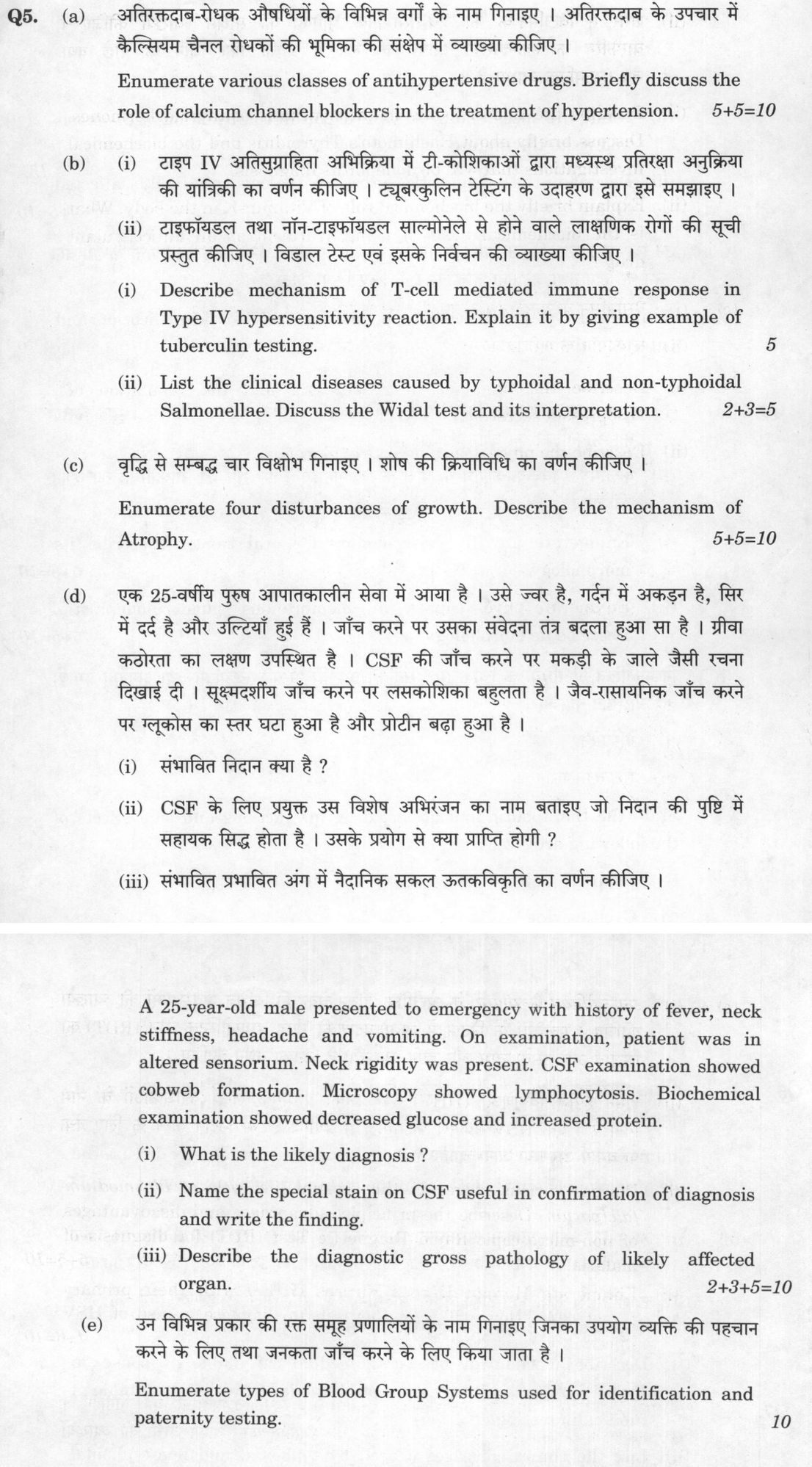
(a) Enumerate various classes of antihypertensive drugs. Briefly discuss the role of calcium channel blockers in the treatment of…
Enumerate various classes of antihypertensive drugs. Briefly discuss the role of calcium channel blockers in the treatment of hypertension. 5+5=10
Describe mechanism of T-cell mediated immune response in Type IV hypersensitivity reaction. Explain it by giving example of tuberculin testing. 5 marks
List the clinical diseases caused by typhoidal and non-typhoidal Salmonellae. Discuss the Widal test and its interpretation. 2+3=5
Enumerate four disturbances of growth. Describe the mechanism of Atrophy. 5+5=10
A 25-year-old male presented to emergency with history of fever, neck stiffness, headache and vomiting. On examination, patient was in altered sensorium. Neck rigidity was present. CSF examination showed cobweb formation. Microscopy showed lymphocytosis. Biochemical examination showed decreased glucose and increased protein. What is the likely diagnosis?
Name the special stain on CSF useful in confirmation of diagnosis and write the finding.
Describe the diagnostic gross pathology of likely affected organ. 2+3+5=10
Enumerate types of Blood Group Systems used for identification and paternity testing. 10 marks
हिंदी में प्रश्न पढ़ें
अतिरक्तदाब-रोधक औषधियों के विभिन्न वर्गों के नाम गिनाइए । अतिरक्तदाब के उपचार में कैल्सियम चैनल रोधकों की भूमिका की संक्षेप में व्याख्या कीजिए । 5+5=10
टाइप IV अतिसंवेदनशीलता अभिक्रिया में टी-कोशिकाओं द्वारा मध्यस्थ प्रतिरक्षा अनुक्रिया की यांत्रिकी का वर्णन कीजिए । ट्यूबरकुलिन टेस्टिंग के उदाहरण द्वारा इसे समझाइए । 5
टाइफॉयडल तथा नॉन-टाइफॉयडल साल्मोनेल्ले से होने वाले लाक्षणिक रोगों की सूची प्रस्तुत कीजिए । विडाल टेस्ट एवं इसके निर्वचन की व्याख्या कीजिए । 2+3=5
वृद्धि से संबद्ध चार विसंबंध गिनाइए । शोष की क्रियाविधि का वर्णन कीजिए । 5+5=10
एक 25-वर्षीय पुरुष आपातकालीन सेवा में आया है । उसे ज्वर है, गर्दन में अकड़न है, सिर में दर्द है और उल्टियाँ हुई हैं । जाँच करने पर उसका संवेदना तंत्र बदला हुआ सा है । ग्रीवा कठोरता का लक्षण उपस्थित है । CSF की जाँच करने पर मकड़ी के जाले जैसी रचना दिखाई दी । सूक्ष्मदर्शीय जाँच करने पर लसिकाकोशिका बहुलता है । जैव-रासायनिक जाँच करने पर ग्लूकोस का स्तर घटा हुआ है और प्रोटीन बढ़ा हुआ है । संभावित निदान क्या है ?
CSF के लिए प्रयुक्त उस विशेष अभिरंजन का नाम बताइए जो निदान की पुष्टि में सहायक सिद्ध होता है । उसके प्रयोग से क्या प्राप्ति होगी ?
संभावित प्रभावित अंग में नैदानिक सकल उत्कबिकृति का वर्णन कीजिए । 2+3+5=10
उन विभिन्न प्रकार की रक्त समूह प्रणालियों के नाम गिनाइए जिनका उपयोग व्यक्ति की पहचान करने के लिए तथा जनकता जाँच करने के लिए किया जाता है । 10
Model answer
Written by UPSC Answer Check against this question's marking rubric, to the expected length. UPSC does not publish answers for Mains — this is one way to score well, not an official key.
(a) Antihypertensive classes and CCBs. The antihypertensive drugs can be enumerated as diuretics (thiazides, loop and potassium-sparing), angiotensin-converting enzyme inhibitors, angiotensin receptor blockers, calcium channel blockers, beta-adrenergic blockers, alpha-adrenergic blockers, centrally acting alpha-2 agonists, direct arterial vasodilators, direct renin inhibitors, and mineralocorticoid receptor antagonists. Their roles differ: diuretics reduce sodium and water retention, ACE inhibitors and ARBs reduce angiotensin II effects, beta, alpha and central agents reduce sympathetic drive, vasodilators relax arterioles, and mineralocorticoid antagonists reduce aldosterone-mediated sodium retention. In clinical practice, thiazide diuretics, ACE inhibitors, ARBs and CCBs are commonly first-line; beta blockers are preferred when angina, post-infarction state, or tachyarrhythmia coexists; alpha blockers are usually reserved for resistant hypertension or benign prostatic hyperplasia; direct vasodilators are used in resistant cases. Calcium channel blockers block L-type voltage-gated calcium channels in vascular smooth muscle, reducing calcium influx, causing relaxation, decreased systemic vascular resistance and lower blood pressure. Dihydropyridines such as amlodipine and nifedipine mainly cause peripheral vasodilation and are useful first-line agents, especially in older patients, isolated systolic hypertension and high stroke risk. Non-dihydropyridines verapamil and diltiazem also slow conduction and reduce heart rate, so they are used when angina or rate control coexists, but are less preferred as sole antihypertensives.
(b)(i) Type IV hypersensitivity and tuberculin test. Type IV hypersensitivity is a delayed, cell-mediated reaction, not antibody-mediated. Antigen is taken up by antigen-presenting cells and presented to naive CD4+ T cells; with IL-12, they differentiate into Th1 cells. Th1 cells secrete IFN-γ and IL-2; IFN-γ activates macrophages, enhances phagolysosome fusion, reactive oxygen species, MHC expression, and recruits monocytes, leading to granulomatous inflammation with epithelioid macrophages and lymphocytes. The delayed nature reflects time required for T-cell proliferation and macrophage recruitment. The reaction peaks at 48-72 hours. In tuberculin testing, 5 TU PPD is injected intradermally by the Mantoux technique; induration, not erythema, is measured. Interpretation is risk-based: ≥5 mm is positive in HIV-positive or immunocompromised persons, recent TB contacts, and those with fibrotic chest radiographs; ≥10 mm in high-risk groups such as healthcare workers, injection drug users, children under four, and residents or caregivers of high-burden settings; ≥15 mm in persons with no known risk factors. A positive test indicates prior sensitization to mycobacterial antigens, not necessarily active disease. A negative test may occur in early infection, anergy, or immunosuppression.
(b)(ii) Salmonella diseases and Widal test. Typhoidal Salmonellae, mainly S. Typhi and S. Paratyphi A, B and C, cause enteric fever, typhoid fever, paratyphoid fever, bacteremia, septicemia, and chronic gallbladder carriage. Non-typhoidal Salmonellae cause acute gastroenteritis, bacteremia, septicemia, osteomyelitis, septic arthritis, meningitis in young children, and endovascular infections. The Widal test is a slide or tube agglutination test detecting agglutinins against O (somatic) and H (flagellar) antigens. O agglutinins appear early and are mainly IgM, suggesting recent infection; H agglutinins appear later and may be IgG, persisting after past infection or vaccination. O agglutinins are generally more specific than H agglutinins; false positives may occur in malaria, dengue, typhus, sepsis, or other febrile illnesses. A single titer is not diagnostic, especially in endemic India; a fourfold rise in paired sera is significant. Commonly, O ≥1:80 or 1:160 and H ≥1:160 are considered supportive, but interpretation must be risk-based and correlated clinically. Anamnestic responses after prior infection or vaccination can cause false-positive or misleading rises.
(c) Growth disturbances and atrophy. Four disturbances of growth are hypertrophy, hyperplasia, atrophy and metaplasia. Hypertrophy is increase in cell size; hyperplasia is increase in cell number; atrophy is decrease in cell size and sometimes number; metaplasia is reversible replacement of one differentiated cell type by another. Atrophy may be physiological, such as uterine involution after pregnancy or thymic involution, or pathological, as in disuse atrophy of a limb in a cast. Atrophy occurs when a cell is smaller than normal due to decreased protein synthesis and increased protein degradation. Reduced trophic factors, denervation, ischemia, disuse, endocrine deficiency, aging, or malnutrition lower mTOR signalling and biosynthesis. Proteins are tagged by ubiquitin and degraded by the proteasome; autophagy removes damaged organelles; apoptosis may remove cells in some tissues. The cell shows shrunken cytoplasm, loss of organelles, autophagic vacuoles and lipofuscin accumulation.
(d) Tuberculous meningitis. The likely diagnosis is tuberculous meningitis. The special stain on CSF useful for confirmation is Ziehl-Neelsen acid-fast stain; the finding is acid-fast bacilli, seen as red or pink rods against a blue background. The CSF findings of lymphocytic pleocytosis, low glucose and high protein with cobweb formation support the diagnosis. Gross pathology of the affected meninges and base of brain shows a thick, opaque, gelatinous or fibrinopurulent exudate concentrated in the basal cisterns, around the optic chiasm, pituitary stalk, cranial nerves and Sylvian fissures. Small tubercles or granulomas may be seen on the meninges, with caseous necrosis. The exudate obstructs CSF flow and arachnoid granulation absorption, producing communicating hydrocephalus; vasculitis may cause infarcts, but the diagnostic gross feature is basal meningeal exudate with tubercles and hydrocephalus. Cranial nerve compression may produce optic atrophy, facial palsy, or abducens palsy.
(e) Blood group systems for identification and paternity. Blood group systems used for identification and paternity testing include ABO, Rh (D), MNSs, Kell, Duffy, Kidd, Lewis, P1PK, Hh and Xg. ABO and Rh are most important for routine identification because they are highly polymorphic and clinically significant. The other systems are useful in forensic identification, transfusion medicine and exclusion when ABO/Rh are non-informative. In paternity testing, ABO and Rh can provide exclusion when the child's genotype cannot be inherited from the alleged father; for example, a child with blood group B and a mother with group O must have received a B allele from the biological father, so an alleged father with group O is excluded, whereas an alleged father with AB, being heterozygous, can transmit B and is not excluded on this basis. When no exclusion is found, probability of paternity is calculated; HLA typing and especially DNA fingerprinting or STR analysis are now used because they give much higher discriminatory power and can establish a high probability of paternity. HLA typing is a genetic marker rather than a blood group system, and DNA fingerprinting remains the reference method for high-confidence paternity.
What "Enumerate" is asking you to do
Produce the complete set of items asked for, countable and correctly named. The examiner marks against a checklist, so a missing item costs and an elaborated one gains nothing — where discussion is wanted the stem asks for it as a separate sub-part.
Structure that answers it
One line naming the basis on which the set is drawn → items numbered, each in a phrase or a single line → the discussion sub-part taken up separately, after the list is complete
Where marks are lost
Treating it as an essay. Six items named in six lines score better than three items explained at length.
How this answer will be evaluated
Approach
Framework: Clinical Pathology & Pharmacology Framework. (a) discuss: intro > 3-4 dimensions > example > balanced close | (b) explain: definition/context > points in order > small example > short close | (c) discuss: intro > 3-4 dimensions > example > balanced close | (d) explain: definition/context > points in order > small example > short close | (e) discuss: intro > 3-4 dimensions > example > balanced close Full marks: Precise mechanisms, correct stains, clear gross pathology, comprehensive blood group list.
Key points expected
- CCB mechanism: L-type channel blockade
- Type IV: T-cell mediated, delayed
- Atrophy: increased apoptosis, decreased synthesis
- Tuberculous meningitis: ZN stain, basal exudate
- Blood groups: ABO, Rh, MNS, Kell, HLA
Evaluation rubric
Each sub-part is marked on its own, against the marks and word limit printed on the paper.
- (a) List antihypertensive classes and explain CCB mechanism/role. 10 marks
discuss— intro → 3-4 dimensions → example → balanced close
Must cover
- List 5+ antihypertensive classes
- CCB mechanism: L-type channel blockade
- CCB effect: vasodilation, reduced afterload
- CCB role: first-line, elderly, isolated systolic
Loses marks
- Listing drugs without class names
- CCB discussion without mechanism
Earns more
- Dihydropyridine vs non-dihydropyridine distinction
- Mention of side effects (edema, bradycardia)
Extra mark
- Reference to JNC 8 or ISH guidelines
- (b) Explain Type IV hypersensitivity mechanism and Salmonella/Widal details. 5 marks
explain— definition/context → points in order → small example → short close
Must cover
- Type IV: T-cell mediated, delayed
- Tuberculin test: 48-72h induration
- Typhoidal vs non-typhoidal Salmonella diseases
- Widal test: O and H agglutination
Loses marks
- Confusing Type I and Type IV
- Widal test without interpretation criteria
Earns more
- Mention of Th1/Th17 cells
- Widal interpretation: 1:80 or 1:160 titre
Extra mark
- Mention of PCR for Salmonella confirmation
- (c) List 4 growth disturbances and describe atrophy mechanism. 10 marks
discuss— intro → 3-4 dimensions → example → balanced close
Must cover
- List 4: Atrophy, Hypertrophy, Hyperplasia, Dysplasia
- Atrophy: decrease in cell size
- Mechanism: increased apoptosis, decreased synthesis
- Mechanism: autophagy, ubiquitin-proteasome pathway
Loses marks
- Listing without mechanism for atrophy
- Confusing atrophy with necrosis
Earns more
- Examples: disuse, denervation, ischemia
- Distinction between physiological and pathological
Extra mark
- Mention of lipofuscin accumulation
- (d) Diagnose meningitis, identify stain, describe gross pathology. 10 marks
explain— definition/context → points in order → small example → short close
Must cover
- Diagnosis: Tuberculous meningitis
- Stain: Ziehl-Neelsen (AFB)
- Finding: Acid-fast bacilli
- Gross pathology: Basal exudate, hydrocephalus
Loses marks
- Diagnosing bacterial meningitis instead
- Gross pathology without 'basal exudate'
Earns more
- Mention of 'cobweb' formation significance
- Gross: thick gelatinous exudate at base
Extra mark
- Mention of cranial nerve involvement
- (e) List blood group systems for ID and paternity. 10 marks
discuss— intro → 3-4 dimensions → example → balanced close
Must cover
- ABO system: primary for ID
- Rh system: secondary for ID
- Paternity: ABO, Rh, MNS, Kell
- Mention of HLA for high accuracy
Loses marks
- Listing only ABO and Rh
- Ignoring paternity testing context
Earns more
- Mention of DNA profiling as gold standard
- Specific antigens for paternity (e.g., D, C, E)
Extra mark
- Reference to ISBT nomenclature
Practice this exact question
Write your answer and it is marked point by point against the model answer above — what you covered, what you missed, what you got wrong.
Evaluate my answer →More from Medical Science 2023 Paper I
- Q2 A 56-year-old male visits a surgery OPD with complaints of difficulty in passage of urine…
- Q3 (a) (i) Describe the following regarding the knee joint : (I) All movements including loc…
- Q4 (a) (i) Describe the role of SRY (Sex-determining region on Y gene) transcription factors…
- Q5 (a) Enumerate various classes of antihypertensive drugs. Briefly discuss the role of calc…
- Q6 (a) (i) Enumerate any five risk factors for oral cancer. Describe its morphology. 5+5=10…
- Q7 (a) Classify the various types of poisons. Enumerate the features of Plumbism. Discuss th…
- Q8 (a) (i) Describe the morphological characteristics of *Cryptococcus neoformans* on micros…