Paper I — Q7
(a) Classify the various types of poisons. Enumerate the features of Plumbism. Discuss the tests which will show/establish the…
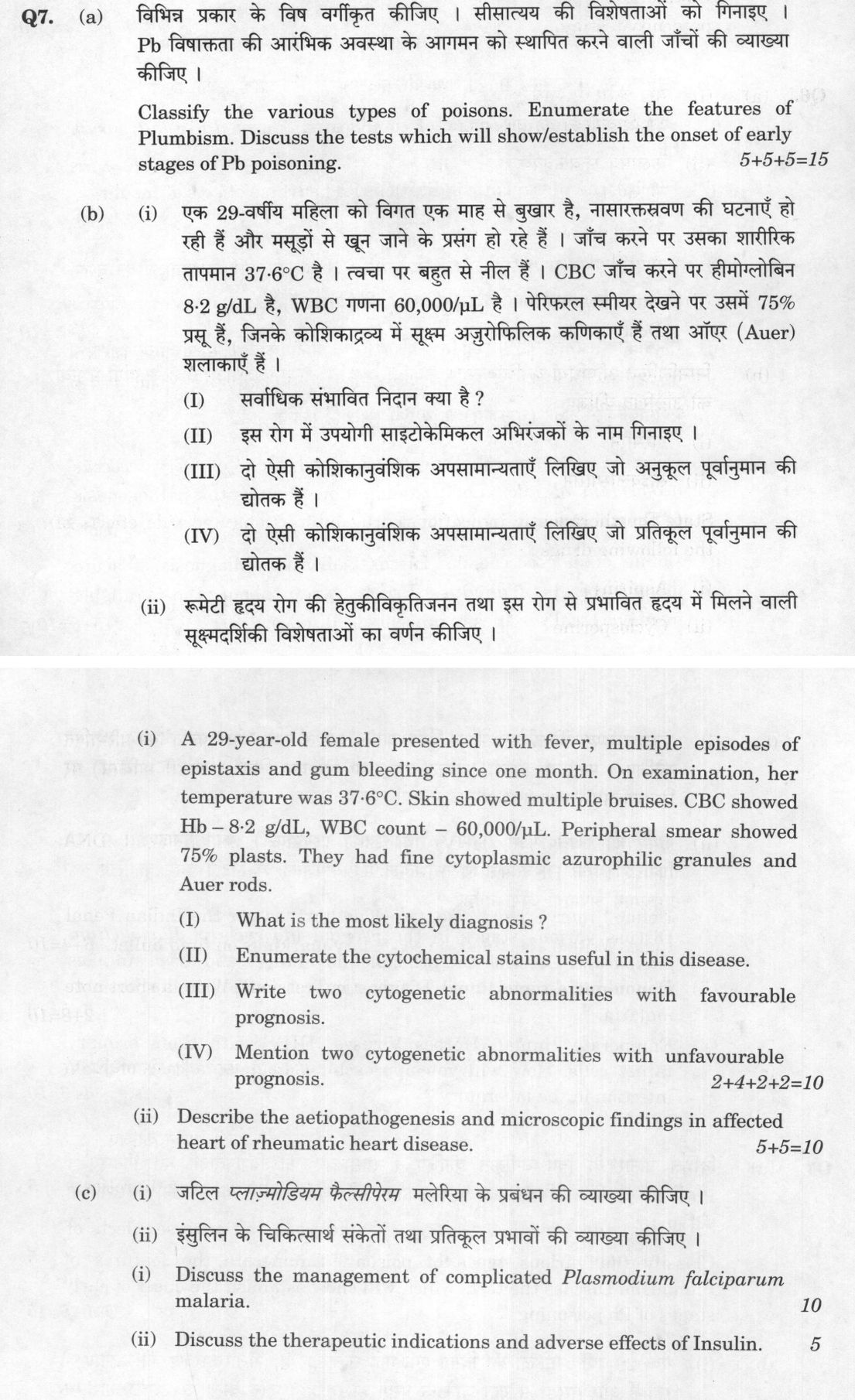
Classify the various types of poisons. Enumerate the features of Plumbism. Discuss the tests which will show/establish the onset of early stages of Pb poisoning. 5+5+5=15
A 29-year-old female presented with fever, multiple episodes of epistaxis and gum bleeding since one month. On examination, her temperature was 37·6°C. Skin showed multiple bruises. CBC showed Hb – 8·2 g/dL, WBC count – 60,000/µL. Peripheral smear showed 75% plasts. They had fine cytoplasmic azurophilic granules and Auer rods.
(I) What is the most likely diagnosis ?
(II) Enumerate the cytochemical stains useful in this disease.
(III) Write two cytogenetic abnormalities with favourable prognosis.
(IV) Mention two cytogenetic abnormalities with unfavourable prognosis. 2+4+2+2=10
Describe the aetiopathogenesis and microscopic findings in affected heart of rheumatic heart disease. 5+5=10
Discuss the management of complicated *Plasmodium falciparum* malaria. 10 marks
Discuss the therapeutic indications and adverse effects of Insulin. 5 marks
हिंदी में प्रश्न पढ़ें
विभिन्न प्रकार के विष वर्गीकृत कीजिए । सीसात्वय की विशेषताओं को गिनाइए । Pb विषाक्तता की आरंभिक अवस्था के आगमन को स्थापित करने वाली जाँचों की व्याख्या कीजिए । 5+5+5=15
एक 29-वर्षीय महिला को विगत एक माह से बुखार है, नासारक्तस्रावण की घटनाएँ हो रही हैं और मसूड़ों से खून जाने के प्रसंग हो रहे हैं । जाँच करने पर उसका शारीरिक तापमान 37·6°C है । त्वचा पर बहुत से नील हैं । CBC जाँच करने पर हीमोग्लोबिन 8·2 g/dL है, WBC गणना 60,000/μL है । पेरिफरल स्मीयर देखने पर उसमें 75% प्रसू हैं, जिनके कोशिकाद्रव्य में सूक्ष्म अणुरोफिलिक कणिकाएँ हैं तथा ऑर (Auer) शलाकाएँ हैं ।
(I) सर्वाधिक संभावित निदान क्या है ?
(II) इस रोग में उपयोगी साइटोकैमिकल अभिरंजकों के नाम गिनाइए ।
(III) दो ऐसी कोशिकानुवंशिक अपसामान्यताएँ लिखिए जो अनुकूल पूर्वानुमान की घोतक हैं ।
(IV) दो ऐसी कोशिकानुवंशिक अपसामान्यताएँ लिखिए जो प्रतिकूल पूर्वानुमान की घोतक हैं । 2+4+2+2=10
रूमेटी हृदय रोग की हेतुकीविकृतिजन तथा इस रोग से प्रभावित हृदय में मिलने वाली सूक्ष्मदर्शिकी विशेषताओं का वर्णन कीजिए । 5+5=10
जटिल प्लाज़्मोडियम फैल्सीपेरम मलेरिया के प्रबंधन की व्याख्या कीजिए । 10
इंसुलिन के चिकित्सार्थ संकेतों तथा प्रतिकूल प्रभावों की व्याख्या कीजिए । 5
Model answer
Written by UPSC Answer Check against this question's marking rubric, to the expected length. UPSC does not publish answers for Mains — this is one way to score well, not an official key.
Toxicology Poisons are classified by chemical nature and source: corrosives (sulphuric acid, alkali, kerosene), metallic (lead, arsenic, mercury), gaseous (carbon monoxide, hydrogen sulphide), organic (organophosphates, carbon tetrachloride), vegetable (aconite, datura), animal (snake venom, scorpion venom) and mechanical (foreign bodies). They may also be grouped by route—ingestion, inhalation, injection or skin absorption—and by target organ, as neurotoxins, haematotoxins, hepatotoxins and nephrotoxins. Plumbism is chronic lead poisoning. Features include abdominal colic, constipation, Burtonian blue-black gingival line, wrist drop or peripheral neuropathy, hypertension, renal tubular dysfunction, microcytic or normocytic anaemia with basophilic stippling, and encephalopathy in severe cases. Lead colic may mimic acute abdomen; renal Fanconi syndrome and optic neuritis may occur. Early biochemical tests are more sensitive than symptoms: raised urinary delta-aminolevulinic acid and coproporphyrin, raised blood zinc protoporphyrin in µg/dL, raised urinary lead, and raised blood lead level in µg/dL; these reflect inhibition of ALA dehydratase and ferrochelatase and establish early stages before overt neuropathy or colic.
Haematology The bleeding, fever, anaemia, very high WBC count and 75% blasts with fine azurophilic granules and Auer rods point to acute promyelocytic leukaemia, AML-M3. APL often presents with DIC and bleeding, and Auer rods may form faggot cells; bone marrow confirms the diagnosis. Cytochemical stains useful are myeloperoxidase and Sudan black B, both positive in myeloid blasts; non-specific esterase is negative, helping exclude monocytic leukaemia, and PAS may show block positivity. Favourable cytogenetic findings in APL are t(15;17)(q24;q21) producing PML-RARA and an isolated/simple karyotype without additional rearrangements; the translocation is diagnostic and predicts response to ATRA. Unfavourable findings are complex karyotype and the alternative t(11;17)(q23;q21) PLZF-RARA translocation, which is associated with poorer response to ATRA.
Rheumatic heart disease Rheumatic heart disease follows untreated group A streptococcal pharyngitis. Molecular mimicry between streptococcal M protein and cardiac antigens triggers type II hypersensitivity and autoimmune injury, with immune-complex and T-cell mediated damage, producing pancarditis. Microscopically, the early lesion is the Aschoff body: a perivascular granuloma with fibrinoid necrosis, macrophages, lymphocytes and Anitschkow cells; Aschoff bodies are pathognomonic, and pericardial inflammation may cause effusion. In the mitral valve, early verrucous vegetations form along the line of closure; later the valve thickens, fibroses and calcifies, chordae shorten and fuse, producing commissural fusion, retraction, doming and stenosis, often with regurgitation.
Malaria and insulin Complicated P. falciparum malaria is a medical emergency, with cerebral malaria, severe anaemia, respiratory distress, shock, renal failure, jaundice, hypoglycaemia or acidosis. First-line treatment is intravenous artesunate, 2.4 mg/kg at 0, 12 and 24 hours, then 2.4 mg/kg daily, followed by a full oral course. If artesunate is unavailable, quinine is given as a 20 mg/kg loading dose, then 10 mg/kg every 8 hours, with caution for hypoglycaemia and QT prolongation. Supportive care includes ICU monitoring of airway, glucose, renal function, haemolysis and electrolytes; severe anaemia may need transfusion, and ARDS is managed with lung-protective ventilation. Parenteral benzodiazepines are used for malarial seizures as abortive therapy, not prophylaxis. Exchange transfusion is not routinely recommended; it may be considered case-by-case in selected severe cases, for example very high parasitaemia, often >10% or >5% with severe organ dysfunction, when rapid parasite reduction is needed. Prevention of blackwater fever includes avoiding oxidant drugs, correcting acidosis and monitoring urine for haemoglobinuria.
Insulin is indicated in type 1 diabetes, diabetic ketoacidosis, hyperosmolar hyperglycaemic state, gestational diabetes, perioperative hyperglycaemia and severe insulin resistance. Basal-bolus regimens are commonly used. Adverse effects are hypoglycaemia, weight gain, lipodystrophy at injection sites, local or systemic allergic reactions, insulin resistance, and oedema.
Preventive measures include lead-safe housing and food handling, prompt streptococcal prophylaxis, malaria vector control, and structured diabetes education.
What "Discuss" is asking you to do
Lay the issue out from more than one side — how it arose, what is claimed for it, what is held against it, and where it now stands. UPSC attaches discuss to broad topics with several live dimensions, so coverage of the dimensions earns more than the strength of your opinion.
Structure that answers it
Set the issue up → the case as it is made → the case against → the dimension both sides leave out → where the balance now lies
Where marks are lost
Listing facts with no thread between them, or arguing one side throughout and calling it a discussion.
How this answer will be evaluated
Approach
Framework: Clinical Pathophysiology & Management Framework. (a) discuss: Classification of poisons > Clinical features of Plumbism > Diagnostic tests for early onset | (b) discuss: Diagnosis of AML > Cytochemical stains > Cytogenetic abnormalities (favourable/unfavourable) > Aetiopathogenesis and microscopic findings of RHD | (c) discuss: Management of complicated P. falciparum malaria > Therapeutic indications of Insulin > Adverse effects of Insulin Full marks: Comprehensive, accurate, and well-structured answers with all key points and mechanisms.
Key points expected
- Classification of poisons
- Features of Plumbism
- Diagnostic tests for early Pb poisoning
- Diagnosis of AML
- Cytochemical stains for AML
- Cytogenetic abnormalities in AML
- Aetiopathogenesis of RHD
- Microscopic findings in RHD
- Management of complicated P. falciparum malaria
- Therapeutic indications of Insulin
- Adverse effects of Insulin
Evaluation rubric
Each sub-part is marked on its own, against the marks and word limit printed on the paper.
- (a) Categorize poisons, detail Plumbism features, and list early diagnostic tests. 15 marks
discuss— Classification of poisons → Clinical features of Plumbism → Diagnostic tests for early onset
Must cover
- Classification: Inorganic, Organic, Biological, Mixed
- Features: Colic, Constipation, Lead lines, Anemia
- Tests: Blood lead level, Urine lead, Basophilic stippling
- Mention: X-ray findings (lead lines in bones)
Loses marks
- Listing symptoms without mechanism
- Management without priority
Earns more
- Mention: Erythrocyte protoporphyrin levels
- Mention: Specific gravity of urine
- Mention: Neurological signs (wrist drop)
Extra mark
- Mention: WHO guidelines for lead exposure
- Mention: National health programme for occupational health
- (b) Diagnose AML, list stains, cite cytogenetics, and describe RHD pathology. 10 marks
discuss— Diagnosis of AML → Cytochemical stains → Cytogenetic abnormalities (favourable/unfavourable) → Aetiopathogenesis and microscopic findings of RHD
Must cover
- Diagnosis: Acute Myeloid Leukemia (AML)
- Stains: MPO, Sudan Black B, PAS, NSE
- Favourable: t(8;21), inv(16)
- Unfavourable: t(9;22), t(15;17)
Loses marks
- Listing symptoms without mechanism
- Management without priority
Earns more
- Mention: Auer rods significance
- Mention: RHD: Aschoff bodies, Anitschkow cells
- Mention: RHD: Valvular changes (mitral stenosis)
Extra mark
- Mention: WHO classification of AML
- Mention: National health programme for rheumatic heart disease
- (c) Detail management of severe malaria and insulin indications/effects. 10 marks
discuss— Management of complicated P. falciparum malaria → Therapeutic indications of Insulin → Adverse effects of Insulin
Must cover
- Malaria: IV artesunate, supportive care
- Malaria: Exchange transfusion, ICU management
- Insulin: Type 1 DM, DKA, HHS
- Insulin: Hypoglycemia, weight gain, lipodystrophy
Loses marks
- Listing symptoms without mechanism
- Management without priority
Earns more
- Mention: Malaria: Monitoring for complications
- Mention: Insulin: Types (rapid, short, intermediate, long)
- Mention: Insulin: Injection technique
Extra mark
- Mention: WHO guidelines for malaria management
- Mention: National health programme for diabetes
Practice this exact question
Write your answer and it is marked point by point against the model answer above — what you covered, what you missed, what you got wrong.
Evaluate my answer →More from Medical Science 2023 Paper I
- Q4 (a) (i) Describe the role of SRY (Sex-determining region on Y gene) transcription factors…
- Q5 (a) Enumerate various classes of antihypertensive drugs. Briefly discuss the role of calc…
- Q6 (a) (i) Enumerate any five risk factors for oral cancer. Describe its morphology. 5+5=10…
- Q7 (a) Classify the various types of poisons. Enumerate the features of Plumbism. Discuss th…
- Q8 (a) (i) Describe the morphological characteristics of *Cryptococcus neoformans* on micros…