Paper I — Q4
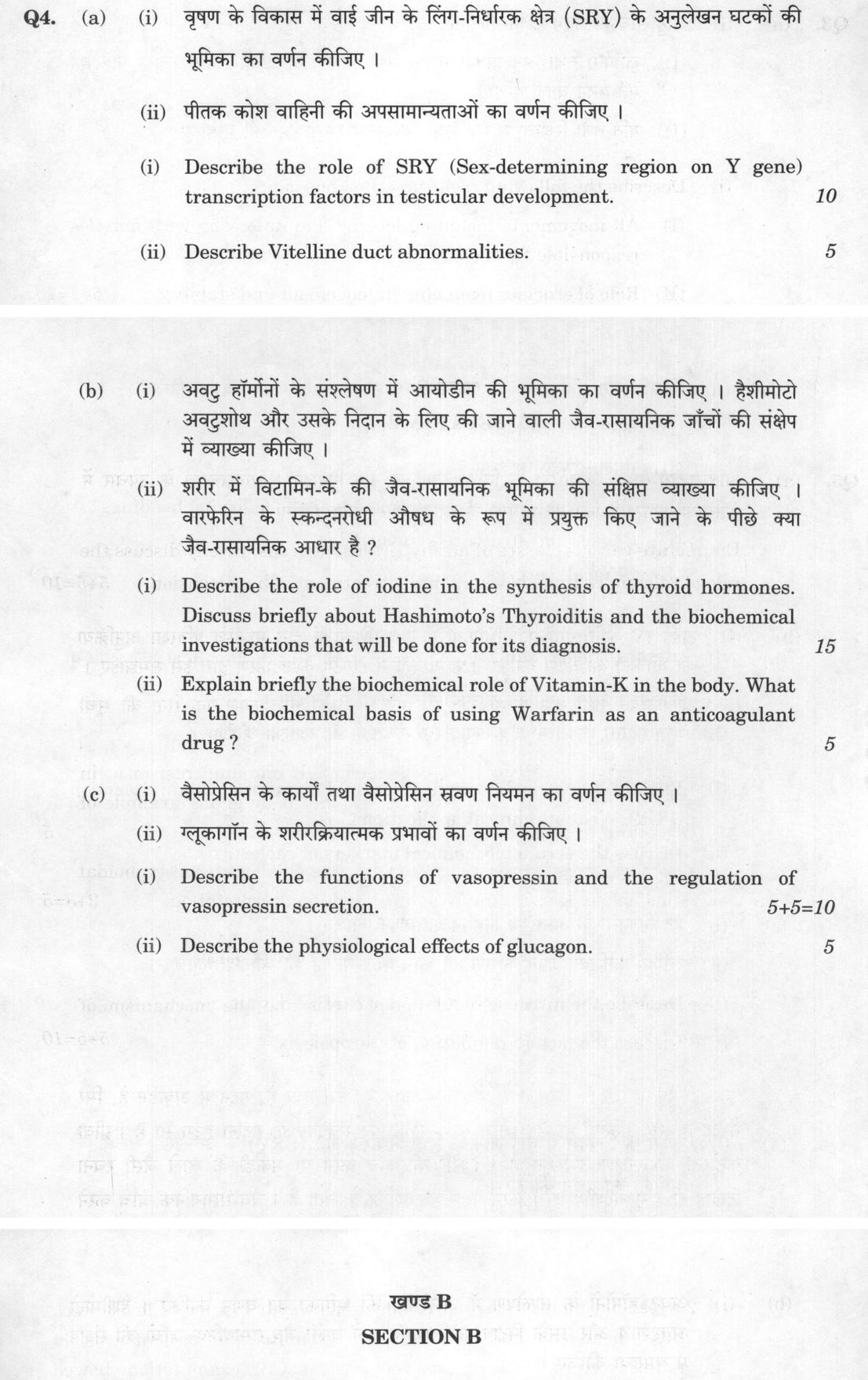
(a) (i) Describe the role of SRY (Sex-determining region on Y gene) transcription factors in testicular development. 10 (ii)…
Describe the role of SRY (Sex-determining region on Y gene) transcription factors in testicular development. 10 marks
Describe Vitelline duct abnormalities. 5 marks
Describe the role of iodine in the synthesis of thyroid hormones. Discuss briefly about Hashimoto's Thyroiditis and the biochemical investigations that will be done for its diagnosis. 15 marks
Explain briefly the biochemical role of Vitamin-K in the body. What is the biochemical basis of using Warfarin as an anticoagulant drug ? 5 marks
Describe the functions of vasopressin and the regulation of vasopressin secretion. 5+5=10
Describe the physiological effects of glucagon. 5 marks
हिंदी में प्रश्न पढ़ें
वृषण के विकास में वाई जीन के लिंग-निर्धारक क्षेत्र (SRY) के अनुलेखन घटकों की भूमिका का वर्णन कीजिए ।
पीतक कोश वाहिनी की अपसामान्यताओं का वर्णन कीजिए ।
अवटु हार्मोनों के संश्लेषण में आयोडीन की भूमिका का वर्णन कीजिए । हैशिमोटो अवटुशोथ और उसके निदान के लिए की जाने वाली जैव-रासायनिक जाँचों की संक्षेप में व्याख्या कीजिए ।
शरीर में विटामिन-के की जैव-रासायनिक भूमिका की संक्षिप्त व्याख्या कीजिए । वारफेरिन के स्कन्दनरोधी औषध के रूप में प्रयुक्त किए जाने के पीछे क्या जैव-रासायनिक आधार है ?
वैसोप्रेसिन के कार्यों तथा वैसोप्रेसिन स्रवण नियमन का वर्णन कीजिए ।
ग्लूकागॉन के शारीरिकीयात्मक प्रभावों का वर्णन कीजिए ।
Model answer
Written by UPSC Answer Check against this question's marking rubric, to the expected length. UPSC does not publish answers for Mains — this is one way to score well, not an official key.
Testicular Development and SRY Gene Regulation
Testicular differentiation begins with the expression of the SRY (Sex-determining region on Y) gene on the short arm of the Y chromosome in the bipotential gonad. The SRY transcription factor interacts synergistically with Steroidogenic Factor 1 (SF1) to bind the testis-specific enhancer (TSE) core element of the SOX9 gene, driving high-level SOX9 expression. SOX9 directs the differentiation of primitive somatic cells into Sertoli cells. These newly differentiated Sertoli cells organize into testicular cords and secrete Anti-Müllerian Hormone (AMH), which induces the regression of paramesonephric (Müllerian) ducts. Concurrently, Sertoli cells signal the differentiation of mesenchymal cells into Leydig cells, which secrete testosterone to stabilize the mesonephric (Wolffian) duct system and drive male phenotypic development.
Vitelline Duct Abnormalities
The vitelline (omphalomesenteric) duct connects the primary intestinal loop to the yolk sac and normally obliterates by the sixth week of gestation. Failure of obliteration results in well-defined clinical anomalies:
- Meckel’s Diverticulum: Partial persistence of the proximal ileal end, adhering to the "Rule of 2s" (2% prevalence, 2 inches long, within 2 feet of the ileocecal valve, and often containing 2 types of heterotopic mucosa: gastric and pancreatic).
- Vitelline Fistula: Complete patency of the duct, resulting in direct discharge of fecal matter at the umbilicus.
- Umbilical Sinus: Persistence of the distal duct beneath the umbilicus with a closed intestinal end.
- Vitelline Cyst (Enterocystoma): Persistence of the intermediate portion forming a mucus-secreting cyst isolated between fibrous cords.
Thyroid Hormone Synthesis and Hashimoto's Thyroiditis
Thyroid hormone synthesis requires adequate inorganic iodide, processed through three sequential steps:
- Iodide Trapping: Active basolateral transport of iodide into follicular cells against a concentration gradient via the Sodium-Iodide Symporter (NIS).
- Organification: At the apical membrane, thyroid peroxidase (TPO) utilizes hydrogen peroxide to oxidize iodide to active iodine, which iodinates tyrosine residues on thyroglobulin to form monoiodotyrosine (MIT) and diiodotyrosine (DIT).
- Coupling Reaction: TPO catalyzes the intramolecular coupling of MIT and DIT to form triiodothyronine (T3), and two DIT molecules to form thyroxine (T4). Endocytosis of colloid followed by lysosomal proteolysis releases free T3 and T4 into the circulation.
Hashimoto's Thyroiditis is an autoimmune disorder characterized by cell-mediated and humoral destruction of thyroid architecture. Biochemical diagnosis is established by:
- Hormone Profiling: Elevated serum Thyroid Stimulating Hormone (TSH) with subnormal or low free T4 and T3 levels.
- Antibody Titers: Markedly elevated circulating anti-thyroid peroxidase (anti-TPO) antibodies (>90% of cases) and anti-thyroglobulin (anti-Tg) antibodies, confirming autoimmune etiology.
Biochemistry of Vitamin K and Warfarin Anticoagulation
Vitamin K functions as an essential cofactor for the microsomal enzyme γ-glutamyl carboxylase. This enzyme post-translationally converts specific glutamate residues into γ-carboxyglutamate (Gla) residues within the Gla domain of coagulation factors II, VII, IX, and X, as well as proteins C and S. The negatively charged Gla residues chelate calcium ions (Ca²⁺), allowing clotting factors to bind negatively charged platelet membrane phospholipids to form active procoagulant complexes.
Warfarin acts as a competitive inhibitor of the enzyme Vitamin K Epoxide Reductase Complex 1 (VKORC1). By blocking the reduction of inactive vitamin K 2,3-epoxide back to its active hydroquinone form, Warfarin causes functional vitamin K deficiency, leading to the synthesis of non-functional, under-carboxylated clotting factors.
Vasopressin: Functions and Regulation
Arginine Vasopressin (AVP/ADH) is synthesized in the supraoptic and paraventricular nuclei of the hypothalamus and released from the posterior pituitary.
- Physiological Functions: AVP binds to basolateral V2 receptors on renal collecting duct principal cells, stimulating the cAMP/Protein Kinase A (PKA) pathway. This drives the exocytic insertion of Aquaporin-2 (AQP2) water channels into the apical membrane, promoting water reabsorption and producing concentrated urine. At higher concentrations, AVP binds vascular V1a receptors (G_q-coupled/IP3-DAG-calcium pathway), causing systemic vasoconstriction.
- Regulation of Secretion: Secretion is regulated primarily by hypothalamic osmoreceptors in the organum vasculosum of the lamina terminalis (sensitive to ≥ 1% changes in effective serum osmolality) and secondarily by low- and high-pressure baroreceptors (responding to ≥ 5-10% reductions in blood volume or pressure). Clinically, autonomous hypersecretion causes the Syndrome of Inappropriate Antidiuretic Hormone (SIADH), characterized by euvolemic hyponatremia, whereas deficient secretion or renal resistance results in Diabetes Insipidus, characterized by hypotonic polyuria.
Physiological Effects of Glucagon
Secreted by pancreatic α-cells during fasting or hypoglycemia, glucagon binds hepatic Gₛ-protein coupled receptors to elevate intracellular cAMP and activate PKA:
- Carbohydrate Metabolism: Promotes hepatic glycogenolysis via activation of glycogen phosphorylase and stimulates gluconeogenesis by upregulating phosphoenolpyruvate carboxykinase (PEPCK) and fructose-1,6-bisphosphatase, while concurrently inhibiting glycogen synthesis and glycolysis.
- Lipid and Ketone Metabolism: Stimulates hormone-sensitive lipase in adipose tissue to enhance lipolysis; in the liver, it inhibits acetyl-CoA carboxylase, reducing malonyl-CoA levels, which disinhibits Carnitine Palmitoyltransferase-1 (CPT-1) to promote mitochondrial β-oxidation and ketogenesis.
Through these integrated genomic, biochemical, and endocrine mechanisms, the human body maintains structural morphogenesis, fluid and electrolyte balance, and metabolic homeostasis.
What "Describe" is asking you to do
Give a full, ordered account of the thing named — its parts, stages or mechanism — in the sequence in which it actually exists or occurs. Most describe questions come from the science optionals, where the marks sit in correct technical detail and, where the stem says so, a labelled diagram.
Structure that answers it
One-line identification of the subject → the parts or stages in their real order, each with its defining detail → labelled diagram where the subject is structural → closing line on function or significance
Where marks are lost
Loose general prose where the examiner is ticking named parts, correct terminology and their sequence; and in the General Studies papers, turning to evaluation before the description is finished.
How this answer will be evaluated
Approach
Framework: Clinical Sequence (Definition > Aetiology/Pathophysiology > Features > Investigation/Management). (a) describe: define SRY/Vitelline duct > process in order > labelled diagram | (b) describe: define Iodine/Vit K > process in order > labelled diagram | (c) describe: define Vasopressin/Glucagon > process in order > labelled diagram Full marks: Precise biochemical pathways and clinical correlations with diagrams.
Key points expected
- SRY-SOX9-AMH axis
- Meckel's diverticulum
- NIS and TPO enzymes
- Anti-TPO antibodies
- Gamma-carboxylation
- V2 receptor aquaporins
- Hepatic glycogenolysis
Evaluation rubric
Each sub-part is marked on its own, against the marks and word limit printed on the paper.
- (a) SRY mechanism in testis differentiation and classification of vitelline duct anomalies.
describe— define SRY/Vitelline duct → process in order → labelled diagram
Must cover
- SRY triggers SOX9 expression
- Sertoli cell differentiation mechanism
- AMH secretion by Sertoli cells
- Vitelline duct closure timeline
Loses marks
- Listing symptoms without mechanism
- Omitting AMH role in SRY
Earns more
- Müllerian duct regression pathway
- Meckel's diverticulum pathophysiology
- Vitelline cyst formation
- Vitelline fistula presentation
Extra mark
- Diagram of SRY-SOX9-AMH cascade
- Diagram of vitelline duct closure
- (b) Iodine in thyroid synthesis, Hashimoto's diagnosis, and Vitamin K/Warfarin biochemistry.
describe— define Iodine/Vit K → process in order → labelled diagram
Must cover
- Iodine trapping via NIS transporter
- TPO-mediated iodination of tyrosine
- Hashimoto's anti-TPO antibody test
- Vitamin K-dependent clotting factors
Loses marks
- Listing symptoms without mechanism
- Omitting NIS or TPO role
Earns more
- Coupling reaction for T3/T4
- Hashimoto's TSH/T4 profile
- Gamma-carboxylation mechanism
- Warfarin VKORC1 inhibition
Extra mark
- Flowchart of thyroid hormone synthesis
- Diagram of clotting cascade
- (c) Vasopressin functions/regulation and physiological effects of glucagon.
describe— define Vasopressin/Glucagon → process in order → labelled diagram
Must cover
- Vasopressin V2 receptor action
- Osmoreceptor regulation mechanism
- Glucagon hepatic glycogenolysis
- Glucagon lipolysis pathway
Loses marks
- Listing symptoms without mechanism
- Omitting osmoreceptor role
Earns more
- Vasopressin V1 receptor action
- ADH release from posterior pituitary
- Glucagon gluconeogenesis stimulation
- Glucagon counter-regulatory role
Extra mark
- Diagram of ADH feedback loop
- Diagram of glucagon signaling
Practice this exact question
Write your answer and it is marked point by point against the model answer above — what you covered, what you missed, what you got wrong.
Evaluate my answer →More from Medical Science 2023 Paper I
- Q1 A 35-year-old male smoker with complaints of difficulty in swallowing and ulcer on tip of…
- Q2 A 56-year-old male visits a surgery OPD with complaints of difficulty in passage of urine…
- Q3 (a) (i) Describe the following regarding the knee joint : (I) All movements including loc…
- Q4 (a) (i) Describe the role of SRY (Sex-determining region on Y gene) transcription factors…
- Q5 (a) Enumerate various classes of antihypertensive drugs. Briefly discuss the role of calc…
- Q6 (a) (i) Enumerate any five risk factors for oral cancer. Describe its morphology. 5+5=10…
- Q7 (a) Classify the various types of poisons. Enumerate the features of Plumbism. Discuss th…