Paper I — Q6
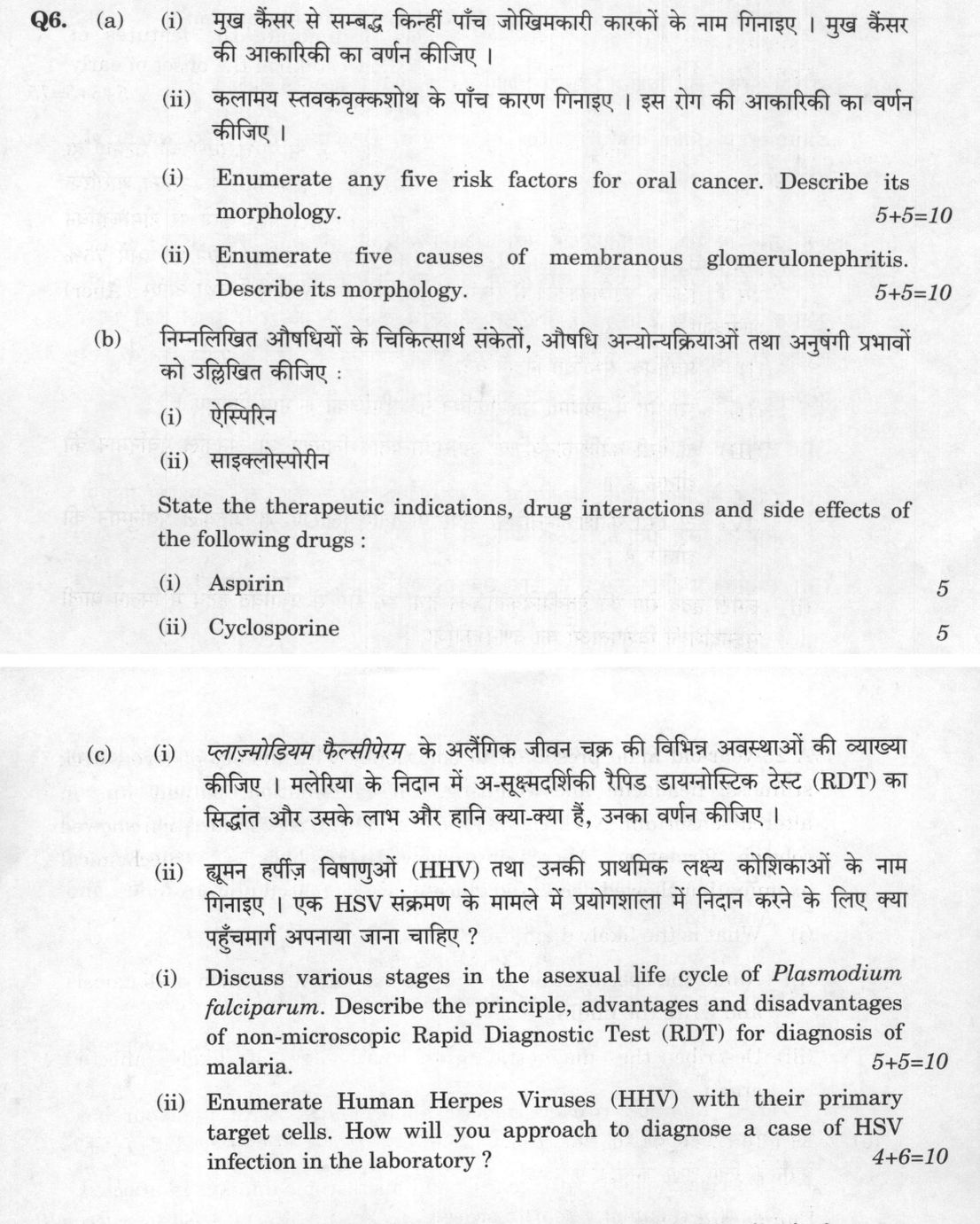
(a) (i) Enumerate any five risk factors for oral cancer. Describe its morphology. 5+5=10 (ii) Enumerate five causes of membranous…
Enumerate any five risk factors for oral cancer. Describe its morphology. 5+5=10
Enumerate five causes of membranous glomerulonephritis. Describe its morphology. 5+5=10
State the therapeutic indications, drug interactions and side effects of the following drugs: Aspirin 5
Cyclosporine 5
Discuss various stages in the asexual life cycle of *Plasmodium falciparum*. Describe the principle, advantages and disadvantages of non-microscopic Rapid Diagnostic Test (RDT) for diagnosis of malaria. 5+5=10
Enumerate Human Herpes Viruses (HHV) with their primary target cells. How will you approach to diagnose a case of HSV infection in the laboratory? 4+6=10
हिंदी में प्रश्न पढ़ें
मुख कैंसर से सम्बद्ध किन्हीं पाँच जोखिमकारी कारकों के नाम गिनाइए । मुख कैंसर की आकृति का वर्णन कीजिए । 5+5=10
कलामय स्तवकवृक्कशोथ के पाँच कारण गिनाइए । इस रोग की आकृति का वर्णन कीजिए । 5+5=10
निम्नलिखित औषधियों के चिकित्सार्थ संकेतों, औषधि अन्योन्यक्रियाओं तथा अनुषंगी प्रभावों को उल्लिखित कीजिए : ऐसिपिरिन 5
साइक्लोस्पोरिन 5
प्लाज्मोडियम फैल्सीपेरम के अलैंगिक जीवन चक्र की विभिन्न अवस्थाओं की व्याख्या कीजिए । मलेरिया के निदान में अ-सूक्ष्मदर्शिकी रैपिड डायनोस्टिक टेस्ट (RDT) का सिद्धांत और उसके लाभ और हानि क्या-क्या हैं, उनका वर्णन कीजिए । 5+5=10
ह्यूमन हर्पीज विषाणुओं (HHV) तथा उनकी प्राथमिक लक्ष्य कोशिकाओं के नाम गिनाइए । एक HSV संक्रमण के मामले में प्रयोगशाला में निदान करने के लिए क्या पहुँचमार्ग अपनाया जाना चाहिए ? 4+6=10
Model answer
Written by UPSC Answer Check against this question's marking rubric, to the expected length. UPSC does not publish answers for Mains — this is one way to score well, not an official key.
Pathology of Oral Cancer and Membranous Glomerulonephritis
Oral Cancer: Major risk factors include tobacco use (smoking and smokeless forms like gutkha), heavy alcohol consumption, betel nut (areca nut) chewing, infection with high-risk Human Papillomavirus (predominantly HPV-16), and chronic mucosal irritation from poor dentition or poor oral hygiene. Grossly, oral cancer manifests as an exophytic/fungating mass, an endophytic ulcerative lesion with indurated, raised margins, or a verrucous leukoplakic plaque. Microscopically, over 90% are squamous cell carcinomas characterized by invasive nests of atypical squamous cells, variable keratinization (keratin pearls), intercellular bridges, nuclear pleomorphism, mitotic figures, and subepithelial stromal invasion, often against a background of field cancerization.
Membranous Glomerulonephritis (MGN): Primary MGN is idiopathic (autoantibodies against phospholipase A2 receptor, PLA2R). Secondary causes include chronic infections (Hepatitis B, Hepatitis C, malaria), autoimmune diseases (Systemic Lupus Erythematosus—Class V), malignancies (carcinomas of lung, colon, stomach), and drugs (NSAIDs, penicillamine, gold). Light microscopy reveals diffuse, uniform thickening of the glomerular basement membrane (GBM) without notable hypercellularity. Silver methenamine stain demonstrates a pathognomonic "spike and dome" appearance. Immunofluorescence shows diffuse, granular deposition of IgG and C3 along the GBM. Electron microscopy confirms electron-dense subepithelial deposits separated by GBM spikes, accompanied by diffuse effacement of podocyte foot processes.
Applied Pharmacology of Aspirin and Cyclosporine
Aspirin: Indications include secondary prevention of myocardial infarction and ischemic stroke (antiplatelet, 75–150 mg/day), mild-to-moderate pain and fever (analgesic/antipyretic), and acute rheumatic fever or Kawasaki disease (anti-inflammatory). Drug interactions involve displacement of and synergism with warfarin (severe hemorrhage risk), decreased renal clearance of methotrexate leading to toxicity, and attenuation of the antihypertensive actions of ACE inhibitors. Adverse effects include gastric mucosal ulceration with upper gastrointestinal bleeding, Reye syndrome in febrile children, aspirin-exacerbated respiratory disease (bronchospasm), and tinnitus in salicylism.
Cyclosporine: Indications include prophylaxis of organ transplant rejection (kidney, liver, heart) and severe autoimmune disorders such as refractory psoriasis, rheumatoid arthritis, and steroid-resistant nephrotic syndrome. Interactions occur with CYP3A4 inhibitors (ketoconazole, erythromycin) which elevate blood levels, CYP3A4 inducers (rifampicin, phenytoin) which precipitate graft rejection, and nephrotoxic agents (aminoglycosides, amphotericin B) which potentiate renal damage. Major side effects are dose-dependent nephrotoxicity, secondary systemic hypertension, gingival hyperplasia, hirsutism, and hepatotoxicity.
**Microbiology of Plasmodium falciparum and Human Herpes Viruses**
***Plasmodium falciparum* Asexual Life Cycle & RDT:** The cycle begins when an infective female Anopheles mosquito injects sporozoites into the bloodstream. Sporozoites invade hepatocytes, initiating exo-erythrocytic schizogony to form tissue schizonts containing thousands of merozoites, without a hypnozoite phase. Ruptured liver cells release merozoites into the circulation to invade erythrocytes (erythrocytic schizogony). Intracellular parasites mature through ring forms (early trophozoites), mature trophozoites, and erythrocytic schizonts. Schizont rupture releases new merozoites and pyrogens, producing tertian fever paroxysms.
Rapid Diagnostic Tests (RDTs) operate on lateral flow immunochromatography, using labeled monoclonal antibodies to capture parasite-specific antigens: Histidine-Rich Protein-2 (HRP-2) or parasite Lactate Dehydrogenase (pLDH). Advantages: Rapid results (15 minutes), requires no electricity or skilled microscopy, and enables point-of-care diagnosis under national health programs. Disadvantages: Inability to quantify parasitemia, false positives due to persistent HRP-2 circulation post-cure, and false negatives arising from pfhrp2/3 gene deletions.
Human Herpes Viruses (HHV) & HSV Diagnosis: The eight HHVs and primary target cells are: HHV-1 (HSV-1): Mucoepithelial cells and sensory ganglia; HHV-2 (HSV-2): Mucoepithelial cells and sacral ganglia; HHV-3 (VZV): T cells, epithelial cells, and sensory ganglia; HHV-4 (EBV): B lymphocytes and epithelial cells; HHV-5 (CMV): Monocytes, granulocytes, and endothelial cells; HHV-6 & HHV-7: CD4+ T lymphocytes; HHV-8 (KSHV): Endothelial cells and B lymphocytes.
Laboratory diagnosis of HSV utilizes: Cytology: Tzanck smear of vesicle scrapings stained with Giemsa reveals multinucleated giant cells and Cowdry A inclusion bodies. Direct Antigen Detection: Direct immunofluorescence assay (DFA) on lesion smears. Polymerase Chain Reaction: Real-time PCR detecting HSV DNA (gold standard for HSV encephalitis and neonatal infections). Viral Culture: Inoculation into human diploid fibroblast cell lines showing characteristic cytopathic effect. Serology: Type-specific ELISA detecting IgG and IgM against glycoprotein G1 (HSV-1) and G2 (HSV-2) for sero-epidemiology and primary infection confirmation.
What "Describe" is asking you to do
Give a full, ordered account of the thing named — its parts, stages or mechanism — in the sequence in which it actually exists or occurs. Most describe questions come from the science optionals, where the marks sit in correct technical detail and, where the stem says so, a labelled diagram.
Structure that answers it
One-line identification of the subject → the parts or stages in their real order, each with its defining detail → labelled diagram where the subject is structural → closing line on function or significance
Where marks are lost
Loose general prose where the examiner is ticking named parts, correct terminology and their sequence; and in the General Studies papers, turning to evaluation before the description is finished.
How this answer will be evaluated
Approach
Framework: Clinical Pathology & Pharmacology. (a) describe: definition > structure or process in order > labelled diagram > significance | (b) describe: definition > structure or process in order > labelled diagram > significance | (c) discuss: intro > 3-4 dimensions > example > balanced close Full marks: Precise morphological descriptions, specific drug interactions, and detailed life cycle stages.
Key points expected
- Oral cancer risk factors: Tobacco, Alcohol, HPV, Betel nut, Poor hygiene
- Membranous GN causes: SLE, Malignancy, Drugs (NSAIDs, Penicillamine), Infections (Hep B/C)
- Aspirin: Irreversible COX inhibitor, antiplatelet, GI bleeding risk
- Cyclosporine: Calcineurin inhibitor, nephrotoxic, gingival hyperplasia
- P. falciparum: Ring forms, multiple rings per RBC, appliqué forms
- RDT: HRP-2 antigen, rapid, point-of-care, false negatives in low parasitemia
- HHV: HSV-1 (neurons), HSV-2 (neurons), VZV (neurons), CMV (monocytes), EBV (B cells)
Evaluation rubric
Each sub-part is marked on its own, against the marks and word limit printed on the paper.
- (a) List 5 risk factors/causes and describe morphology for oral cancer and membranous GN.
describe— definition → structure or process in order → labelled diagram → significance
Must cover
- 5 risk factors for oral cancer (tobacco, alcohol, HPV)
- Oral cancer morphology (ulcerated, indurated, rolled edges)
- 5 causes of membranous GN (lupus, drugs, infections)
- Membranous GN morphology (spike and dome, subepithelial deposits)
Loses marks
- Listing symptoms without pathological mechanism
- Confusing membranous with membranoproliferative morphology
Earns more
- Mention of specific HPV strains (16, 18)
- Immunofluorescence pattern (granular) for membranous GN
Extra mark
- Diagram of glomerular spike and dome pattern
- (b) Detail indications, interactions, and side effects for Aspirin and Cyclosporine.
describe— definition → structure or process in order → labelled diagram → significance
Must cover
- Aspirin indications (analgesic, antiplatelet, anti-inflammatory)
- Aspirin side effects (GI bleed, Reye's syndrome)
- Cyclosporine indications (transplant rejection, autoimmune)
- Cyclosporine side effects (nephrotoxicity, hypertension, gingival hyperplasia)
Loses marks
- Listing side effects without mechanism
- Omitting drug interactions as requested
Earns more
- Aspirin interaction with warfarin (increased bleeding)
- Cyclosporine interaction with azole antifungals (CYP3A4 inhibition)
Extra mark
- Mention of therapeutic drug monitoring for Cyclosporine
- (c) Explain P. falciparum asexual cycle and RDT pros/cons; list HHVs and HSV diagnosis.
discuss— intro → 3-4 dimensions → example → balanced close
Must cover
- P. falciparum asexual stages (ring, trophozoite, schizont, merozoite)
- RDT principle (antigen detection, e.g., HRP-2)
- RDT advantages (rapid, no microscopy) and disadvantages (sensitivity)
- HHV list with target cells (HSV-1/2, VZV, CMV, EBV, HHV-6/7/8)
Loses marks
- Confusing sexual and asexual life cycles
- Listing HHVs without their specific target cells
Earns more
- HSV lab diagnosis (PCR, culture, DFA)
- Specific mention of HRP-2 vs pLDH in RDTs
Extra mark
- Mention of WHO guidelines for malaria diagnosis
Practice this exact question
Write your answer and it is marked point by point against the model answer above — what you covered, what you missed, what you got wrong.
Evaluate my answer →More from Medical Science 2023 Paper I
- Q3 (a) (i) Describe the following regarding the knee joint : (I) All movements including loc…
- Q4 (a) (i) Describe the role of SRY (Sex-determining region on Y gene) transcription factors…
- Q5 (a) Enumerate various classes of antihypertensive drugs. Briefly discuss the role of calc…
- Q6 (a) (i) Enumerate any five risk factors for oral cancer. Describe its morphology. 5+5=10…
- Q7 (a) Classify the various types of poisons. Enumerate the features of Plumbism. Discuss th…
- Q8 (a) (i) Describe the morphological characteristics of *Cryptococcus neoformans* on micros…