Paper I — Q2
A 56-year-old male visits a surgery OPD with complaints of difficulty in passage of urine especially on straining. Based on his…
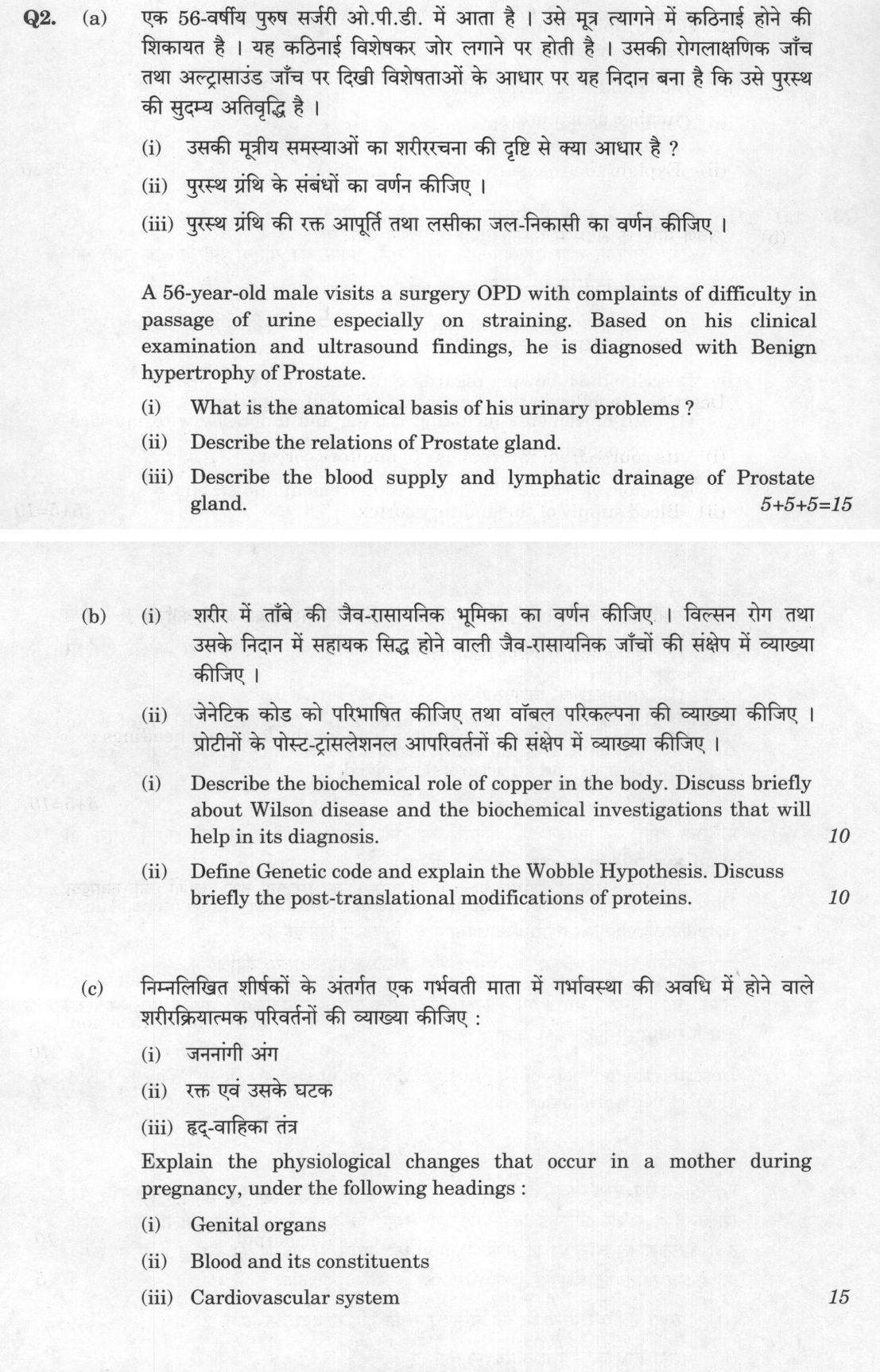
A 56-year-old male visits a surgery OPD with complaints of difficulty in passage of urine especially on straining. Based on his clinical examination and ultrasound findings, he is diagnosed with Benign hypertrophy of Prostate.
What is the anatomical basis of his urinary problems ? 5 marks
Describe the relations of Prostate gland. 5 marks
Describe the blood supply and lymphatic drainage of Prostate gland. 5 marks
Describe the biochemical role of copper in the body. Discuss briefly about Wilson disease and the biochemical investigations that will help in its diagnosis. 10 marks
Define Genetic code and explain the Wobble Hypothesis. Discuss briefly the post-translational modifications of proteins. 10 marks
Explain the physiological changes that occur in a mother during pregnancy, under the following headings : Genital organs 5 marks
Blood and its constituents 5 marks
Cardiovascular system 5 marks
हिंदी में प्रश्न पढ़ें
एक 56-वर्षीय पुरुष सर्जरी ओ.पी.डी. में आता है । उसे मूत्र त्यागने में कठिनाई होने की शिकायत है । यह कठिनाई विशेषकर जोर लगाने पर होती है । उसकी रोगलाक्षणिक जाँच तथा अल्ट्रासाउंड जाँच पर दिखी विशेषताओं के आधार पर यह निदान बना है कि उसे पुरुष की सुदम्य अतिवृद्धि है ।
उसकी मूत्रीय समस्याओं का शरीररचना की दृष्टि से क्या आधार है ? (5 अंक)
पुरुष ग्रंथि के संबंधों का वर्णन कीजिए । (5 अंक)
पुरुष ग्रंथि की रक्त आपूर्ति तथा लसीका जल-निकासी का वर्णन कीजिए । (5 अंक)
शरीर में ताँबे की जैव-रासायनिक भूमिका का वर्णन कीजिए । विल्सन रोग तथा उसके निदान में सहायक सिद्ध होने वाली जैव-रासायनिक जाँचों की संक्षेप में व्याख्या कीजिए । (10 अंक)
जेनेटिक कोड को परिभाषित कीजिए तथा वॉबल परिकल्पना की व्याख्या कीजिए । प्रोटीनों के पोस्ट-ट्रांसलेशनल आपरिवर्तनों की संक्षेप में व्याख्या कीजिए । (10 अंक)
निम्नलिखित शीर्षकों के अंतर्गत एक गर्भवती माता में गर्भावस्था की अवधि में होने वाले शारीरक्रियात्मक परिवर्तनों की व्याख्या कीजिए : जननांगी अंग (5 अंक)
रक्त एवं उसके घटक (5 अंक)
हृद्-वाहिका तंत्र (5 अंक)
Model answer
Written by UPSC Answer Check against this question's marking rubric, to the expected length. UPSC does not publish answers for Mains — this is one way to score well, not an official key.
The obstructive symptoms arise because the prostate surrounds the prostatic urethra. Enlargement of the median lobe and periurethral tissue compresses the urethra at the bladder neck and involves the internal urethral sphincter, producing difficulty on straining, bladder outlet obstruction and incomplete emptying. The narrowed lumen increases resistance to flow. Relations. Anteriorly it lies against the pubic symphysis and retropubic space; posteriorly it is separated from the rectum by the rectovesical septum and Denonvilliers’ fascia; laterally by levator ani; superiorly by the bladder neck; inferiorly by the urogenital diaphragm and external urethral sphincter. Vascular and lymphatic supply. Arteries are inferior vesical, middle rectal and internal pudendal; veins drain into the prostatic venous plexus and then internal iliac veins; lymphatics pass to internal iliac, sacral and obturator nodes.
Copper and Wilson disease. Copper is a cofactor for cytochrome c oxidase in mitochondrial respiration, Cu/Zn superoxide dismutase in antioxidant defence, lysyl oxidase in connective-tissue cross-linking and ceruloplasmin in iron metabolism. Ceruloplasmin is the major copper-carrying plasma protein. Wilson disease results from ATP7B mutation causing defective biliary copper excretion and low ceruloplasmin, with copper accumulation in liver and brain. Biochemical investigations include low serum ceruloplasmin, low total serum copper with raised non-ceruloplasmin copper, raised 24-hour urinary copper and raised hepatic copper concentration; Kayser-Fleischer rings are a slit-lamp clinical finding, not a biochemical test. Genetic code and modifications. The genetic code is triplet, non-overlapping, degenerate, universal and commaless. Crick’s wobble hypothesis explains degeneracy at the third codon base by flexible pairing at the anticodon wobble position, while the first two bases pair more strictly; one tRNA can therefore read several codons. Post-translational modifications include phosphorylation, glycosylation, ubiquitination, proteolytic cleavage and disulfide bond formation, which regulate activity, stability, folding and localization. These modifications occur after synthesis in the cell.
Pregnancy changes. In genital organs, the uterus enlarges with increased vascularity and increased uterine blood flow, the cervix softens, and vaginal vascularity increases. In blood and its constituents, plasma volume rises more than red-cell mass, causing physiological anaemia and haemodilution, while hypercoagulability develops; blood volume rises, with increased clotting factors. In the cardiovascular system, cardiac output rises through increased heart rate and stroke volume, while peripheral resistance decreases and haemodilution occurs; these changes reflect increased plasma volume and reduced systemic vascular resistance. Supine hypotension syndrome may occur due to aortocaval compression. Thus, the case illustrates anatomical obstruction, copper-homeostasis defects, codon-anticodon flexibility and ordered maternal adaptation.
What "Describe" is asking you to do
Give a full, ordered account of the thing named — its parts, stages or mechanism — in the sequence in which it actually exists or occurs. Most describe questions come from the science optionals, where the marks sit in correct technical detail and, where the stem says so, a labelled diagram.
Structure that answers it
One-line identification of the subject → the parts or stages in their real order, each with its defining detail → labelled diagram where the subject is structural → closing line on function or significance
Where marks are lost
Loose general prose where the examiner is ticking named parts, correct terminology and their sequence; and in the General Studies papers, turning to evaluation before the description is finished.
How this answer will be evaluated
Approach
Framework: Clinical Anatomy & Biochemistry. (a) describe: anatomical basis > relations > vascular supply | (b) discuss: biochemical role > pathology > investigations | (c) explain: genital changes > blood changes > cardio changes Full marks: Precise anatomical/biochemical mechanisms with correct clinical correlations.
Key points expected
- Prostatic urethra compression
- Denonvilliers' fascia
- Wilson's disease diagnosis
- Wobble hypothesis
- Physiological anemia
- Cardiac output increase
Evaluation rubric
Each sub-part is marked on its own, against the marks and word limit printed on the paper.
- (a) Explain BPH mechanism, prostate relations, and vascular/lymphatic anatomy. 15 marks
describe— anatomical basis → relations → vascular supply
Must cover
- Prostatic urethra compression mechanism
- Anterior: pubic symphysis relation
- Posterior: rectum relation
- Inferior: urogenital diaphragm
Loses marks
- Confusing prostate with seminal vesicles
- Omitting the urethral compression mechanism
Earns more
- Internal/external pudendal artery supply
- Internal iliac vein drainage
- Pelvic lymph node drainage
- Labelled diagram of relations
Extra mark
- Mention of Denonvilliers' fascia
- Specific lymph node names (obturator/iliac)
- (b) Detail copper metabolism, Wilson's diagnosis, and genetic code/wobble hypothesis.
discuss— biochemical role → pathology → investigations
Must cover
- Copper in cytochrome c oxidase
- Wilson's: low ceruloplasmin
- Wilson's: high urinary copper
- Wobble hypothesis: 5' end of tRNA
Loses marks
- Confusing Wilson's with Menkes disease
- Vague description of wobble base pairing
Earns more
- K-F ring mention
- Genetic code degeneracy
- Post-translational: phosphorylation
- Post-translational: glycosylation
Extra mark
- Mention of ATP7B gene mutation
- Specific post-translational example (e.g., proline hydroxylation)
- (c) Describe physiological adaptations in genital, hematological, and cardiovascular systems. 15 marks
explain— genital changes → blood changes → cardio changes
Must cover
- Uterine hypertrophy/hyperplasia
- Physiological anemia (plasma expansion)
- Increased cardiac output
- Increased blood volume
Loses marks
- Confusing physiological changes with pathology
- Omitting the mechanism of physiological anemia
Earns more
- Chadwick's sign mention
- Hemodilution mechanism
- Decreased systemic vascular resistance
- Supine hypotension syndrome
Extra mark
- Specific cardiac output increase percentage
- Mention of leftward shift of ECG axis
Practice this exact question
Write your answer and it is marked point by point against the model answer above — what you covered, what you missed, what you got wrong.
Evaluate my answer →More from Medical Science 2023 Paper I
- Q1 A 35-year-old male smoker with complaints of difficulty in swallowing and ulcer on tip of…
- Q2 A 56-year-old male visits a surgery OPD with complaints of difficulty in passage of urine…
- Q3 (a) (i) Describe the following regarding the knee joint : (I) All movements including loc…
- Q4 (a) (i) Describe the role of SRY (Sex-determining region on Y gene) transcription factors…
- Q5 (a) Enumerate various classes of antihypertensive drugs. Briefly discuss the role of calc…