Paper I — Q8
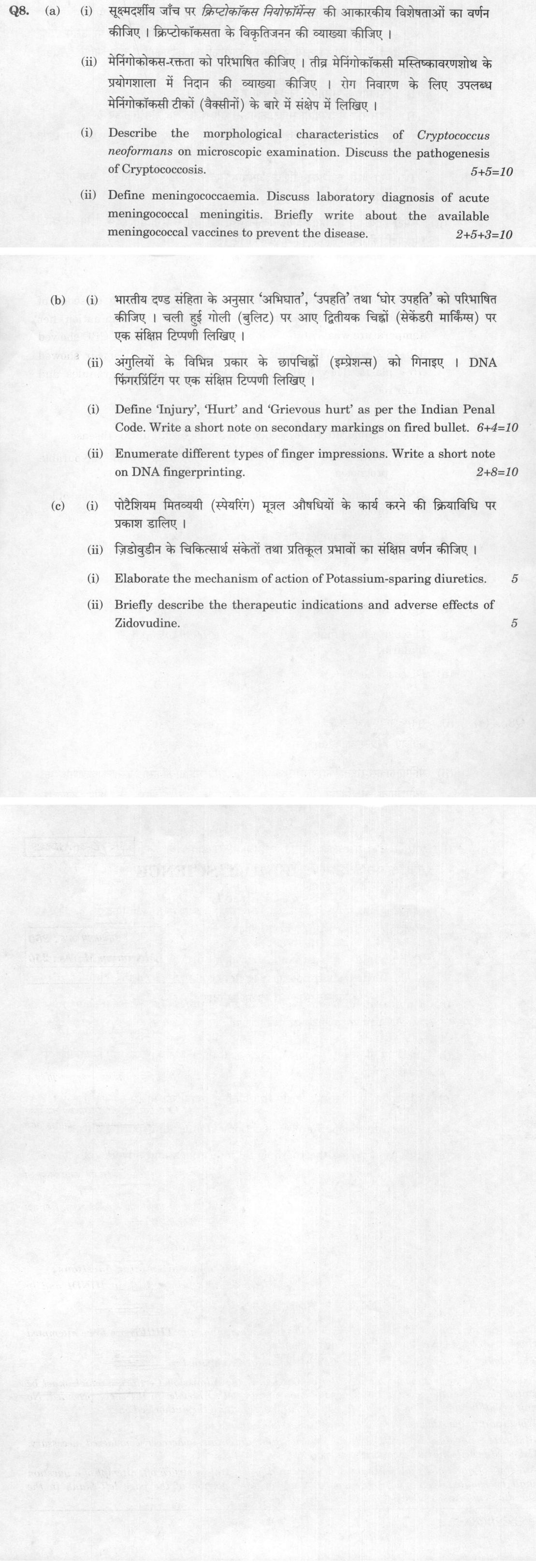
(a) (i) Describe the morphological characteristics of *Cryptococcus neoformans* on microscopic examination. Discuss the…
Describe the morphological characteristics of *Cryptococcus neoformans* on microscopic examination. Discuss the pathogenesis of Cryptococcosis. 5+5=10
Define meningococcaemia. Discuss laboratory diagnosis of acute meningococcal meningitis. Briefly write about the available meningococcal vaccines to prevent the disease. 2+5+3=10
Define 'Injury', 'Hurt' and 'Grievous hurt' as per the Indian Penal Code. Write a short note on secondary markings on fired bullet. 6+4=10
Enumerate different types of finger impressions. Write a short note on DNA fingerprinting. 2+8=10
Elaborate the mechanism of action of Potassium-sparing diuretics. 5 marks
Briefly describe the therapeutic indications and adverse effects of Zidovudine. 5 marks
हिंदी में प्रश्न पढ़ें
सूक्ष्मदर्शीय जाँच पर क्रिप्टोकोकस नियोफॉर्मन्स की आकारकीय विशेषताओं का वर्णन कीजिए । क्रिप्टोकोक्सता के विकृतिजन की व्याख्या कीजिए । 5+5=10
मैनिंगोकोकस-रक्तता को परिभाषित कीजिए । तीव्र मैनिंगोकोक्की मस्तिष्कावरणशोथ के प्रयोगशाला में निदान की व्याख्या कीजिए । रोग निवारण के लिए उपलब्ध मैनिंगोकोक्की टीकों (वैक्सीनों) के बारे में संक्षेप में लिखिए । 2+5+3=10
भारतीय दण्ड संहिता के अनुसार 'अभिघात', 'उपहति' तथा 'घोर उपहति' को परिभाषित कीजिए । चली हुई गोली (बुलेट) पर आए द्वितीयक चिह्नों (सेकेंडरी मार्किंग्स) पर एक संक्षिप्त टिप्पणी लिखिए । 6+4=10
अंगुलियों के विभिन्न प्रकार के छापचिह्नों (इम्प्रेशन्स) को गिनाइए । DNA फिंगरप्रिंटिंग पर एक संक्षिप्त टिप्पणी लिखिए । 2+8=10
पोटेशियम मितव्ययी (स्पेयरिंग) मूत्रल औषधियों के कार्य करने की क्रियाविधि पर प्रकाश डालिए । 5
ज़िडोवुडीन के चिकित्सार्थ संकेतों तथा प्रतिकूल प्रभावों का संक्षिप्त वर्णन कीजिए । 5
Model answer
Written by UPSC Answer Check against this question's marking rubric, to the expected length. UPSC does not publish answers for Mains — this is one way to score well, not an official key.
Cryptococcus neoformans. On microscopic examination, C. neoformans is a narrow-based budding yeast with a thick polysaccharide capsule. In India ink or mucicarmine-stained CSF or tissue smears, the capsule appears as a clear halo around oval yeast cells, and urease positivity helps separate it from other yeasts. The capsule is the major virulence factor, inhibiting phagocytosis and allowing survival in macrophages. Pathogenesis follows inhalation of desiccated pigeon droppings or soil, producing a small pulmonary focus. In immunocompromised patients, especially HIV/AIDS with low CD4 counts, the organism multiplies in alveolar macrophages, escapes locally, and spreads haematogenously to the meninges and brain, causing meningitis, meningoencephalitis or cryptococcomas.
Meningococcaemia and meningitis. Meningococcaemia is the presence of Neisseria meningitidis in the blood, producing bacteraemia or septicaemia, often with fever, petechiae or purpura. Laboratory diagnosis of acute meningococcal meningitis begins with CSF Gram stain showing Gram-negative diplococci, followed by culture on chocolate agar or Thayer-Martin medium. CSF is typically turbid with neutrophilic pleocytosis, low glucose and raised protein. Capsular polysaccharide can be detected by latex agglutination or counterimmunoelectrophoresis, and PCR gives rapid confirmation; blood culture and skin-lesion swabs may also be positive. Prevention relies on conjugate MenACWY vaccines and MenB vaccines such as Bexsero and Trumenba. In India, MenACWY is available for outbreak or high-risk use and may be procured through UIP/State immunisation channels, while MenB vaccines are available for selected indications.
IPC definitions and bullet markings. Under the IPC, injury (Section 44) means bodily pain, disease or infirmity. Hurt (Section 319) is voluntarily causing injury, disease or bodily pain. Grievous hurt (Section 320) is a specified serious hurt: permanent privation of sight of either eye; permanent privation of hearing of either ear; privation of any member or organ of its use; extirpation of any part of the reproductive organs; permanent privation of the use of any member or organ; fracture or dislocation of bone or joint; bodily pain disabling for twenty days; or continued severe bodily pain. Secondary markings on a fired bullet are fine individual striations produced by microscopic imperfections, wear, nicks and scratches in the barrel. They are distinct from primary rifling impressions, i.e. land and groove engravings, which are class characteristics. Class characteristics identify make, model or calibre; individual characteristics identify the specific gun.
Finger impressions and DNA fingerprinting. Finger impressions are friction-ridge patterns classified as arches (plain and tented), loops (ulnar and radial) and whorls (central pocket spiral, double loop and accidental). Each pattern is further identified by minutiae such as ridges, bifurcations and dots. DNA fingerprinting identifies individuals by analysing variable DNA regions. Classically, Alec Jeffreys’ VNTR method used restriction digestion, Southern blotting and hybridisation; modern forensic practice uses STR analysis by PCR and capillary electrophoresis. Applications include paternity, kinship, disaster victim identification and criminal cases, where a match narrows the suspect pool and a mismatch excludes.
Potassium-sparing diuretics. These act on collecting duct principal cells. Spironolactone competitively antagonises aldosterone, reducing Na+ reabsorption and K+ secretion, while amiloride and triamterene directly block epithelial sodium channels. The result is mild natriuresis with potassium retention, useful when hypokalaemia must be avoided. They are used in heart failure or with other diuretics to offset potassium loss.
Zidovudine. Zidovudine is an NRTI and chain terminator used in HIV treatment, prevention of perinatal transmission, and post-exposure prophylaxis. It inhibits reverse transcriptase after phosphorylation to triphosphate. Adverse effects include myelosuppression, especially anaemia and neutropenia, lactic acidosis, hepatotoxicity, lipodystrophy, and GI intolerance; monitoring of haemoglobin and liver function is important.
Together, the answer requires ordered description of morphology, pathogenesis, laboratory steps, legal definitions, forensic identification and drug action, with public-health relevance in infection control, vaccination and safe drug use.
What "Describe" is asking you to do
Give a full, ordered account of the thing named — its parts, stages or mechanism — in the sequence in which it actually exists or occurs. Most describe questions come from the science optionals, where the marks sit in correct technical detail and, where the stem says so, a labelled diagram.
Structure that answers it
One-line identification of the subject → the parts or stages in their real order, each with its defining detail → labelled diagram where the subject is structural → closing line on function or significance
Where marks are lost
Loose general prose where the examiner is ticking named parts, correct terminology and their sequence; and in the General Studies papers, turning to evaluation before the description is finished.
How this answer will be evaluated
Approach
Framework: Clinical Sequence (Definition > Aetiology/Pathophysiology > Features > Investigation/Management). (a) describe: define > structure or process in order > labelled diagram > significance | (b) describe: define > structure or process in order > labelled diagram > significance | (c) describe: define > structure or process in order > labelled diagram > significance Full marks: Precise definitions, clear pathophysiology, specific lab tests, correct drug mechanisms, no errors.
Key points expected
- Cryptococcus neoformans morphology and pathogenesis
- Meningococcaemia definition and lab diagnosis
- Meningococcal vaccines
- IPC definitions of Injury, Hurt, Grievous Hurt
- Secondary markings on fired bullet
- Types of finger impressions
- DNA fingerprinting principles
- Mechanism of Potassium-sparing diuretics
- Zidovudine therapeutic indications
- Zidovudine adverse effects
Evaluation rubric
Each sub-part is marked on its own, against the marks and word limit printed on the paper.
- (a) Morphology of C. neoformans, pathogenesis, meningococcaemia definition, lab diagnosis, and vaccines.
describe— define → structure or process in order → labelled diagram → significance
Must cover
- C. neoformans: encapsulated yeast, narrow-based budding
- Cryptococcosis pathogenesis: inhalation, hematogenous spread to CNS
- Meningococcaemia definition: bacteremia with N. meningitidis
- Lab diagnosis: CSF Gram stain, culture, PCR
Loses marks
- Confusing Cryptococcus with other yeasts
- Listing symptoms without pathophysiology
- Omitting CSF analysis in lab diagnosis
Earns more
- Mention India Ink stain for capsule
- List specific meningococcal vaccines (ACWY, B)
- Mention blood culture for meningococcaemia
- Mention latex agglutination for antigen detection
Extra mark
- Mention India's National Immunization Schedule for meningococcal vaccine
- Mention specific antibiotic regimen (Ceftriaxone)
- (b) IPC definitions of injury/hurt, secondary bullet markings, finger impression types, DNA fingerprinting.
describe— define → structure or process in order → labelled diagram → significance
Must cover
- IPC definitions: Injury, Hurt, Grievous Hurt
- Secondary markings: rifling, lands, grooves on bullet
- Types of finger impressions: friction, plastic, blood
- DNA fingerprinting: RFLP, STR, PCR principles
Loses marks
- Confusing primary and secondary bullet markings
- Listing finger types without classification
- Omitting PCR in DNA fingerprinting
Earns more
- Mention specific IPC sections (319, 320, 321)
- Mention class vs individual characteristics of bullets
- Mention specific DNA markers (VNTR, STR)
- Mention applications in forensic identification
Extra mark
- Mention specific case law for Grievous Hurt
- Mention specific DNA database (NADP)
- (c) Mechanism of K-sparing diuretics, Zidovudine indications and adverse effects.
describe— define → structure or process in order → labelled diagram → significance
Must cover
- K-sparing diuretics: ENaC or aldosterone receptor blockade
- Zidovudine: NRTI, inhibits reverse transcriptase
- Zidovudine indications: HIV/AIDS, PMTCT
- Zidovudine adverse effects: anemia, neutropenia, myopathy
Loses marks
- Confusing K-sparing with K-wasting diuretics
- Omitting mechanism of Zidovudine
- Listing adverse effects without mechanism
Earns more
- Mention specific K-sparing drugs (Spironolactone, Amiloride)
- Mention Zidovudine mechanism: chain termination
- Mention Zidovudine in combination therapy (ART)
- Mention monitoring for Zidovudine toxicity
Extra mark
- Mention specific K-sparing diuretic side effects (gynecomastia)
- Mention Zidovudine resistance mutations
Practice this exact question
Write your answer and it is marked point by point against the model answer above — what you covered, what you missed, what you got wrong.
Evaluate my answer →More from Medical Science 2023 Paper I
- Q5 (a) Enumerate various classes of antihypertensive drugs. Briefly discuss the role of calc…
- Q6 (a) (i) Enumerate any five risk factors for oral cancer. Describe its morphology. 5+5=10…
- Q7 (a) Classify the various types of poisons. Enumerate the features of Plumbism. Discuss th…
- Q8 (a) (i) Describe the morphological characteristics of *Cryptococcus neoformans* on micros…