Paper II — Q1
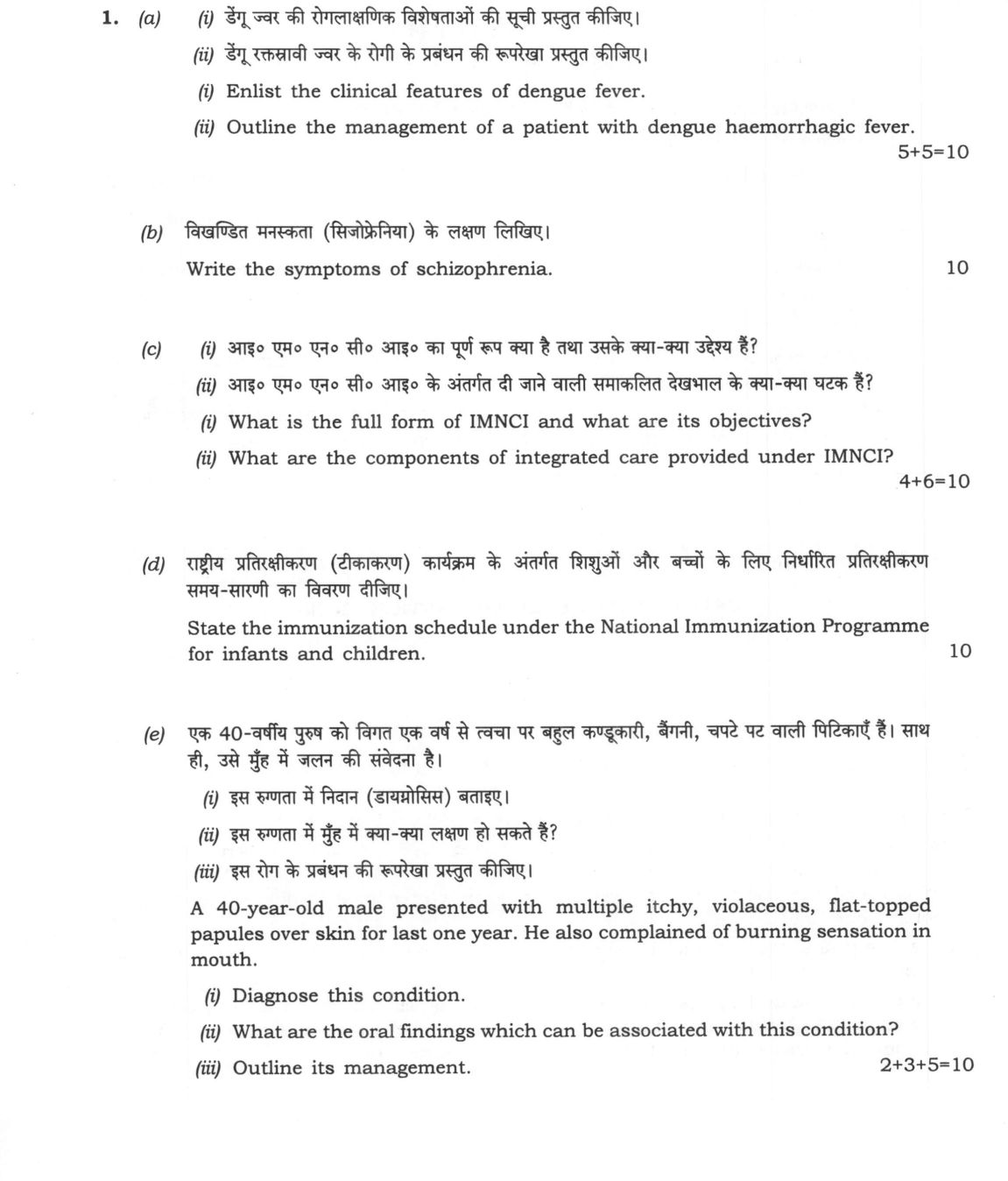
(a) (i) Enlist the clinical features of dengue fever. (ii) Outline the management of a patient with dengue haemorrhagic…
Enlist the clinical features of dengue fever.
Outline the management of a patient with dengue haemorrhagic fever. (5+5=10 marks)
Write the symptoms of schizophrenia. 10 marks
What is the full form of IMNCI and what are its objectives?
What are the components of integrated care provided under IMNCI? (4+6=10 marks)
State the immunization schedule under the National Immunization Programme for infants and children. 10 marks
A 40-year-old male presented with multiple itchy, violaceous, flat-topped papules over skin for last one year. He also complained of burning sensation in mouth. Diagnose this condition.
What are the oral findings which can be associated with this condition?
Outline its management. (2+3+5=10 marks)
हिंदी में प्रश्न पढ़ें
(क) (i) डेंगू ज्वर की रोगलाक्षणिक विशेषताओं की सूची प्रस्तुत कीजिए। डेंगू रक्तस्रावी ज्वर के रोगी के प्रबंधन की रूपरेखा प्रस्तुत कीजिए। (5+5=10)
(ख) विखण्डित मनस्कता (सिज़ोफ्रेनिया) के लक्षण लिखिए। 10 marks
(ग) (i) आई० एम० एन० सी० आई० का पूर्ण रूप क्या है तथा उसके क्या-क्या उद्देश्य हैं?
आई० एम० एन० सी० आई० के अंतर्गत दी जाने वाली समाकलित देखभाल के क्या-क्या घटक हैं? (4+6=10)
(घ) राष्ट्रीय प्रतिरक्षीकरण (टीकाकरण) कार्यक्रम के अंतर्गत शिशुओं और बच्चों के लिए निर्धारित प्रतिरक्षीकरण समय-सारणी का विवरण दीजिए। 10 marks
(ङ) एक 40-वर्षीय पुरुष को विगत एक वर्ष से त्वचा पर बहुत कण्ठकारी, बैंगनी, चपटे पट वाली पिटिकाएँ हैं। साथ ही, उसे मुँह में जलन की संवेदना है।
इस रूपता में निदान (डायमोसिस) बताइए।
इस रूपता में मुँह में क्या-क्या लक्षण हो सकते हैं?
इस रोग के प्रबंधन की रूपरेखा प्रस्तुत कीजिए। (2+3+5=10)
Model answer
Written by UPSC Answer Check against this question's marking rubric, to the expected length. UPSC does not publish answers for Mains — this is one way to score well, not an official key.
A structured clinical outline is as follows.
Dengue fever. Dengue fever usually presents with abrupt high fever lasting two to seven days, severe headache, retro-orbital pain, marked myalgia and arthralgia, nausea, vomiting, anorexia, maculopapular rash, and sometimes mild bleeding such as petechiae, epistaxis or gum bleeding. Laboratory clues include thrombocytopenia, leucopenia, rising haematocrit and positive NS1 antigen or IgM/IgG serology. In the WHO 2009 framework, dengue is classified into dengue, dengue with warning signs, and severe dengue; dengue haemorrhagic fever corresponds to the severe end with haemorrhagic manifestations, plasma leakage, haemoconcentration, pleural effusion or ascites, hypotension, and shock if decompensated. Warning signs such as abdominal pain, persistent vomiting, mucosal bleeding, liver enlargement, increasing haematocrit with falling platelets, or fluid accumulation require close observation. The critical phase usually begins with defervescence, when capillary leakage is maximal and shock is most likely.
Management of dengue haemorrhagic fever is supportive and monitoring-driven. The patient should be hospitalised, kept at rest, given oral fluids if stable, and monitored for pulse, blood pressure, urine output, haematocrit, platelet count and signs of fluid overload. Paracetamol is used for fever; aspirin, NSAIDs and intramuscular injections are avoided. In shock, rapid isotonic crystalloid boluses of 20 ml/kg of Ringer lactate or normal saline are given over 15–30 minutes and repeated until stable, followed by 10–30 ml/kg/hour, then tapered as haematocrit and circulation improve. Dextrose-containing fluids are added once shock resolves. Platelet transfusion is reserved for significant bleeding or very low platelets with bleeding, and packed red cells are given for symptomatic anaemia or low haemoglobin. Haematocrit should be checked every 6–8 hours in the critical phase, and fluid rate adjusted according to haematocrit, urine output and clinical response. If shock persists despite adequate crystalloids, colloid or blood products may be considered under specialist supervision, and severe cases require ICU care. Close observation during the critical defervescence phase, with careful fluid titration, is essential to prevent both shock and fluid overload.
Schizophrenia. Symptoms are grouped into positive, negative and cognitive domains. Positive symptoms reflect excess or distortion of normal mental functions and include auditory hallucinations, persecutory, referential or grandiose delusions, disorganized speech, and grossly disorganized or catatonic behaviour. Negative symptoms reflect loss of function and include alogia, avolition, affective flattening, anhedonia and asociality. Cognitive symptoms involve impaired attention, memory and executive function, which often affect work, study and self-care. For diagnosis, DSM-5 requires at least six months of disturbance, with at least one month of active-phase symptoms, while ICD-10 requires characteristic symptoms to be present for at least one month; functional impairment and exclusion of other causes are also considered. The illness is usually chronic and requires long-term psychiatric care, psychosocial rehabilitation and family support.
IMNCI. IMNCI stands for Integrated Management of Neonatal and Childhood Illness. Its objectives are to reduce under-five mortality and morbidity, improve the quality of care for sick children, integrate treatment of common childhood illnesses with nutrition, immunization and growth monitoring, and strengthen community and facility-based care. It aims to reduce deaths from pneumonia, diarrhoea, measles, malaria and neonatal conditions, and to reduce malnutrition-related illness. The strategy targets children from birth to five years and is delivered through ANMs, ASHAs, sub-centres, primary health centres and referral facilities. The clinical algorithm is built around four steps: assess the child, classify the illness, treat according to the classification, and counsel the caregiver. Integrated care under IMNCI also includes management of fever, cough and cold, diarrhoea, pneumonia, measles, malaria, anaemia, malnutrition, immunization, growth monitoring, oral rehydration, zinc, vitamin A, hygiene and referral. Counseling includes feeding, immunization, hygiene, danger signs and follow-up.
Immunization schedule. Under the National Immunization Programme, the UIP schedule for infants and children includes BCG, Hepatitis B birth dose and OPV-0 at birth, with the Hepatitis B birth dose ideally given within 24 hours. At 6, 10 and 14 weeks, children receive Pentavalent, OPV, IPV and PCV; Rotavirus is given at 6 and 10 weeks. In Japanese encephalitis endemic districts, JE vaccine is given at 16 and 20 weeks. MR-1 is given at 9 months. At 16–24 months, children receive Pentavalent booster, OPV-4 and MR-2. OPV-5 is given at 4–6 years, and DPT booster is given at 10–12 years, with TT/TT boosters as per the school-age schedule. The schedule is designed to prevent vaccine-preventable diseases such as tuberculosis, polio, hepatitis B, diphtheria, tetanus, pertussis, measles, rubella, rotavirus diarrhoea, pneumococcal disease and Japanese encephalitis. Mission Indradhanush strengthens this schedule by targeting zero-dose and partially immunized children through door-to-door visits, sub-centre days, camps and catch-up immunization drives, supported by cold-chain maintenance and AEFI surveillance. Full immunization means completion of all scheduled doses, including catch-up for missed doses.
Lichen planus. The described itchy, violaceous, flat-topped papules with oral burning are diagnostic of lichen planus. The classic skin features are pruritic, purple, polygonal, planar papules, often on wrists, ankles and mucous membranes, and may show Koebner phenomenon after trauma. Diagnosis is usually clinical, but biopsy may be done when the presentation is atypical. Oral findings include white reticular Wickham striae, most commonly on buccal mucosa, as well as erosive, atrophic, plaque-like or bullous lesions on the tongue, gingiva, lips or palate; erosive forms may cause burning, pain and secondary infection.
Management is stepwise. The first step is to identify and remove triggers, provide dental care, avoid irritants, smoking and alcohol, and treat secondary infection. Topical corticosteroids such as clobetasol, betamethasone or fluocinonide are first-line for skin and oral lesions; topical calcineurin inhibitors may be used for oral disease. For severe, widespread or refractory disease, systemic corticosteroids, antimalarials such as hydroxychloroquine, retinoids, or immunosuppressants such as azathioprine, methotrexate or cyclosporine may be used. Antihistamines relieve itching, and analgesics help oral pain. Management of oral disease also includes soft diet, topical anaesthetics, and treatment of candidal superinfection if present. Long-term follow-up is important, especially for erosive oral lichen planus, because of the small risk of malignant transformation.
Thus, the outline moves from acute febrile and psychiatric care to child-health systems and dermatology, reflecting India’s integrated primary-care and immunization architecture.
What "Outline" is asking you to do
Set out a whole scheme from end to end in its main steps without going into any of them. It is the directive used for protocols and frameworks — a management plan, a reaction mechanism, a statutory scheme — where the mark lies in having the full sequence with nothing missing.
Structure that answers it
What the scheme is for → step one → step two → the remaining steps through to the end point → the condition on which the sequence turns
Where marks are lost
Depth in the wrong place: elaborating the first two steps and never reaching the end of the scheme, which is where completeness is checked.
How this answer will be evaluated
Approach
Framework: Clinical Sequence (Definition > Aetiology > Features > Management). (a(i)) enumerate: list the items in order > one line each > no commentary | (a(ii)) explain: definition/context > points in order > small example > short close | (b) enumerate: list the items in order > one line each > no commentary | (c(i)) define: precise definition > the distinguishing feature > one example | (c(ii)) enumerate: list the items in order > one line each > no commentary | (d) enumerate: list the items in order > one line each > no commentary | (e(i)) define: precise definition > the distinguishing feature > one example | (e(ii)) enumerate: list the items in order > one line each > no commentary | (e(iii)) explain: definition/context > points in order > small example > short close Full marks: Accurate clinical features, correct management protocols, and precise identification of Lichen Planus with specific oral findings.
Key points expected
- High-grade fever
- Severe headache/retro-orbital pain
- Myalgia/arthralgia (breakbone fever)
- Maculopapular rash
- Fluid resuscitation (crystalloids)
- Monitoring of hematocrit
- Platelet transfusion if indicated
- Avoidance of NSAIDs
Evaluation rubric
Each sub-part is marked on its own, against the marks and word limit printed on the paper.
- (a(i)) List the clinical features of dengue fever. 5 marks
enumerate— list the items in order → one line each → no commentary
Must cover
- High-grade fever
- Severe headache/retro-orbital pain
- Myalgia/arthralgia (breakbone fever)
- Maculopapular rash
Loses marks
- Listing only non-specific symptoms
- Confusing with DHF features
Earns more
- Leukopenia/Thrombocytopenia
- Nausea/vomiting
- Positive tourniquet test
Extra mark
- Mention of specific serotypes (D1-D4)
- (a(ii)) Outline the management of a patient with dengue haemorrhagic fever. 5 marks
explain— definition/context → points in order → small example → short close
Must cover
- Fluid resuscitation (crystalloids)
- Monitoring of hematocrit
- Platelet transfusion if indicated
- Avoidance of NSAIDs
Loses marks
- Suggesting aspirin/NSAIDs
- Ignoring fluid management
Earns more
- Monitoring for shock
- Antipyretics (Paracetamol only)
- ICU admission criteria
Extra mark
- Specific fluid replacement formulas
- (b) Write the symptoms of schizophrenia. 10 marks
enumerate— list the items in order → one line each → no commentary
Must cover
- Positive symptoms (hallucinations/delusions)
- Negative symptoms (flat affect/avolition)
- Disorganized speech/behavior
- Cognitive impairment
Loses marks
- Listing only positive symptoms
- Vague descriptions without categories
Earns more
- Disturbance of thought content
- Social withdrawal
- Duration criteria (6 months)
Extra mark
- Differentiation from mood disorders
- (c(i)) Define IMNCI and state its objectives. 4 marks
define— precise definition → the distinguishing feature → one example
Must cover
- Full form: Integrated Management of Neonatal and Childhood Illness
- Objective: Reduce child mortality
- Objective: Improve child survival
- Objective: Improve quality of care
Loses marks
- Incorrect full form
- Vague objectives
Earns more
- Mention of WHO/UNICEF origin
- Focus on community-based care
Extra mark
- Specific year of introduction (1995)
- (c(ii)) List the components of integrated care under IMNCI. 6 marks
enumerate— list the items in order → one line each → no commentary
Must cover
- Treatment of common childhood illnesses
- Prevention of common childhood illnesses
- Management of malnutrition
- Care of sick newborns
Loses marks
- Listing only treatment components
- Missing malnutrition component
Earns more
- Care of sick children
- Community-based care
- Health education
Extra mark
- Specifics on newborn care protocols
- (d) State the immunization schedule under the National Immunization Programme. 10 marks
enumerate— list the items in order → one line each → no commentary
Must cover
- Birth: BCG, Hep B
- 6 weeks: OPV, Pentavalent
- 10 weeks: OPV, Pentavalent
- 14 weeks: OPV, Pentavalent
Loses marks
- Missing key vaccines (BCG/OPV)
- Incorrect age intervals
Earns more
- 9 months: MMR, JE
- 16-24 months: DPT, MMR boosters
- 10 years: Td
Extra mark
- Mention of specific vaccine brands or cold chain requirements
- (e(i)) Diagnose the condition based on the clinical presentation. 2 marks
define— precise definition → the distinguishing feature → one example
Must cover
- Diagnosis: Lichen Planus
Loses marks
- Incorrect diagnosis (e.g., Psoriasis)
- No diagnosis provided
Earns more
- Mention of '6 Ps' (Pruritic, Purple, Polygonal, Planar, Papules, Plaques)
Extra mark
- Mention of Wickham's striae
- (e(ii)) List the oral findings associated with this condition. 3 marks
enumerate— list the items in order → one line each → no commentary
Must cover
- Wickham's striae (white lacy lines)
- Erosive lesions
- Atrophic lesions
Loses marks
- Listing only skin findings
- Missing Wickham's striae
Earns more
- Burning sensation
- Involvement of buccal mucosa
Extra mark
- Mention of potential malignant transformation
- (e(iii)) Outline the management of the condition. 5 marks
explain— definition/context → points in order → small example → short close
Must cover
- Topical corticosteroids
- Systemic corticosteroids (if severe)
- Topical calcineurin inhibitors
- Regular follow-up
Loses marks
- Suggesting only symptomatic relief
- Ignoring follow-up
Earns more
- Phototherapy (PUVA)
- Immunosuppressants (Methotrexate)
- Pain management
Extra mark
- Mention of specific drug dosages
Practice this exact question
Write your answer and it is marked point by point against the model answer above — what you covered, what you missed, what you got wrong.
Evaluate my answer →More from Medical Science 2023 Paper II
- Q1 (a) (i) Enlist the clinical features of dengue fever. (ii) Outline the management of a pa…
- Q2 (a) A 30-year-old female has been brought to medical emergency with a history of low-grad…
- Q3 (a) Discuss in short the aetiology, clinical features, investigations and management of c…
- Q4 (a) A 20-year-old male has presented to the medicine OPD. He has complaints of episodes o…