Paper II — Q3
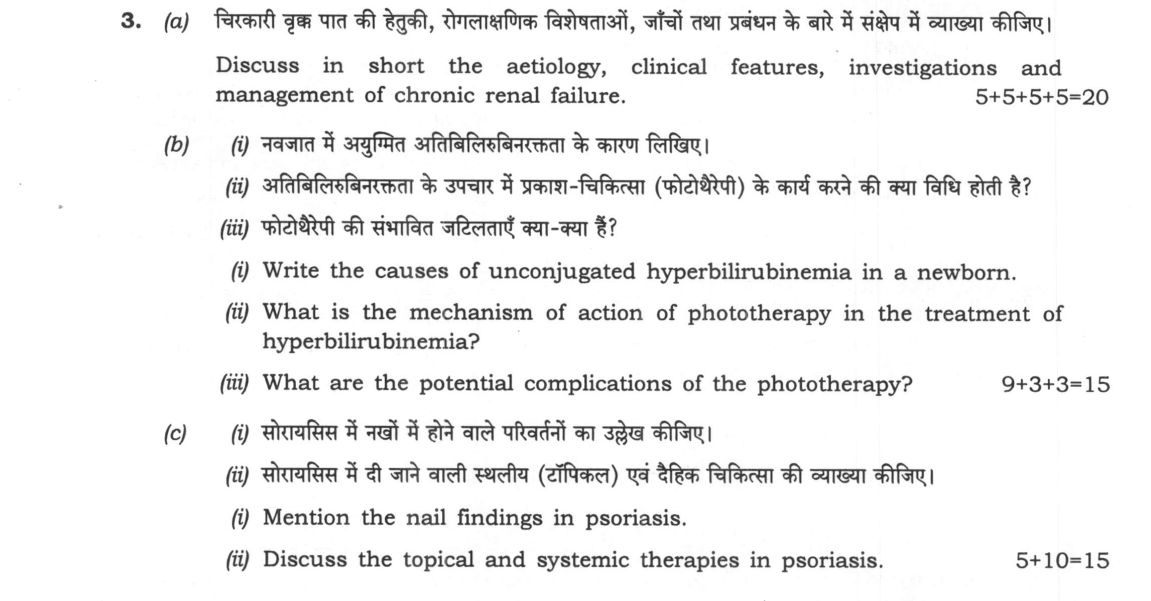
(a) Discuss in short the aetiology, clinical features, investigations and management of chronic renal failure. (5+5+5+5=20…
Discuss in short the aetiology, clinical features, investigations and management of chronic renal failure. (5+5+5+5=20 marks)
Write the causes of unconjugated hyperbilirubinemia in a newborn. 9 marks
What is the mechanism of action of phototherapy in the treatment of hyperbilirubinemia? 3 marks
What are the potential complications of the phototherapy? (3 marks) (9+3+3=15 marks)
Mention the nail findings in psoriasis. 5 marks
Discuss the topical and systemic therapies in psoriasis. (10 marks) (5+10=15 marks)
हिंदी में प्रश्न पढ़ें
चिरकारी वृक्क पात की हेतुकी, रोगलाक्षणिक विशेषताओं, जाँचों तथा प्रबंधन के बारे में संक्षेप में व्याख्या कीजिए। (5+5+5+5=20)
नवजात में अयुग्मित अतिबिलिरुबिनरक्तता के कारण लिखिए। 9 marks
अतिबिलिरुबिनरक्तता के उपचार में प्रकाश-चिकित्सा (फोटोथेरेपी) के कार्य करने की क्या विधि होती है? 3 marks
फोटोथेरेपी की संभावित जटिलताएँ क्या-क्या हैं? (3) (9+3+3=15)
सोरायसिस में नखों में होने वाले परिवर्तनों का उल्लेख कीजिए। 5 marks
सोरायसिस में दी जाने वाली स्थलीय (टॉपिकल) एवं दैहिक चिकित्सा की व्याख्या कीजिए। (10) (5+10=15)
Model answer
Written by UPSC Answer Check against this question's marking rubric, to the expected length. UPSC does not publish answers for Mains — this is one way to score well, not an official key.
Chronic renal failure. Chronic renal failure is the irreversible loss of renal function, now framed as CKD when structural or functional abnormality persists for >3 months. In India, diabetic nephropathy and hypertensive nephrosclerosis are the commonest aetiologies, followed by chronic glomerulonephritis, chronic interstitial nephritis, obstructive uropathy and polycystic kidney disease; late presentation is common because of limited access to screening. CKD is staged by eGFR: stage 1 ≥90 mL/min/1.73 m² with kidney damage; stages 2–5 are 60–89, 45–59, 30–44, 15–29 and <15 mL/min/1.73 m² respectively. Staging guides prognosis, drug dosing and referral. Clinical features reflect uraemia: anorexia, nausea, fatigue, pruritus, metallic taste, pericarditis, encephalopathy, bleeding due to platelet dysfunction, anaemia from reduced erythropoietin, metabolic acidosis, hyperphosphataemia, hypocalcaemia and renal osteodystrophy. Investigations include serum creatinine/eGFR, electrolytes, ABG, calcium/phosphate/PTH, haemoglobin, urinalysis, renal ultrasound, and biopsy when glomerular disease is suspected. Management is aetiological and supportive: control BP with ACE inhibitor/ARB where appropriate, glycaemic control, treat anaemia, acidosis, mineral-bone disorder, and avoid nephrotoxins. Renal replacement therapy is needed in stage 5 or with refractory uraemia, hyperkalaemia, acidosis or fluid overload: haemodialysis, peritoneal dialysis or continuous renal replacement in unstable patients; dialysis planning should include vascular access, patient education and psychosocial support. Kidney transplantation is the preferred long-term option when immunologically suitable, with compatible HLA/crossmatch and no active infection, malignancy or uncontrolled disease.
Neonatal unconjugated hyperbilirubinaemia. In a newborn, unconjugated hyperbilirubinaemia may be physiological, due to increased red cell mass, short RBC survival and immature hepatic conjugation. Pathological causes include haemolysis from ABO/Rh incompatibility, hereditary spherocytosis, G6PD deficiency—important in India—sepsis, cephalohaematoma, and inborn errors such as Crigler-Najjar syndrome. Breast milk jaundice, hypothyroidism, and galactosaemia can also raise unconjugated bilirubin. Management follows NICE/Indian Academy of Pediatrics principles: assess risk, serial bilirubin, early feeding, hydration and temperature monitoring, and treat with phototherapy or exchange transfusion when thresholds are crossed. Phototherapy is first-line; exchange transfusion prevents kernicterus.
Phototherapy. Phototherapy works by photoisomerisation of unconjugated bilirubin in the skin into water-soluble lumirubin and configurational isomers, which are excreted in bile and urine without hepatic conjugation. It reduces serum unconjugated bilirubin and risk of bilirubin neurotoxicity. It is effective for unconjugated, not conjugated, bilirubin. Blue light, eye shielding, continuous exposure, hydration and temperature monitoring are essential. Potential complications include dehydration and heat loss, temperature instability, skin rash, retinal damage if eyes are not shielded, and bronze baby syndrome when conjugated bilirubin is also present.
Psoriasis. Nail psoriasis shows pitting, oil-drop or salmon-patch discolouration of the nail bed, onycholysis, subungual hyperkeratosis, and splinter haemorrhages; these reflect matrix and nail-bed inflammation. Topical therapy is first-line for limited disease: potent corticosteroids, vitamin D analogues such as calcipotriol, dithranol, coal tar, keratolytics and emollients; combination calcipotriol/betamethasone is useful for plaques and nails. Topical therapy should be combined with emollients and occlusion; systemic therapy requires shared decision-making. Systemic therapy is considered for extensive, rapidly progressive, or disabling disease, using PASI, BSA and DLQI to gauge severity. Conventional agents include methotrexate, cyclosporine and acitretin. Biologics now transform care: anti-TNF agents (adalimumab, etanercept), IL-17 inhibitors (secukinumab, ixekizumab), IL-23 inhibitors such as guselkumab, and the IL-12/23 inhibitor ustekinumab. Choice depends on comorbidities, infection risk, pregnancy plans, cost and access in India. Methotrexate needs CBC/LFT monitoring, cyclosporine BP/creatinine surveillance, acitretin lipid monitoring, and biologics require TB screening.
Way forward. These conditions require staged, guideline-based care: CKD needs early nephrology referral, dialysis planning and transplant evaluation; neonatal jaundice needs timely risk assessment and safe phototherapy; psoriasis needs integrated skin, nail and systemic management with monitoring. In India, strengthening primary screening for CKD, neonatal bilirubin protocols, and affordable biologic access will improve outcomes.
What "Discuss" is asking you to do
Lay the issue out from more than one side — how it arose, what is claimed for it, what is held against it, and where it now stands. UPSC attaches discuss to broad topics with several live dimensions, so coverage of the dimensions earns more than the strength of your opinion.
Structure that answers it
Set the issue up → the case as it is made → the case against → the dimension both sides leave out → where the balance now lies
Where marks are lost
Listing facts with no thread between them, or arguing one side throughout and calling it a discussion.
How this answer will be evaluated
Approach
Framework: Clinical Sequence (Definition > Aetiology > Features > Investigation > Management). (a) discuss: intro > 3-4 dimensions > example > balanced close | (b) discuss: intro > 3-4 dimensions > example > balanced close | (c) discuss: intro > 3-4 dimensions > example > balanced close Full marks: Comprehensive clinical sequence with specific drugs and mechanisms.
Key points expected
- CRF: Diabetes as primary cause
- CRF: Dialysis and Transplant as definitive management
- Neonatal: Hemolysis as primary cause of unconjugated hyperbilirubinemia
- Neonatal: Photoisomerization mechanism of phototherapy
- Psoriasis: Pitting and Oil drop sign in nails
- Psoriasis: Methotrexate and Biologics as systemic therapy
Evaluation rubric
Each sub-part is marked on its own, against the marks and word limit printed on the paper.
- (a) Comprehensive overview of CRF covering causes, signs, tests, and treatment. 20 marks
discuss— intro → 3-4 dimensions → example → balanced close
Must cover
- Aetiology: Diabetes, Glomerulonephritis, Hypertension
- Features: Anemia, Bone disease, Uremia
- Investigations: Serum Creatinine, BUN, USG
- Management: Dialysis, Transplant, Conservative
Loses marks
- Listing symptoms without pathophysiology
- Management without priority order
Earns more
- Mention of GFR stages
- Specific dialysis modalities (Hemodialysis/Peritoneal)
Extra mark
- Reference to KDIGO guidelines
- National health programme for renal care
- (b) Causes of unconjugated hyperbilirubinemia, phototherapy mechanism, and complications. 15 marks
discuss— intro → 3-4 dimensions → example → balanced close
Must cover
- Causes: Hemolysis, Immaturity, Excess production
- Mechanism: Photoisomerization, Excretion without conjugation
- Complications: Bronze baby, Dehydration, Hyperthermia
- Differentiation of conjugated vs unconjugated
Loses marks
- Confusing conjugated and unconjugated causes
- Vague mechanism without chemical change
Earns more
- Specific hemolytic causes (ABO/Rh)
- Bilirubin levels for phototherapy initiation
Extra mark
- Mention of exchange transfusion threshold
- Specific wavelength of light (460nm)
- (c) Nail findings in psoriasis and detailed topical/systemic therapies. 15 marks
discuss— intro → 3-4 dimensions → example → balanced close
Must cover
- Nail findings: Pitting, Onycholysis, Oil drop sign
- Topical: Steroids, Vitamin D analogs, Anthralin
- Systemic: Methotrexate, Acitretin, Cyclosporine
- Biologics: TNF-alpha, IL-12/23 inhibitors
Loses marks
- Listing drugs without indication
- Ignoring nail-specific findings
Earns more
- Phototherapy as a treatment modality
- Side effects of systemic drugs
Extra mark
- Mention of JAK inhibitors
- Specific dosages for systemic therapy
Practice this exact question
Write your answer and it is marked point by point against the model answer above — what you covered, what you missed, what you got wrong.
Evaluate my answer →More from Medical Science 2023 Paper II
- Q1 (a) (i) Enlist the clinical features of dengue fever. (ii) Outline the management of a pa…
- Q2 (a) A 30-year-old female has been brought to medical emergency with a history of low-grad…
- Q3 (a) Discuss in short the aetiology, clinical features, investigations and management of c…
- Q4 (a) A 20-year-old male has presented to the medicine OPD. He has complaints of episodes o…
- Q5 (a) A 65-year-old lady has progressively increasing dysphagia for last 6 months. She also…
- Q6 (a) (i) Enumerate the causes for postpartum haemorrhage (PPH). (ii) Discuss the managemen…